
By Scot Johnson, Founder / CEO, i3solutions. Scot Johnson co-founded i3solutions 30 years ago with a focus on expert-led delivery, strategic advisory, and complex Microsoft-centered solutions for organizations where technology decisions carry operational, financial, and mission risk.
Microsoft 365 E3 is $39.00 per user per month and E5 is $60.00 on Microsoft’s published US price list as of July 2026, both on annual commitment, which makes E5 a $21 per user per month decision, about $252 per user per year. Whether that delta is worth paying is not a features question at most regulated organizations; it is a controls question, because several of the security and compliance capabilities auditors and frameworks name only exist at the E5 tier, and the alternative path of E3 plus targeted add-ons has to be priced against your actual requirements rather than assumed cheaper.
This guide prices the decision the way a steering committee will interrogate it: what each tier costs now after Microsoft’s July 2026 price changes, what the $21 actually buys, when E5 stops being optional, and where Microsoft 365 Copilot and the new E7 suite change the math.
Microsoft raised suite pricing on July 1, 2026: E3 moved from $36 to $39 per user per month and E5 from $57 to $60, a change documented in partner reporting of the July 2026 update and reflected on Microsoft’s published price list. Both figures are annual-commitment prices paid yearly; month-to-month flexibility costs more. At 1,000 seats the E3-to-E5 delta is $252,000 a year, which is why nobody should upgrade a whole tenant to answer a requirement that applies to a fraction of it.
Enterprise Agreement customers negotiate against these list prices at volume, so treat them as the ceiling the negotiation starts from. Verify current figures against Microsoft’s pricing page before committing; the numbers here were checked against it in July 2026.
E5 is E3 plus four capability families, and it helps to name them because each one maps to a different budget owner:
The honest way to evaluate the delta is to price what you would otherwise buy separately. An organization that needs two of the four families usually finds E5 competitive; one that needs a single capability should price the targeted add-on route first.
For regulated enterprises, the tier decision is usually made by a named control, not by preference. If your framework or auditor requires endpoint DLP, DLP for Teams chat, Information Barriers between business units, Insider Risk Management, or audit log retention beyond E3’s window, you are choosing between E5 and E3 plus the specific add-on that carries the control. Neither answer is wrong; what is wrong is discovering the gap during an audit. This is the same order-of-operations discipline we describe in Secure Copilot Enablement vs Turn It On: decide the controls first, then buy the license that carries them. For defense contractors, CMMC names those controls outright, and our CMMC compliance cost guide prices the licensing uplift alongside the rest of the program.
Seat mix is the second half of the answer. Tiers can be mixed within a tenant, and most organizations that model it find a minority of users genuinely need E5 controls while the majority runs well on E3. A licensing review that maps roles to required controls routinely takes six figures a year out of an all-E5 default at enterprise scale, with no compliance loss, because the controls land where the risk lives.
Sometimes, and it depends on how many E5 capability families you actually need. Microsoft sells the E5 security and compliance capabilities as add-on bundles on top of E3, and the crossover math is simple: one family via add-on usually beats full E5 on price; two or more usually does not. The add-on route also buys precision, because you can put the compliance add-on on the 300 users inside a regulatory boundary instead of the whole company. Price the add-ons against your Enterprise Agreement rather than list, since add-on discounting varies more than suite discounting. The trap to avoid is stacking three add-ons and paying more than E5 for less than E5. Seat tiers are also not the entire Microsoft 365 bill: metered services such as SharePoint Premium bill on usage on top of whichever tier you choose, a budget line our SharePoint Premium cost guide walks in detail.
If your renewal date is close and the controls inventory behind this decision does not exist yet, that inventory is the artifact to build first. Request a Microsoft 365 Consultation and we will build it with you before the renewal clock forces a default.
Microsoft 365 Copilot is a $30.00 per user per month add-on on annual commitment and requires a qualifying base plan; E3 and E5 both qualify, so Copilot itself does not force the tier decision. What Copilot does force is a governance review, because an AI assistant reading your tenant inherits whatever data protection your base plan provides, and that pushes some organizations toward E5-tier controls before broad rollout. Our Copilot licensing guide prices that full picture, and our Copilot readiness page covers the pre-rollout work.
Microsoft 365 E7, at $99.00 per user per month on Microsoft’s published list, bundles E5, Copilot, agent capability, and the Entra identity suite into one SKU. For an organization already committed to E5 plus Copilot, which lists at $90 combined, E7 is a $9 step to a broader bundle and worth a direct comparison. For an organization still on E3, E7 is not the next decision; the E3-versus-E5 controls question comes first.
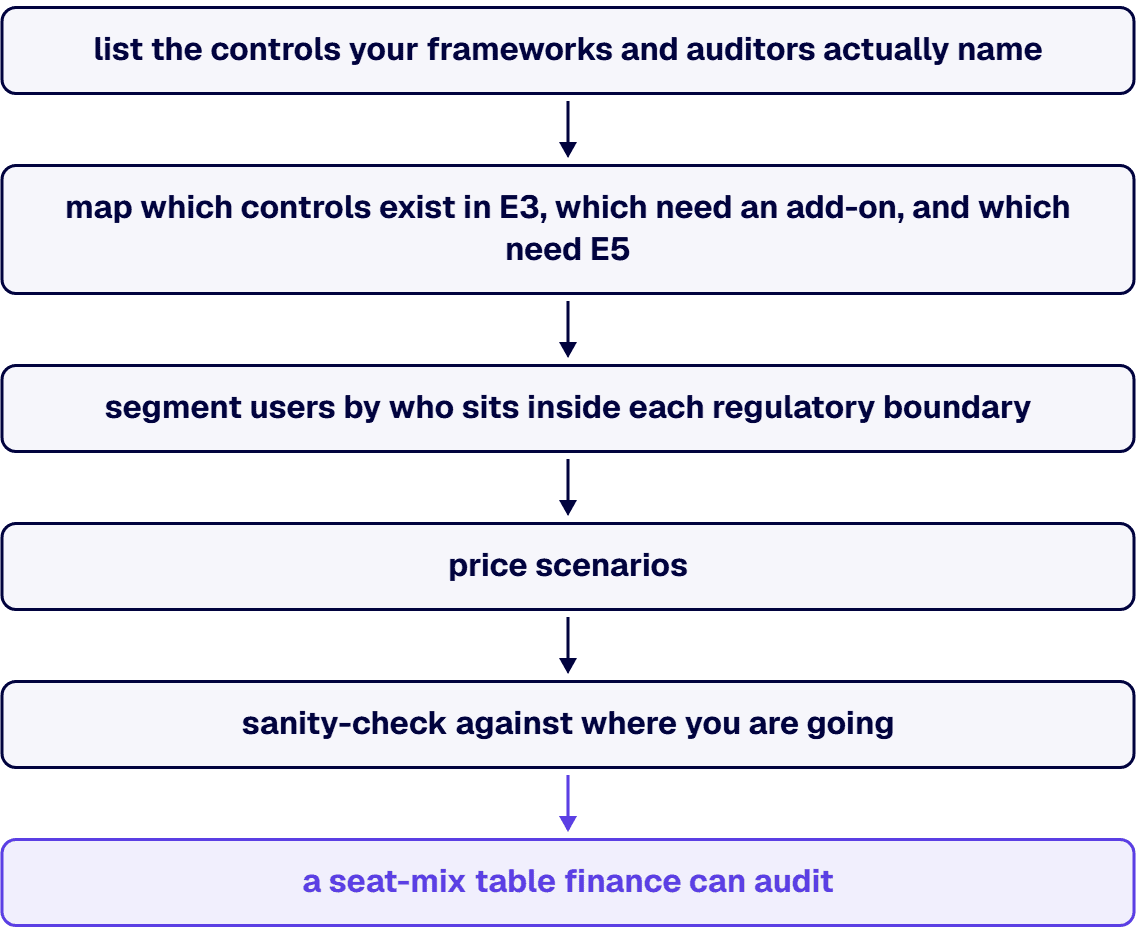
Run the decision in this order. First, list the controls your frameworks and auditors actually name, with citations. Second, map which controls exist in E3, which need an add-on, and which need E5. Third, segment users by who sits inside each regulatory boundary. Fourth, price three scenarios at your EA discount: all-E3 plus add-ons, mixed E3/E5, and all-E5. Fifth, sanity-check against where you are going: if Copilot at scale or heavy analytics is on the roadmap, the E5 families you will need anyway change the crossover point. The output is a seat-mix table finance can audit, which is a stronger artifact than any tier recommendation.
i3solutions is a Microsoft Solutions Partner, and i3solutions has completed more than 600 Microsoft platform implementations. Much of that work is for regulated organizations where the license tier is a compliance decision. Microsoft 365 compliance consulting for regulated enterprises ranges from $35,000 to $120,000 or more depending on the framework, the number of in-scope systems, and the current tenant configuration. An i3solutions Microsoft 365 Copilot readiness engagement typically runs $18,000 to $35,000. Both start from your controls inventory, not from a license sheet, and both produce the seat-mix and controls mapping described above. Our Microsoft 365 consulting services page describes the practice, and organizations consolidating tenants alongside a tier decision can see our Microsoft 365 migration services. If your clients already own these licenses, a complimentary Microsoft Modernization Plan shows where they can get more from tools they hold.
On Microsoft’s published US list as of July 2026, E5 is $60.00 per user per month against $39.00 for E3, a $21 monthly delta, roughly $252 per user per year before Enterprise Agreement discounting. At a thousand seats that is about a quarter million dollars a year, which is why the seat-mix question matters more than the tier question.
Four families: the advanced Defender security stack, the advanced Purview compliance capabilities such as endpoint DLP, Insider Risk Management, Information Barriers, and premium eDiscovery and audit, Power BI Pro analytics rights, and Teams Phone calling. Organizations that need two or more families usually find E5 competitive with buying them separately.
When you need a single E5 capability family, usually yes; the add-on route also lets you license only the users inside a regulatory boundary. When you need two or more families across a broad population, full E5 usually prices better and is simpler to operate. Model both at your actual EA discount before deciding, because add-on discounting varies.
When a control your framework or auditor names only exists at the E5 tier, endpoint DLP, Information Barriers, or extended audit retention being the common triggers, and the population needing it is broad enough that per-user add-ons stop being economical. The upgrade decision should come from a controls inventory, not from a renewal deadline.
No. Copilot is a $30.00 per user per month add-on that runs on qualifying base plans including E3 and E5. The practical connection is governance: Copilot inherits the data protection of the plan underneath it, so organizations often close E5-tier control gaps before broad Copilot rollout rather than because Copilot demands the license.
E7 is Microsoft’s $99.00 per user per month suite bundling E5, Copilot, agent capability, and the Entra identity suite. It changes the decision only for organizations already committed to E5 plus Copilot, where the incremental cost of the bundle is small. For everyone else the controls-driven E3 versus E5 analysis still comes first.

US-Based | Est. 1997
© i3solutions. All rights reserved.
US-Based | Est. 1997
© i3solutions. All rights reserved.


