
Power Apps Premium is a user license at $20.00 per user per month paid yearly that entitles one named person to unlimited Power Apps and unlimited Power Pages websites. Power Apps per app is a capacity license, listed End of Sale in Microsoft’s October 2026 licensing guide, that entitles one person to one app or one Power Pages website in one environment. Against the $10 per-app meter, the list-price break-even is two apps per user, but the list price is not the whole answer: per app capacity is allocated to environments rather than assigned to people, per app carries 6,000 Power Platform requests per 24 hours against Premium’s 40,000, and per app does not cover owning Power Automate flows that use premium features.
Premium and per app are not a big plan and a small plan. They are administered in two different places by two different people, and that is the difference that actually shapes a licensing estate.
Premium is a user license. An administrator assigns it to a person in the Microsoft 365 admin center, and from that moment the person can build and run any number of apps and access any number of Power Pages websites, anywhere in the tenant.
Per app is capacity. Microsoft is explicit that per app plans do not appear on the Billing and Licenses page in the Microsoft 365 admin center at all: after purchase they show up under Billing and Your products, and an administrator allocates them to specific environments in the Power Platform admin center under Licensing and Capacity add-ons. Nobody assigns them to a user. They are assigned automatically, to unlicensed users, at the moment a maker shares an app in that environment. Allocating per app capacity to an environment also turns the per-app licensing toggle on by default for apps created after October 1, 2020, and leaving the environment unallocated turns it off.
That sequence is the whole governance problem in one sentence: under per app licensing, the person who spends the money is the maker who clicks Share, not the administrator who bought the capacity.
Microsoft’s published Power Apps pricing lists Premium at $20.00 per user per month paid yearly, with a second tier at $12.00 per user per month paid yearly at a 2,000-license minimum. The entitlement covers unlimited Power Apps and Power Pages for the assigned user, prebuilt, custom, and on-premises connectors, Dataverse entitlements of 250 MB database and 2 GB file per license, agentic features in apps, and Microsoft 365 Copilot chat in apps. Read the footnotes on those last two before you plan around them: Microsoft marks agentic features as model-driven only, and Microsoft 365 Copilot chat as generally available for model-driven apps and in public preview for canvas apps. A Premium user carries 40,000 Power Platform requests per 24 hours, and Managed Environments are included.
One naming point matters more than it should: Microsoft’s licensing FAQ states plainly that Power Apps per user has been renamed Power Apps Premium and that there is no difference between the two offers. If your renewal paperwork, your chargeback model, and your architecture documentation each use a different one of those names, they are describing the same SKU.
Microsoft’s Power Platform licensing FAQ describes per app as one custom app or one Power Pages website for a specific business scenario, on the full capabilities of Power Apps, and the October 2026 licensing guide lists the plan End of Sale. Each license grants one user rights to one app, canvas or model-driven, within a single environment, and the licenses stack: a user who needs three apps is covered by three per app licenses without ever holding a user license. Embedded canvas components inside a model-driven app count as a single app. Dataverse accrual per license is 50 MB database and 400 MB file, against 250 MB and 2 GB for a user license. Managed Environments are included here too. Power Platform requests are capped at 6,000 per 24 hours.
There is one caveat worth surfacing rather than burying. As of August 2026, Microsoft’s public Power Apps pricing page lists Premium, the 2,000-license Premium tier, the free Developer Plan, Dataverse Database Capacity, and a Microsoft Copilot Studio add-on, and it does not list the per app plan at all. The plan remains documented in Microsoft’s Power Platform licensing FAQ and is listed End of Sale in the October 2026 licensing guide, per app has its own current administrator article, and it remains one of only two standalone plans offered in the US Government clouds. What that split means for a specific agreement is a question for your licensing channel, and it is worth asking before a per app strategy goes into a multi-year budget.
The arithmetic is simple enough to do in a meeting. Two apps on the $10 per-app meter is $20.00, which is exactly Premium. At one app per user, per app costs less. At three or more, Premium costs less. At the $12.00 volume tier the break-even drops to between one and two apps. Then four mechanics move the answer.
Environments multiply the count. Consumption is counted per user per app per environment. The consumption table in Microsoft’s per app plans administrator article shows a user with two apps in one environment and two apps plus a portal in another consuming five per app licenses. Development, test, and production are three environments, so an estimate built on a tenant-wide app inventory understates per app cost by however many environments the estate runs.
The request ceiling is 6,000, not 40,000. Per app and pay-as-you-go users get 6,000 Power Platform requests per 24 hours; Premium and other paid Power Platform user licenses get 40,000. For a form-style canvas app that ceiling is irrelevant. For a Dataverse-heavy model-driven app used all day it is the binding constraint, and the remedy is not free: the Power Platform Request capacity add-on raises a limit by another 50,000 per 24 hours per pack.
Per app does not cover Power Automate authoring. A per app assignment does not give a user the ability to create or own Power Automate flows that use premium features. That requires Power Apps per user, which is Premium, or a Power Automate per user license. The exception is narrow: it does not apply to flows associated to an app.
Dataverse accrues differently. Each user license adds 250 MB of database and 2 GB of file capacity to the tenant pool; each per app license adds 50 MB and 400 MB. An estate moved from user licenses to per app licenses loses pooled storage as it goes, and Microsoft’s Power Apps pricing page lists Dataverse Database Capacity at $40.00 per GB per month paid yearly. That line item surfaces a quarter after the licensing decision, which is exactly when nobody is looking for it.
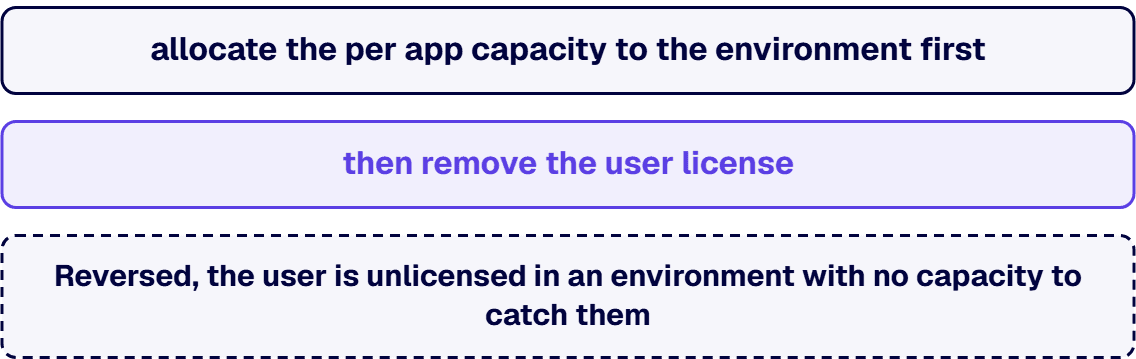
Order of operations when moving a user to per app. Microsoft’s instruction is sequenced for a reason: allocate the per app capacity to the environment first, then remove the user license. Reversed, the user is unlicensed in an environment with no capacity to catch them.
Reducing per app capacity to zero does not clean up. Users added to Dataverse while capacity was above zero are not disabled when capacity drops to zero. They cannot launch apps, but their roles remain, and Microsoft’s per app plans administrator article states directly that the administrator must remove the roles of users no longer intended to have platform access. A decommissioned app can leave a live access surface behind it, which is a finding an assessor writes down.
Legacy app passes count differently. Before October 2021, one app pass covered two apps and one portal. Subscriptions purchased before October 1, 2021 keep that entitlement for the agreement term, with three app passes per license; anything purchased after that date is one app pass per license. A tenant on an inherited agreement is counting on different rules than the renewal quote in front of it assumes.
Power Apps also bills through an Azure subscription, and Microsoft publishes every one of those rates in its pay-as-you-go meters documentation. The per-app meter is $10.00 per active user per app per month, where an active user is someone who opens the app at least once in the month, repeat access is not counted, and users who already hold Power Apps per user licenses are not counted at all. The meter carries the same 6,000 requests per user per app per day. That same meter documentation puts Dataverse in a pay-as-you-go environment at $48.00 per GB per month for database and $2.40 per GB per month for file, in both cases above the first 1 GB per environment, and log storage at $12.00 per GB per month with no free allowance at all if auditing is on. The metering model is the same for a government tenant, but the pay-as-you-go route that absorbs Dataverse overage is not available in GCC High or DoD, which is why Dataverse storage pricing in government clouds has to be modeled through the channel that serves the tenant.
The comparison against a prepaid per app license is a utilization question, not a price question. A prepaid per app license, now listed End of Sale, is charged whether the person opens the app or not; the $10.00 meter is charged only in the months they do. So pay-as-you-go charges nothing in the months a given user leaves that app closed, which is precisely the profile of a broadly shared, occasionally used app. One switching hazard: if an environment already has app passes assigned and is then enabled for pay-as-you-go, the app passes are ignored and not consumed. They can be reallocated to another environment, but only if somebody notices.
For federal agencies and defense contractors this is the part that changes the paperwork. Access to Power Apps US Government is restricted to two standalone offerings, the Power Apps per app plan for Government and the Power Apps per user plan for Government, each a monthly subscription that can be licensed to an unlimited number of users. The commercial Premium rename does not carry across, so the sovereign-cloud SKU list still reads per app and per user. Purchasing runs through Volume Licensing and Cloud Solution Provider, and Cloud Solution Provider is not currently available for GCC High customers. GCC provides compliance with FedRAMP High and DoD DISA IL2, GCC High is designed to the DISA SRG IL4 framework with a Provisional Authority to Operate granted by DISA, and DoD to IL5. A licensing model chosen in a commercial tenant does not transfer to a GCC High tenant without checking both the SKU names and the channel.
Start from the app inventory and the environment map, not the price list. For every production app, record the environment it lives in, whether it is canvas or model-driven, the connector classes it uses, the real audience size, and whether that audience opens it daily or a few times a year. Then classify the people: makers and administrators are Premium by function, single-app consumers are per app candidates, and occasional users of broadly shared apps are pay-as-you-go candidates. What you want out of it is a per-environment allocation plan you can defend in a budget review, not a tenant-wide average. The inputs live in the Power Platform admin center license consumption reports, and most estates have never had an owner responsible for reading them: if your Power Apps estate grew out of citizen development, the licensing question and the governance question are the same question. That plan is the deliverable, and it is three concrete things: every production app mapped to the environment it actually lives in rather than a tenant-wide app count, every user classified by function before a seat is quoted, and the 6,000 request ceiling checked against the Dataverse-heavy apps. Our Power Platform architects run that as an engagement, described on our Power Apps licensing consultants page, and Power Pages sizing has its own path through our Power Pages development services team.
Bring in a partner when the licensing decision is entangled with environment sprawl, unmeasured audiences, and apps nobody owns. i3solutions has been a Microsoft Partner with 30 years of enterprise technology delivery experience and has delivered 1,500+ Microsoft engagements across aerospace and defense, financial services, and health sciences. i3solutions is a Microsoft Partner with 30 years of enterprise technology delivery experience. i3 deployed Power Platform across a federal defense intelligence command spanning 10,000 personnel and 180 locations, which is enterprise scale by any measure. That work sits inside our broader Power Platform development services, where environment strategy, ALM and governance are delivered as one practice.
Environment discipline is what makes per app licensing predictable rather than surprising, and it is delivery practice rather than a spreadsheet exercise: i3solutions delivery includes ALM practices with Power Platform pipelines or Azure DevOps integration, environment separation strategies, and change control processes. Portfolio scale is the other half. On one program, replacing 32 outdated InfoPath forms with Power Apps reduced maintenance demands by 40%, saving an estimated $150K to $200K annually in IT labor and support, and a 32-app portfolio is exactly the shape where a per app plan and a Premium plan diverge by six figures a year. If you need that analysis as an artifact rather than an opinion, our Power Apps development services team builds it alongside the estate.
Below two apps per user, yes. Microsoft’s licensing guide lists the per app meter at $10 per active user/app/month against Premium at $20.00 per user per month, so two apps is the exact break-even; below that per app costs less and above it Premium does. At the $12.00 per user per month volume tier, which requires a 2,000-license minimum, the break-even falls between one and two apps. Count apps per user per environment, because per app capacity is consumed per environment.
Yes. Microsoft’s Power Platform licensing FAQ states that Power Apps per user has been renamed Power Apps Premium and that there is no difference between the two offers. The older name persists in agreements, admin center views, and internal documentation, and in the US Government clouds the plan is still sold as the Power Apps per user plan for Government.
Not by assignment. An administrator allocates per app capacity to an environment in the Power Platform admin center under Licensing and Capacity add-ons, and the license is then assigned to an unlicensed user automatically when a maker shares an app in that environment. Per app plans do not appear on the Billing and Licenses page in the Microsoft 365 admin center, which is why tenants routinely believe they own no per app capacity while consuming it. The Power Platform admin center license consumption reports are where the real number lives.
Not flows that use premium features. Microsoft is explicit that a per app assignment does not give a user the ability to create or own Power Automate flows using premium features; that requires Power Apps per user, meaning Premium, or a Power Automate per user license. The exception is flows associated to an app. A per app rollout that assumed the same people would keep authoring premium flows needs a Premium seat for each of them.
Paid Power Platform user licenses, including Power Apps Premium, get 40,000 requests per 24 hours. Power Apps per app licenses and the Power Apps pay-as-you-go meter get 6,000. If a user holds multiple paid licenses the entitlements sum, and the Power Platform Request capacity add-on raises a limit by a further 50,000 per 24 hours per pack. One timing caveat: Microsoft states that add-on packs cannot currently be assigned to users or flows during the transition period, while still recommending the purchase to stay inside license terms. For Dataverse-heavy model-driven apps this gap matters more than the price gap.
Yes, under the original names. Power Apps US Government is restricted to the Power Apps per app plan for Government and the Power Apps per user plan for Government, plus the Power Apps capabilities seeded in certain Microsoft 365 and Dynamics 365 US Government plans. Both are monthly subscriptions with no user cap. Purchasing runs through Volume Licensing or Cloud Solution Provider, and Cloud Solution Provider is not currently available for GCC High customers.
No, and the reason is a governance rule, not a price change. Microsoft’s Managed Environments licensing article states that once Managed Environments is active in an environment, “all active usage requires one of these standalone licenses or pay-as-you-go meters,” meaning every user running an app there must hold Power Apps Premium, Power Automate Premium, or a Dynamics 365 Enterprise license with premium Power Apps usage rights. Per app capacity still satisfies that requirement: the same article states, “If you use capacity-based licenses, a managed environment must have Power Apps per app plans such as app passes allocated to it.” So Managed Environments does not force a move to Premium; it closes off any license-free path and requires that the per app capacity actually be allocated to that environment. The two-app break-even above is unchanged.

US-Based | Est. 1997
© i3solutions. All rights reserved.
US-Based | Est. 1997
© i3solutions. All rights reserved.


