
By Michael Branson, Founder / COO, i3solutions
When you price Power Apps for a government tenant, no public list gives you the number: Microsoft’s US Government documentation names the standalone Government plans and publishes no price for them. The commercial cloud publishes its per user prices openly, so the tier comparison starts with what changes.
If you are pricing Power Apps for a government tenant against a commercial baseline, the first thing to know is that the two sides of the comparison are not documented the same way. The commercial side carries public list prices. The Government side carries a published offering set, a published purchasing rule, and a published eligibility rule, and the number arrives from a channel quote. A comparison that treats those two as the same kind of evidence produces a confident answer built on one real figure and one guess.
So this page does the part that can be sourced. It states what a government tenant is allowed to buy, what the commercial cloud publishes, what Microsoft does not publish for GCC, and what actually changes between the tiers when you sit down to build an estimate. Who should evaluate the options with you, and what to look for in that person, is a separate question answered at Who Do We Hire to Evaluate Power Apps Licensing Options?.
The Government offering set, which plan fits a given app portfolio, and where the break-even between the plans sits are answered in full at Power Apps Premium vs Per App: What Actually Differs, and Where the Break-Even Sits. For the estimate here, carry forward what Microsoft documents at Power Apps US Government: the Power Apps per app plan for Government, the Power Apps per user plan for Government, and the Power Apps and Power Automate capabilities included in certain Microsoft 365 US Government and Dynamics 365 US Government plans. Price the included path first, because an entitlement a tenant already holds is the cheapest line in the estimate.
The commercial figures are public. Microsoft’s Power Apps pricing page lists Power Apps Premium at $20.00 per user per month paid yearly, with a volume tier at $12.00 per user per month paid yearly at a 2,000-seat minimum. Our comparison of the two plans is at Power Apps Premium vs Per App: What Actually Differs, and Where the Break-Even Sits.
Those are commercial figures. They are the baseline of the comparison and they are not GCC figures, and the distance between those two sentences is the whole reason this page exists.
Microsoft’s Power Apps US Government documentation names the plans, sets the purchasing rule and sets the eligibility rule, and it states no dollar figure for the Government plans anywhere on that page. For plan differences it points readers at the Power Apps licensing information page, which is the same commercial pricing surface quoted in the section above. So the published record gives a government buyer the structure of the offer and sends the price question to a channel.
That absence is a fact about what Microsoft has chosen to publish, and it is not a finding about price. The only comparison the record supports is procedural, not numeric: the commercial tier carries a public list price and the Government tier does not, and that gap is closed by a channel quote rather than by inference. Anyone who converts the silence into a number, in either direction, has written a figure with nothing under it. The number for a specific tenant comes from a quote, and the section below is what to have in hand before you ask for one.
Five things change, and each one is documented rather than inferred. They are worked here in this order: the offering set, the purchasing channel, eligibility validation, the identity requirement, and functional parity exceptions.
The offering set. The commercial catalogue is open; the Government catalogue is restricted to the offerings the documentation lists, which is the two standalone Government plans named above plus the capabilities included in certain Microsoft 365 US Government and Dynamics 365 US Government plans. A model you priced commercially can lack a standalone Government equivalent to price against, because the Government offering set is limited to the offerings that documentation lists.
The purchasing channel. The source page states that “Power Apps US Government is available through the Volume Licensing and Cloud Solution Provider purchasing channels. The Cloud Solution Provider program isn’t currently available for GCC High customers.” Read those two sentences together before you plan a procurement route, because they mean a GCC tenant and a GCC High tenant do not have the same set of ways to buy the same plan. Where the two disagree, the tenant’s own cloud determines the route: a GCC High tenant follows the Volume Licensing path whatever a GCC-oriented quote suggests.
Eligibility validation. The Government plans are sold “subject to validation of eligibility”, and the documentation records that validation “includes confirmation of handling data subject to International Traffic in Arms Regulations (ITAR), law enforcement data subject to the FBI’s Criminal Justice Information Services (CJIS) policy, or other government-regulated or controlled data.” It adds that validation “might require sponsorship by a government entity”, and that on contract renewal “revalidation of eligibility is required.” A renewal that has to clear validation again is a schedule input, and a schedule input on a renewal is a cost input.
The identity requirement. The same documentation records that the GCC High deployment option “enables and requires the customer to use Microsoft Entra Government for customer identities, in contrast to GCC which uses Public Microsoft Entra ID.” That is an identity-plane fact, not a licensing-plane one. It belongs in this list because it decides which tenant the plans are bought into, and a tenant move is the expensive part of a licensing plan that assumed the wrong one.
Functional parity exceptions. Microsoft states that it “strives to maintain functional parity between our commercially available service and those enabled through our US Government clouds”, and that “There are exceptions to the principle of maintaining product functional parity within the US Government clouds.” The exception list is published as a downloadable summary, Business Applications US Government Availability Summary. A feature you counted on when you chose a commercial plan is worth checking against that summary before the same plan is priced for a government tenant.
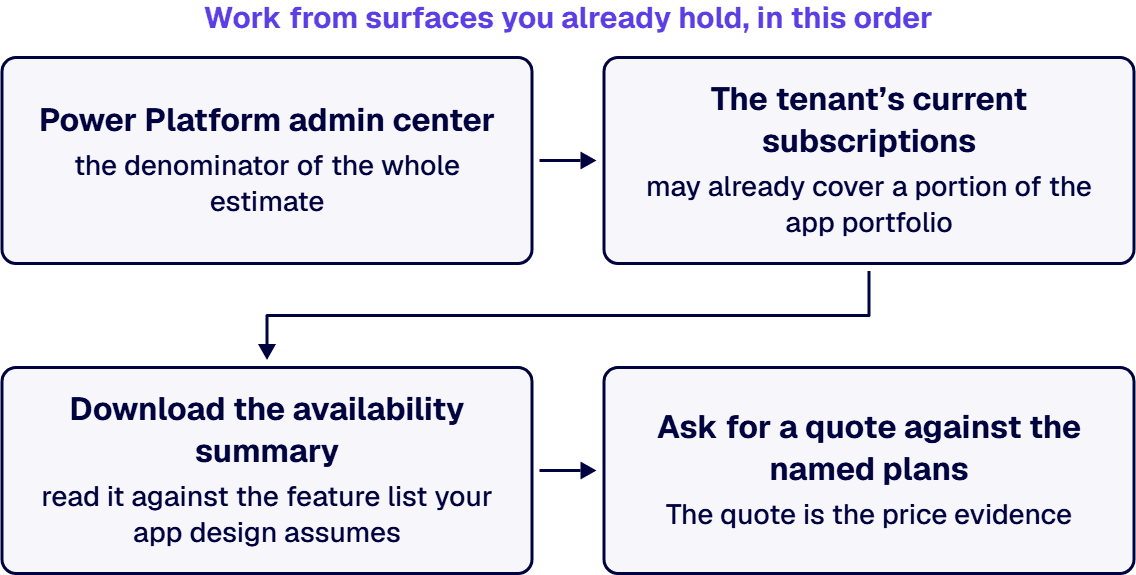
Work from surfaces you already hold, in this order, and record what each one returned.
Start in the Power Platform admin center for your own cloud, at gcc.admin.powerplatform.microsoft.us for GCC or high.admin.powerplatform.microsoft.us for GCC High. Its licensing and capacity pages report the plans and entitlements the tenant already carries, and that report is the denominator of the whole estimate. Then pull the tenant’s current Microsoft 365 US Government or Dynamics 365 US Government subscriptions from the same admin surface, because the included-capabilities path above may already cover a portion of the app portfolio you were about to buy standalone.
Next, download the availability summary linked in the section above and read it against the feature list your app design assumes. Then take that assumption list and the plan count to your Volume Licensing or Cloud Solution Provider channel and ask for a quote against the named plans. The quote is the price evidence; nothing before it is.
Two of those inputs can disagree, and there is one rule for it. Where the admin center’s entitlement report and the availability summary disagree about whether a capability is usable in your cloud, the availability summary governs the design and the entitlement report governs the count. A capability you are entitled to but that is listed as an exception in your cloud is not a capability you can build on, and a capability that is available but unentitled is a purchase, not a blocker.
Environment capacity is a separate billable object in a Power Apps estimate, priced on its own meters and not inside a user license. That question is answered at Is Dataverse Storage Priced Differently in Government Clouds? What GCC, GCC High and DoD Buyers Pay, and this page does not restate its meters or rates.
This page assumes the tier is already chosen and prices Power Apps inside it. If the tier itself is still open, the choice between the government clouds is settled at Microsoft 365 GCC vs GCC High: Which Government Cloud Does Your Organization Need?. And if the question in front of you is the Microsoft 365 bill rather than the Power Apps bill, including what migration adds to it, that is answered at How Much Does Microsoft 365 GCC High Cost, Including Licensing and Migration?.
The estimate above works with any partner, or none, because its inputs are the tenant’s own admin surfaces and its own channel quote. i3solutions implements Power Platform licensing across Power Apps per-app and per-user plans, Power Automate per-flow and per-user plans, and the Microsoft 365 default entitlements where app complexity is low.
The Government clouds carry no published Power Apps price. Microsoft’s Power Apps US Government documentation names two standalone Government plans, the Power Apps per app plan for Government and the Power Apps per user plan for Government, and states no dollar figure for either, so a Government price for a specific tenant comes from a quote through the Volume Licensing or Cloud Solution Provider channel. The commercial baseline, listed on Microsoft’s own Power Apps pricing page, is Power Apps Premium at $20.00 per user per month paid yearly, with a volume tier at $12.00 per user per month paid yearly at a 2,000-seat minimum, and those are not Government figures.
It sets schedule inputs, not a published price. Microsoft’s Power Apps US Government documentation states that the Government plans are sold subject to validation of eligibility, that validation might require sponsorship by a government entity, and that revalidation of eligibility is required on contract renewal. A renewal that has to clear validation again is a schedule input, and a schedule input on a renewal is a cost input. The documentation states no dollar figure for the Government plans, so the number arrives from a channel quote rather than from the published record.
The published record gives the structure of the offer and sends the price question to a channel. The Power Apps US Government page sets the offering set, the purchasing rule and the eligibility rule, points readers at the commercial licensing information page for plan differences, and states no Government dollar figure. Treat that absence as a disclosure fact and not as a price signal: it is not evidence that the Government plans cost the same as the commercial ones, and not evidence that they cost more.
No published figure says it does; the route changes where the price evidence comes from. Microsoft states that Power Apps US Government is available through the Volume Licensing and Cloud Solution Provider purchasing channels, and that the Cloud Solution Provider program is not currently available for GCC High customers. A GCC tenant therefore has both routes to quote from and a GCC High tenant has one, Volume Licensing, and where a quote assumes the wrong route the tenant’s own cloud decides it. Purchase is also subject to validation of eligibility, and revalidation of eligibility is required on contract renewal.
There is no published basis for saying so in either direction. Microsoft names the Government plans and states no price for them, so a claim that the Government tiers cost more, or that they cost the same, rests on nothing published. What is documented is what changes: the offering set, the purchasing channel, eligibility validation, the identity requirement, and functional parity exceptions. Price the tier from a channel quote against the named plans, and treat any figure offered without that quote as an estimate.
Five things, documented rather than inferred: the offering set, the purchasing channel, eligibility validation, the identity requirement, and functional parity exceptions. The offering set is restricted to the Government offerings the documentation lists. The purchasing channel is Volume Licensing or Cloud Solution Provider, with Cloud Solution Provider not currently available for GCC High customers. Eligibility validation gates the purchase and is required again at renewal. The GCC High deployment option requires Microsoft Entra Government for customer identities while GCC uses public Microsoft Entra ID. And Microsoft publishes an availability summary listing the exceptions to functional parity in the US Government clouds.
Power Apps follows the tenant’s cloud, so the contractor chooses the tenancy once and the data the contractor holds decides it before price does. Microsoft states that the GCC High deployment option enables and requires Microsoft Entra Government for customer identities, in contrast to GCC which uses Public Microsoft Entra ID, and that Power Apps US Government is available to entities that handle data that is subject to government regulations and requirements, subject to validation of eligibility. Which tenancy fits the data a contractor holds is worked through at GCC vs GCC High vs Commercial Microsoft 365 for CUI: An Evaluation Matrix. Price comes second, because Microsoft states no Government dollar figure and the quote is taken once the tenancy is settled.

US-Based | Est. 1997
© i3solutions. All rights reserved.
US-Based | Est. 1997
© i3solutions. All rights reserved.


