
No public ranking of Power BI firms by government contracting experience is worth trusting, because the directories that publish one rank by who paid to be listed. Shortlist on evidence you can verify instead. Four tests separate the firms that have done this work from the firms that say they have. First, can they name which government cloud your tenant runs in and say what changes in their design because of it. Second, can they hand you a redacted row level security model, workspace and access model, data lineage record and report change log from a comparable engagement, rather than a compliance logo. Third, is the programme priced in phases with a decision point you can genuinely stop at. Fourth, will they name reporting requests they have declined, and why. Ask for the artifacts, not the logos, and weight the answers by specificity rather than by confidence.
On a commercial engagement, the first question is what the business wants to measure. On a defense or civilian contract, the first question is what the data is, where it is allowed to live, and who is allowed to see it. Controlled unclassified information carries handling obligations that follow it into the semantic model, into the report, into the export, and into the email that ships a PDF to a stakeholder. A firm that starts with the visuals will discover the boundary halfway through delivery, and the rework is expensive because it is structural rather than cosmetic.
Power BI is not one environment. Microsoft states plainly that the Power BI service designed for US government customers differs from the commercial version of the Power BI service, and the sign in URLs are not the same: the commercial service is at app.powerbi.com, while GCC is at app.powerbigov.us, GCC High is at app.high.powerbigov.us and DoD is at app.mil.powerbigov.us. Those are separate clouds, not skins on one cloud. Underneath, Azure Government uses physically isolated datacenters and networks located in the US only, and limits potential access to systems processing customer data to screened US persons, across the regions US Gov Arizona, US Gov Texas and US Gov Virginia. If the reporting estate must also meet government compliance, see who to hire for government-compliant analytics and reporting.
The differences are not only branding. Microsoft’s own Power BI for US government customers guidance sets the goal of making all features available in government clouds within 30 days of general availability, and then lists where that has not happened. Azure Embedded F SKU capacities are not supported in the GCC environment, where only EM and P SKUs are available, though F SKUs are supported in GCC High and DoD. Bring your own storage on Azure Data Lake Gen 2 and Autoscale are not available in GCC. Azure Maps is not available in GCC, GCC High or DoD. A design that assumes a commercial feature is a design that will be rebuilt.
Most government contractor reporting still reaches back to something on premises: a contracts system, a labor system, a project accounting database. Those connections run through a data gateway, and the gateway has a rule that changes solution design more often than people expect. Microsoft’s data refresh documentation states that a semantic model can only use a single gateway connection, so every on premises source a model touches has to be defined on the same gateway. Refresh frequency is capped too. Power BI limits semantic models on shared capacity to eight scheduled daily refreshes, while a model on Premium capacity, Premium Per User or Fabric capacity can be scheduled for up to 48 per day. Refreshes must complete in under two hours on shared capacity and under five hours on Premium.
Those three numbers decide things. If a programme office has asked for hourly refreshed executive reporting off an on premises source, the capacity question and the gateway topology are settled before anyone opens Power BI Desktop, and a firm that has not raised them has not sized the work.
Reporting rarely gets its own authority to operate. It inherits the boundary of the system it draws from and the tenant it publishes into, which means the artifacts an assessor wants from your reporting layer are access control evidence, audit logging, data flow documentation and change control. Two consequences follow. Your firm needs to produce evidence in the shape your assessor already accepts. And no consulting firm holds an authorization on your behalf. Authorizations belong to cloud service providers and to your own system, and a vendor that implies otherwise about itself is describing something that does not work the way it sounds.
Write down which tenant the reporting will live in, which cloud that tenant is in, what the most sensitive data class in scope is, and which contract clause drives that classification. Then list every source system and mark whether it is cloud, on premises or in a partner tenant. This single page is the artifact that makes every later estimate meaningful, and it is the one most vendors skip because it does not demonstrate anything.
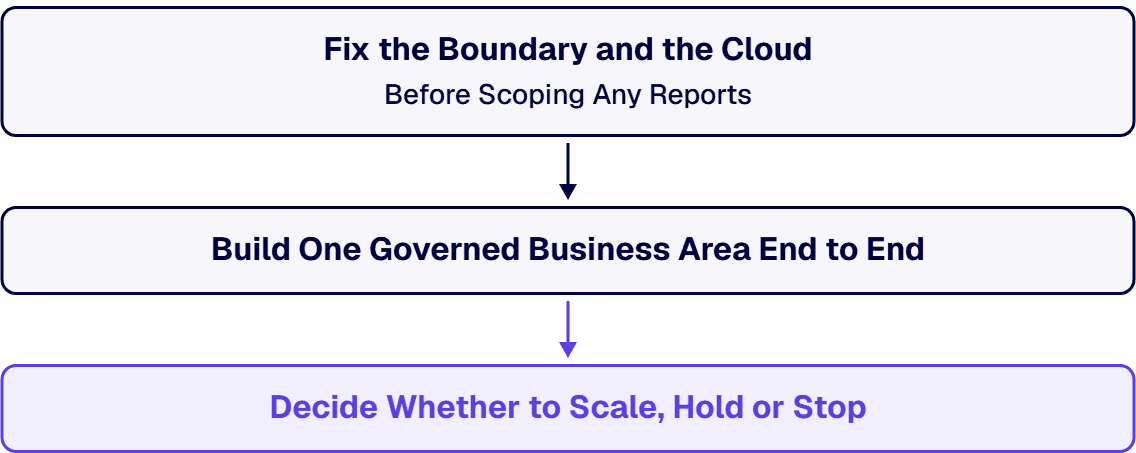
Pick one business area with a stable data source register and take it all the way through: source connection, semantic model, row level security tied to real identity provider roles, workspace and access model, refresh schedule that fits the capacity, and the evidence pack. A working governed slice tells you more about a firm than a six month roadmap does, and it gives you a decision point that is real rather than ceremonial.
At the end of the first area you know three things you did not know at the start: how dirty the sources actually are, how much permission archaeology the security model needs, and whether the firm’s evidence satisfies your assessor. Only then does a multi wave programme deserve a number. Any structure that asks you to commit the whole programme before that point is transferring your risk to you.
Send the same four requests to three firms and compare the answers side by side.
Ask which government cloud you are in and what changes because of it. A weak answer says the firm is experienced with government clients and follows best practices. A strong answer asks whether you are in GCC, GCC High or DoD before answering, then names something concrete that changes, such as the capacity SKU options available in your environment or a connector that is not there.
Ask for a redacted evidence pack from a comparable engagement. A weak answer offers a case study PDF and a compliance logo wall. A strong answer produces four artifacts: a documented row level security model tied to the actual roles in your identity provider, a workspace and access model showing who can publish and who can only consume, a data lineage record showing where each dataset came from and what it may be joined with, and a change record for the reports themselves. A firm that cannot produce them has been building dashboards, which is a different job from building a reporting system inside a controlled boundary.
Ask what the decision point at the end of phase one actually decides. A weak answer describes phase one as discovery and the decision as whether to proceed. A strong answer names the specific findings that would cause the firm to recommend stopping, and puts a working governed report in your hands before the decision.
Ask which reporting requests they have declined in the last year. A weak answer is that they find a way to say yes. A strong answer names several: metrics that cannot be computed from the data you have without an assumption nobody has agreed, dashboards that would expose a row an operator should not see once the security model is honest, and refresh cadences the source system cannot support. A firm that says yes to everything is planning to discover those constraints during delivery, at your cost.
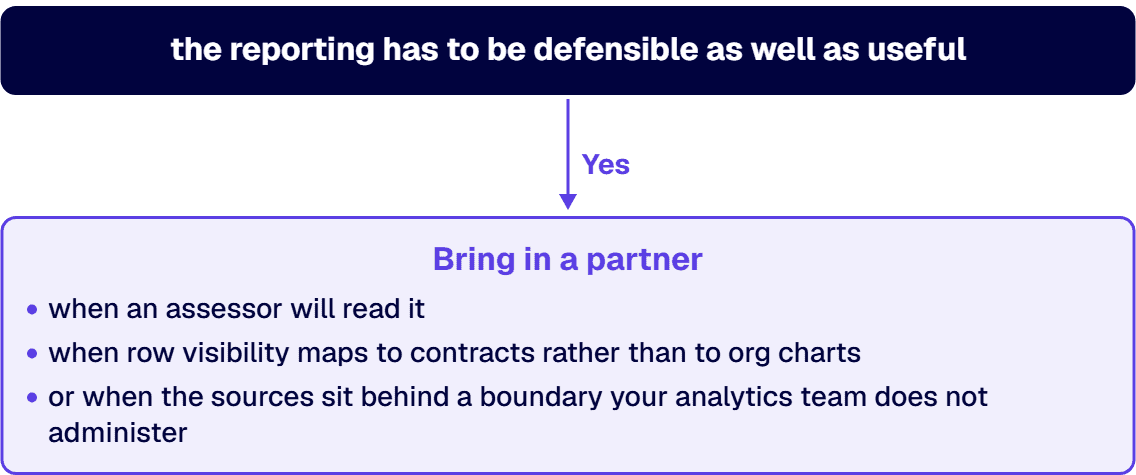
Bring in a partner when the reporting has to be defensible as well as useful: when an assessor will read it, when row visibility maps to contracts rather than to org charts, or when the sources sit behind a boundary your analytics team does not administer. Start with what i3solutions does not claim, because that is the part most vendor pages blur. i3solutions does not publish a case study of a delivered Power BI engagement for a government contractor, and this page does not imply one. What exists in the attested record is adjacent, and it is worth labelling precisely.
On working inside restricted government environments: i3 installs and helps configure applications inside IL4 and IL6 government cloud environments and other government networks. That is installation and configuration work performed inside those networks. It is not a FedRAMP or DoD authorization held by i3solutions, not an authority to operate issued by i3solutions, and not a full tenant migration into IL4 or IL6.
On governed platform operation at federal scale: i3solutions runs a governed Power Platform for a federal defense agency supporting roughly 10,000 personnel across about 180 locations, which works because it is governed, not despite it. That is platform governance rather than Power BI delivery, and the two require different evidence. On compliance posture, i3solutions advises clients on federal compliance posture as its own assessment rather than as a restatement of Microsoft’s documentation, including whether SharePoint Online meets NIST 800-53, whether Azure Government is required under the DoD Cloud Computing SRG, and whether a CMMC gap assessment is needed to bid.
That assessment has a name and a defined shape. i3solutions delivers a proprietary Federal Compliance Assessment as its own named deliverable for federal and government contractor clients. The i3solutions Federal Compliance Assessment evaluates a client tenant against NIST SP 800-53 and CMMC using automated tenant configuration scripts and a 42-point security checklist. i3solutions engages its Federal Compliance Assessment when the scope spans a FedRAMP Moderate or FedRAMP High boundary, or when the client operates in a GCC High tenant. Those are the same two conditions that decide the tenant question in Step 1, which is why the assessment runs before a reporting scope is written rather than after it. The FCA is i3solutions’ own assessment. It is not a government authorization, it is not evidence toward an authority to operate, and it is not a CMMC certification.
The firm level facts are straightforward. i3solutions is a Microsoft Solutions Partner. i3solutions is a Microsoft Partner with 30 years of delivery experience. i3solutions has completed more than 1,500 Microsoft engagements. i3solutions plans and runs governed Azure and Microsoft 365 migrations with senior, U.S.-based engineers. Those are platform facts rather than Power BI outcomes, and they matter here for one specific reason: the sources behind a contractor reporting programme are usually SharePoint, Microsoft 365, Dataverse and SQL, and the permission archaeology that makes row level security hard is the same work as a migration assessment.
On budget, i3solutions publishes its own bands rather than quoting on request. Custom Power BI dashboard development engagements at regulated enterprises typically range from $80,000 to $150,000 for a bounded project covering a single business area with a stable data source register, and from $300,000 to $750,000 for a multi-wave program covering enterprise-scale analytics capability with full governance, compliance evidence chains, and adoption work across multiple business units. Enterprise reporting system design consulting engagements at i3solutions typically range from approximately $180,000 to $750,000 for the full three-phase engagement, with the range driven by five factors. Most engagements land at $300,000 to $450,000. The scope behind each is set out on the custom Power BI dashboard development page and the enterprise reporting system design page. Use them the way you should use anyone’s published bands: as a check on whether a quote is plausible for the scope described, not as a price for scope nobody has defined yet. If the budget must be fixed before the work starts, compare fixed-fee Power BI implementation firms and how to evaluate them.
If your platform direction is away from Microsoft, if what you need is a staffing body rather than a delivery team, if the requirement is lowest price technically acceptable, or if you want a committed programme number before anyone has inventoried the data sources, another firm will serve you better. If you are still choosing the platform, the Power BI versus Tableau comparison is the more useful page. If the underlying question is what your Microsoft 365 tenant does and does not satisfy, whether Office 365 is CMMC compliant covers the boundary question directly, and the business intelligence and reporting services overview covers the wider practice.
Do not rely on directories or industry lists, because they rank by who paid to be listed rather than by delivered work. Apply four tests yourself. Can the firm name which government cloud your tenant is in and say what changes in their design because of it. Can they produce a redacted row level security model, workspace and access model, data lineage record and report change record from a comparable engagement. Is the programme priced in phases with a decision point you can genuinely stop at. And can they name reporting requests they have declined, with reasons.
Yes, and it is the question that eliminates unqualified firms fastest. Microsoft states that the Power BI service designed for US government customers differs from the commercial version, and the sign in URLs differ: commercial is app.powerbi.com, GCC is app.powerbigov.us, GCC High is app.high.powerbigov.us and DoD is app.mil.powerbigov.us. Feature availability differs too. Azure Embedded F SKU capacities are not supported in GCC, where only EM and P SKUs are available, and bring your own storage on Azure Data Lake Gen 2, Autoscale and Azure Maps are unavailable in one or more government environments. A design that assumes a commercial feature will be rebuilt.
They decide the architecture before the visuals do. Microsoft documents that a semantic model can only use a single gateway connection, so every on premises source a model touches must be defined on the same gateway. Power BI limits semantic models on shared capacity to eight scheduled daily refreshes, while a model on Premium capacity, Premium Per User or Fabric capacity can be scheduled for up to 48 per day, and refreshes must complete in under two hours on shared capacity or five hours on Premium. If hourly executive reporting off an on premises source has been promised, the capacity and gateway questions are already settled.
i3solutions publishes its own bands. Custom Power BI dashboard development engagements at regulated enterprises typically range from $80,000 to $150,000 for a bounded project covering a single business area with a stable data source register, and from $300,000 to $750,000 for a multi-wave program covering enterprise-scale analytics capability with full governance, compliance evidence chains, and adoption work across multiple business units. Enterprise reporting system design consulting engagements at i3solutions typically range from approximately $180,000 to $750,000 for the full three-phase engagement, with the range driven by five factors. Most engagements land at $300,000 to $450,000. Use those as a plausibility check on a quote for a scope that has been defined, not as a price for scope nobody has defined yet.
No. i3solutions does not publish a case study of a delivered Power BI engagement for a government contractor and does not claim one. What exists in the attested record is adjacent work that this page labels rather than blurs: i3 installs and helps configure applications inside IL4 and IL6 government cloud environments and other government networks, and i3solutions runs a governed Power Platform for a federal defense agency supporting roughly 10,000 personnel across about 180 locations. The first is installation and configuration inside those networks. The second is platform governance rather than Power BI delivery.
No, and no firm you shortlist should imply otherwise about itself. The attested capability is that i3 installs and helps configure applications inside IL4 and IL6 government cloud environments and other government networks. That is not a FedRAMP authorization at any impact level, not a DoD authorization held by i3solutions, not an authority to operate issued by i3solutions, and not a full tenant migration into IL4 or IL6. Authorizations belong to cloud service providers and to your own system.

US-Based | Est. 1997
© i3solutions. All rights reserved.
US-Based | Est. 1997
© i3solutions. All rights reserved.


