AI initiatives create risk when they move faster than the data, workflows, security model, and operating ownership behind them. Many organizations have strong interest in AI, but limited clarity around where AI belongs, which use cases deserve investment, what data is ready, and how outputs should be governed after deployment.
For enterprise IT leaders, the challenge is not finding AI capability. The challenge is determining which AI use cases are practical, defensible, secure, and supportable inside the Microsoft environment the organization already operates. Data quality, identity, workflow design, integration architecture, model behavior, and human oversight all shape whether AI becomes an enterprise capability or another unsupported experiment.
i3solutions delivers custom AI consulting and integration services for Microsoft-centric organizations that need to evaluate, design, integrate, and govern AI use cases before they reach production. Our teams assess AI readiness, workflow fit, data foundations, integration dependencies, risk exposure, and long-term ownership before recommending a path forward.
The objective is to move AI decisions from abstract interest to practical evidence. That evidence defines which use cases belong in a prototype, which require stronger data foundations, which fit Microsoft-native AI capabilities, and which need custom integration across existing applications, workflows, and reporting environments.
Enterprise AI requires more than a model, chatbot, or automation idea. i3solutions evaluates data readiness, workflow fit, governance requirements, integration paths, security controls, and support ownership before AI work moves toward production.
Enterprise AI efforts rarely fail because AI tools are unavailable. They fail because use cases are selected before the organization understands the data, workflows, permissions, ownership model, and decision risk involved.
These breakdowns become more serious in Microsoft-centric environments where AI decisions affect SharePoint, Power Platform, Microsoft 365, Azure, Dataverse, Power BI, Fabric, SQL Server, Dynamics 365, Teams, custom applications, and external business systems.
AI ideas often begin with visible excitement around a tool or model. The risk appears later, when the data is incomplete, workflows are undocumented, access rules are unclear, or the expected output lacks a practical decision owner.
AI depends on source data, definitions, lineage, permissions, quality, and context. If the organization already struggles to trust reporting, AI output inherits the same weakness and creates a more difficult governance problem.
AI creates limited value when it sits outside the systems where work occurs. Custom AI needs connection to workflows, applications, documents, approvals, reporting, knowledge repositories, and operational handoffs.
Enterprise AI requires clear rules for review, escalation, accountability, exception handling, and output ownership. Without human oversight designed into the process, AI output becomes difficult to defend when the decision affects users, customers, compliance, or operations.
AI prototypes often use sample data, broad access, or informal review processes. Production AI requires stronger boundaries around sensitive data, identity, permissions, prompt behavior, audit evidence, and model monitoring.
A successful pilot still needs production ownership. Someone must own data refresh, model behavior, user feedback, monitoring, change control, support, and retirement decisions. Without that ownership, AI becomes operational debt.

Custom AI consulting at the enterprise level is not a brainstorming exercise or a tool recommendation. It is a structured evaluation of where AI belongs, what evidence supports the use case, what systems must be involved, and what governance is required before the capability is trusted in production.

AI should be evaluated against the work it changes. That includes how information is received, how decisions are made, which users need support, which exceptions occur, and which outputs require review. The use case has to be tied to a real workflow, not only a technical capability.

AI output depends on the structure, quality, accessibility, and context of the data behind it. i3solutions evaluates source systems, data movement, security boundaries, reporting definitions, document repositories, APIs, and integration paths before recommending an AI approach.

Enterprise AI requires durable operating controls. Data access, review responsibility, model monitoring, explainability, change control, documentation, and support ownership need definition before AI becomes part of daily operations.
i3solutions focuses on AI work where the use case has enterprise consequences. The work is designed for organizations that need AI aligned to Microsoft platforms, existing systems, governed data, workflow execution, and long-term supportability.
We evaluate candidate AI use cases against business value, data readiness, workflow fit, integration complexity, security constraints, risk exposure, and operational ownership. This separates practical AI opportunities from ideas that need stronger foundations first.
We define a prioritized AI path that reflects current systems, Microsoft platform maturity, available data, governance requirements, and delivery capacity. The roadmap gives leadership a decision structure for what to prototype, what to defer, and what to prepare for production.
Some AI ideas need controlled validation before implementation. i3solutions defines prototype scope, success criteria, data boundaries, user feedback paths, and feasibility questions so early AI work produces evidence instead of open-ended experimentation.
We design AI capabilities that connect to enterprise applications, Microsoft workflows, document repositories, reporting environments, and business systems. This work often involves Azure AI services, Power Platform, custom .NET applications, APIs, Dataverse, SharePoint, Teams, or other enterprise systems.
Many organizations need AI to improve access to policies, procedures, records, contracts, technical documentation, service history, or institutional knowledge. i3solutions evaluates content structure, permissions, retrieval patterns, source authority, and review processes before implementing knowledge-based AI.
AI may support planning, prioritization, classification, scoring, and decision-support workflows when data foundations and review paths are mature enough. i3solutions evaluates whether the use case belongs in a custom AI capability, a governed analytics model, or a separate data fusion and predictive analytics path.
We define governance structures for access, oversight, explainability, output review, bias awareness, monitoring, documentation, and lifecycle control. Responsible AI becomes part of the operating model, not a policy added after deployment.
Enterprise AI decisions are not always a choice between custom AI, Microsoft Copilot, Copilot Studio, Azure AI, Power Platform, Fabric, or a third-party model. The right path depends on the use case, data sensitivity, workflow complexity, integration needs, governance requirements, and support model.
i3solutions evaluates the use case before recommending a platform path. Some organizations need Microsoft-native AI configuration. Others need custom AI integration. Many need a combination, with governance and data readiness defining the sequence.
Microsoft Copilot and Copilot Studio are often appropriate when the use case involves productivity assistance, controlled conversational experiences, Microsoft 365 content interaction, or guided workflows that fit existing Microsoft patterns. These options require governance, data boundaries, prompt design, testing, and adoption planning before enterprise rollout.

Azure AI services and custom model integration fit scenarios that require deeper control over model behavior, application logic, retrieval architecture, APIs, data processing, or system-specific workflows. These paths require stronger engineering discipline, integration design, and monitoring practices.

Power Platform supports AI-assisted intake, routing, summarization, classification, approvals, and workflow actions when the surrounding process is well defined. The risk is unmanaged automation. AI-enabled workflows need environment strategy, DLP alignment, identity access controls, exception handling, and support ownership.

Large language models, retrieval-augmented generation, and private AI deployment paths require specialized evaluation of data boundaries, retrieval quality, access control, infrastructure constraints, and production ownership. i3solutions evaluates these factors at the strategy level when they affect feasibility, platform fit, workflow integration, governance, or long-term supportability. Deeper LLM, RAG, and private deployment work belongs in a more specialized implementation path when the use case requires it.
i3solutions structures AI consulting around the decision the organization needs to make. Engagements begin with use case clarity and readiness assessment, then move into prototype planning, architecture, implementation support, governance, and handoff when the evidence supports moving forward.
The engagement begins by clarifying the business decision, workflow, user group, data sources, and risk profile behind the AI request. This prevents AI work from becoming tool exploration without a defined operational purpose.
i3solutions reviews the data, documents, applications, integrations, security model, reporting structures, and process dependencies required for the use case. This identifies gaps that need resolution before AI produces trustworthy outputs.
Based on the use case, i3solutions defines the appropriate platform direction. The path could involve Microsoft Copilot, Copilot Studio, Azure AI, Power Platform, Microsoft Fabric, Dataverse, SharePoint, Teams, custom applications, APIs, or a hybrid approach

AI work is sequenced based on evidence required, delivery risk, data maturity, stakeholder needs, and production complexity. Some use cases need a short prototype. Others need an AI readiness roadmap before any build activity starts.

i3solutions defines the controls required for responsible use. This includes access boundaries, testing scenarios, human review points, exception handling, logging, monitoring, output quality review, and ownership responsibilities.

AI engagements should leave the organization with clearer ownership and stronger decision evidence. i3solutions documents findings, architecture decisions, governance recommendations, prototype outputs, and next-step requirements so internal teams understand how the AI capability should be managed.
AI exploration often starts small, but unmanaged pilots create enterprise risk when they depend on sensitive data, informal prompts, unclear access, unsupported integrations, or undocumented business logic. A useful pilot should clarify whether the use case deserves further investment without creating a production dependency before the organization is ready.
Prototype and pilot work should define what is being tested, which data is in scope, who reviews output, how findings are measured, and what decisions follow. Bounded pilots produce usable evidence without creating uncontrolled adoption.

AI value depends on what happens after the pilot. Monitoring, data updates, feedback loops, user support, governance review, and change control need an owner before the capability becomes part of daily operations.
A model response or demo often looks compelling while the underlying data, integration, security, and support model remain immature. i3solutions distinguishes proof-of-concept success from production readiness so leadership does not overcommit based on a narrow demonstration.
AI validation should not disrupt the processes teams rely on. i3solutions evaluates how existing workflows, reports, approvals, documents, and systems remain stable while AI use cases are assessed or piloted.
AI initiatives need a clear use case, trusted data, secure integration, human oversight, and a practical operating model. i3solutions structures AI consulting around the evidence leaders need before approving prototype, pilot, or production work.
For enterprise and regulated organizations, AI decisions affect sensitive data, user access, records, reporting outputs, workflow logic, customer information, compliance obligations, and executive confidence. Governance and security should shape the AI path before any model is connected to business systems.

AI systems often require access to documents, databases, applications, conversations, service histories, or operational records. i3solutions evaluates data boundaries, permission models, source authority, retention considerations, and role-based access before defining the solution path.
AI output needs review paths appropriate to the decision it influences. We define where humans remain in control, who validates outputs, how exceptions are handled, and which decisions should never be automated without review.
Enterprise leaders need to understand why AI output is trusted, where information came from, and how decisions are documented. i3solutions designs AI recommendations with traceability, evidence, and reviewability in mind.
Custom AI consulting often requires access to sensitive systems, data structures, workflows, security controls, and business logic. i3solutions uses senior, US-based specialists so enterprise teams work directly with experienced professionals throughout assessment, integration, governance, and handoff.
Not every AI initiative is straightforward. Many enterprise environments contain fragmented data, unclear ownership, legacy systems, manual workflows, inconsistent reporting, immature governance, or AI pilots that moved faster than the organization could support.
AI initiatives stall when no one owns the decision, workflow, data, or support model affected by the output. i3solutions clarifies ownership before architecture or implementation decisions are made.
Disconnected systems, weak definitions, poor data quality, missing lineage, and unmanaged documents reduce AI reliability. i3solutions identifies the data conditions that need resolution before AI work expands.
A pilot might prove technical possibility without proving readiness for enterprise use. i3solutions evaluates what is required for security, integration, monitoring, adoption, support, and governance before scaling.
AI often needs to operate inside intake processes, approval paths, case management, reporting, knowledge retrieval, or custom applications. i3solutions designs integration patterns that keep AI connected to the work it supports.
AI that touches regulated data, confidential documents, HR records, customer information, contracts, financial data, or audit-facing processes requires stronger review. i3solutions incorporates access control, traceability, and oversight into the AI path.
Departments sometimes adopt AI tools independently before IT has standards for data, identity, monitoring, or governance. i3solutions provides a structured way to evaluate where AI belongs and how it should be controlled.

Custom AI becomes more valuable when it is tied to broader modernization priorities. AI exposes where workflows are undocumented, where data is unreliable, where reporting definitions conflict, where knowledge is trapped, and where systems are not integrated well enough to support intelligent automation.
When AI consulting is handled with structure, it strengthens the modernization roadmap instead of distracting from it. The work clarifies whether the organization first needs data modernization, workflow redesign, application integration, SharePoint governance, Power Platform standards, reporting cleanup, or a custom application path.
This is why i3solutions treats AI as part of the enterprise operating environment. The goal is not to attach AI to disconnected processes. The goal is to define where AI improves decisions, reduces manual burden, or creates more reliable access to information inside systems the organization already governs.
Custom AI consulting reduces the uncertainty created when organizations want AI capability but lack evidence around readiness, fit, governance, and production ownership. A structured approach gives leaders a clearer basis for investment, prototype decisions, and operating control.

Custom AI consulting often connects to broader decisions about data, workflow, applications, analytics, integration, and Microsoft platform readiness. These related services give organizations a path for addressing the foundations AI depends on.
Organizations evaluating large language models, RAG, enterprise knowledge assistants, or production deployment use this path. It covers the architecture, security, and operating-model decisions that move teams from experimentation to governed enterprise use.
Strict data sovereignty, security, or regulatory requirements call for AI deployed inside private, on-premises, or isolated infrastructure. This path covers secure model deployment, private document retrieval, vector database design, and access control.
Teams need to understand current systems, workflows, data flows, technical debt, and integration points before they select an AI use case or modernization path. This service maps those constraints first.
Feasibility often has to be proven before full implementation begins. This service gives organizations a controlled way to validate AI feasibility, user interaction, workflow fit, data requirements, and stakeholder expectations.
Some organizations are ready to engineer governed automation across their core platforms now. This service spans Power Automate, SharePoint, Dynamics 365, Azure, custom applications, and connected enterprise systems.
Trusted data and clear metric definitions have to exist before AI or advanced analytics initiatives move forward. This service builds the reporting models, dashboards, and operational visibility that work depends on.
Organizations often combine data from multiple systems to sharpen the signals their decisions rely on. This service improves signal quality, forecasting, risk detection, and AI-ready decision support.
i3solutions’ custom AI consulting services are designed for Microsoft-centric organizations where AI decisions affect enterprise systems, sensitive data, workflow execution, reporting trust, governance, compliance, or operational ownership.
This service is best suited for initiatives where AI must be practical, integrated, secure, explainable, and supportable rather than a disconnected experiment.
Custom AI consulting is a strong fit when the organization needs objective clarity before AI ideas move into prototype, pilot, implementation, or enterprise rollout.
Best fit scenarios
Some AI requests are better handled as routine configuration, experimentation, or internal productivity support when they do not involve enterprise systems, governance, integration, or decision risk.
Less Suited for Purely Tactical Needs
i3solutions is best aligned to AI initiatives that require practical technical execution, Microsoft platform expertise, and a clear connection between data, workflows, systems, governance, and enterprise decision-making.
Organizations engage i3solutions for custom AI consulting when AI decisions are too important, too complex, or too risk-sensitive for tool-first experimentation. Enterprise AI requires more than access to a model. It requires understanding how the model interacts with data, workflows, systems, users, security, governance, and long-term support.

i3solutions brings 30 years of Microsoft platform, integration, workflow, application, data, analytics, and enterprise delivery experience to AI work that requires operational discipline. Our senior, US-based teams evaluate how AI fits inside the systems and processes already in place before recommending a prototype, platform path, integration approach, or production roadmap.
We work across Microsoft 365, Azure, Power Platform, SharePoint, Dataverse, Power BI, Microsoft Fabric, SQL Server, Teams, Dynamics 365, custom applications, external systems, data environments, and legacy platforms. That breadth matters because custom AI rarely affects one system alone. Data, workflow, identity, reporting, applications, and support decisions often span multiple parts of the enterprise environment.
For enterprise IT leaders, the value is not simply adding AI capability. The value is arriving at a decision path where use case fit, data readiness, architecture, governance, supportability, and delivery risk are clearer before the organization commits.
Real-world case studies and expert perspectives showing how organizations operationalize Microsoft platforms with governance, scale, and confidence.
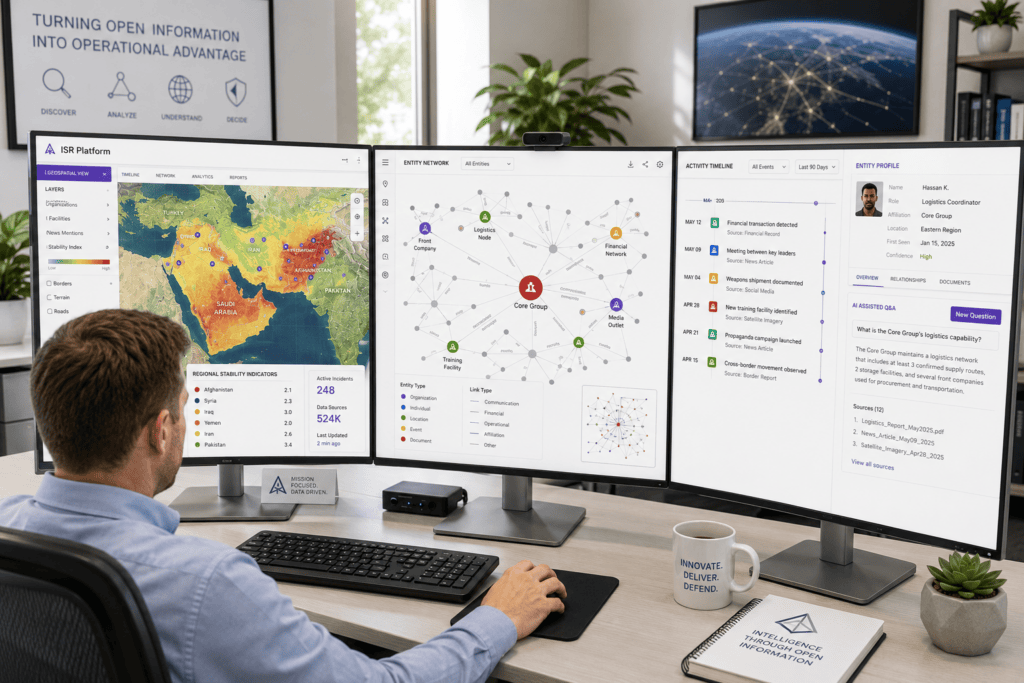
Publicly accessible sources numbering in the hundreds of thousands outpaced the legacy tools used for intelligence analysis. i3solutions built a real-time ISR platform where 20+ machine learning models feed the geospatial displays, timelines, and network graphs analysts read in near real time.
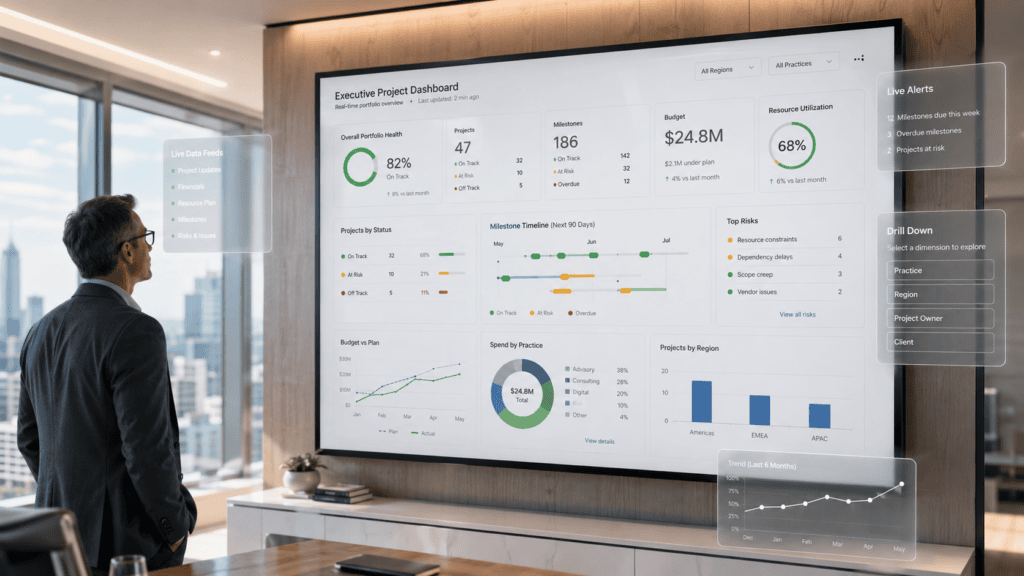
Project and milestone health got tracked by hand from spreadsheets and emailed documents in the Office of the CEO. i3solutions built a real-time executive dashboard with automated data compilation, giving project managers and the CEO's office the same live view...
Custom AI consulting services evaluate, design, integrate, and govern AI use cases inside enterprise systems, workflows, data environments, and Microsoft platforms. The work includes readiness assessment, use case prioritization, prototype planning, AI architecture, integration design, governance, and production readiness.
General AI strategy often focuses on broad opportunity identification or tool selection. Custom AI consulting focuses on the practical path from use case to governed implementation, including data readiness, workflow fit, Microsoft platform alignment, security, integration, human oversight, and support ownership.
Custom AI consulting is useful when leaders need to determine whether an AI use case is practical, secure, supportable, and worth funding. It is especially relevant before prototypes, pilots, Copilot Studio work, Azure AI integration, custom model development, or AI-enabled workflow automation.
Yes. i3solutions evaluates where Microsoft Copilot, Copilot Studio, Azure AI, Power Platform, Fabric, or custom AI integration fits the use case. The recommendation depends on data sensitivity, workflow complexity, integration needs, governance requirements, and operating ownership.
The right path depends on the use case, data sensitivity, workflow complexity, integration requirements, governance needs, and production ownership model. Microsoft Copilot and Copilot Studio are often appropriate for Microsoft 365 productivity, guided experiences, and controlled conversational workflows. Azure AI or custom AI development may be appropriate when the use case requires deeper integration, custom logic, specialized data access, or application-specific behavior.
Yes. AI readiness depends on source systems, data quality, permissions, definitions, lineage, access control, and operational context. i3solutions reviews the data foundation before recommending AI prototypes, models, assistants, automations, or production integrations.
Not always. Some use cases require readiness assessment before a prototype. Others benefit from a controlled proof of concept or pilot. i3solutions defines the right level of validation based on evidence required, technical uncertainty, stakeholder needs, and production risk.
Responsible AI is addressed through access controls, human oversight, explainability, monitoring, output review, documentation, and support ownership. These controls are considered part of the AI architecture, not a final policy layer added after implementation.
Yes, when the use case and data path justify the integration. i3solutions evaluates APIs, databases, documents, workflow dependencies, security controls, and system ownership before defining how AI should interact with legacy or custom applications.
Deliverables depend on scope, but often include use case findings, readiness assessment, data and workflow dependency review, platform recommendations, prototype scope, governance requirements, architecture guidance, implementation roadmap, and support readiness recommendations.
Custom AI Consulting & Integration Services is the broader parent service for AI readiness, use case evaluation, Microsoft platform fit, workflow integration, governance, and production ownership. LLM Adoption & Strategy Consulting is the dedicated path for large language models, RAG strategy, enterprise knowledge assistants, model governance, evaluation, and production rollout. Private Cloud LLM & RAG Implementation Services is the specialized path for organizations that need self-hosted or isolated AI infrastructure because of data sovereignty, security, regulatory, or intellectual property requirements.
An AI use case is not ready when the data is incomplete, ownership is unclear, workflow impact is undefined, security boundaries are unresolved, or no one owns review and accountability after deployment. In those cases, the next step is readiness assessment, data preparation, workflow clarification, or prototype validation before AI moves toward production.
i3solutions is best aligned to AI initiatives involving enterprise systems, Microsoft platform dependencies, sensitive data, workflow complexity, governance, integration, or decision impact. Small individual productivity requests or isolated AI experiments are usually better handled internally.

US-Based | Est. 1997
© i3solutions. All rights reserved.
US-Based | Est. 1997
© i3solutions. All rights reserved.