

Azure development for government contractors turns on one question: can the partner deliver inside the impact level the contract names. Four tests answer it in order: impact-level delivery, authorization separation, named onward routes, and contract-scoped fit.
A flowdown clause landed, and the compliance posture of your Azure environment is now your problem. Controlled Unclassified Information is coming into scope, or a prime has named IL5 for next quarter, or an assessment date is on the calendar. You have been told by one firm that this is routine work for it, and by another that the first firm will bury you in change orders. Neither statement is something you can take to your program office. What you need to defend is narrower and harder: which partner shape fits this workload, what that partner has to already hold before you sign, and what happens to the contract if you choose wrong.
The four tests, applied in this order:
The honest counter-case, in one sentence: if your scope is a multi-agency program with dozens of workstreams, or the contract requires a prime carrying its own authorization boundary, or the clauses name a specific vendor list, a small specialist partner is the wrong answer and the four tests will tell you so.
Split the decision in two. A partner that has delivered inside the impact level your contract names should build the workload. Running it splits three ways: Microsoft operates the Azure Government platform, the builder or your team runs the custom applications, and your security team or a provider you choose runs security operations. Sign when the checklist is in writing.
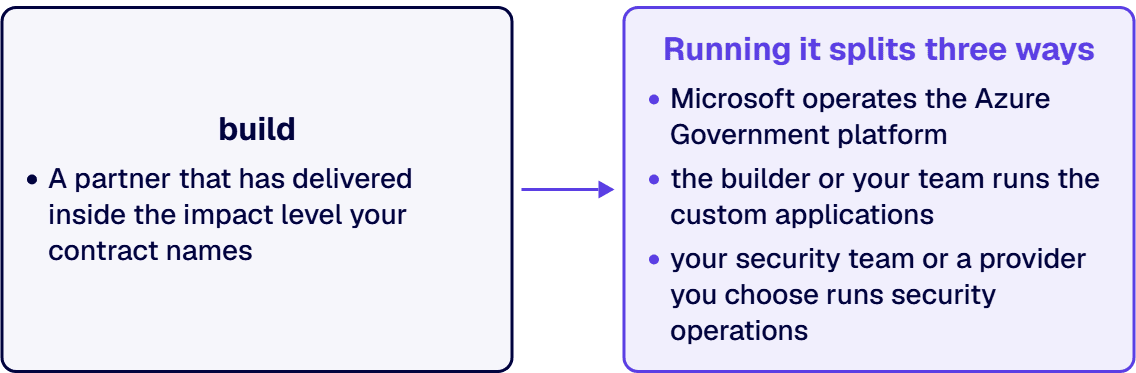
The platform. Microsoft operates Azure Government, the cloud your workload runs on, and what that cloud is authorized for belongs to the cloud service rather than to any partner, which is the line drawn in the section on what the platform authorizes.
The custom applications. Whoever the statement of work names runs the applications after go-live: the partner that built them, or your own team once the handover package is delivered. i3solutions’ Application Managed Services covers only applications and workflows i3solutions built or modernized; never the tenant, infrastructure, backup/DR, SOC, service desk or MSP-style packages. i3solutions designs Azure integration architecture and builds and operates Azure Logic Apps workflows for enterprise clients, including running them on an ongoing basis rather than only building them.
Security operations and the tenant. i3solutions sells no ongoing security operations and no ongoing endpoint management. That work stays with your own security team or a provider you select, and the statement of work names which one before you sign.
The decision is not which firm is best. It is which firm can operate inside the boundary your contract has already drawn, and which one is sized to the work that boundary contains. Four tests answer that, and they are worth applying in order, because the first one disqualifies faster than the other three combined.
Ask what the partner has installed and configured at the impact level your contract names, as work performed rather than a capability page; the vetting questions for FedRAMP High and IL4 delivery sit at Hire a Firm for FedRAMP High and DoD IL4 Compliance in Azure: How to Vet One.
The vetting questions for telling what a firm builds apart from what the platform authorizes sit on that same page, Hire a Firm for FedRAMP High and DoD IL4 Compliance in Azure: How to Vet One.
A partner that has done this before can say where each adjacent question goes before the first invoice: who moves the tenant, who handles the integration between your existing systems and the new workload, who owns identity, and which of those it will not do itself. Where the route is not named before the work starts, the question gets answered inside your project instead, on your budget, at the point it becomes urgent.
Ask how the partner staffs and sequences a bounded piece of work: who is on it, what happens when the contract’s security requirements move mid-build, and what the handover looks like when the work ends. A firm built for multi-agency work carries overhead that a single accredited application pays for and never uses, and a firm built for single applications is swamped by the coordination a large program runs on.
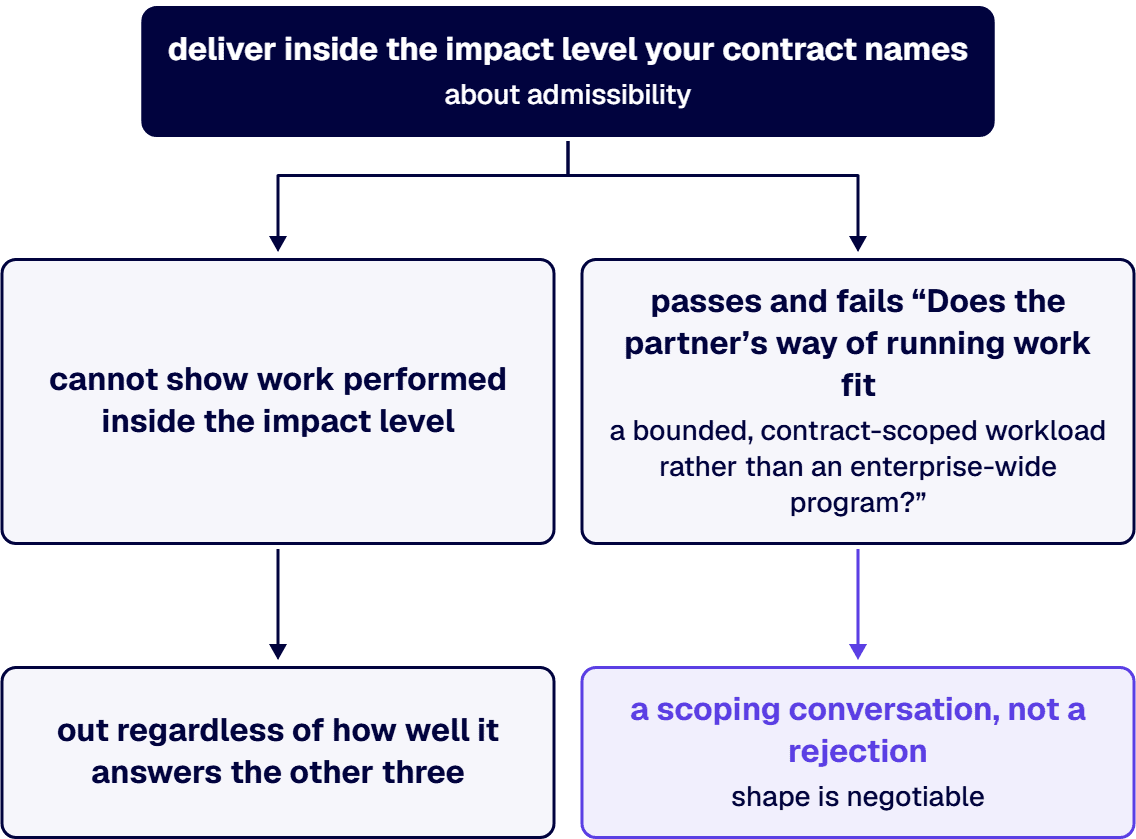
When two tests disagree, “Can the partner deliver inside the impact level your contract names?” settles it. A partner that cannot show work performed inside the impact level is out regardless of how well it answers the other three, because the other three are about fit and “Can the partner deliver inside the impact level your contract names?” is about admissibility. A partner that passes “Can the partner deliver inside the impact level your contract names?” and fails “Does the partner’s way of running work fit a bounded, contract-scoped workload rather than an enterprise-wide program?” is a scoping conversation, not a rejection: the capability is real and the shape is wrong, and shape is negotiable in a way that impact-level experience is not.
| Test | The question you are asking | Evidence that answers it | A weak answer |
|---|---|---|---|
| Impact-level delivery | Has this firm built at the impact level my contract names? | A described build in an IL4, IL5 or FedRAMP High environment: the services, the configuration, and the resource inventory it left behind | A capability page, a partner badge, or a list of agencies served |
| Authorization separation | Does this firm know the difference between what the platform holds and what it holds? | The firm draws the line unprompted and says which part stays yours | “We are FedRAMP authorized” said about the firm rather than about the cloud service |
| Named onward routes | Where does each adjacent question go? | Named routes for migration, integration and identity, including the ones the firm will not do | “We handle all of that” with no route named |
| Contract-scoped fit | Is this firm sized to the work my contract contains? | A staffing and sequencing answer for a bounded build, and a described handover at the end | A program-shaped proposal for a single accredited application |
Capability and proof are different questions, so what follows is what i3solutions attests about itself, in the register’s own words, and nothing adjacent to it.
Work performed inside government-hosted impact levels. i3solutions installs and configures applications inside IL4 and IL6 government cloud environments and other government networks.
GCC High migration delivery, around a provisioning step it does not perform. The attested sentence reads: “We manage GCC High migrations end-to-end: from eligibility validation and licensing coordination with your AOS-G supplier through identity architecture, data migration, security baseline configuration, and post-migration governance. i3solutions plans and runs these migrations for regulated defense organizations, structuring each phase around the compliance evidence assessors expect.” GCC High tenant provisioning itself is the AOS-G supplier’s role. i3solutions does not hold AOS-G status.
Identity governance in the verticals that carry the obligations. i3solutions has deep experience implementing identity governance for enterprises in aerospace and defense manufacturing, financial services, and healthcare, including environments with CMMC and ITAR obligations.
What i3solutions does not claim. It does not hold a FedRAMP authorization at any impact level. It does not hold a DoD authorization of its own. It has not authorized, accredited or issued an ATO for any system. Those boundaries are stated here directly, and a firm that will not state them plainly is the firm “Does the partner separate what it builds from what the platform authorizes?” is designed to catch. Whether FedRAMP High applies to your application at all is answered on the routed applicability page, and is not restated in this guide.
The impact levels in your contract are properties of the cloud environment, described in Department of Defense guidance, and they are not credentials a consulting firm carries. Microsoft’s own documentation states that “Azure Government supports applications that use Impact Level 5 (IL5) data in all available regions” and that “IL5 requirements are defined in the US Department of Defense (DoD) Cloud Computing Security Requirements Guide (SRG)” (Isolation guidelines for Impact Level 5 workloads, Microsoft Learn, page dated 2024-01-04). Read that as it is written: the platform supports the workload class, and the guidance sets what the workload has to satisfy.
Three things stay separate on this page and should stay separate in your evaluation. What the vendor documents about the platform is a citable fact with a source. What a partner recommends for your build is that partner’s professional position, attested by the partner and no one else. What your organization is obliged to do under a specific clause is a determination for your contracting officer and the clause itself, and no consulting firm makes it for you. A sentence that blends any two of those three is the sentence to slow down on.
i3solutions designs and implements governance across Microsoft 365, Power Platform, and Azure, with enforced controls, named ownership, and evidence an assessor can follow.
This guide decides who builds, then hands each adjacent question to the page that owns it.
The broader strategy question. The whole-estate strategy question, covering the Microsoft environment against the contract clauses you have to satisfy, sits at IT Strategy Consulting for Government Contractors: What the Engagement Covers and How It Runs. The commercial Azure practice this offer sits under is Azure Development Services for Regulated Enterprise Workloads.
Moving an existing environment. Evaluating a partner for the move itself is a different question from selecting one to build and run, and it has its own six questions, at Azure Government Migration from Azure Commercial.
Choosing the platform. If the platform decision is still open, the comparison lives at Azure Government vs AWS GovCloud: Which Platform Fits Your Compliance and Security Needs.
Deciding whether FedRAMP High applies. The applicability question, with the small-business line that travels with it, is at Is FedRAMP High Required to Build Government Contractor Applications?.
Choosing an integration platform. The integration-platform comparison for a contractor of this size sits at MuleSoft vs Boomi vs Azure Integration Services for a Mid-Sized Government Contractor.
Tenancy. The tenancy sequence for a defense contractor moving into GCC High is at Microsoft 365 GCC High Migration Checklist: Best Practices for Defense Contractors.
The regime question underneath tenancy. Whether your current Microsoft 365 estate meets a CMMC obligation turns on the license you hold before it turns on anything you configure, and that is answered at Is Office 365 CMMC Compliant? The SKU Decides Before the Environment Does.
Staffing a compliance-scoped build. When the need is people to vet for FedRAMP High and IL4 work, the vetting questions are at Hire a Firm for FedRAMP High and DoD IL4 Compliance in Azure: How to Vet One.
A related question this page does not answer. Best value across Microsoft implementation firms as a whole is a cost-and-value question, not the Azure capability-and-authorization rule set out here, and it is answered at Microsoft Implementation Firms for Government Contractors: What Best Value Means.
Two published case studies carry the shape of work this guide is about, and both are linked rather than summarized into claims.
A US military command with personnel dispersed across worldwide locations replaced outdated manual processes with SharePoint Online, Power Apps and Power Flows built inside its IL4 and IL6 government hosted environments, alongside the systems integration and data management work behind those workflows, in a case study titled “Modernizing Internal Operations Processes With Digital Transformation”: the published case study.
In the second, a standards development organization that works in close collaboration with a federal regulatory partner had its committee voting, collaboration and scheduling running on an unsupported application, and now runs them on a custom .NET platform with SharePoint as the document repository, hosted in the Azure cloud, under the case study title “Revolutionizing Operations With a Custom Collaboration Platform”: the published case study.
A known limitation, stated plainly. The published case-study corpus does not yet contain a dedicated study of a DoD or intelligence community client where an Azure Government or Azure IL4, IL5 or IL6 environment was architected and deployed for a mission-critical workload. The IL4 and IL6 work in the first case study is published; an Azure-Government-specific published study is not, and until one exists this guide points at the attested capability rather than at a case study that would support more.
Three situations make a small, focused partner the wrong answer, and none of them is a judgment about quality.
Scale of coordination is the first. A multi-agency program with dozens of parallel workstreams puts more of its effort into coordination than into build, and a partner sized for one accredited application will be absorbed by that coordination load instead of doing the work you hired it for.
The second is the authorization boundary itself: if your contract requires a prime carrying its own authorization boundary, the vetting questions for that case sit on the routed hiring page.
A named vendor list is the third. When the clauses name specific vendors, the selection has already been made and the useful conversation is about how a specialist fits underneath one of them, not about replacing them.
What to do in those cases is the same in all three: take the four tests to the prime or the named vendor and apply them to the team that will be on your workload, because a large contracting vehicle does not by itself tell you whether the people assigned to your build have worked inside your impact level.
A first conversation produces a read of the impact-level requirements in your contract against what your Azure portal and subscription inventory show, and a plain statement of which of the four tests i3solutions passes for your specific workload and which it does not. That conversation is not a sales call, and it does not end in a proposal unless you ask for one.
If a flowdown, an assessment date or an IL requirement has just landed on your Azure environment, bring the clause. The clause is the thing worth reading first.

Michael Branson co-founded i3solutions 30 years ago and brings executive, operational, and technical perspective to organizations working in complex, secure, and mission-critical environments. His insights focus on business process consulting, automation, data analytics, collaboration, secure operating models, and the operational discipline required to turn technology investments into practical business systems with measurable value.
Connect on LinkedInThere is no list that answers this for your contract, because the answer changes with the impact level the contract names. A firm belongs on your shortlist when it can describe work it installed and configured inside IL4, IL5 or FedRAMP High, separates what the cloud platform is authorized for from what the firm itself does, names the migration, integration and identity routes it will hand off, and staffs a bounded contract-scoped build instead of a multi-year program. Apply those four tests to any list you are handed and the firms that cannot answer the first of them come off it.
Specialization for a government contractor means work performed inside a government-hosted environment, not a federal practice page. The work i3solutions performs inside IL4 and IL6 environments is set out at Hire a Firm for FedRAMP High and DoD IL4 Compliance in Azure: How to Vet One, and i3solutions also manages GCC High migration delivery around the tenant-provisioning step that an AOS-G supplier performs. i3solutions holds no FedRAMP authorization at any impact level, no DoD authorization of its own, and no AOS-G status. Ask any firm you are evaluating to state its own boundaries in that plain a form: a firm that will not separate the platform's authorization from its own capability has already answered the harder question.
i3solutions publishes case studies in the federal and defense sector. One covers a US military command whose manual internal processes were rebuilt on SharePoint Online and the Power Platform within its government hosted IL4 and IL6 environments. What i3solutions does inside IL4 and IL6 environments is answered in depth at Hire a Firm for FedRAMP High and DoD IL4 Compliance in Azure: How to Vet One. A second covers a standards body working with a federal regulatory partner, whose committee voting and collaboration now run on a custom .NET platform using SharePoint for documents, hosted in Azure. Both are published on i3solutions.com. A dedicated published study of an Azure Government IL4, IL5 or IL6 deployment for a DoD or intelligence community client is not yet in that corpus, which is said here rather than implied away.
Running splits three ways. Microsoft operates the Azure Government platform. The partner that built the custom applications can keep running them after go-live, or hand them to your team with a named handover package. Security operations and the tenant sit with your own security team or a provider you choose. Name the owner of each of the three in the statement of work before you sign, so no part of the workload is left without one.
Six things: a described build at the impact level your contract names; a statement that authorization belongs to the cloud service and your system's own authorization stays with you; where every person with access to your environment is based; a named route for migration, integration and identity; the run split, naming who operates the applications, security operations and the tenant after go-live; and the handover package your team inherits. Whether a specific clause applies to you is a determination for your contracting officer.
A policy no platform control enforces is a finding waiting for its audit. i3solutions' senior governance advisors work with IT leaders ready to move governance from documents into enforced platform controls with named owners.
Talk to a Senior Governance Advisor
US-Based | Est. 1997
© i3solutions. All rights reserved.
US-Based | Est. 1997
© i3solutions. All rights reserved.


