
IT strategy consulting for a U.S. government contractor is a fixed-scope advisory engagement that maps your Microsoft environment against the contract clauses you have to satisfy, then produces a sequenced modernization roadmap your program managers, auditors and prime customers can all defend. i3solutions runs it as a Risk & Roadmap Assessment.
This page defines that engagement: what happens in it, what you receive at the end, what it costs, and the conditions under which it is the wrong thing to buy. It is deliberately an offer page rather than a capability brochure, because the question most contractors actually need answered is not whether a firm does IT strategy work. It is what the deliverable looks like when the reviewers include a contracting officer.
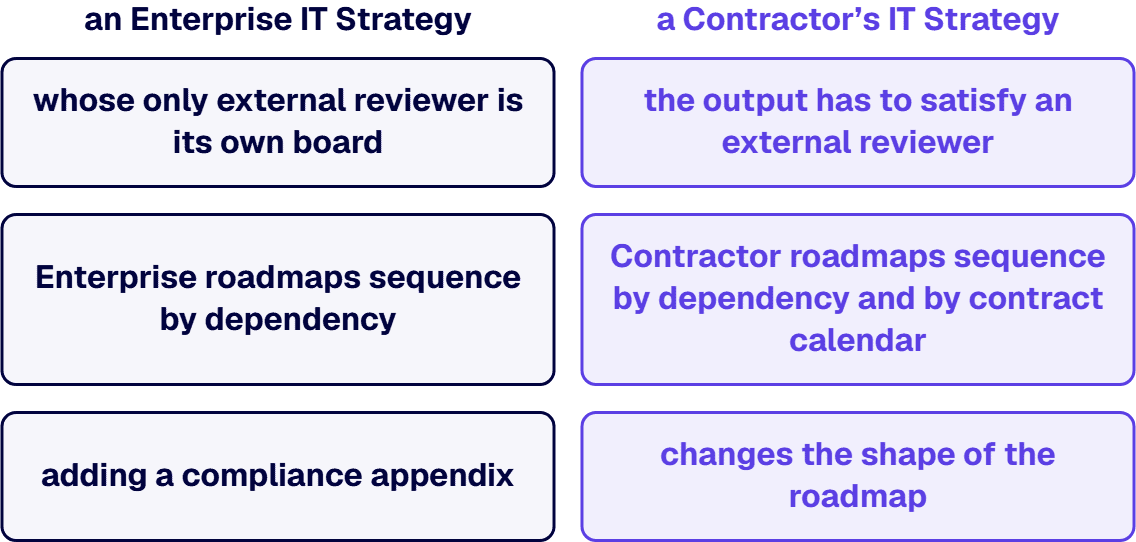
Most IT strategy consulting is written for a commercial enterprise whose only external reviewer is its own board. A government contractor operates under a different constraint set, and it changes the shape of the roadmap rather than just adding a compliance appendix to it.
If your organization is a federal agency rather than a company selling to one, the constraint set is genuinely different and the general-purpose page is the better starting point: strategic IT advisory and consulting services.
The engagement is bounded and priced before it starts. A Microsoft discovery assessment is a fixed-scope, fixed-fee engagement, typically $10K-$25K depending on scope, not an open-ended hourly meter, and the roadmap it produces is yours to execute with or without the firm that wrote it. That last clause is the part worth reading twice. An assessment whose findings only make sense if you also buy the delivery work is a sales document with a deliverable stapled to it.
Larger estates and multi-framework compliance profiles scope above that band. The variables are the number of systems in the inventory, the number of control frameworks anchoring the audit profile, and how many separate contract vehicles the environment has to serve. We price against those three things explicitly rather than against headcount and duration, and the reasoning behind that is set out in our Microsoft consulting billing models.
The sequence below is the one we run. It is published here so you can compare it to whatever another firm proposes, and so you can tell whether a proposal has skipped a phase.
The underlying discipline is the same one described in IT systems analysis, applied to a contractor’s constraint set.
Named artifacts, not a summary presentation:
All of it is yours. There is no dependency on i3solutions delivering the roadmap, and no artifact that is withheld pending a follow-on award.
Honest disqualification is cheaper for both sides than a badly matched engagement.
It fits a U.S. government contractor or regulated enterprise, broadly in the 1,500 to 25,000 employee range, running a Microsoft-centered estate, facing a decision that carries real consequence: a safeguarding requirement arriving through a new contract, a CUI boundary that has never been formally drawn, a modernization that needs a funded and defensible business case, or an accumulation of legacy systems that is now slowing proposals and delivery.
It does not fit in four cases, and we would rather say so on a web page than in month two:
The proof on this page is scoped deliberately, and the distinction between a federal agency and a government contractor is not one we are going to blur, because it is the distinction that matters most to the buyer reading this.
Federal agency, strategy and analysis work. For a federal housing agency we ran an IT systems analysis covering a feasibility study, an infrastructure assessment, evaluation of commercial off-the-shelf contract management systems, and a cost benefit analysis. The IT Systems Analysis provided an alternative solution that saved the agency over $1.5 million in unnecessary development costs by identifying a cost-effective, off-the-shelf contract management system. i3solutions’ project plan streamlined the system upgrade process, reducing implementation time by over 35%, allowing the agency to transition to a modern system more efficiently. That engagement is the closest analogue we have to the methodology described above, and it was delivered to a federal agency, not to a contractor. Details are in the federal housing agency case study and the reasoning is unpacked in IT systems analysis as a strategic foundation.
Government contractor, delivery work. For a global engineering and government services contractor we designed and developed an enterprise proposal management system. The company’s former proposal management process was largely manual, using network drives and folders to support the production of approximately 100 proposals per year. That was a build engagement rather than a strategy engagement, and we are naming it as such: it evidences that we work inside a government contractor’s operating and procurement reality, not that we have delivered that contractor a multi-year IT strategy roadmap. See the government services contractor case study.
Contractor-side context. i3solutions has delivered enterprise SharePoint consulting for defense contractors and a federal research agency. i3solutions’ Virtual Proposal Center (i3VPC) implements a requirements and compliance matrix tracked to Section L and Section M and color team (pink, red, gold) review gates for federal proposals, which is the kind of contract-shaped detail that only comes from working in this market. i3solutions is a Microsoft Partner with 30 years of delivery experience.
What we are not claiming. We have not published a multi-year enterprise IT strategy roadmap delivered to a government contractor. If that specific reference is your gate for a shortlist, we will tell you on the first call rather than in a proposal, and the assessment above is the honest way to test whether the method holds up on your environment before anything larger is committed.
A Risk & Roadmap Assessment turns the constraint set on this page into a dated, phased document your leadership and your customer can both act on. The first call is a scoping conversation, not a pitch: we establish which contracts carry safeguarding obligations, how many tenants and environments are in scope, and whether a CUI boundary has been formally drawn. That is enough to fix the fee and the phase count before anyone signs anything. If you need something in writing for a program manager or a contracting officer before you can put a meeting on the calendar, say so on that call and we will produce it first.
Ask every firm on your shortlist for the same three things before price: the assessment deliverable inventory in writing, the phase where contract clauses get mapped to findings, and a statement of what you own at the end. A firm that cannot name its artifacts is selling hours. A firm whose roadmap only executes with its own delivery team has priced the assessment as an option fee. And a firm that never mentions the clauses on your contracts is going to hand you an enterprise plan with a compliance section bolted to the back.
Where a broader integration or data estate is the real subject, the pillar view is system integration and data management solutions, and where the need is senior capacity inside a structure you already run, that is hire Microsoft integration developers rather than an advisory engagement.
It is a bounded advisory engagement that assesses your current technology estate, maps every finding to the contract clauses and control frameworks that govern it, and produces a phased modernization roadmap with a business case attached to each phase. The distinguishing feature against commercial IT strategy work is that the output has to satisfy an external reviewer, not only your own leadership.
A Microsoft discovery assessment is a fixed-scope, fixed-fee engagement, typically $10K-$25K depending on scope, not an open-ended hourly meter, and the roadmap it produces is yours to execute with or without the firm that wrote it. Larger estates and multi-framework compliance profiles scope above that band, driven by inventory size, the number of control frameworks in the audit profile, and the number of contract vehicles the environment serves.
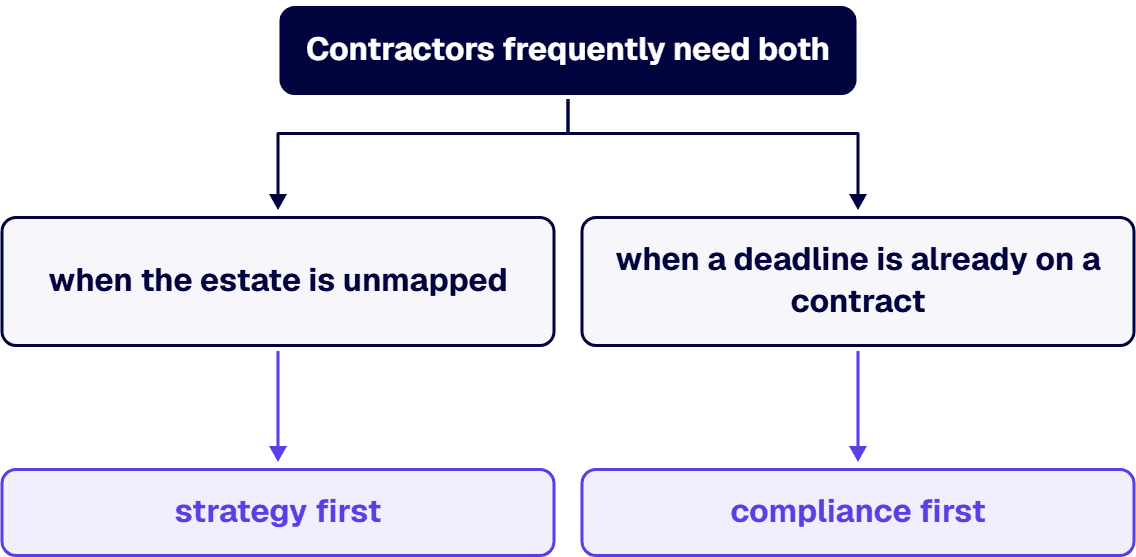
A compliance readiness assessment answers whether you can evidence a specific framework by a specific date. An IT strategy engagement answers what to build, buy, retire and sequence across the whole estate, with compliance as one input among several. Contractors frequently need both, and the usual order is strategy first when the estate is unmapped, compliance first when a deadline is already on a contract.
The people who operate the systems, not only the people who own the budget. On one federal engagement, i3solutions began with a comprehensive Needs Assessment, interviewing 30 individuals across seven departments to gather key requirements for an upgraded procurement system. Contract and program management should also be represented, because the sequencing constraints that reshape a roadmap most often come from the contract calendar rather than from the technology.
Yes. Every artifact, including the current-state assessment, control and clause mapping, risk register, alternatives analysis, roadmap and executive brief, is yours. The roadmap it produces is yours to execute with or without the firm that wrote it. An assessment that only makes sense if you also buy the delivery work is not an assessment.
Not one we have published. Our closest published strategy and analysis engagement was delivered to a federal housing agency, and our published government contractor work is delivery rather than strategy: an enterprise proposal management system for a global engineering and government services contractor. We keep that distinction explicit rather than presenting adjacent work as a match, and the fixed-scope assessment exists so the method can be tested on your environment before anything larger is committed.

US-Based | Est. 1997
© i3solutions. All rights reserved.
US-Based | Est. 1997
© i3solutions. All rights reserved.


