
No workflow automation platform makes you compliant, so the selection is decided by three checkable properties rather than by a vendor’s compliance page. Require a signed business associate agreement that names the workflow service itself, a current SOC 2 Type II report whose scope covers that same service rather than a sibling product, and platform-native controls you can evidence: data residency, connector restriction, immutable run history, and administrative access separation. On those three tests the Microsoft-native options and the enterprise workflow suites clear the bar for regulated estates, general-purpose integration services usually do not, and compliance-automation software is not a workflow platform at all and should not be shortlisted as one.
This question gets answered badly more often than almost any other platform question, and the reason is a category error rather than a lack of research. Asked which workflow platform suits SOC 2 and HIPAA, the market answers with software that manages compliance evidence. That software is real and often useful, but it does not route an approval, move a record between systems, or run a scheduled process. Shortlisting it against a workflow requirement produces a selection that satisfies an auditor’s checklist and automates nothing.
The second failure is subtler and more expensive. Buyers treat SOC 2 and HIPAA as a single hurdle labeled compliance and look for a platform that clears it. The two frameworks are different in kind, they constrain a platform choice along different axes, and a platform can be entirely adequate for one and disqualifying for the other. Reading them separately is what narrows a long list to a short one.
SOC 2 is an attestation about a service organization, and you consume it as evidence. A SOC 2 report is produced by an independent CPA firm under the AICPA attestation standards and evaluates a service organization against the Trust Services Criteria, where security is the common criteria set and availability, confidentiality, processing integrity and privacy are elected. A Type I report addresses the design of controls at a point in time. A Type II report addresses operating effectiveness across a stated period. The definitions live in the AICPA’s Trust Services Criteria and its attestation standards, and those are the documents to read rather than any vendor’s summary of them, including this one.
What that means for a platform selection is narrow and practical. You do not become SOC 2 compliant by choosing a platform. If your own organization is pursuing a SOC 2 report, your workflow platform becomes a subservice organization inside your description of the system, and the report you collect from that vendor is the evidence your auditor will read. So the question is not whether the vendor has SOC 2. It is whether the report covers the specific service you will run workflows on, whether it is Type II rather than Type I, whether the period is current, and whether the complementary user entity controls listed in it are ones you can actually implement.
HIPAA is a regulation about protected health information, and it constrains who may touch it. The Security Rule at 45 CFR Part 164 sets administrative, physical and technical safeguards for electronic protected health information, and the business associate provisions at 45 CFR 160.103 and 164.308(b) require a written agreement with any party that creates, receives, maintains or transmits that information on your behalf. A workflow platform that moves a record containing protected health information is squarely inside that definition. The authoritative text and the current guidance sit on the HHS Office for Civil Rights site, and one point from that guidance matters more than any other for a shortlist: HHS does not recognize any HIPAA certification. A vendor badge asserting HIPAA certified describes a private program, not a government status.
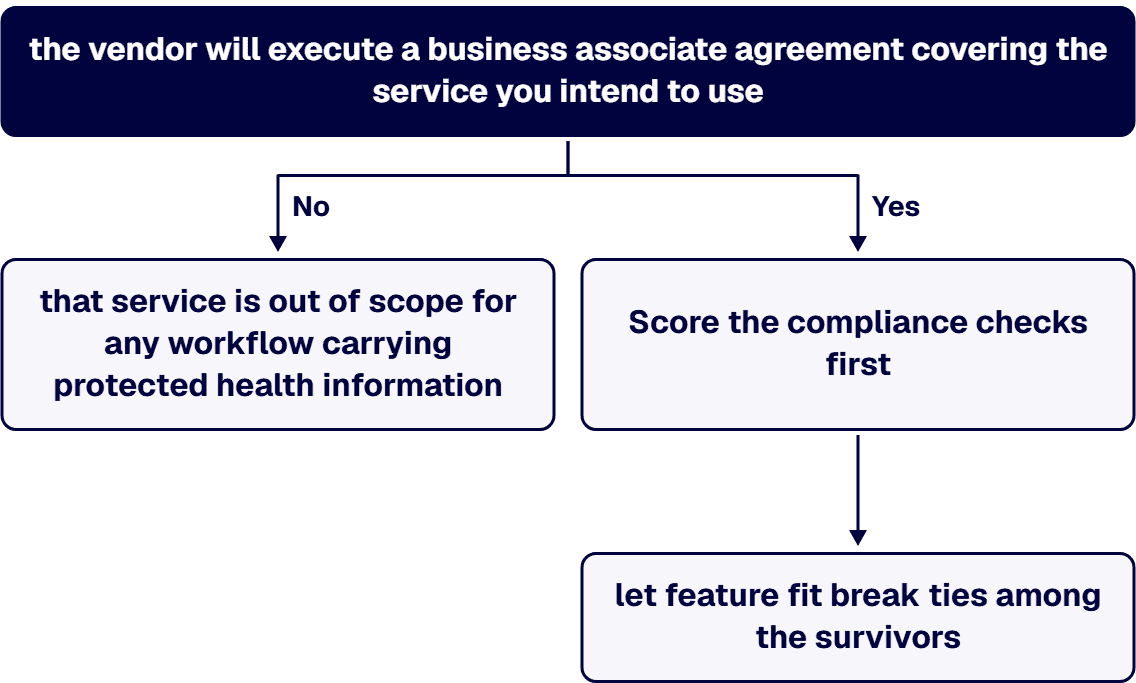
So HIPAA turns into a binary gate before it turns into a technical evaluation. Either the vendor will execute a business associate agreement covering the service you intend to use, or that service is out of scope for any workflow carrying protected health information, regardless of how good the product is.
Once the two frameworks are read separately, the selection collapses to three checks that can be performed before a demo.
Notice what is not on that list. Feature depth, connector count, pricing model and ease of use are real selection criteria and belong in the evaluation, but none of them changes whether the platform can be evidenced. Run the three compliance checks first, because they eliminate candidates that no amount of feature fit will rescue.
Applying those three checks to the categories a regulated enterprise realistically shortlists produces a stable ordering, and the ordering is about evidence rather than about product quality.
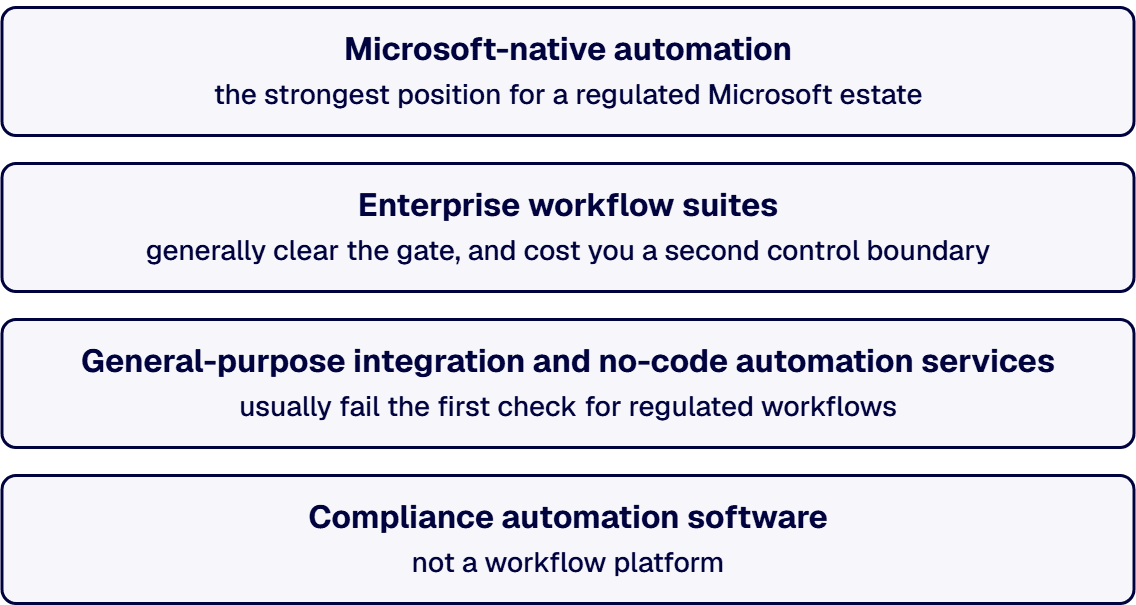
Microsoft-native automation, meaning Power Automate and Azure Logic Apps, is the strongest position for a regulated Microsoft estate. Both run inside a tenant you already govern, both inherit the identity and conditional access design you have already evidenced elsewhere, data location follows the tenant and environment strategy you control, and connector restriction is a first-class policy surface through Power Platform data loss prevention policies. The practical consequence is that most of your control evidence is reusable rather than net new. Verify the current coverage and reports at the Microsoft Trust Center and in the Microsoft licensing terms for your agreement rather than taking that from any partner page.
Enterprise workflow suites sold into regulated verticals generally clear the gate, and cost you a second control boundary. Nintex, FlowForma and AgilePoint are the products most often shortlisted in this class, and they typically execute the agreement and publish a Type II report. What they add is an additional processing environment outside your tenant, with its own identity model, its own retention behavior and its own set of complementary user entity controls to operate. That is a legitimate trade when the product does something your native platform genuinely cannot, and it is a poor trade when it was chosen for convenience, because you have taken on an entire second boundary to evidence for the life of the system.
General-purpose integration and no-code automation services usually fail the first check for regulated workflows. Zapier and Make.com are the usual entrants here, and the category is excellent at what it is for, which is connecting many third-party applications quickly. For protected health information the question is simply whether the specific plan you are buying is covered by an executed agreement, and for a great many of these services on their standard tiers it is not. Where an offering does cover it, the coverage is frequently confined to particular plan levels and particular components, so the answer has to be re-derived for your exact subscription rather than assumed from a marketing page.
Compliance automation software is not a workflow platform and does not belong on this shortlist. It collects evidence, monitors control status and shortens audit preparation. Those are useful jobs. None of them is routing an approval or integrating two systems of record, and a selection process that puts the two categories in the same comparison table has confused the tool that documents the control with the tool that performs the work.
Every platform on that list leaves the same residue, and budgeting for it is the difference between a selection that survives an audit and one that produces a finding twelve months later.
Data classification has to be decided before environment strategy, because the environment boundary is where the classification is enforced. Connector and data loss prevention policy has to be authored against that classification rather than accepted at its default, which permits far more than a regulated estate should allow. Service accounts and connection ownership need named owners and a rotation practice, because an automated workflow running under a departed employee’s connection is both an availability risk and an access control finding. Run history and change history need a retention setting that matches your framework rather than the platform default. And the workflows themselves need a change control path, because an automation that can be edited in production by anyone who can see it will not evidence as a controlled process no matter which platform executes it.
That work is the same in kind across every candidate. What differs is how much of it the platform gives you as configuration and how much becomes custom build, which is precisely what the third check measures.
i3solutions runs comparative platform-selection evaluations for clients, recommending among IAM platforms for hybrid estates and among workflow automation platforms against SOC 2 and HIPAA, rather than only implementing the Microsoft option. That is stated plainly because the incentive runs the other way. i3solutions is a Microsoft Partner. A partner recommending its own stack by default is a conflict a buyer should assume until it is disproved in writing, so treat the sentence above as a claim to test rather than as a reassurance.
The delivery record behind the recommendation is Microsoft-centered, and on this page’s own subject it is direct. i3solutions delivers workflow automation and development inside customers’ SOC 2-audited environments, operating under the customer’s own controls, and knows how to operate in those regulated environments. i3solutions runs migrations against named control families across CMMC, HIPAA, SOC 2, and NIST 800-171, producing artifacts auditors can review. Our teams maintain dedicated compliance specialists who understand CMMC, HIPAA, SOC 2, and financial services regulations within Microsoft environments, providing audit trail documentation and access control frameworks that reduce audit preparation time by 60%. i3solutions designs Azure integration architecture and builds and operates Azure Logic Apps workflows for enterprise clients, including running them on an ongoing basis rather than only building them. In the published record for a state National Guard organization: Thirty-four workflows essential for automating key processes were migrated seamlessly, along with over 336,000 custom list items. The full account is in the InfoPath and SharePoint workflow modernization case study. i3solutions delivers under a partner-led engagement model with named accountability and governance that holds up under a client audit, as distinct from contractor-only staff augmentation.
Sector outcome patterns, stated as ranges rather than as a promise. Financial services outcomes anchor to SOC 2 trust services criteria closure and decision-velocity improvement for client reporting; time-recovered ranges 10 to 18 hours per week per analyst; error reduction 75 to 90 percent. Healthcare outcomes anchor to HIPAA Security Rule provision closure and operational decision velocity; time-recovered ranges 6 to 12 hours per week per affected role; error reduction 65 to 85 percent. On cost, Enterprise workflow automation consulting engagements typically range from $75,000 to $350,000 for Phase 1 assessment and pilot delivery, depending on process complexity, integration surface area, and compliance framework requirements.
Now the boundaries, because a page about attestation should be precise about its own. i3solutions is an implementation partner. It does not perform SOC 2 examinations, does not issue attestation reports, and does not certify any organization or platform against HIPAA, which is consistent with the HHS position that no HIPAA certification is recognized. It does not sign a business associate agreement on a software vendor’s behalf, and it does not substitute for your own counsel or your own auditor in reading one. On i3solutions’ own side of that line there is one thing worth stating and no more than one: i3solutions has executed a Business Associate Agreement for a customer engagement. That is a record of something that has happened, not an offer, and whether such an agreement belongs in your engagement is a contracting conversation rather than a web page. What it does is implement and evidence: environment and classification design, data loss prevention and connector policy, identity and least-privilege service account design, retention and monitoring configuration, and the documentation your assessor will ask for. Ask any implementation partner, this one included, for its own control posture and its own security documentation in writing before you scope, and weigh the precision of the answer more heavily than its length.
This page answers one question: which platform to select when SOC 2 and HIPAA apply together. Three adjacent questions have their own pages, and sending you to the right one is more useful than restating them here.
Shortlist two or three platforms and ask each vendor for the same four artifacts before any demo: the current business associate agreement with its covered services list, the most recent SOC 2 Type II report under non-disclosure with the system description intact, the data residency options for the service in your region, and the connector or integration restriction capability documented rather than demonstrated. Score the three compliance checks first and let feature fit break ties among the survivors, not the other way round.
Then read the complementary user entity controls in each report side by side, because that document tells you what each vendor expects your team to operate, and it is the clearest available preview of what the platform will cost you after the license. Verify every framework claim at its primary source, the AICPA for the Trust Services Criteria and HHS for the Security Rule and business associate provisions, rather than in a vendor deck. When you are ready to test the shortlist against a real estate, i3solutions routes a senior U.S.-based engineer to a client call usually within one to two weeks. You can reach the team by phone at 703.652.8966.
For a Microsoft-centered regulated estate, the Microsoft-native options, Power Automate and Azure Logic Apps, are the strongest position, because they execute inside a tenant whose identity, conditional access and data residency you already govern and evidence, and because connector restriction is a first-class policy surface. Enterprise workflow suites sold into regulated verticals also clear the gate but add a second control boundary outside your tenant to evidence for the life of the system. General-purpose no-code integration services frequently fail the business associate agreement check on their standard tiers. The answer is estate-dependent rather than universal, which is why the three checks matter more than the ranking: a covered business associate agreement naming the service, a current Type II report scoped to that same service, and platform-native controls for residency, connector restriction, tamper-evident run history and administrative access separation.
No. A SOC 2 report is an attestation about a service organization, produced by an independent CPA firm under the AICPA attestation standards against the Trust Services Criteria. Your own report covers your own system, and a platform you use appears inside it as a subservice organization whose report you collect as evidence. Every report also lists complementary user entity controls, which are the controls the service organization expects you to operate for its own controls to be effective. Those are your work, not the vendor’s, and they are the most reliable preview of what a platform will actually cost you to run in scope.
No, and a badge claiming otherwise describes a private program rather than a government status. HHS does not recognize any HIPAA certification. What is real and verifiable is whether the vendor will execute a business associate agreement covering the specific service you intend to use, since the business associate provisions at 45 CFR 160.103 and 164.308(b) require a written agreement with any party that creates, receives, maintains or transmits electronic protected health information on your behalf. Ask for the current covered services list in writing and compare it against your design, because coverage is commonly scoped to particular services and plan tiers rather than to the whole product.
A Type I report addresses whether controls were suitably designed at a point in time. A Type II report addresses whether they operated effectively across a stated period. For a platform that will execute regulated workflows continuously, require Type II and check that the period end date is recent enough for your own audit calendar, because a lapsed period leaves a gap your assessor will ask about. If a vendor offers only a Type I, that is not automatically disqualifying for an early-stage product, but it is a gap you carry and should price rather than one you can inherit.
Yes, and this is where selections usually go wrong. The platform decides how much of the control work is configuration and how much is custom build; it does not remove the work. Data classification has to be settled before environment strategy, data loss prevention and connector policy has to be authored rather than left at its default, service accounts and connection ownership need named owners and rotation, run and change history need retention set to your framework rather than the product default, and the workflows need a change control path so a production automation cannot be edited by anyone who can see it. A platform with strong native controls makes that work configurable and evidenceable. It does not make it optional.
Not for this decision. Compliance automation software collects evidence, monitors control status and shortens audit preparation, which are useful jobs and often worth buying. It does not route an approval, integrate two systems of record or run a scheduled process. Putting it in the same comparison table as a workflow platform confuses the tool that documents a control with the tool that performs the work, and it is the single most common reason a search for this answer returns a list that automates nothing.
No. i3solutions is an implementation partner. It does not perform SOC 2 examinations, does not issue attestation reports, and does not certify any organization or platform against HIPAA. What it does is work inside the boundary rather than around it: i3solutions delivers workflow automation and development inside customers’ SOC 2-audited environments, operating under the customer’s own controls, and knows how to operate in those regulated environments. i3solutions runs comparative platform-selection evaluations for clients, recommending among IAM platforms for hybrid estates and among workflow automation platforms against SOC 2 and HIPAA, rather than only implementing the Microsoft option. It implements the environment, policy, identity, retention and monitoring configuration those frameworks require, and produces artifacts an assessor can review. i3solutions delivers under a partner-led engagement model with named accountability and governance that holds up under a client audit, as distinct from contractor-only staff augmentation.

US-Based | Est. 1997
© i3solutions. All rights reserved.
US-Based | Est. 1997
© i3solutions. All rights reserved.


