

Yes, fixed price and Agile hold together in a regulated program when six things are settled in writing: the boundary, the definition of done, change control, evidence, who absorbs uncertainty, and the gates. A fixed price fixes a price, not the implementation sequence, which is the only thing Agile varies.
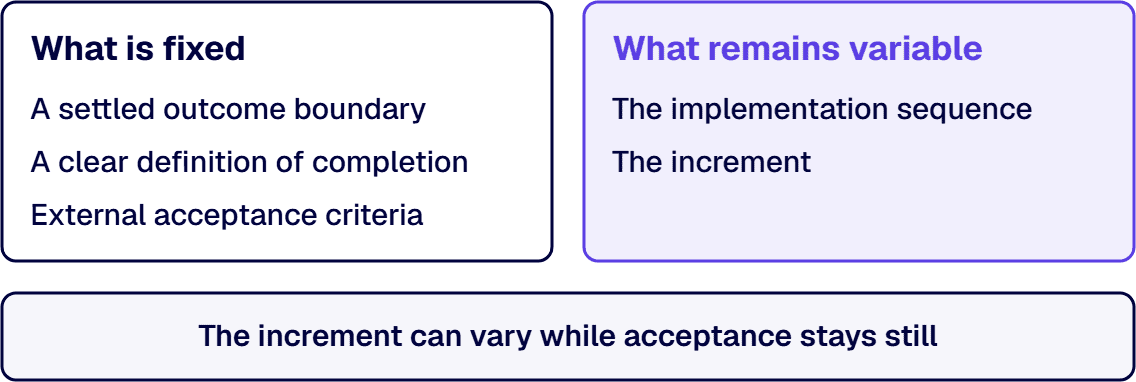
The common objection claims a fixed price means scope is fixed while Agile means scope changes, and the two cannot coexist. The argument conflates two different things. A fixed price establishes a firm price, not a fixed specification. The critical distinction is that a firm price requires a settled outcome boundary and a clear definition of completion, neither of which constrains the implementation sequence. The implementation sequence is the only thing an Agile delivery method actually varies, so the two are compatible when the right separation exists between what is fixed and what remains variable.
In regulated settings this distinction becomes even more workable. Regulated programs already possess external acceptance criteria independent of project requirements: control sets, acceptance protocols, evidence expectations. Because the referent does not move with the work, the increment can vary while acceptance stays still. That is the stable acceptance foundation a fixed price requires.
| Condition | What it settles | The test you apply |
|---|---|---|
| The Boundary | Which systems, interfaces, data, and regulatory regime are inside the work versus outside | Ask to see written exclusions. An unmarked boundary suggests the price carries unstated assumptions. |
| The Definition of Done | What acceptance measures against, and whether that standard moves with requirement changes | Ask which document defines done. If it is the requirements list, acceptance criteria shift whenever requirements do. |
| Change Control | What happens when scope genuinely changes, and whether the change process is efficient enough to use | Ask for the change artifact itself: what records it, who approves it, and what occurs between submission and implementation. |
| Evidence | Whether audit trails are created alongside the work or assembled afterward | Ask whether delivered capabilities include their evidence, or whether documentation is a separate end-phase activity. |
| Who Absorbs Uncertainty | Which of four variables shifts when assumptions prove incorrect: boundary, standard, sequence, or exit | Ask what happens when assumptions fail and observe which element the answer names. An unnamed allocation transfers uncertainty to you. |
| The Gates | Whether the commitment is one continuous price or a sequence of stoppable, bounded commitments | Ask where the arrangement can terminate without breaking. An arrangement with no stopping point has no real exit. |
Unregulated programs typically define done through requirements lists that prove incorrect once the environment becomes visible, creating ongoing disputes over every change. Regulated programs bypass this through established, external acceptance criteria. That independence means the increment can vary while acceptance stays still, which is the exact separation a fixed price requires.
Regulated settings introduce genuine complexity of their own: access provisioning and environment setup typically operate on the buyer’s timeline rather than the supplier’s, and sit upstream of priced work. Those dependencies must be documented explicitly in the boundary rather than left as unstated contingencies.
i3solutions’ model embeds senior specialists who work inside your governance and stay accountable for what the work does in production, not just the hours billed against it.
Change control failures in fixed-price Agile arrangements stem not from scope changing (which is expected) but from scope changes going unrecorded. When escalating a change requires extensive routing through compliance and governance, the rational move for everyone involved is to absorb the change quietly inside the current work and hope. The arrangement drifts from what was priced, and discovery happens at the worst possible moment: acceptance.
The solution is examining the buyer’s own change process before engagement starts. Where processes are heavy, the response is making increments smaller and explicitly defining which decisions delivery can make without formal change control.
Every fixed price contains uncertainty somewhere. Four variables absorb it. The boundary: narrower scope carries less risk. The acceptance standard: clearer definition reduces disputes. The sequence: reordering accommodates surprises. Or a defined exit point: either party can stop at gates.
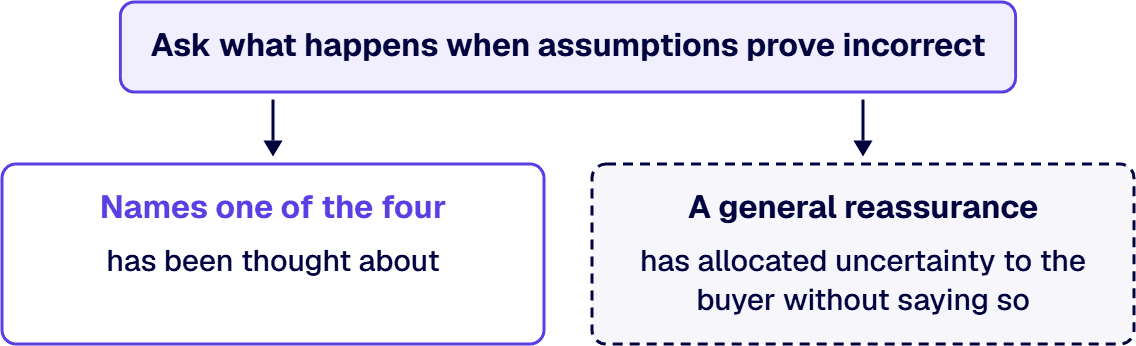
The diagnostic is straightforward. Ask what happens when assumptions prove incorrect and identify which variable is named. An arrangement that names one of the four has been thought about. An arrangement that answers with a general reassurance has allocated uncertainty to the buyer without saying so.
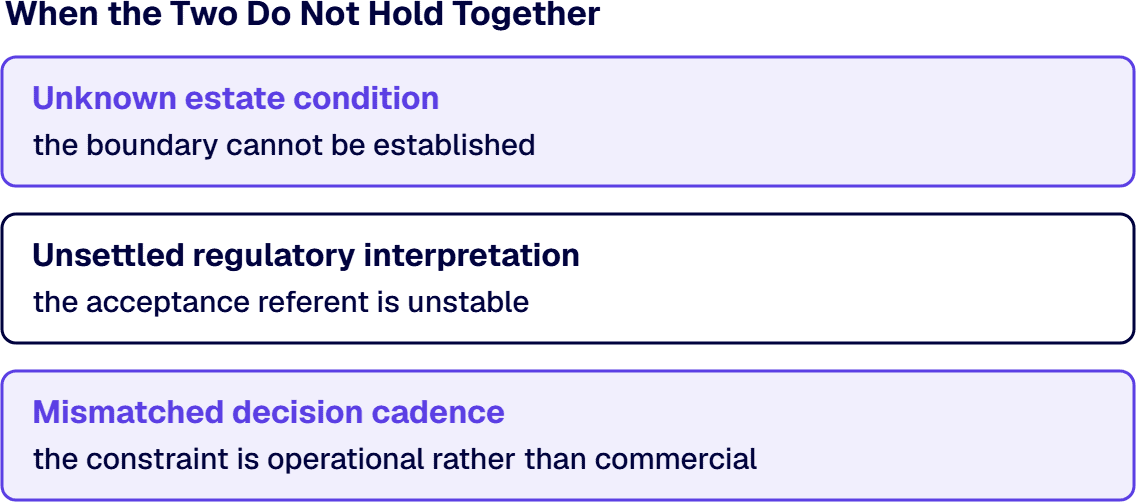
Three situations prevent combining fixed price with Agile.
Unknown estate condition. When the environment remains unassessed, the boundary cannot be established, and firm pricing is impossible. Only the assessment that establishes the boundary can carry a firm price.
Unsettled regulatory interpretation. If regulatory requirements are being written or reinterpreted, the acceptance referent is unstable, and fixed downstream commitments cannot follow.
Mismatched decision cadence. When buyers cannot supply decisions and access at the pace increments require, the constraint is operational rather than commercial. Repricing cannot fix an organizational incapacity.
The boundary and the gates often conflict. Narrow boundaries firm up pricing; small, stoppable commitments provide real exits. Combining both can leave increments delivering nothing sponsors can use. Where two of the six conflict, the one that preserves the buyer’s ability to stop wins. Everything else can be renegotiated; an arrangement with no exit point cannot.
i3solutions delivers under a partner-led engagement model with documented governance, senior US-based delivery, and formal accountability. The engagement includes application lifecycle management, environment separation strategies, and change control processes matching the mechanisms the third and fourth conditions require. The framework means all six questions have documented answers rather than conversational descriptions. Pose the same six questions to competing vendors: an arrangement that cannot answer them is not made safer by being priced differently.
Yes, when six elements are documented: boundary, definition of done, change control, evidence, uncertainty absorption, and gates. A firm price constrains the price itself, not the implementation sequence, and the implementation sequence is the only thing an Agile delivery method actually varies.
The outcome boundary and the definition of done. Those establish what is included and excluded and what completion means, without constraining how the work sequences. A boundary settled in writing and a definition of done that does not move with requirement changes are the two things a firm price requires.
Regulated programs possess independent, external acceptance criteria that do not move with requirements changes, enabling variable increments against a stable completion standard. Because the referent does not move with the work, the increment can vary while acceptance stays still.
One efficient enough that people actually use it. The artifact capturing changes, the approval chain, and the implementation requirements must be lightweight enough that scope changes are recorded rather than absorbed silently. Where the buyer's own change process is heavy, the response is making increments smaller and defining which decisions delivery can make without formal change control.
Ask what shifts when assumptions fail. Naming a specific variable (boundary, standard, sequence, exit) indicates deliberate allocation. General reassurance indicates unallocated uncertainty defaulting to the buyer.
Three cases: unknown estate conditions preventing boundary definition; unsettled regulatory interpretation destabilizing acceptance criteria; or buyer inability to provide decisions at the cadence increments require. Each needs structural changes rather than commercial renegotiation.
Applications that pass functional tests and fail compliance review were staffed below their complexity. i3solutions' senior delivery leaders work with enterprise IT leaders who want the depth decision made before the contract, not after the audit.
Talk to a Senior Staffing Advisor
US-Based | Est. 1997
© i3solutions. All rights reserved.
US-Based | Est. 1997
© i3solutions. All rights reserved.


