
Michael Branson
If your engineering organization picked its code host years before any of its code was CUI, the question arrives with a contract, a data classification memo or an export review, and one failure that can surface late is a repository moved inside the boundary while its builds still run on hosted agents outside it, because Microsoft Learn says Azure Pipelines “runs its pipelines outside of Azure Government.” The code host is then a boundary decision, and it is a different decision from the Microsoft 365 tenant. This page sets out what Microsoft and GitHub say about each of the four offerings, where each keeps your code, and what the build pipeline adds, so the choice can be made before repositories and pipelines are rebuilt on the wrong one. Every Microsoft and GitHub page this guide cites was read on October 19, 2026.
When a program office asks where the code is, the answer depends on which of four offerings holds it, and two of them are services you do not run:
If your engineering teams already run on Azure DevOps Services, your code sits wherever that organization was placed when it was created, and that location is the first fact to establish when a contract brings CUI into the repositories. Microsoft’s Data locations for Azure DevOps page lists the locations, including “United States (US)”, and says “By default, your organization uses the closest location. However, you can choose a different location when you create your organization.” It says “Azure DevOps keeps all customer data within your selected geographical location, with limited exceptions.” and “Customer data includes source code, work items, test results, geo-redundant mirrors, and offsite backups.” Microsoft’s Deploy an app in Azure Government with Azure Pipelines page says “Azure DevOps isn’t available on Azure Government.” No newer Microsoft statement of Azure DevOps availability in Azure Government was found when this guide was written.
For the self-hosted Microsoft product, Microsoft’s What is Azure DevOps? page says “Azure DevOps Server is available for organizations that need to keep their data on-premises or require specific customizations not available in the cloud service. It includes the same core services as Azure DevOps Services but requires your own infrastructure and maintenance.” The Azure Pipelines page says “You can set up Azure DevOps Server in Azure Government.” Microsoft’s Azure DevOps Server Release Notes list “Azure DevOps Server Release Date: December 9, 2025” and “Azure DevOps Server Patch 8 Release Date: September 10, 2026”, which is the patch cadence a self-hosted server carries.
GitHub Enterprise Cloud keeps code on GitHub’s service. GitHub’s About GitHub Enterprise Cloud with data residency page says “By default, GitHub stores data for GitHub.com in the USA.” and “When you adopt GitHub Enterprise Cloud with data residency, you can choose where your company’s code and data are stored.” It adds “Your enterprise will be hosted on a dedicated subdomain of GHE.com.” and names the EU, Australia, the US and Japan as regions. GitHub’s About storage of your data with data residency page carries the caveat: “Although your code and user data are stored within your chosen region, GitHub may store certain types of data outside your region, and may need to transfer some data outside your region.”
On the self-hosted side, GitHub’s About GitHub Enterprise Server page says “GitHub Enterprise Server is a self-hosted version of the GitHub platform.” and its Installing GitHub Enterprise Server on Azure page says “You can deploy GitHub Enterprise Server on global Azure or Azure Government.”
Readers comparing boards, repositories and pipelines as features, rather than as a boundary, will find that comparison on the Jira and Azure DevOps project management page.
When a company moves mail and files to GCC High, it can assume its code followed, and find at assessment that the repositories never moved. The tenant and the code host are separate decisions. The Azure Pipelines page says “Azure DevOps isn’t available on Azure Government.” What Azure Government itself adds is contractual: Microsoft’s International Traffic in Arms Regulations (ITAR) page says “Azure Government provides an extra layer of protection to customers through contractual commitments regarding storage of customer data in the United States and limiting potential access to systems processing customer data to screened US persons.” Those commitments reach code only when the code host runs in Azure Government.
The planning rule i3solutions recommends: record the code host as its own entry in the system security plan’s boundary description, with its own location, its own administrators and its own access logs, next to the Microsoft 365 tenant rather than inside it. Which Microsoft 365 environment the rule itself calls for is covered on the CMMC and GCC High page, and the tenant options are laid side by side on the Microsoft 365 for CUI evaluation matrix page.
A gap teams can find late is a repository moved inside the boundary while builds still run on hosted agents outside it. The Azure Pipelines page says “be aware that Azure Pipelines runs its pipelines outside of Azure Government.” It answers the agent question directly: “Configuring a private agent would limit data sharing outside of Azure Government.” It also says “Research your organization’s security and service policies before using it as part of your deployment tools.”
Some data sits apart from the code. The Data locations page says “Azure DevOps stores token data, such as personal access tokens and Secure Shell (SSH) keys, in a US datacenter.” and “For builds and releases that run on Microsoft-provided macOS agents, Azure DevOps transfers your data to a GitHub datacenter in the United States.”
The planning rules i3solutions recommends: run self-hosted build agents inside the same boundary as the code; inventory every hosted agent, token store, artifact feed and build log location before calling the boundary closed; and keep that inventory with the system’s other boundary evidence. The contract terms that govern the pipeline itself are a separate question from where it runs.
When the contract carries the DFARS safeguarding clause, the question for a cloud code host is what the clause asks of a cloud provider. Microsoft’s Defense Federal Acquisition Regulation Supplement (DFARS) page says “Where a DoD contractor uses an external cloud service provider to process, store, or transmit covered defense information, such provider must meet security requirements that are equivalent to the FedRAMP Moderate baseline.” and “Azure services in scope for DFARS reflect the Azure FedRAMP High P-ATO scope.”
Microsoft’s Azure, Dynamics 365, Microsoft 365, and Power Platform services compliance scope page says “This article provides a detailed list of Azure, Dynamics 365, Microsoft 365, and Power Platform cloud services in scope for FedRAMP High, DoD IL2, DoD IL4, DoD IL5, and DoD IL6 authorizations across Azure, Azure Government, and Azure Government Secret cloud environments.” Azure DevOps does not appear on that page as read on October 19, 2026. Microsoft’s Data protection overview page for Azure DevOps says “Azure DevOps achieved the following certifications:” and lists ISO 27001:2022, ISO 27018:2019, ISO 26262:2023, a HIPAA Business Associate Agreement, EU Model Clauses, SOC 1 Type 2, SOC 2 Type 2, Germany C5, Australia IRAP and ENS-Spain. FedRAMP is not on that list. Neither page is a statement about any authorization outside it, so check the FedRAMP marketplace record for the offering you are considering before relying on it.
GitHub’s authorization status for GitHub Enterprise Cloud is also a question for the FedRAMP marketplace record on the day you decide.
Export control has no certificate to point to. The ITAR page says “There is no ITAR compliance certification.” and “You’re wholly responsible for ensuring your own compliance with all applicable laws and regulations and should consult your legal advisor for questions regarding regulatory compliance.” Microsoft’s Azure support for export controls page says “You’re responsible for choosing Azure or Azure Government regions for deploying your applications and data.”
This page does not say whether your code is CUI or export-controlled, or which regime applies to your organization. The contracting officer and your export compliance officer determine that, and the choice of code host starts from what they confirm.
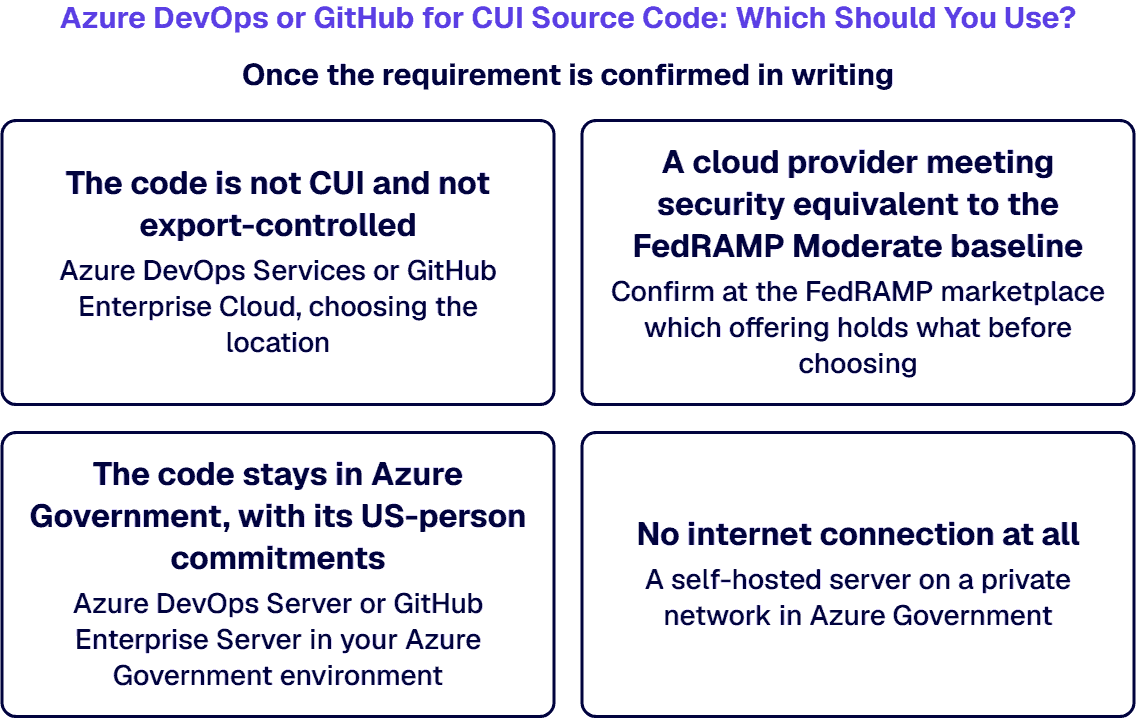
Once the requirement is confirmed in writing, the choice narrows quickly. Use the row that matches what the requirement names:
For the last row, Microsoft’s Azure Government blog post Azure DevOps Server in Azure Government, posted December 18th, 2019, says “Azure DevOps Server can be used to create a DevOps experience inside a completely private network on Azure Government with no outside connection to the internet.”
Every self-hosted row carries the cost Microsoft names for Azure DevOps Server, which “requires your own infrastructure and maintenance”, and the patch cadence the release notes show. Standing up the Azure Government environment the self-hosted options run in is its own piece of work, covered on the Azure Government migration page.
When a self-hosted server in Azure Government is the first answer reached for, check it against these cases, because it is not always the right one:
Whether the work is done by your own team or an outside firm, ask for these, in writing:
Vetting a firm for FedRAMP High and IL4 work in Azure is covered on the Azure FedRAMP High and IL4 firm page.
If the platform move needs outside support, the work is a project: the platform choice, installing and configuring the self-hosted option in your government environment, moving repositories and pipelines, and building the ALM practice around them, with specialists embedded in your team where the program needs them.
i3solutions is a Microsoft-focused application development and integration firm. i3solutions has successfully delivered software development projects under CMMC, HIPAA, ITAR, and SOC 2 compliance frameworks with audit-ready documentation and governance practices built into our standard delivery methodology. i3solutions delivery includes ALM practices with Power Platform pipelines or Azure DevOps integration, environment separation strategies, and change control processes.
For government environments, i3solutions installs and helps configure applications inside IL4 and IL6 government cloud environments and other government networks. That is installation and configuration work, and i3solutions holds no FedRAMP or DoD authorization of its own. i3solutions advises clients on federal compliance posture as its own assessment rather than as a restatement of Microsoft’s documentation, including whether SharePoint Online meets NIST 800-53, whether Azure Government is required under the DoD Cloud Computing SRG, and whether a CMMC gap assessment is needed to bid. That advice is an assessment, not a certification.
Staffing is stated plainly. i3solutions provides dedicated US-based Microsoft teams for aerospace and defense programs. Delivery is senior and US-based. This work sits within governance and compliance solutions.
The cloud service is not. Microsoft Learn says “Azure DevOps isn’t available on Azure Government.” Microsoft Learn also says “You can set up Azure DevOps Server in Azure Government.”
Yes. GitHub’s documentation says “You can deploy GitHub Enterprise Server on global Azure or Azure Government.”
Azure DevOps Services stores it in the geography selected for your organization. Microsoft Learn says “By default, your organization uses the closest location. However, you can choose a different location when you create your organization.” It also says “Azure DevOps keeps all customer data within your selected geographical location, with limited exceptions.” and “Customer data includes source code, work items, test results, geo-redundant mirrors, and offsite backups.”
Hosted pipelines run outside it. Microsoft Learn says “be aware that Azure Pipelines runs its pipelines outside of Azure Government.” and “Configuring a private agent would limit data sharing outside of Azure Government.” It also says “For builds and releases that run on Microsoft-provided macOS agents, Azure DevOps transfers your data to a GitHub datacenter in the United States.”
Plan the code host as its own decision. Microsoft Learn says “Azure DevOps isn’t available on Azure Government.” Where an Azure DevOps organization keeps its code is the location selected for that organization, so the repositories stay where their code host puts them.

US-Based Microsoft System Integrator | Est. 1997
© i3solutions. All rights reserved.
US-Based Microsoft System Integrator | Est. 1997
© i3solutions. All rights reserved.


