
Michael Branson
Your finance operation runs on Oracle E-Business Suite, or an Oracle Fusion Cloud ERP proposal is on the table, while identity and collaboration have moved to Microsoft, sometimes into GCC High. A Microsoft partner is presenting Dynamics 365, and Oracle is offering its own route, which its E-Business Suite page labels “Move from Oracle E-Business Suite to Oracle Fusion Cloud ERP”. Oracle’s March 18, 2026 announcement extends “Premier Support for Oracle E-Business Suite 12.2 through at least 2037”, so for a 12.2 customer the decision has to stand on the regulated workload and the estate around it, not on a support date.
A steering committee asked to fund an ERP change wants the conditions that decide it, not a feature list. Dynamics 365 Finance and Supply Chain Management is the stronger answer when both of these conditions hold for your organization:
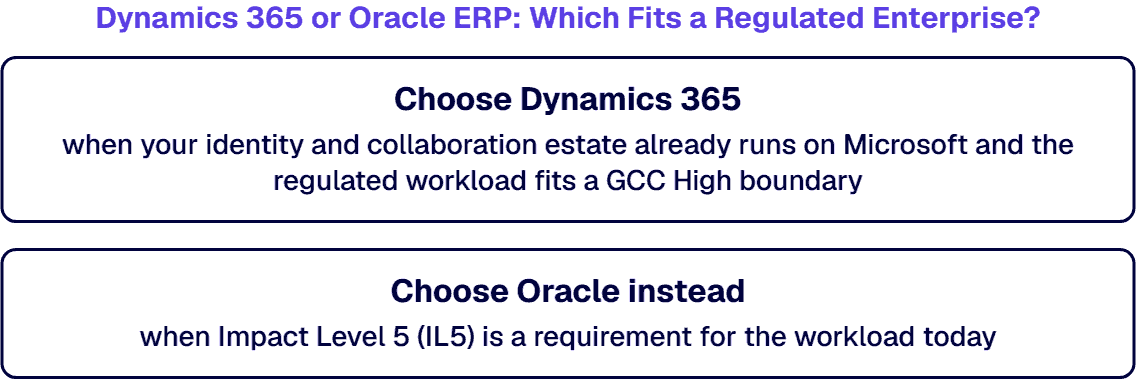
When these conditions pull in different directions, the authorization requirement settles it. A workload that needs Impact Level 5 (IL5) authorization today points to Oracle regardless of how much of the estate runs on Microsoft, because Microsoft’s own availability list reads “Pending IL5 Approval” against Dynamics 365 Finance in the DoD environment. Where IL5 is not required, the estate condition carries the most weight, because it decides how many vendor perimeters your auditors review.
An E-Business Suite team hearing Oracle’s own Fusion proposal is comparing two different things at once, and the answer changes with which one is on the table.
Oracle describes its cloud product this way: “Oracle Fusion Cloud ERP is a complete, modern, cloud ERP suite” with, in the same sentence, “automatic updates to stay current”. Of E-Business Suite, Oracle writes that “Thousands of organizations around the world rely on Oracle E-Business Suite to run their key business operations.”
Against Fusion Cloud ERP, you are comparing two cloud suites whose vendors manage the update cycle, Oracle through automatic updates and Microsoft through continuous updates. Against E-Business Suite 12.2, you are comparing a move with staying on a release Oracle continues to support, and the question becomes whether the move is worth making at all. If you are weighing more than two vendors, the three-way comparison is the Dynamics 365 vs Salesforce vs SAP comparison.
If your case for moving rests on E-Business Suite running out of support, read Oracle’s own dates before you take it to a steering committee.
Oracle’s announcement dated March 18, 2026 extends Premier Support for Oracle E-Business Suite 12.2 to a new support date, and Oracle’s Applications Unlimited page states the same horizon for the wider product family.
That date is a floor in Oracle’s words, “through at least 2037”, not an end date. For a 12.2 customer, the case for leaving has to be made on the regulated workload, the government cloud each vendor offers, and the estate around the ERP.
A defense supplier’s auditor will ask which authorization applies to the ERP, and the two vendors answer that question at different levels. Oracle states authorizations for its government cloud regions. Microsoft states them per product. Read the table with that difference in mind.
The Oracle pages read for this comparison do not name Oracle Fusion Cloud ERP together with a specific Impact Level, so this comparison makes no per-product authorization claim for Oracle. Ask Oracle which services each government region covers before you rely on a region’s authorization for the ERP. Whether a given contract’s data belongs in any of these environments is a determination for your contracting officer and the contract clause, not for either vendor’s web page. For the full mapping of Microsoft’s commercial and government environments to regulatory obligations, see the Dynamics 365 ERP for regulated enterprises guide.
A budget owner asked for a list price on both sides will find one published number and one sales conversation.
Microsoft’s Finance pricing page lists Dynamics 365 Finance at “$210.00 user/month, paid yearly” and Dynamics 365 Finance Premium at “$300.00 user/month, paid yearly”, as read in September 2026. Oracle’s ERP page routes buyers to “Request a demo” and “Contact Sales”, so the Oracle side of a like-for-like comparison starts with a quote from Oracle’s sales team.
A list price per user is the smallest part of the number your committee will see. What that price becomes across your user mix is worked through on the Dynamics 365 licensing cost page, what implementation adds is on the Dynamics 365 Finance and Supply Chain implementation cost page, and the GCC High version of that question is on the Dynamics 365 implementation cost for defense contractors page.
Your release calendar has to absorb whichever update rhythm the vendor sets, so read both vendors’ statements side by side.
Microsoft’s update policy for finance and operations apps states: “Customers who purchase subscriptions of finance and operations apps experience continuous updates that Microsoft manages. Customers can postpone one consecutive service update.” Oracle describes Fusion Cloud ERP as carrying “automatic updates to stay current”, and its Oracle Cloud Applications documentation states: “We use quarterly updates to deliver new features and functionality for your Oracle Cloud Applications.”
Both cloud suites put the update cycle in the vendor’s hands, and each gives your release process a rhythm to plan around. Neither statement makes one platform easier to govern than the other.
Some enterprises reading a Microsoft partner’s comparison should stay on Oracle, and any one of these cases is enough on its own:
A re-platforming justified only by estate alignment has to survive your auditors’ first review. If it cannot, stay.
A group finance function on Oracle with subsidiaries on other systems faces this question before any replacement question.
Two patterns fit. In a two-tier design, Oracle stays the group ledger and Dynamics 365 runs in the subsidiaries, with results consolidated at group level. In an edge design, Dynamics 365 runs the customer-facing layer and Oracle stays the ERP behind it. Either way the integration carries the design, and the mechanisms matter: i3solutions builds Dynamics 365 integrations using named Microsoft mechanisms including Dataverse, dual write, virtual tables, Azure Logic Apps, Azure Service Bus, and Power Automate connectors.
For the two-tier question with SAP at group instead of Oracle, see the Dynamics 365 vs SAP comparison. If the customer-facing layer is the open question, that decision is the Dynamics 365 vs Salesforce comparison.
A partner presenting Dynamics 365 to an Oracle customer has an interest in the answer, so this is what ours rests on. The claims in this list are the ones we can document, quoted at the size we can document them:
The decision work starts from your estate: which systems hold the regulated data, which environment your contracts name, and what the Oracle side runs today. The answer can be to stay on Oracle, to run the two side by side, or to move; the last two both turn on the integration design. Our wider Dynamics 365 practice is on the Dynamics 365 development services page, and capacity for a program already underway is on the hire Dynamics 365 developers page.
Choose Dynamics 365 when your identity and collaboration estate already runs on Microsoft and the regulated workload fits a GCC High boundary. With the estate on Microsoft, finance data can stay in step with Dataverse through dual-write, which Microsoft describes as “tightly coupled, bidirectional integration between finance and operations apps and Dataverse”. Choose Oracle instead when Impact Level 5 (IL5) is a requirement for the workload today, because Dynamics 365 Finance carries the status “Pending IL5 Approval” on Microsoft’s DoD environment availability list.
In GCC High, yes. Microsoft’s deployment FAQ states that “Dynamics 365 Finance and Dynamics 365 Supply Chain Management are supported in both US Government Community Cloud (GCC) and GCC-High environments”. At IL5, the Dynamics 365 US Government article on Microsoft Learn (dated December 9, 2025) lists “Dynamics 365 Finance – Pending IL5 Approval” for the DoD environment. Whether a specific contract’s data belongs in either environment is a determination for the contracting officer and the contract clause.
For release 12.2, an Oracle announcement dated March 18, 2026 extends Premier Support “through at least 2037”. That is a floor in Oracle’s own words, not an end date, so a support date does not force an E-Business Suite 12.2 customer off the platform; a move has to be justified by the estate and the regulated workload instead.
Oracle is the better choice when the ERP sits inside a wider Oracle standard your teams already run, when the workload has to run at Impact Level 5 now, or when a stable E-Business Suite 12.2 meets your compliance obligations. Oracle states that its US Defense Cloud is “fully authorized for DISA Impact Levels (IL) 2, 4, and 5”, while Microsoft’s availability list gives Dynamics 365 Finance the status “Pending IL5 Approval”. Oracle’s statement covers its defense cloud rather than a named ERP product, so confirm with Oracle which services the region includes.
Yes. Two patterns fit: a two-tier design, where Oracle keeps the group ledger while subsidiaries run Dynamics 365, or an edge design, where Dynamics 365 serves the customer-facing layer and Oracle remains the ERP behind it. The integration decides whether either pattern works, and Microsoft documents dual-write as a mechanism for keeping finance and operations data and Dataverse in step in both directions.

US-Based Microsoft System Integrator | Est. 1997
© i3solutions. All rights reserved.
US-Based Microsoft System Integrator | Est. 1997
© i3solutions. All rights reserved.


