
By Michael Branson
Microsoft’s documentation now places Subject Rights Requests work in Microsoft Purview eDiscovery: the Microsoft Priva service description lists Privacy Risk Management only, and the old Subject Rights Requests pages on Microsoft Learn now redirect to Purview eDiscovery and to Office 365 Data Subject Requests for the GDPR and CCPA, which tells administrators to use Microsoft Purview eDiscovery to search for a person’s data across Microsoft 365 and then export or delete it. Before rebuilding the runbook, scope the request: under California Civil Code section 1798.145, the California Consumer Privacy Act does not apply to personal information collected, processed, sold or disclosed subject to the Gramm-Leach-Bliley Act, or to protected health information collected by a HIPAA covered entity or business associate, but its employee-data exemption expired on December 31, 2022, according to the California Privacy Protection Agency’s Frequently Asked Questions, so the employee, applicant and marketing data of a bank or a health system can still sit inside a request. Under California Civil Code section 1798.130, the response is due within 45 days of receiving a verifiable consumer request, extendable once by another 45 days with notice given inside the first period, and which of the enterprise’s data a given request reaches is a determination for counsel.
A request reaches the IT Director in one of two ways: a privacy officer forwards a California consumer’s request, or the annual plan review reaches the line that names Priva Subject Rights Requests as the tool, and the Priva portal no longer offers what the plan assumed. Behind it sits a second assumption, that the enterprise’s standing under the Gramm-Leach-Bliley Act or HIPAA puts it outside the state law altogether, and that one is only partly true. This guide sets out what Microsoft’s documentation now says about Priva, how California’s statute draws its financial, health and employee-data lines, with Virginia as the one contrast in structure, how the Microsoft 365 share of a request is answered with eDiscovery, and where Privacy Risk Management fits. Whether a law applies to the enterprise, and how a given request must be answered, is for its privacy officer and counsel to determine, as Microsoft’s own Data Subject Requests and the GDPR and CCPA page puts it: “Consult with your own legal or compliance advisers regarding the proper disposition of any given DSR.”
If your plan names Priva Subject Rights Requests as the request tool, it now points at something Microsoft’s documentation no longer describes. The Microsoft Priva service description (last updated May 11, 2026) lists Privacy Risk Management as the Priva offering and carries no subject rights feature, and the Priva table of contents on Microsoft Learn documents the portal, its settings and the privacy risk management pages only.
Microsoft’s own addresses tell the same story. When this guide was checked on September 24, 2026, the old Subject Rights Requests overview on Microsoft Learn redirected to Learn about eDiscovery, and the old pages on creating a request, the request workflow and data review redirected to Microsoft’s Office 365 Data Subject Requests for the GDPR and CCPA guide, at its section on using search in eDiscovery to respond to requests. The Microsoft pages read for this guide give no date for the change, and this guide states none.
What remains is narrower. According to Learn about Microsoft Priva (last updated May 11, 2026), “Priva Privacy Risk Management, located in the Microsoft Priva portal, provides visibility into your organization’s data.” and “Priva evaluates data that is only within your organization’s Microsoft 365 environment.” The service description adds that “Priva Risk Management must be added on.” and lists the Office 365 and Microsoft 365 subscriptions it can be added to.
The planning consequence is simple to state: a runbook written around Priva Subject Rights Requests needs a new owner and a new tool named before the next request arrives, not after it.
The costly scoping error runs in both directions: treating the whole enterprise as exempt because it is a bank or a HIPAA covered entity, and missing an employee’s request, or building for every data set when the statute has already carved much of it out. California’s carve-outs are written around data and how it is handled, so scope by data set rather than by the enterprise’s regulator, and have counsel confirm the result. Each passage in this section is quoted from California Civil Code section 1798.145, in the text in force on January 1, 2026.
Financial data: the Gramm-Leach-Bliley Act carve-out follows the data. When a bank, insurer or broker-dealer assumes its Gramm-Leach-Bliley Act status settles the question, subdivision (e) of section 1798.145 is the text to read: “This title shall not apply to personal information collected, processed, sold, or disclosed subject to the federal Gramm-Leach-Bliley Act (Public Law 106-102), and implementing regulations”, and the same subdivision closes: “This subdivision shall not apply to Section 1798.150.” By its words the carve-out reaches personal information handled subject to that Act, not every record the institution holds. Website and marketing data, job applicants, employees and business contacts are not named by it.
Health data: the HIPAA carve-out is limited to patient information. Subdivision (c)(1) of section 1798.145 excludes medical information governed by California’s Confidentiality of Medical Information Act and “protected health information that is collected by a covered entity or business associate governed by the privacy, security, and breach notification rules” issued under HIPAA. It reaches a provider of health care or a covered entity itself only “to the extent the provider or covered entity maintains patient information in the same manner as” medical information or protected health information. A health system’s employee records, applicant files and marketing lists are not described by those words.
Employees and business contacts: the exemptions lapsed. This is where the question grows rather than shrinks. The California Privacy Protection Agency’s Frequently Asked Questions (FAQs) says: “The exemptions for employment-related personal information and personal information reflecting business-to-business transactions … expired on December 31, 2022.” Answering who has privacy rights under the CCPA, it says of California residents: “It includes California residents that are employees or job applicants, and contacts for business customers, vendors, or independent contractors.” For an enterprise on Microsoft 365, that data lives in Exchange, OneDrive, SharePoint and Teams.
Virginia draws the line at the entity. Virginia’s Consumer Data Protection Act is built the other way, which is why the patchwork cannot be scoped from one state’s reading. Its § 59.1-576 Scope; exemptions says the chapter shall not apply to any “financial institution or data subject to Title V of the federal Gramm-Leach-Bliley Act” and any “covered entity or business associate governed by the privacy, security, and breach notification rules” issued under HIPAA, and its § 59.1-575 Definitions says of a consumer: “It does not include a natural person acting in a commercial or employment context.” Virginia’s text can exempt the whole entity, not only its data, and leaves employees outside its consumer definition; California’s text does neither. This guide covers only these two states, and no other state’s law should be assumed to follow either model.
When a request is handled as an occasional favor rather than a timed process, it is the one that misses its date. California Civil Code section 1798.130, in the text in force on January 1, 2026, sets the response “within 45 days of receiving a verifiable consumer request from the consumer.” and says the period “may be extended once by an additional 45 days when reasonably necessary, provided the consumer is provided notice of the extension within the first 45-day period.” Build the runbook to finish inside the first 45 days, and treat the one extension as the exception, noticed inside the first period.
Once counsel has scoped which data sets a request reaches, the IT question is narrower: where in the tenant that person’s data sits, and who finds, reviews, exports or deletes it. Microsoft’s guide Office 365 Data Subject Requests for the GDPR and CCPA (last updated July 27, 2026) gives the instruction directly: “Use Microsoft Purview eDiscovery to search for personal data among all your organization’s data in Microsoft 365, or go directly to the native application where the data was created.” It also sets the roles: “In most cases, when users in your organization use Microsoft Office 365 products and services, you’re the data controller and Microsoft is the processor.”
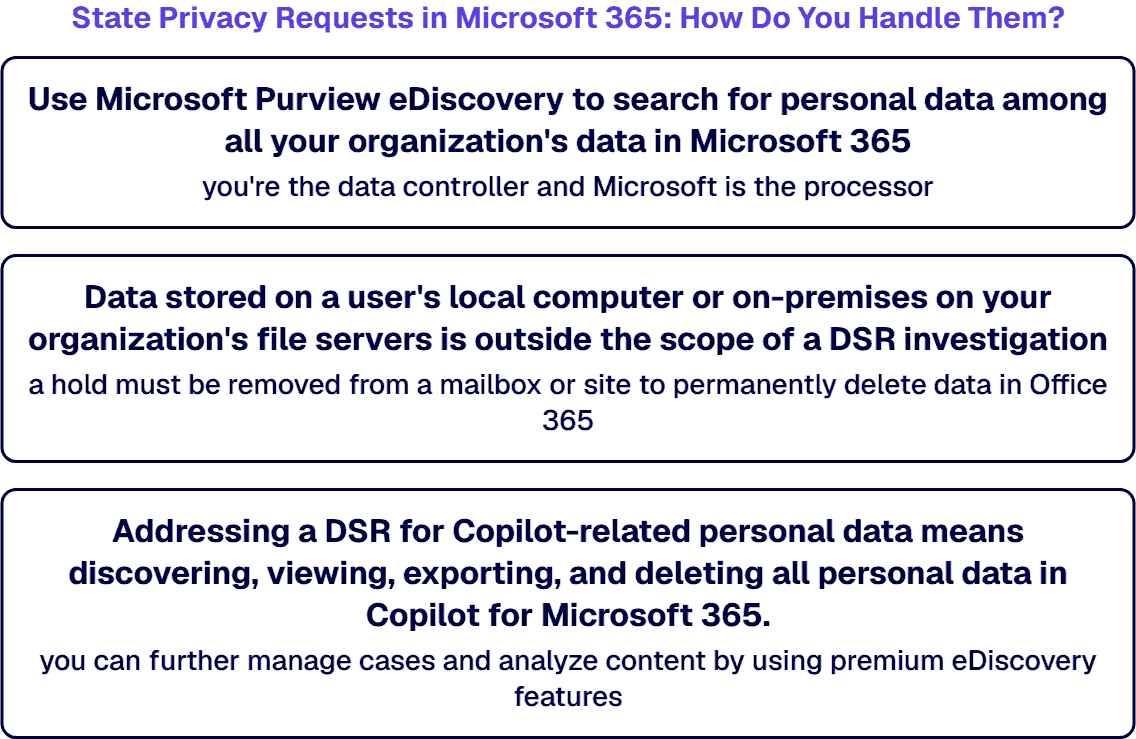
The same guide marks three limits a runbook has to carry. The first is scope: “Data stored on a user’s local computer or on-premises on your organization’s file servers is outside the scope of a DSR investigation for data stored in Office 365.” The second is holds: “If your organization has a requirement or policy that data be permanently deleted and unrecoverable in Office 365 in response to DSR, then a hold must be removed from a mailbox or site to permanently delete data in Office 365.” The third is Copilot: “Addressing a DSR for Copilot-related personal data means discovering, viewing, exporting, and deleting all personal data in Copilot for Microsoft 365.”
On licensing, Learn about eDiscovery (last updated June 29, 2026) says: “If your organization has an Office 365 E5 or Microsoft 365 E5 subscription (or related E5 add-on subscriptions), you can further manage cases and analyze content by using premium eDiscovery features.” Which eDiscovery tier the enterprise needs is a separate decision this guide does not make.
The planning rule for this section is about people, not features: name who on the IT Director’s team runs the search, who reviews the results, who approves an export or a deletion with the privacy officer, who speaks for any legal hold that stands in the way with counsel, and where the record of each response is kept.
The tempting reading is that Privacy Risk Management replaced Subject Rights Requests, and nothing in Microsoft’s documentation says so. Learn about privacy risk management (last updated May 11, 2026) says “Privacy Risk Management policies are meant to be internal guides” and lists what its policies do for an organization:
That is useful work before a request arrives: this guide’s reading is that less overexposed, transferred or unused personal data means less for a request search to find and review. It is not a request-handling workflow, it evaluates only data inside Microsoft 365, and the Microsoft Priva service description says it must be added on. Federal and government-cloud buyers should read two footnotes in the same service description’s feature table: “Preview features not available for GOV or EDU.” and, on its personal data insights row, “Features not available for GOV.”
Some requests arrive framed as a Priva Subject Rights Requests tooling problem when the decision behind them is a different one.
When an outside firm designs the request process, or your own team does, the same requests separate a plan the privacy officer can defend from a slide.
When a regulated enterprise takes this on, it needs a project with an end date: the Microsoft 365 data map, the eDiscovery request runbook with its roles tested, and Purview and Privacy Risk Management configuration where the enterprise has chosen them, handed over to the internal team, with embedded specialists where the team needs more hands for a period. i3solutions maps governance to named control families, enforces it in the platform through Entra ID, Purview, and Azure Policy, and evidences it continuously rather than reconstructing it at audit. i3solutions has been a Microsoft Partner with 30 years of enterprise technology delivery experience and has delivered 1,500+ Microsoft engagements across aerospace and defense, financial services, and health sciences. The people who do the work are senior and based in the US. An i3solutions project engagement does not by itself include ongoing support of what it delivers, which i3solutions scopes separately as Application Managed Services, and it is not a replacement for the internal team, open-ended scope expansion, or vendor lock-in. For a team whose eDiscovery is not yet ready to carry request handling, the starting point is Microsoft Purview readiness services. This work sits within i3solutions’ enterprise governance and compliance solutions.
The planning consequence is simple to state: a runbook written around Priva Subject Rights Requests needs a new owner and a new tool named before the next request arrives, not after it.
Not in Microsoft’s current documentation. As read on September 24, 2026, the Microsoft Priva service description lists Privacy Risk Management only, and Microsoft Learn redirects the old Subject Rights Requests pages to Learn about eDiscovery and to Office 365 Data Subject Requests for the GDPR and CCPA. The Microsoft pages read for this answer give no date for the change, so it states none; if a Microsoft message or contract gives your tenant a different path, that governs.
Microsoft Priva now documents Privacy Risk Management, which Microsoft’s Learn about Microsoft Priva page describes as providing visibility into your organization’s data from the Microsoft Priva portal. Its policies can detect overexposed personal data, limit transfers of personal data across departments or regional borders, and reduce unused personal data; it evaluates only data within Microsoft 365, and the service description says it must be added on.
California Civil Code section 1798.145(e) says the title does not apply to personal information collected, processed, sold, or disclosed subject to the Gramm-Leach-Bliley Act and its implementing regulations, and that the subdivision does not apply to Section 1798.150. The carve-out is written around that data, not around the institution, so an institution’s employee, applicant and marketing data are not named by it. Whether a particular institution or data set falls inside it is a determination for counsel.
The employee exemption in subdivision (m) is no longer in effect (the quick answer above gives the date, citing the California Privacy Protection Agency’s Frequently Asked Questions), and the California Privacy Protection Agency’s FAQ says the California residents with privacy rights under the CCPA include employees and job applicants. Whether a given hospital’s employee data is in scope is a determination for counsel.
The California Civil Code sets the response deadline from receipt of a verifiable consumer request, and allows one extension when reasonably necessary if the consumer is told within the first period. The quick answer above gives both periods with the Civil Code source.
Yes, for data in Microsoft 365. Microsoft’s guide Office 365 Data Subject Requests for the GDPR and CCPA tells administrators to use Microsoft Purview eDiscovery to search for personal data across the organization’s Microsoft 365 data, or to go to the native application where the data was created, and it says data on a user’s local computer or on on-premises file servers is outside the scope of that investigation.

US-Based Microsoft System Integrator | Est. 1997
© i3solutions. All rights reserved.
US-Based Microsoft System Integrator | Est. 1997
© i3solutions. All rights reserved.


