Microsoft Team Augmentation for Regulated Enterprises: How IT Leaders Add Senior Capacity Without Adding Program Risk

Quick Answer
Microsoft team augmentation deploys senior US-based Microsoft specialists in an active regulated-enterprise initiative within weeks, operating at the architectural level under CMMC, HIPAA, NIST 800-171, and SOC 2 controls. The right partner delivers compliance-literate specialists from day one, with no offshore handoffs and no junior resources.
Key Takeaways
- Microsoft team augmentation is an engagement model, not a staffing transaction; the question is what the specialists deliver inside an active Microsoft initiative, not how fast someone can fill a seat.
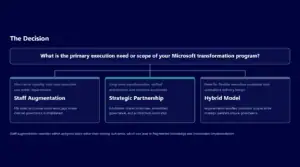
- Three scenarios justify augmentation over full consulting or dedicated teams: capacity gap (project behind schedule), skill gap (specific Microsoft expertise missing), and oversight gap (architectural review of an existing vendor’s work).
- The Expert Delivery Model anchors i3solutions augmentation in senior-only, US-based specialists with no learning on client time, which separates the engagement from body-shop staffing and offshore handoff models.
- Compliance framework literacy is non-negotiable for regulated-enterprise augmentation; specialists arrive with operational depth in CMMC 2.0 Level 2, HIPAA Security Rule, NIST 800-171 Rev 2, SOC 2, and DFARS 252.204-7012 CUI handling.
- Partner evaluation depends on five observable signals: senior-only roster transparency, US-based delivery anchor, named-control-family compliance literacy, audit-survived references from regulated sectors, and an on-time, in-scope, in-production delivery posture.
The Microsoft Team Augmentation Decision Most Regulated Enterprises Get Wrong
Microsoft team augmentation is an engagement-model decision, not procurement, and it fits three situations. A capacity gap when a project is behind and needs senior hands, a skill gap when the team lacks specific Microsoft expertise, or an oversight gap when an existing vendor’s work needs architectural review.
The audit decides what augmentation actually means at regulated-enterprise scale. Defense contractors operating under CMMC 2.0 Level 2 cannot put junior developers on systems that touch controlled unclassified information without breaking access-control boundaries under NIST 800-171 Rev 2 control family 3.1. Healthcare organizations under HIPAA Security Rule cannot accept offshore handoffs on systems with electronic protected health information without breaking the 164.308 administrative safeguards. Financial services firms under SOC 2 cannot rotate junior specialists through privileged Microsoft 365 administrator roles without breaking the CC6.1 logical access controls. The cost of any of those gaps showing up on an audit finding eclipses the entire augmentation budget by an order of magnitude.
Three failure patterns recur in regulated-enterprise Microsoft team augmentation engagements that treat the problem as resource supply rather than embedded expertise. The first is the offshore handoff. A vendor accepts the augmentation engagement with US-based specialists named on the statement of work, then mid-engagement the work flows to offshore delivery teams while the US-based specialists become coordination layer. The client discovers this when an audit finding names offshore access to controlled data the client did not contractually authorize. The second is the junior-developer substitution. A vendor sources senior specialists at engagement start, then rotates junior specialists through the seat as senior specialists complete or roll off other engagements. The client discovers this when the architectural-level work the program needed comes back at task-execution depth and requires rework. The third is the compliance-blind specialist. A vendor places a competent Microsoft developer on a regulated-enterprise engagement without compliance framework literacy. The developer builds working Microsoft systems that fail audit because the underlying access control, audit-log retention, or data-residency configuration does not satisfy the framework the client carries.
All three failure patterns share a root cause: the engagement was scoped as staffing rather than as expertise. The Expert Delivery Model below names the four commitments that distinguish expertise-based Microsoft team augmentation from staffing transactions.
i3solutions has delivered Microsoft consulting and augmentation to regulated enterprises as a Microsoft partner since 1997, with 600+ Microsoft platform implementations across aerospace, defense, financial services, and healthcare. The augmentation model below reflects what regulated-enterprise programs actually need from embedded senior specialists, not what generic staff augmentation guides describe.
The Three Scenarios Where Microsoft Team Augmentation Is the Right Engagement Model
Microsoft team augmentation fits three specific scenarios. Each carries different symptoms, different engagement scope, and a different internal buyer. Recognizing which scenario applies determines whether augmentation is the right engagement model or whether full consulting or a dedicated team is the better fit.
Capacity gap: project behind schedule and the team needs senior throughput now
Capacity-gap engagements arrive at trigger moment one. The Microsoft initiative is in flight, the timeline has slipped, and the internal team cannot recover without additional senior specialists embedded immediately. Symptoms include sprint velocity below half of original estimate for two or more consecutive sprints, architecture decisions deferred because no one on the team has the Microsoft depth to make them, and stakeholders escalating because the go-live date is no longer credible. The engagement scope is bounded: augment for the duration of the recovery, deliver against the original commitments, and exit when the program returns to predictable velocity. The internal buyer is usually the program director or VP of IT under delivery pressure from a board or executive sponsor.
Skill gap: specific Microsoft expertise the internal team does not carry
Skill-gap engagements arrive when the internal team has competent Microsoft generalists but needs depth in a specific area that comes up rarely enough to not justify a permanent hire. Examples include SharePoint Online security model design for a regulated-sector tenant, Power Platform DLP policy architecture for CMMC scope, Microsoft Entra ID conditional access policy for a hybrid identity model, or Microsoft 365 audit-log retention design for a HIPAA covered entity. Symptoms include reliance on Microsoft documentation alone for decisions that carry compliance weight, vendor support tickets escalated to Microsoft Premier without internal capacity to interpret the response, and architecture review boards stalling on Microsoft topics. The engagement scope is narrow and time-bounded. The internal buyer is usually the architecture lead or director of enterprise applications. When the buyer states the need as someone who can mentor and train our own team while they deliver, the skill-gap engagement takes an embedded mentor shape: the specialist closes the gap and leaves the internal team carrying the depth.
Oversight gap: architectural review of an existing vendor’s Microsoft work
Oversight-gap engagements arrive when an existing vendor is building Microsoft systems and the buyer needs senior architectural review of the vendor’s work without replacing the vendor. Symptoms include vendor proposals the internal team cannot fully evaluate, vendor-delivered designs that smell wrong but cannot be specifically refuted, and audit-finding risk concentrated in vendor-built systems with no internal architectural challenge function. The engagement scope is independent verification and validation work, typically across architecture documentation review, code or configuration spot-audits, and ongoing design review board participation. The internal buyer is the CIO, CISO, or VP of IT carrying audit accountability for the vendor’s work.
The Expert Delivery Model: Four Pillars That Define How i3solutions Delivers Senior Microsoft Consultants
i3solutions delivers Microsoft team augmentation through the Expert Delivery Model. The model names four pillars that separate the engagement from commodity staff augmentation: senior-only roster, US-based delivery, compliance-literate specialists, and architectural engagement level rather than task-execution level.
Senior-only means the roster carries no junior specialists who would need supervision or learning time on the client’s environment. Every augmented specialist arrives with named Microsoft platform depth (SharePoint architecture, Power Platform governance, Microsoft 365 compliance, Azure security, Dataverse design, .NET enterprise integration) and a delivery history in regulated environments. Junior pipelines exist inside i3solutions for capacity building, but they do not augment client engagements. The economic logic is straightforward: senior throughput beats junior labor on regulated programs because the audit, the architecture, and the compliance posture all turn on judgment, not effort.
US-based means every augmented specialist is located in the United States and operates under US-based delivery management. No offshore handoffs, no time-zone gaps that absorb a workday before a question reaches a human, no overnight queues that delay architectural decisions. For defense contractors and other organizations whose contracts carry CUI handling requirements under DFARS 252.204-7012 or ITAR-adjacent restrictions, the US-based posture is a contractual necessity. For commercial regulated buyers the US-based posture is a delivery-quality decision: Microsoft architectural conversations are faster, deeper, and more accountable when the specialists are reachable in the same business day.
Compliance-literate means every specialist arrives with named-control-family operational depth in the compliance frameworks the client carries. CMMC 2.0 Level 2 controls AC-2 Account Management, AC-6 Least Privilege, AU-2 Audit Events, SC-8 Transmission Confidentiality. HIPAA Security Rule 164.308 administrative safeguards, 164.312 technical safeguards. The full NIST 800-171 Rev 2 control set published by NIST is the framework specialists work against on defense engagements NIST Special Publication 800-171 Rev 2. SOC 2 CC6 logical access controls, CC7 system operations. DFARS 252.204-7012 CUI handling. The specialist does not learn the framework on the client’s time; the framework literacy is the entry condition.
Architectural engagement level means specialists operate at the decision-making depth the client team needs, not at task-execution depth. The Microsoft Purview audit-log retention configuration that satisfies CMMC AU-2 evidence requirements is an architectural decision with downstream cost implications across the entire Microsoft 365 tenant; specialists arrive with operational depth in the Microsoft primary documentation for audit log retention policies Microsoft Purview audit log retention and translate that depth into client-specific configuration. The same discipline applies to Microsoft Entra ID conditional access policy architecture, Microsoft 365 sensitivity-label architecture, Power Platform DLP policy design, and Dataverse access control design across every regulated-enterprise engagement.
Microsoft Team Augmentation by Regulated Enterprise Sector
Microsoft team augmentation looks different across regulated sectors because the compliance frameworks, the audit cadence, and the in-scope Microsoft technology surface area shift by sector. The patterns below reflect how i3solutions has delivered embedded senior specialists across aerospace and defense, financial services, and healthcare organizations under audit pressure.
Defense contractors and aerospace organizations under CMMC 2.0 and DFARS
An aerospace organization preparing for CMMC 2.0 Level 2 certification engaged i3solutions to augment its internal Microsoft 365 team for the assessment-preparation window. The internal team had Microsoft 365 administrators with three years of GCC-tenant experience but no operational depth in CMMC 2.0 Level 2 NIST 800-171 Rev 2 control mapping for the 110 controls across the 14 control families. i3solutions embedded two senior specialists for sixteen weeks: one carrying Microsoft Entra ID identity-architecture depth and DFARS 252.204-7012 CUI handling background, the other carrying Microsoft Purview audit-and-retention depth and AU-2 Audit Events evidence-package experience. The augmentation deliverables included the control-family-to-Microsoft-feature mapping artifact, the audit-log retention configuration, and the assessor-evidence package. The internal team retained ownership of the program; the augmented specialists delivered the depth the team needed inside a fixed window.
Financial services firms under SOC 2 and SEC cybersecurity rules
A regional financial services firm preparing for its annual SOC 2 Type II audit engaged i3solutions to augment its enterprise applications team for the Microsoft 365 control-readiness window. The firm had previously relied on its internal team plus its existing Microsoft reseller for tactical support, but the SOC 2 CC6 logical access controls and CC7 system operations evidence requirements exceeded the team’s bandwidth. i3solutions embedded one senior Microsoft Entra ID specialist and one senior Microsoft Purview specialist for twelve weeks. The augmentation scope was bounded to the conditional access policy architecture, the audit-log retention design, and the privileged-access management posture, including the SC-8 transmission confidentiality controls the auditor had flagged in the prior year. The augmented specialists operated at the architectural level alongside the firm’s internal staff; the firm retained vendor management, project ownership, and ultimate decision rights.
Healthcare networks and life sciences organizations under HIPAA Security Rule
A mid-sized healthcare network engaged i3solutions to augment its IT modernization program with embedded SharePoint and Power Platform specialists during a clinical-systems migration that touched electronic protected health information. The internal team needed architectural-level Microsoft depth on the HIPAA Security Rule 164.308 administrative safeguards and 164.312 technical safeguards as the migration touched the boundary between covered-entity and business-associate systems. i3solutions embedded one senior SharePoint information-architecture specialist and one senior Power Platform DLP specialist for twenty weeks. The augmentation deliverables included the SharePoint Online sensitivity-label architecture, the Power Platform environment-strategy and DLP policy configuration, and the audit-log retention design under 164.312(b). The internal team owned the clinical-systems integration work; the augmented specialists delivered the Microsoft architectural depth the program needed to clear the next HIPAA Security Rule review.
When to Use Microsoft Team Augmentation vs Full Consulting vs Dedicated Teams
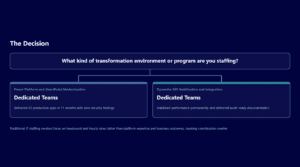
Microsoft team augmentation is one of three engagement models i3solutions delivers for regulated enterprises. The other two are full consulting (fixed-scope outcome-based engagements i3solutions executes end-to-end) and dedicated agile teams (long-running multi-specialist teams that operate as the client’s Microsoft delivery function). The right engagement model depends on what the client needs and who owns the outcome.
Microsoft team augmentation fits when the client owns the program, the internal team is in flight, and the engagement is for embedded senior specialists who join the existing team and operate under client direction. Scope is bounded by specialist count and duration. Accountability for the program outcome stays with the client. Risk profile is moderate: the client retains program risk, i3solutions carries specialist-quality risk. Typical engagement length is six weeks to nine months. Internal buyer is usually the program director or VP of IT.
Full Microsoft consulting fits when the client wants i3solutions to deliver a fixed-scope outcome end-to-end. Scope is bounded by deliverable specification and acceptance criteria. Accountability for the outcome sits with i3solutions under Enterprise Delivery Assurance commitments. Risk profile is concentrated: i3solutions carries both delivery risk and outcome risk; the client carries consumption risk only. Typical engagement length is twelve weeks to nine months. Internal buyer is usually the CIO, CISO, or business sponsor accountable for the named outcome.
Dedicated Microsoft agile teams fit when the client needs ongoing Microsoft delivery capacity at the team level rather than at the specialist level, typically as the client’s primary or secondary Microsoft delivery function. Scope is bounded by team composition and engagement duration measured in quarters or years. Accountability is shared: i3solutions delivers the team and carries team-level performance commitments; the client owns the work backlog. Risk profile is distributed across both parties. Typical engagement length is twelve months and longer. Internal buyer is usually the CIO or VP of IT managing a multi-year Microsoft transformation program.
The augmentation-vs-full-consulting decision turns on who owns the outcome. The augmentation-vs-dedicated-team decision turns on engagement duration. Most regulated-enterprise programs that begin with augmentation either stay with augmentation, exit to internal completion, or evolve into a dedicated team when the program becomes ongoing rather than bounded.
How to Evaluate a Microsoft Team Augmentation Partner
Five observable signals separate Microsoft team augmentation partners that operate at the regulated-enterprise level from commodity staff augmentation providers. Each signal corresponds to a concrete artifact, reference, or contractual commitment the prospective partner should be able to produce on request. The combination of all five is what makes the engagement defensible in the audit and credible to internal stakeholders carrying delivery accountability.
First, senior-only roster transparency. The partner should be willing to share specialist profiles, named Microsoft platform depth, regulated-sector delivery history, and US-based location for every specialist offered into the engagement. Resume samples without specialist names, offshore handoff acceptance, or junior-developer pipeline blending are all signals to exit. The diagnostic question is direct: ask the partner to name the specific specialists proposed for the engagement, with platform depth and regulated-sector references, and ask whether the partner will contractually commit to those specialists for the engagement duration. Partners who cannot answer that question, or who substitute the proposed specialists at engagement start, are operating a staffing model that prioritizes utilization over expertise. i3solutions ships specialist profiles before any engagement begins, with named delivery history attached and contractual commitments to the named specialists.
Second, US-based delivery anchor with named delivery management. The partner should name the US-based delivery manager who owns the engagement, the escalation path inside the partner organization, and the contractual commitments around offshore-handoff prohibition for engagements that carry CUI or PHI surface area. Vague responses on US-based posture or willingness to substitute offshore specialists mid-engagement are signals to exit. The contractual language should explicitly prohibit offshore access to in-scope client systems under DFARS 252.204-7012 or HIPAA business-associate-agreement terms where applicable.
Third, named-control-family compliance literacy. The partner should be able to discuss CMMC 2.0 Level 2 control families, NIST 800-171 Rev 2 control families 3.1 and 3.3, HIPAA Security Rule 164.308 and 164.312 sections, SOC 2 CC6 and CC7 trust services criteria, and DFARS 252.204-7012 CUI handling at named-control depth. Partners who can only discuss compliance frameworks at the framework-name level cannot operate as architectural-level augmentation in regulated environments. The diagnostic question is to ask the partner to walk through a specific Microsoft architectural decision (Entra ID conditional access policy, SharePoint sensitivity label architecture, Power Platform DLP policy, Microsoft Purview audit-log retention) under the client’s specific compliance framework. A partner with compliance literacy answers in control-family language; a partner without it answers in Microsoft product language only.
Fourth, audit-survived references from regulated sectors. The partner should provide references from named-sector clients (defense, financial services, healthcare) who have completed audits with the partner’s augmentation work as part of the audit surface area. References that name the program, the engagement scope, the compliance framework, and the audit outcome are the gold standard. i3solutions carries 600+ Microsoft platform implementations as a Microsoft partner since 1997, with regulated-sector references including aerospace and defense manufacturers, financial services firms, and national healthcare systems. Every reference reflects an actual delivery, not a logo on a slide.
Fifth, on-time, in-scope, and in-production delivery posture under Enterprise Delivery Assurance. Augmentation work that does not land in production on the committed timeline is a delivery failure regardless of how many specialist hours billed. The partner should commit to delivery-outcome language rather than effort-billed language and should be able to describe the borrowed expertise pattern: senior specialists are borrowed by the engagement, then return to the partner’s roster for reuse on subsequent engagements, which means the specialist roster compounds over time rather than churning.
About i3solutions
i3solutions has been a Microsoft partner since 1997 with 600+ Microsoft platform implementations across aerospace, defense, financial services, and healthcare. The firm delivers Microsoft consulting, team augmentation, and dedicated agile teams under Enterprise Delivery Assurance commitments to on-time, in-scope, and in-production delivery. All specialist delivery is US-based with no offshore handoffs. The firm’s borrowed expertise model assigns senior architects to client engagements, then returns those specialists to the firm’s roster for reuse on subsequent regulated-enterprise programs.
Related Reading
For readers evaluating Microsoft engagement models in regulated environments, the following i3solutions pieces extend the topic into adjacent decisions.
Microsoft 365 Compliance Consulting: CMMC, HIPAA, SOC 2, and NIST for Regulated Enterprises. Covers the compliance-aware Microsoft 365 consulting engagement model when the augmentation question is preceded by a broader compliance-framework readiness initiative across CMMC, HIPAA, SOC 2, and NIST 800-171.
Custom Microsoft Application Development for Regulated Enterprises: What to Look for in a Senior US-Based Partner. Covers the partner-evaluation framework for custom Microsoft application development engagements at regulated-enterprise scale, with the same senior US-based partner posture that defines the Expert Delivery Model.
Microsoft Consulting Services Built for Enterprise Complexity. Covers the full Microsoft consulting engagement model when the client wants i3solutions to deliver a fixed-scope outcome end-to-end rather than embedded augmentation specialists.
How to Prepare for a CMMC Audit Without Disrupting Operations. Covers the CMMC audit preparation sequencing for defense contractors when Microsoft team augmentation engagements include the assessor-evidence package work that feeds the audit.
Frequently Asked Questions
What does Microsoft team augmentation cost for a regulated enterprise?
Microsoft team augmentation cost scales with specialist seniority, count, duration, and compliance framework scope. Typical engagement ranges land at $28,000 to $48,000 per specialist per month for senior US-based Microsoft specialists with named platform depth (SharePoint, Power Platform, Microsoft 365 compliance, Azure security, Dataverse, .NET enterprise integration) and compliance literacy in CMMC 2.0 Level 2, HIPAA Security Rule, NIST 800-171 Rev 2, SOC 2, or DFARS 252.204-7012. A capacity-gap engagement at two specialists for twelve weeks typically lands in the $170,000 to $290,000 range. A skill-gap engagement at one specialist for eight weeks typically lands in the $58,000 to $96,000 range. An oversight-gap engagement at one senior architect for sixteen weeks for ongoing design review board participation typically lands in the $110,000 to $170,000 range. Total engagement cost is materially lower than full Microsoft consulting for equivalent scope because augmentation keeps program ownership with the client.
How fast can senior Microsoft specialists embed in our team?
Senior Microsoft specialists from i3solutions typically embed in the client’s team within two to four weeks of engagement start. The Expert Delivery Model assumes specialists arrive ready to contribute without learning time on the client’s environment, which means initial onboarding is bounded to client-specific access provisioning, repository permissions, and program-context briefing. For regulated-enterprise engagements that require background check completion under DFARS, CMMC, or client-specific clearance requirements, embed time extends to four to six weeks depending on the clearance scope. i3solutions runs background-check pre-clearance for specialists assigned to regulated-sector engagements so the clearance window does not delay the engagement start.
How do I decide between Microsoft team augmentation, full consulting, and a dedicated agile team?
The decision turns on three questions: who owns the outcome, how long is the engagement, and what scope-binding approach fits the work. If the client owns the program and needs embedded senior specialists for a bounded window, augmentation fits. If the client wants a fixed-scope deliverable under partner accountability with named acceptance criteria, full consulting fits. If the client needs ongoing Microsoft delivery capacity at the team level for a year or longer, a dedicated agile team fits. Augmentation engagements often evolve into dedicated teams when the engagement becomes ongoing rather than bounded; the evolution is contractual and reflects the client’s posture on internal versus external delivery capacity. Reference the engagement-model comparison section above for the full decision framework.
How does Microsoft team augmentation handle CMMC, HIPAA, NIST 800-171, and SOC 2 compliance?
Microsoft team augmentation at regulated-enterprise scale requires compliance framework literacy from every specialist on the engagement, not just from the engagement manager. i3solutions specialists arrive with operational depth in CMMC 2.0 Level 2 control families AC-2 Account Management, AC-6 Least Privilege, AU-2 Audit Events, and SC-8 Transmission Confidentiality; HIPAA Security Rule 164.308 administrative safeguards and 164.312 technical safeguards; NIST 800-171 Rev 2 control families 3.1 access control and 3.3 audit and accountability; SOC 2 CC6 logical access and CC7 system operations; and DFARS 252.204-7012 CUI handling. All specialists are US-based with no offshore handoffs, which is contractually necessary for engagements touching controlled unclassified information or electronic protected health information. The engagement contract names the in-scope compliance frameworks and the specialist commitments around each framework.
How is i3solutions Microsoft team augmentation different from a body-shop staffing partner?
Five concrete differences. First, senior-only roster: no junior developers in the augmentation pipeline; every embedded specialist arrives ready to contribute at the architectural level. Second, US-based delivery: no offshore handoffs, no time-zone gaps, no contractual loopholes for offshore substitution mid-engagement. Third, compliance-literate specialists: named-control-family operational depth across CMMC, HIPAA, NIST 800-171, SOC 2, and DFARS, not generic compliance familiarity. Fourth, architectural engagement level: specialists operate alongside the client team on architectural decisions, not on task execution under supervision. Fifth, on-time, in-scope, in-production delivery posture under Enterprise Delivery Assurance: augmentation work is committed to land in production on the engagement timeline, not to billed-hours metrics. The borrowed expertise model returns senior specialists to the i3solutions roster after each engagement so the roster compounds over time rather than churning.