

Enforcement casework ran on a spreadsheet-driven manual process across departments.
The client is a major-city housing agency responsible for creating and preserving affordable housing for city residents. The agency works to improve the quality of life in neighborhoods by enforcing the city’s housing code, financing affordable housing development, and promoting economic diversity and stability in communities. Its enforcement mandate runs through the courts: every violation case filed against building owners and tenants has to be tracked from filing to resolution, with the Office of the General Counsel, managers, paralegals, and inspectors all working the same caseload.
With over one million residential properties to oversee, the agency’s existing manual process, heavily dependent on sprawling spreadsheets, was time-consuming and increasingly unwieldy. Case information lived in disconnected departmental systems and spreadsheet copies, legal documents were drafted by hand, and the same case data was re-entered at multiple steps. The process often led to missed violations and unenforced court judgments, and it gave the General Counsel little real-time visibility into where cases actually stood.
A major-city housing agency ran code-enforcement casework through a manual, spreadsheet-driven process spanning multiple departments and the courts. i3solutions built a purpose-built .NET case management system that raised staff efficiency 150% and cut administrative time in half.
Administrative time and costs dropped 50% and data-entry errors fell 90%, driven by preset document templates that let paralegals produce standardized legal briefs and a single centralized real-time case record in place of scattered spreadsheets.
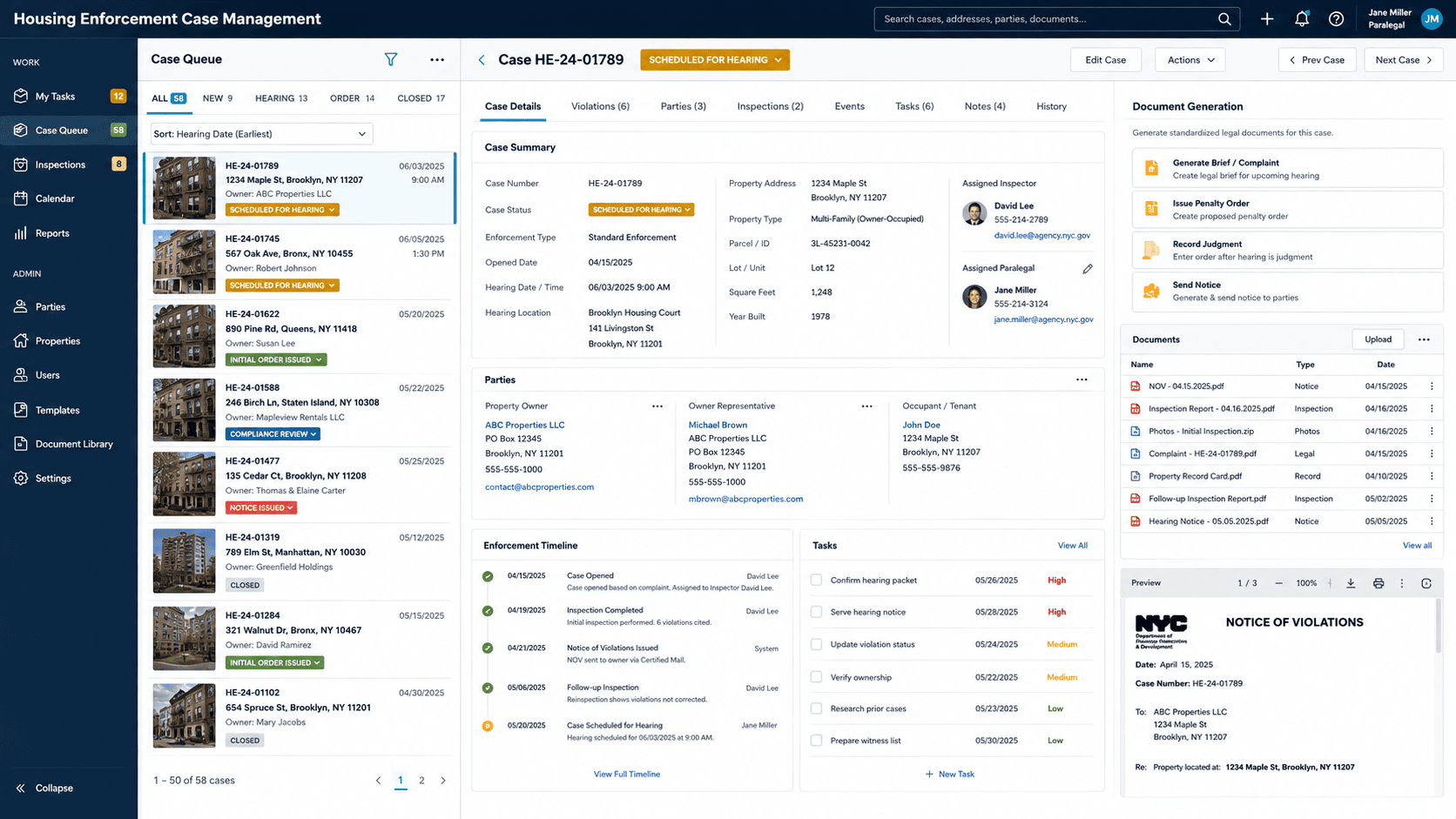
Spreadsheets Could Not Police a Million Properties
The scale gap was structural. A caseload spanning over one million residential properties was being managed through spreadsheets that were time-consuming to maintain and increasingly unwieldy to use. Each department kept its own records, so preparing a single court case meant pulling information from multiple systems, re-keying it into legal documents, and hoping the copies agreed.
The consequences were the trigger: violations were being missed and court judgments were going unenforced. The agency committed to a system that could track and manage every court case and give the General Counsel and other managers real-time case status on one centralized platform, so housing regulations could actually be enforced.
Templates replaced draft-from-scratch document production without losing the precision this agency’s casework requires. If document accuracy is the reason you’ve held off automating a similar process, that tradeoff isn’t as fixed as it looks.
Missed Violations and Unenforced Court Judgments
The failure mode was already visible in the caseload: missed violations and unenforced court judgments. Every unenforced judgment is enforcement work already paid for, in inspection, filing, and litigation effort, that delivers nothing, and every missed violation leaves a housing-code problem standing in a city the agency exists to protect.
The strategic risk compounded with scale. An agency overseeing more than one million properties cannot supervise enforcement it cannot see; without a current, centralized view of case status, the Office of the General Counsel was making programmatic, policy, and legal decisions against stale or fragmented information.
Many Departments, One Case Record
The organizational constraint was fragmentation. Case information originated in multiple departments, each with its own systems and job functions, and a court filing needed inputs from several of them. The platform had to capture critical case information from all of these sources through dynamic forms and consolidate case preparation into a single process, without breaking the working relationships between inspectors, paralegals, and attorneys.
The data constraint was accuracy at volume. Manual re-entry across spreadsheets had made data entry errors routine, and legal documents demand exactness. The system needed single entry of building violations flowing through to every downstream document, plus real-time integration with other agency systems, so that court cases would be prepared and managed with consistency and reliability.
Senior Microsoft Specialists with Proven Delivery Depth
The engagement profile demanded a partner who could unify fragmented departmental systems into one platform on the Microsoft stack, encode legal document production into preset templates, and integrate with the agency’s existing systems in real time. Case management for a legal office is unforgiving delivery territory: the output is court paperwork, and errors have enforcement consequences.
The agency engaged i3solutions, a Microsoft Partner with 30 years of delivery experience and 1,500+ Microsoft engagements, delivered by an all-senior, all US-based delivery team. That depth matched the work: a .NET platform serving the Office of the General Counsel, managers, paralegals, and inspectors on one shared record.
i3solutions developed the platform around how the casework actually flows: single entry, standardized documents, automated downstream paperwork, and one record everyone reads.
PHASE 01
Casework and Systems Assessment
i3solutions mapped how court cases moved from violation to resolution: which departments originated case information, where spreadsheets and re-entry sat in the process, and what tracking the General Counsel and managers needed for oversight and enforcement.
PHASE 02
Platform and Data Architecture
The platform was architected on the Microsoft .NET framework as a single case management system unifying the agency’s fragmented departmental systems, with building violations entered once and flowing through to every downstream document.
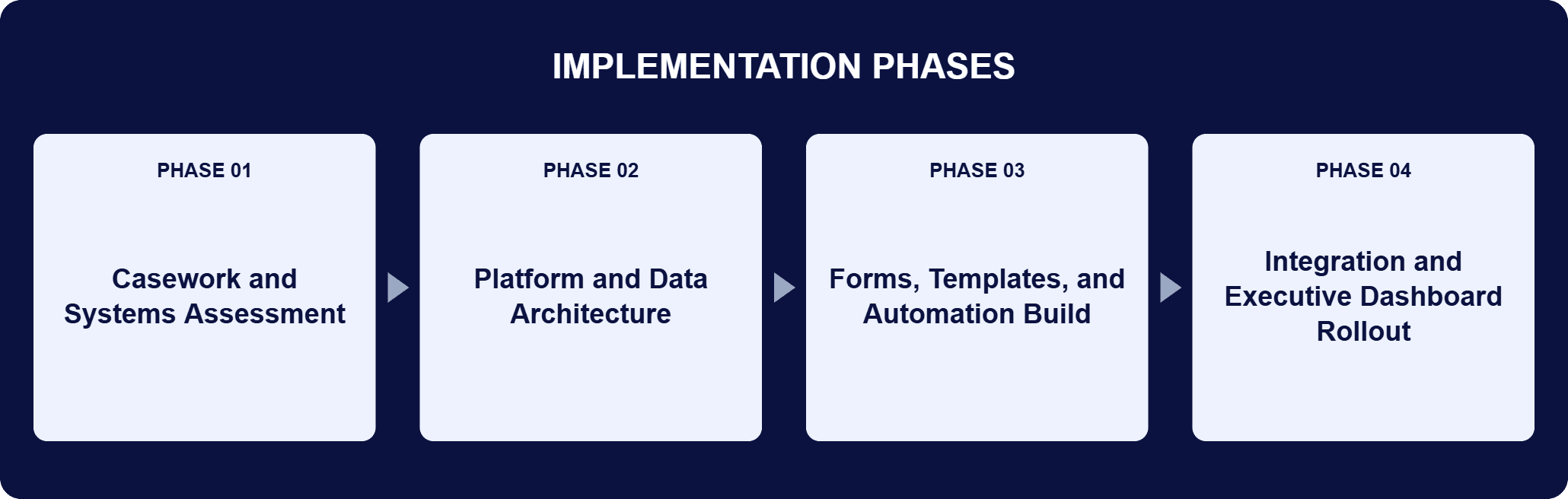
PHASE 03
Forms, Templates, and Automation Build
i3solutions built dynamic forms that capture critical case information from multiple departments, preset document templates that let paralegals produce standardized legal briefs with minimal data entry, and automated workflows that generate judgment notifications, invoices for fines, and penalty orders once a judgment is recorded.
PHASE 04
Integration and Executive Dashboard Rollout
Real-time integration connected the platform with other agency systems for data accuracy, and the Executive Dashboard Reporting Console gave the Office of the General Counsel real-time reports for monitoring case progress and making programmatic, policy, and legal decisions.
The platform is built on the Microsoft .NET framework as one case management system replacing a spreadsheet-driven court case process. Dynamic forms capture critical case information from multiple departments and generate the legal documentation required for court filings. Building violations enter the platform once: from that single entry, paralegals create standardized legal briefs using preset document templates with minimal data entry, and automated workflows generate judgment notifications, invoices for fines, and penalty orders once a judgment is recorded. Real-time integration with other agency systems keeps case data accurate and consistent across departments, and the centralized design gives management clear oversight into case statuses. For strategic oversight, the Executive Dashboard Reporting Console provides the real-time reports the Office of the General Counsel uses to monitor case progress and make programmatic, policy, and legal decisions. The result is one system where case preparation, legal documentation, and enforcement tracking happen together, and every case is followed from violation to resolution.
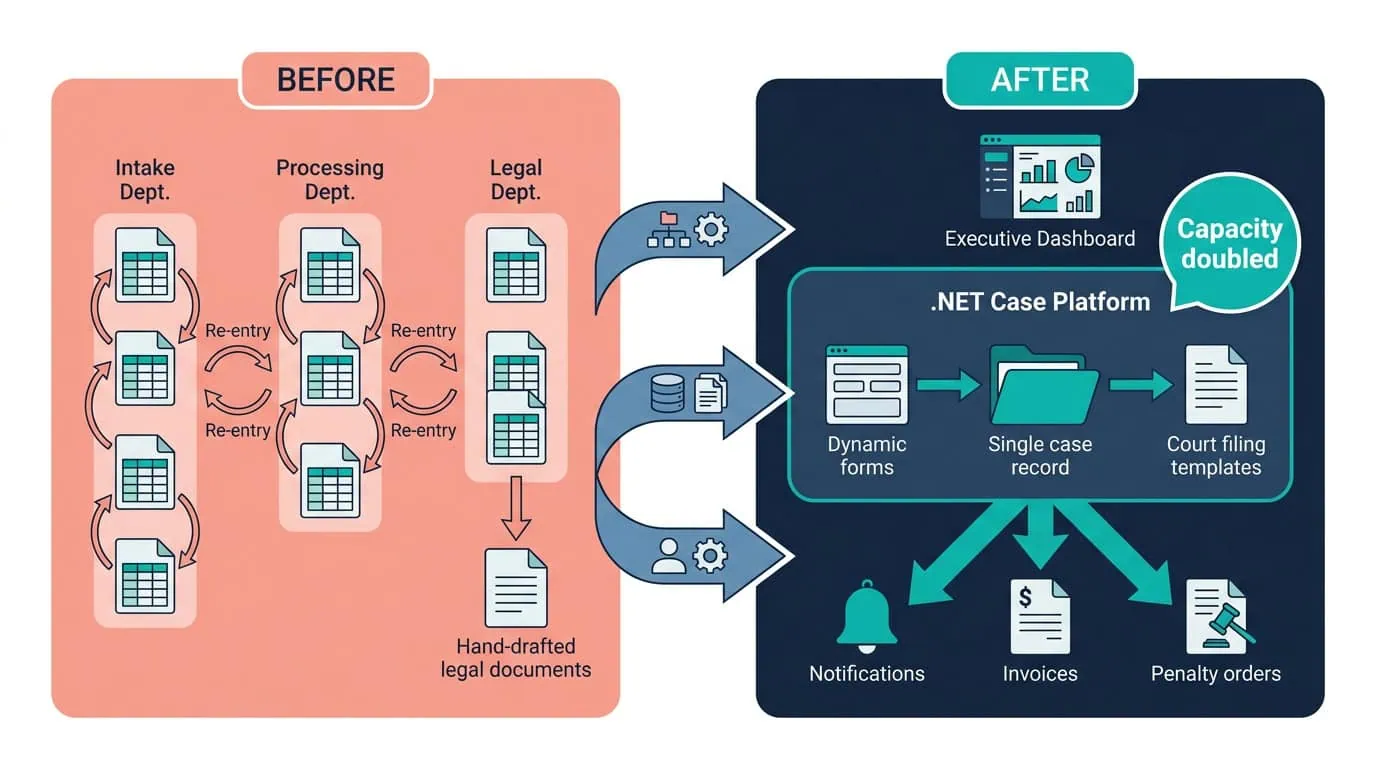
Efficiency Up 150%
A centralized case management system cut administrative time in half and reduced the data entry errors that came with re-keying the same information.
| Outcome | Before | After |
|---|---|---|
| Productivity and efficiency | Spreadsheet-driven manual process | Improved by 150% |
| Administrative time and costs | Manual case preparation across departments | Reduced by 50% |
| Data entry errors | Same data re-keyed at multiple steps | Decreased by 90% |
| Case record | Sprawling spreadsheets and fragmented systems | One centralized real-time platform |
| Legal documentation | Drafted by hand per case | Standardized briefs from preset templates |
Behind those numbers are specific mechanisms: preset document templates that let paralegals produce standardized legal briefs with minimal data entry, automated workflows that generate judgment notifications, invoices for fines, and penalty orders once a judgment is recorded, single entry of building violations that flows through to every downstream document, and one centralized record that inspectors, paralegals, and managers read in real time.
The Executive Dashboard Reporting Console applies the same discipline to oversight, giving the Office of the General Counsel real-time reporting for programmatic, policy, and legal decisions. Automated judgment notifications and template-driven briefs removed manual steps from every case, letting employees focus on higher-value casework, and consolidating case preparation into a single process means inspectors, paralegals, managers, and attorneys work one shared record instead of handing spreadsheets between job functions.
The case management system streamlined workflows and automated previously manual tasks, allowing employees to focus on higher-value activities. By eliminating cumbersome spreadsheets and reducing the risk of data entry errors, the system consolidates case preparation tasks into a single process, reducing reliance on multiple job functions and improving coordination across departments.
Real-time integration with other systems enhances data accuracy, ensuring that court cases are prepared and managed with greater consistency and reliability. The system’s centralized nature also enables better transparency, offering management clear oversight into case statuses.
This engagement is relevant for
Less relevant for
Numbers That Came from Mechanics, Not Magic
The agency’s numbers came from mechanics that transfer: data captured at the point of violation, documents produced from templates instead of drafted from scratch, and post-judgment paperwork that generates itself. None of it required new invention, just a system built around how the casework actually flows. The engagement established that a caseload spanning more than one million properties can run on one platform, that legal document production can be encoded into templates without sacrificing exactness, and that giving the Office of the General Counsel a real-time dashboard changes oversight from reconstruction to observation. For organizations whose casework still runs on spreadsheets, the four measured outcomes, 150% productivity improvement, 50% lower administrative time and costs, 90% fewer data entry errors, and doubled annual case handling capacity, are the argument.
For this agency, it is a single .NET system that tracks every court case filed against building owners and tenants from violation to resolution. It replaced a manual process heavily dependent on sprawling spreadsheets, which, with over one million residential properties to oversee, had become time-consuming and unwieldy and often led to missed violations and unenforced court judgments. The platform captures case information from multiple departments through dynamic forms, generates the legal documentation needed for court filings from preset templates, and gives everyone working the caseload, the Office of the General Counsel, managers, paralegals, and inspectors, one centralized record they read in real time.
In this engagement, i3solutions built the platform around how the casework actually flows rather than imposing a generic case model. The mechanics are deliberately simple. Building violations enter the platform once, and that entry flows through to every downstream document. Standardized legal briefs come from preset templates with minimal data entry. Judgment notifications, invoices for fines, and penalty orders generate automatically once a judgment is recorded. Every role works from the same centralized record. Unifying the agency’s fragmented departmental systems into a single platform, with real-time integration to other agency systems, is what made those mechanics possible at the scale of a million-property caseload.
Dynamic forms capture critical case information from the departments involved in a case, and that information populates preset document templates. Paralegals use the templates to produce standardized legal briefs for court filings with minimal data entry, instead of drafting each document by hand from spreadsheet records. Once a judgment is recorded, automated workflows generate the downstream paperwork: judgment notifications, invoices for fines, and penalty orders. Because building violations are entered only once and real-time integration keeps the platform consistent with other agency systems, the documents are prepared from current, accurate case data, which is how data entry errors fell by 90% while case volume grew.
This engagement produced four attested outcomes: productivity and efficiency improved by 150%, administrative time and costs fell by 50%, data entry errors decreased by 90%, and annual case handling capacity doubled. The pattern behind them is what transfers: returns come from eliminating re-entry, encoding document production into templates, and automating the paperwork that follows a judgment. An agency estimating its own return should count the hours staff spend re-keying case data and hand-drafting standardized documents, then add the enforcement value of judgments that stop slipping through, since unenforced judgments are casework effort already spent that returns nothing.
i3solutions is a Microsoft Partner with 30 years of delivery experience and 1,500+ Microsoft engagements, with every engagement staffed by an all-senior, all US-based delivery team. Enforcement case management rewards that seniority: the system’s output is court paperwork, the users span attorneys, paralegals, managers, and inspectors, and the platform has to integrate with existing agency systems in real time. This engagement is representative of the profile: a .NET platform serving the Office of the General Counsel of a major-city housing agency, four attested operational outcomes, and a caseload covering more than one million properties. A short scoping conversation establishes what a centralized case management platform would take in your environment, where the highest-error handoffs sit in your current process, and comparable engagements to reference when you build the internal case.
A manual process heavily dependent on sprawling spreadsheets. With over one million residential properties to oversee, that process was time-consuming and unwieldy, and it led to missed violations and unenforced court judgments.
The client is a major-city housing agency overseeing more than one million residential properties. The platform unified fragmented departmental systems into one system of record used by the Office of the General Counsel, managers, paralegals, and inspectors.
These four outcomes came from mechanics that transfer to any high-volume casework operation, not from anything unique to housing enforcement. We can talk through what those same mechanics would look like applied to your caseload.

US-Based | Est. 1997
© i3solutions. All rights reserved.
US-Based | Est. 1997
© i3solutions. All rights reserved.


