
By Michael Branson, Founder/COO, i3solutions
As of September 2026, before an audit, according to IAQG, AS9100 lists clauses 10.2 “Nonconformity and corrective action” and 8.7 “Control of nonconforming outputs”. Keep nonconformances in Dynamics 365 when they start there, add Power Apps for workflow gaps, and buy an eQMS for multi-site CAPA.
If the surveillance audit notice has just landed and the nonconformance log lives in three spreadsheets, a shared mailbox and a Dynamics 365 Supply Chain Management instance that was never asked to carry it, you are about to be handed a platform decision. Quality wants a dedicated eQMS. Finance does not want a fourth system of record beside the ERP it already licenses. Someone on your own team has offered to build it in Power Apps. Each answer is defensible for some plants and wrong for others, and the difference is not the software brand. It is where your nonconformances originate, how many corrective actions run at once, and how far the process has to reach into suppliers and other sites. This guide puts the three options side by side against those criteria, using Microsoft’s own documentation for the Dynamics 365 option and IAQG’s own published overview for the standard.
Before you compare platforms, fix what the process has to carry, because the auditor samples the process and its records, not the tool. According to IAQG’s 9100:2016 Executive Overview (IAQG 9100 Team, January 2020), the 9100 series is ISO 9001 plus aviation, space and defense additions, among them product safety, configuration management, counterfeit parts and “Expanded requirements for production and external providers”. According to the same overview’s clause map, 8.7 “Control of nonconforming outputs” sits under Operation and 10.2 “Nonconformity and corrective action” under Improvement.
Two notes in the same overview shape the platform choice. The revision records human factors as a consideration in nonconformity and corrective action, so the record needs room for why the error happened as well as which part failed. And under risk-based thinking, IAQG describes the “Concept of preventive action now addressed throughout the standard by risk identification and mitigation”, which means a CAPA module’s preventive half is one place that work can live, not the only one. In general terms, control of nonconforming outputs is about the nonconforming item: identifying it and deciding what happens to it. Nonconformity and corrective action is about the nonconformity itself: its cause, the corrective action taken and whether that action worked. The platform you pick has to answer both on demand, for any record an auditor names.
When three teams each defend a different option, compare them on where the record comes from rather than on feature lists. The table below describes each option structurally; it ranks none of them, and each row is set out in its own section.
If most of your nonconformances start on a receipt, a production order or a customer return that Dynamics 365 already records, the module you already license is the first option to test. Microsoft’s quality and nonconformance management overview states: “A nonconformance describes an item that has a quality problem.” It continues: “The nonconformance process lets you create a nonconformance order that describes a quantity of nonconforming material, the problem source, the problem type, and explanatory notes.” The same page lists six default nonconformance types (customer, service request, vendor, production, internal and co-product production) and states: “The Corrections page lets you create a list of nonconformances that must be corrected.” It adds: “Each correction item is associated with the diagnostic type that caused the problem to be discovered.”
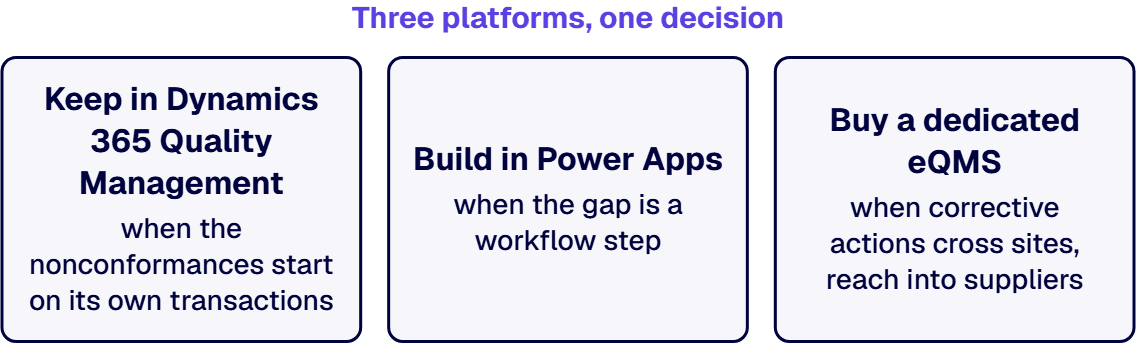
For the corrective action half, Microsoft’s CAPA management overview states: “Corrective and preventive action (CAPA) management lets you create and maintain records of the actions taken to manage and resolve nonconformities or defects.” Its feature list includes a workflow-driven process in which “The system automatically assigns CAPA work, based on the definition of your CAPA processes and CAPA worker groups.” and trending analysis, where “The CAPA workspace provides analytical tools to help you analyze CAPA trends.” Stay inside Dynamics 365 Supply Chain Management’s Quality Management module when your nonconformances trace directly to purchase, production and sales transactions already recorded in that system and your CAPA volume is light enough for its built-in correction and CAPA case tools. Test that against your own last audit sample before anyone buys anything: pull ten closed nonconformances and walk each one through the module end to end.
When the module covers the records but not the way your quality team works, the gap is usually a workflow, and a workflow is what a Power Apps build is for. Typical gaps are a material review board step with its own sign-off, a human factors worksheet attached to the root cause, or a supplier response form that has to reach people who do not hold a Dynamics 365 license. Build the gap in Power Apps when you need a workflow the module does not offer but want to keep the data and the platform you already govern: the nonconformance can still originate in Dynamics 365, and the build adds the steps around it. The cost of this option is ownership. Every step you add is custom code and configuration your team maintains, documents for the auditor and tests after each platform update. Governance of that build belongs with the rest of your estate, covered on Enterprise Power Platform Development & Implementation Services for Governed Operations.
If corrective actions routinely cross sites, reach into your supply base and stay open across several audit cycles, the question changes from which screen to use to which system enforces the discipline. A dedicated eQMS platform is built around nonconformance and CAPA as its core records: a purpose-built corrective action workflow, supplier corrective action requests with the supplier’s response held on the record, and an audit trail designed for quality review across every site. Move to a dedicated eQMS when multi-site CAPA discipline, supplier-flowdown corrective action and audit-trail depth outgrow what either Microsoft path was built to enforce. Scope the integration before you sign: Dynamics 365 still owns the item, the order and the vendor, so the eQMS needs those records, and someone has to own the connection between two systems of record for as long as both run.
If the platform debate has turned into a debate about the whole Dynamics 365 program, separate the two before the audit forces a rushed answer. The cost and scope of a Dynamics 365 Supply Chain Management implementation is its own decision, covered in How Much Does a Dynamics 365 Finance and Supply Chain Implementation Cost?. If your plant also answers to the FDA, lot and serial traceability in Dynamics 365 Supply Chain Management is a separate decision under a different regulator, and it is not settled on this page.
If your plant also answers to the FDA, see whether Dynamics 365 Supply Chain fits FDA lot and serial traceability.
When a nonconformance platform question reaches i3solutions, the work starts from your last audit sample and your open corrective actions, traced record by record through the systems they touch today, so the gap between the Dynamics 365 module and your quality process is measured rather than argued. i3solutions has replaced Excel-based workflows in aerospace manufacturing, financial services, and healthcare environments, including organizations operating under CMMC obligations and ITAR export control requirements. i3solutions has delivered enterprise SharePoint and Power Platform programs for aerospace and defense manufacturers, major defense organizations, a financial-services firm, a national healthcare system, and military organizations. The certification decision stays with your registrar, and your quality management representative owns the process the platform carries.
If your company is not yet AS9100-certified, the first job is the quality management system itself, and choosing its software before the process is written only moves an undefined process into a new screen. If your nonconformance volume is a handful a quarter and each one closes inside a month, a controlled log with named owners may carry it until volume grows, and a platform decision can wait for that growth. And if the last audit finding was about root cause analysis or verification of effectiveness rather than record-keeping, fix the practice first, because every platform in this guide will record a weak corrective action as faithfully as a strong one.
If you were told the standard demands a particular system, the overview does not say so: according to IAQG’s 9100 overview, clause 10.2 is titled “Nonconformity and corrective action”, and the overview names no platform. The auditor samples your process and its records, wherever they are kept.
When you split the work, according to the clause map in IAQG’s 9100 overview, clause 8.7 is “Control of nonconforming outputs” and clause 10.2 is “Nonconformity and corrective action”; in general terms, the first concerns the nonconforming item and what happens to it, and the second concerns the cause, the corrective action and whether it worked.
If you already run Dynamics 365 Supply Chain Management, Microsoft states: “Corrective and preventive action (CAPA) management lets you create and maintain records of the actions taken to manage and resolve nonconformities or defects.” Its CAPA workspace adds workflow-driven assignment and trending analysis.
When the gap is a workflow step, such as a material review board sign-off or a supplier response form, and the nonconformance still originates on a Dynamics 365 transaction, a Power Apps build keeps one system of record. Your team then owns and maintains every step it adds.
When corrective actions routinely cross sites, reach into suppliers and stay open across audit cycles, a dedicated eQMS carries that discipline as its core record. Budget for the integration with Dynamics 365, which still owns the item, the order and the vendor.

US-Based Microsoft System Integrator | Est. 1997
© i3solutions. All rights reserved.
US-Based Microsoft System Integrator | Est. 1997
© i3solutions. All rights reserved.


