

Custom application development was on the table as the upgrade path, with no agreed feasibility or cost analysis behind it.
The client is a federal housing agency responsible for increasing homeownership, supporting community development, and expanding access to affordable housing free from discrimination. To manage procurement operations, the agency relied on two legacy procurement systems, and those systems played a critical role in managing contracts and procurement processes across multiple departments. Both were outdated, built on obsolete technologies, which made them difficult to maintain, inefficient, and increasingly incompatible with modern technology. At an agency whose mission is delivered largely through what it contracts for, the procurement estate is not back-office furniture.
The agency recognized the need to upgrade these systems but faced several challenges in determining the best path forward. It needed to assess whether an upgrade to a modern web-based solution was feasible, understand potential risks, and evaluate the cost-effectiveness of various options. With multiple stakeholders involved, the agency required a comprehensive IT Systems Analysis to ensure that any investment in new technology aligned with its operational needs, budget constraints, and long-term goals.
A federal housing agency was prepared to fund custom development to replace two legacy procurement systems without first testing whether that was the right call. i3solutions ran an independent feasibility and cost-benefit analysis that steered the agency toward a lower-cost path, saving $1.5 million.
With custom application development off the table as the upgrade path, the agency avoided over $1.5 million in unnecessary development costs, and a project plan built from that analysis reduced implementation time by more than 35%, with a cost-benefit analysis run to the agency’s own system development methodology identifying an off-the-shelf contract management system as the most cost-effective path forward.

The Replacement Decision Was Harder Than the Replacement
The agency was not short of agreement that the two legacy systems had to go. Both ran on obsolete technologies, both were difficult to maintain, and both were becoming incompatible with the technology around them, all while continuing to carry contracts and procurement processes across multiple departments. What the agency did not have was an answer to the question that comes immediately after that agreement: what to replace them with, and on what evidence.
That question had three parts, and none of them could be settled by preference. Was an upgrade to a modern web-based solution feasible at all? What were the potential risks? And which of the available options was actually cost-effective? With multiple stakeholders involved, the agency required an IT Systems Analysis so that the investment in new technology would be settled on evidence rather than on whichever case was argued best.
This agency’s most valuable deliverable was a needs assessment that recommended buying off-the-shelf instead of building custom. If your organization is about to commit to a custom build, it’s worth confirming that’s actually the right call first.
The Wrong Answer Gets Funded Before Anyone Finds It
The cost of guessing on this class of decision is not paid at the moment of the guess. It is paid across the build, on a system that manages contracts and procurement for multiple departments, with budget committed long before anyone can tell whether the choice was right. Funding custom application development the agency did not need is the expensive version of that mistake, and it does not look like a mistake while it is happening.
The exposure ran the other way too. An upgrade to a modern web-based solution is only an option if the existing environment can support one, and the potential risks of the upgrade had to be understood before commitments were made rather than after. Those two exposures set the standard the analysis was measured against, and the analysis met both: identifying an off-the-shelf system saved the agency over $1.5 million in unnecessary development costs, and the project plan that came with it reduced implementation time by over 35%.
Many Stakeholders, One Evidence Base
The requirements did not sit in one office. The two legacy systems managed contracts and procurement processes across multiple departments, so the definition of what an upgraded procurement system had to do was distributed across the people who used them. i3solutions interviewed 30 individuals across seven departments to gather it, which is the difference between requirements written from one department’s view and requirements the whole agency can be held to.
The second constraint was the standard of proof. This was a federal agency deciding how to spend on technology, so the cost comparison could not run on a vendor’s arithmetic: the Cost Benefit Analysis was conducted according to the agency’s own system development methodology. The infrastructure question was equally concrete, because a fully web-based solution is only viable if the existing environment can support one, which is exactly what the infrastructure assessment was there to determine.
Proven Depth in System Integration and Web-Based Application Development
The profile this work required is unusual for a development firm, because the deliverable was a decision rather than a system. The analysis had to be credible enough to justify not building something, which takes a firm with enough delivery experience to know what a build would genuinely cost and enough discipline to report that the build is unnecessary. It also had to express the cost case in the agency’s own terms rather than in a generic return-on-investment template.
The agency selected i3solutions to conduct a thorough IT Systems Analysis based on proven expertise in system integration and web-based application development. That expertise is what made the recommendation load-bearing: the same experience that would have gone into building a custom procurement system was applied instead to establishing that the agency did not need one.
i3solutions conducted an IT Systems Analysis that answered four separate questions in order: what an upgraded procurement system had to do, whether the agency’s environment could support one, what the market already offered, and what each option would cost.
PHASE 01
Needs Assessment Across Seven Departments
i3solutions began with a comprehensive Needs Assessment, interviewing 30 individuals across seven departments to gather key requirements for an upgraded procurement system. Because the two legacy systems carried contracts and procurement processes across multiple departments, the requirements had to be collected from the departments that used them rather than derived from the systems being replaced.
PHASE 02
Feasibility Study and Infrastructure Assessment
An in-depth feasibility study analyzed whether the new system requirements could be met. Alongside it, an infrastructure assessment determined whether the agency’s existing environment could support a fully web-based solution, so the platform question was answered against the agency’s real environment rather than assumed in either direction.
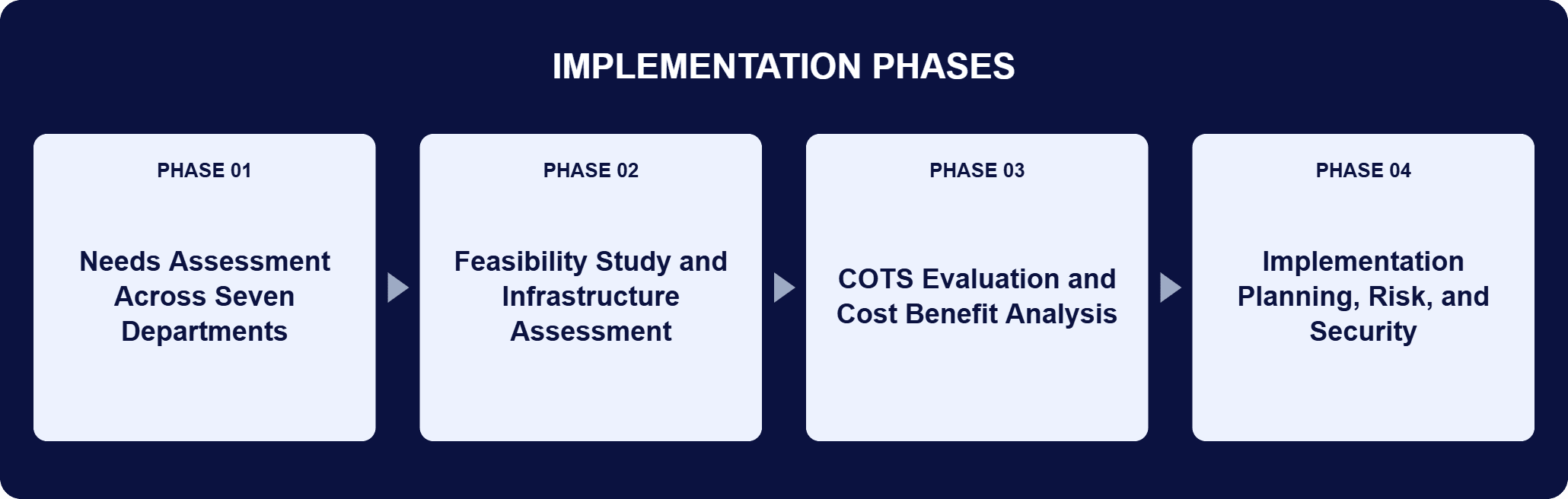
PHASE 03
COTS Evaluation and Cost Benefit Analysis
i3solutions evaluated and demonstrated various Commercial Off-The-Shelf (COTS) contract management systems to identify viable options that met the agency’s procurement needs. A Cost Benefit Analysis, conducted according to the agency’s own system development methodology, revealed that purchasing an off-the-shelf product was the most cost-effective solution, because the agency’s procurement processes aligned with standard software capabilities.
PHASE 04
Implementation Planning, Risk, and Security
i3solutions developed a detailed project plan, risk assessment, and security plan for the upgrade. The project plan reduced implementation time by over 35%. The risk assessment and security plan identified and mitigated potential challenges early, and the upgrade proceeded with minimal disruption to procurement operations.
The deliverable on this engagement was a decision and the evidence behind it, so the architecture of the work is the architecture of the analysis. Five instruments answered five different questions, and none of them substituted for another. The Needs Assessment established requirements from 30 individuals across seven departments, so the specification came from the people running contracts and procurement rather than from the systems being retired. The feasibility study tested whether those requirements could be met at all. The infrastructure assessment answered a question the feasibility study cannot: whether the agency’s existing environment could support a fully web-based solution. Evaluations and demonstrations of Commercial Off-The-Shelf contract management systems tested the requirements against what the market already sells, which converted the buy option from a hypothesis into specific products the agency had seen run. The Cost Benefit Analysis then priced the options according to the agency’s own system development methodology, and found that purchasing an off-the-shelf product was the most cost-effective solution, because the agency’s procurement processes aligned with standard software capabilities. The project plan, risk assessment, and security plan turned that finding into an executable upgrade.

$1.5 Million in Development Costs Avoided
A needs assessment, feasibility study, and cost-benefit analysis recommended buying a COTS system instead, and cut implementation time by over 35%.
| Outcome | Before | After |
|---|---|---|
| Development cost | Custom application development on the table as the upgrade path | Over $1.5 million in unnecessary development costs avoided |
| Implementation time | No agreed path forward for the upgrade | Project plan reduced implementation time by over 35% |
| Buy versus build | Cost-effectiveness of the options not yet evaluated | Cost Benefit Analysis run to the agency’s own system development methodology identified an off-the-shelf contract management system as most cost-effective |
| Requirements basis | Two legacy systems carrying procurement across multiple departments | Requirements gathered from 30 individuals across seven departments |
| Risk and security | Potential risks of the upgrade not yet understood | Risk assessment and security plan, with potential challenges identified and mitigated early |
The two headline numbers come from the same recommendation. Identifying a cost-effective, off-the-shelf contract management system saved the agency over $1.5 million in unnecessary development costs, money that would otherwise have funded custom application development the agency did not need. The project plan i3solutions developed reduced implementation time by over 35%, so the saving was not bought back out of schedule.
The rest of the result sits in what did not happen. The risk assessment and security plan identified and mitigated potential challenges early, which is where costly setbacks in a system upgrade normally originate, and the upgrade proceeded with minimal disruption to procurement operations and continued functionality without delays. The detailed assessment and documentation left the agency able to select its procurement solution against operational and financial goals it had written down, instead of against whichever case was argued hardest in the room.

PENDING-CLIENT-QUOTE
This engagement is relevant for
Less relevant for
An Independent Analysis Costs Less Than the Build It Prevents
The engagement established that the most valuable outcome of a systems analysis can be a recommendation not to build. Two legacy procurement systems on obsolete technologies needed replacing, and the agency’s open question was what to replace them with.
A Needs Assessment across 30 individuals in seven departments, a feasibility study, an infrastructure assessment, evaluations and demonstrations of Commercial Off-The-Shelf contract management systems, and a Cost Benefit Analysis conducted according to the agency’s own system development methodology answered it: purchase off-the-shelf, because the agency’s procurement processes aligned with standard software capabilities. That answer saved over $1.5 million in unnecessary development costs, and the project plan, risk assessment, and security plan delivered alongside it reduced implementation time by over 35% while procurement operations kept running through the upgrade.
An IT systems analysis is a structured examination of what a system has to do, what the existing environment can support, what options exist, and what each would cost, produced before money is committed. On this engagement for a federal housing agency, i3solutions ran it as five connected pieces of work: a Needs Assessment interviewing 30 individuals across seven departments to gather requirements for an upgraded procurement system; a feasibility study analyzing whether those requirements could be met; an infrastructure assessment determining whether the agency’s existing environment could support a fully web-based solution; evaluations and demonstrations of Commercial Off-The-Shelf contract management systems; and a Cost Benefit Analysis conducted according to the agency’s own system development methodology. The output is a recommendation with its evidence attached, plus the project plan, risk assessment, and security plan needed to act on it.
By separating the questions instead of answering them all at once. Whether the requirements can be met is a different question from whether the existing infrastructure can support a fully web-based solution, and both are different from which option is most cost-effective. On this engagement each got its own instrument: a feasibility study, an infrastructure assessment, and a Cost Benefit Analysis, with evaluations and demonstrations of Commercial Off-The-Shelf contract management systems supplying real options rather than hypothetical ones. The cost comparison was conducted according to the agency’s own system development methodology, so the finding arrived in the standard the agency already uses to approve spending. When the analysis showed that the agency’s procurement processes aligned with standard software capabilities, the recommendation was to buy, and the engagement said so.
With a comprehensive Needs Assessment. i3solutions interviewed 30 individuals across seven departments to gather key requirements for an upgraded procurement system, then ran a feasibility study to analyze whether those requirements could be met and an infrastructure assessment to determine whether the agency’s existing environment could support a fully web-based solution. The breadth follows from how the legacy estate was arranged: two systems managed contracts and procurement processes across multiple departments, so no single office held the full specification of what a replacement had to do. Interviewing across seven of them produced requirements the whole agency could be held to, and gave the later Cost Benefit Analysis a definition of scope that had not been written by whoever wanted a new system most.
i3solutions evaluated and demonstrated various Commercial Off-The-Shelf (COTS) contract management systems, then ran a Cost Benefit Analysis according to the agency’s own system development methodology. It showed that purchasing an off-the-shelf product was the most cost-effective solution, because the agency’s procurement processes aligned with standard software capabilities. That alignment is the whole test. Custom application development earns its cost when an organization’s processes cannot be expressed in what the market already sells; when they can, a build pays a second time for capabilities that already exist. Identifying that system saved the agency over $1.5 million in unnecessary development costs. The recommendation came from a firm with proven expertise in system integration and web-based application development, which is to say from people who knew what the alternative build would have cost.
The project plan i3solutions developed reduced implementation time by over 35%. The accompanying risk assessment and security plan identified and mitigated potential challenges early, and the upgrade proceeded with minimal disruption to procurement operations. Schedule and risk are the same subject on a legacy replacement, because the delays that actually hurt are caused by problems nobody planned for, which makes a risk assessment done before the work starts a schedule instrument as much as a governance one. The plan also had the advantage of being built on settled questions rather than open ones: requirements, feasibility, infrastructure fit, and the product choice were already established by the analysis, so procurement operations continued through the transition without delays.
The agency selected i3solutions based on proven expertise in system integration and web-based application development, and that profile is why the analysis carried weight. A firm that builds custom applications recommending against a custom application is an expensive recommendation to make and a credible one to receive, because the estimate of what a build would take comes from the people who do the building. On this engagement that expertise produced a Needs Assessment across 30 individuals in seven departments, a feasibility study, an infrastructure assessment, COTS evaluations and demonstrations, and a Cost Benefit Analysis run to the agency’s own system development methodology, then the project plan, risk assessment, and security plan to execute the result. It saved over $1.5 million in unnecessary development costs and cut implementation time by over 35%. For organizations weighing a legacy replacement, a short scoping conversation establishes what the equivalent analysis would examine in your environment.
Yes, that was the requirement for this federal housing agency’s independent systems analysis. i3solutions conducted the needs assessment, feasibility study, and cost-benefit analysis against the agency’s own methodology, which is what gave leadership a defensible recommendation, buying a COTS system instead of building one, rather than an outside opinion that didn’t match how the agency has to justify spending. The analysis also cut over 35% off the implementation timeline by settling the buy-versus-build question up front.
That figure came from an independent analysis, not from choosing the cheaper option by default. We can talk through what a comparable buy-versus-build analysis would look like for your agency.

US-Based | Est. 1997
© i3solutions. All rights reserved.
US-Based | Est. 1997
© i3solutions. All rights reserved.


