

Organizations should evaluate candidate Copilot use cases using four criteria before assigning licenses: task shape, evidence potential, workload fit, and grounding dependency. A use case that cannot be measured through admin reporting becomes difficult to evaluate objectively, and the missing step is applying a written scorecard before allocating seats.
Steering committees create plausible shortlists of potential Copilot applications without a systematic way to differentiate them. Two quarters later, the organization has satisfaction scores but no finding: nobody can say which of the eight candidates should have gone first, and nobody can defend removing the ones that never delivered. The missing step is applying a written scorecard before allocating seats. The scorecard below is that step.
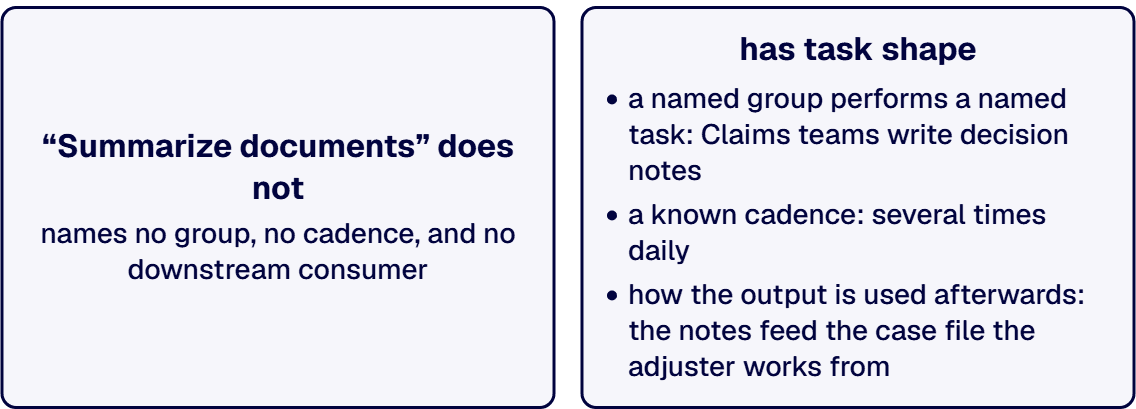
A use case has task shape when a named group performs a named task on a known cadence, and someone can say how the output is used afterwards. “Claims teams write decision notes several times daily, and the notes feed the case file the adjuster works from” has task shape. “Summarize documents” does not, because it names no group, no cadence, and no downstream consumer. A use case without task shape cannot be measured because there is nothing specific to measure.
Whether the Microsoft 365 admin center can produce a measurable artifact for this use case. This criterion outranks the others when conflicts arise. The usage report has to define the metric: submitting a prompt counts, opening the pane does not. If the reporting surface cannot separate the use case from ambient activity, the use case cannot be evaluated after go-live, and it cannot be defended in a renewal conversation.
Whether work occurs within applications Copilot reporting recognizes, and at what resolution. Feature-level reporting in small groups may return suppressed data (double dash) rather than usable metrics, because Microsoft’s privacy floor kicks in below a threshold. A use case that lands below that floor is measurable in principle and unmeasurable in practice.
Whether value derives from general internet capability or from organizational content. Internet-based chat carries no weight in a license conversation, because it is available on cheaper products and does not use the reach the enterprise license pays for. Tenant-content candidates do carry weight, because they demonstrate the specific thing the seat is being bought for.
Scaling Copilot from a cohort to an enterprise adds operating-model, monitoring, and enablement work no pilot team was sized for. i3solutions provides senior AI specialists who take rollouts to production under enterprise governance.
Measurement design requires four elements documented before implementation, so the answer is knowable before rather than argued afterwards.
The unit of activity. Quote it from Microsoft documentation. “Prompts submitted” is a unit. “Engagement” is not. The unit decides what the report can produce, and a use case whose owner cannot say what the unit will be is a use case whose measurement will get invented at renewal.
The reporting surface and export method. Name the admin center report, the field, and how it will be exported. A use case that requires a report that does not exist is a use case that will be measured in narrative instead.
Resolution level. Application level (Outlook, Word, Teams) is one resolution. Feature level (a specific Copilot experience inside an application) is another. Feature-level reporting in small groups may not produce usable data. Establish which resolution the use case sits at before the pilot runs.
Qualitative data from the performing group. Structured interviews with the people doing the task, asked after some real use, about whether the output is usable. This is not satisfaction scoring. It is asking the claims adjuster whether the decision note Copilot drafted is something they would send. If the answer is no, the quantitative data is beside the point.
Not every candidate is wrong; some are wrong for now. Avoid early testing on these six patterns.
Work outside reported Microsoft 365 applications. If the task happens in a system Copilot reporting does not surface, the use case cannot be measured through the admin center, and the evidence criterion fails.
Feature-level candidates in groups below minimum size thresholds. The privacy floor suppresses data, and the use case comes back with double dashes instead of numbers. Run the group size against the reporting threshold before assigning seats.
Tasks valued for internet results. If the value is a well-written summary of publicly available content, cheaper tools do the same thing. This is the grounding-dependency test, and it fails when the answer would be the same on a consumer product.
Work requiring permission remediation first. If the estate has an oversharing problem and Copilot would surface it, the first move is remediation, not licensing. A use case that reads across content nobody re-permissioned produces confident answers about content the asker should not have seen.
Tasks without downstream output consumers. If the output has nowhere to go, the use case is a demo of a capability, not a task being performed. Nobody notices when it stops, which is the same as saying it never started.
Capabilities chosen for demonstration appeal rather than actual workflow value. A use case that looks impressive in a steering committee slide and vanishes in the field is a scorecard failure disguised as an adoption failure.
When a capability would be missed if withdrawn and people could name the task, the use case sticks. Shortlists unable to predict which candidate would generate complaints represent aspirations rather than grounded selections. The scorecard above is designed to sort those two categories before the seats are assigned, not after.
i3solutions has delivered on the Microsoft stack since 1997, with senior, 100 percent US-based teams working under the compliance standards regulated environments require. Copilot use case selection runs the same discipline every governance-first program does: name the group, the task, and the cadence; establish the measurement before the rollout; and set a defer list that the steering committee signs off on so the ambition matches what can be evidenced at renewal.

Michael Branson co-founded i3solutions 30 years ago and brings executive, operational, and technical perspective to organizations working in complex, secure, and mission-critical environments. His insights focus on business process consulting, automation, data analytics, collaboration, secure operating models, and the operational discipline required to turn technology investments into practical business systems with measurable value.
Connect on LinkedInScore each candidate against four criteria before assigning licenses: task shape (a named group performs a named task on a known cadence, and someone can say how the output is used afterwards), evidence potential (the Microsoft 365 admin center can produce a measurable artifact), workload fit (work occurs within applications Copilot reporting recognizes at a usable resolution), and grounding dependency (value derives from organizational content rather than general internet capability). When conflicts arise, evidence potential outranks the others, because a use case that cannot be measured cannot be defended at renewal.
A use case has task shape when a named group performs a named task on a known cadence and someone can say how the output is used afterwards. 'Claims teams write decision notes several times daily, and the notes feed the case file the adjuster works from' has task shape. 'Summarize documents' does not, because it names no group, no cadence, and no downstream consumer. A use case without task shape cannot be measured because there is nothing specific to measure.
Design the measurement before you start, with four elements documented: the unit of activity quoted from Microsoft documentation (prompts submitted is a unit; engagement is not), the reporting surface and export method, the resolution level (application versus feature), and qualitative data from the performing group about whether the output is usable. Feature-level reporting in small groups may be suppressed by the privacy floor, so check group size against the reporting threshold before assigning seats.
Six patterns: work outside reported Microsoft 365 applications, feature-level candidates in groups below minimum size thresholds, tasks valued for internet results, work requiring permission remediation first, tasks without downstream output consumers, and capabilities chosen for demonstration appeal rather than actual workflow value. None of these is a permanent no. Each is a fix-the-prerequisite-first sequence.
When a capability would be missed if withdrawn and people could name the task, the use case sticks. Shortlists unable to predict which candidate would generate complaints represent aspirations rather than grounded selections. The four-criteria scorecard sorts those two categories before the seats are assigned rather than after.
Oversharing, unlabeled content, and ungoverned agents decide what an AI rollout exposes, and they are set before the first prompt. i3solutions' senior AI advisors work with enterprise IT leaders who need the readiness gaps closed under a scoped program.
Schedule an AI and Copilot Scoping Discussion
US-Based | Est. 1997
© i3solutions. All rights reserved.
US-Based | Est. 1997
© i3solutions. All rights reserved.


