

Power Platform ALM moves a maker-built solution out of an unmanaged development environment and into managed production through solutions, source control, and a deployment path with its own test stage. Skipping any of the three leaves an audit gap the next assessor will find. The six-stage release path runs in order: build unmanaged, version and commit, export as managed, test as managed, deploy to production, and hand off ownership.
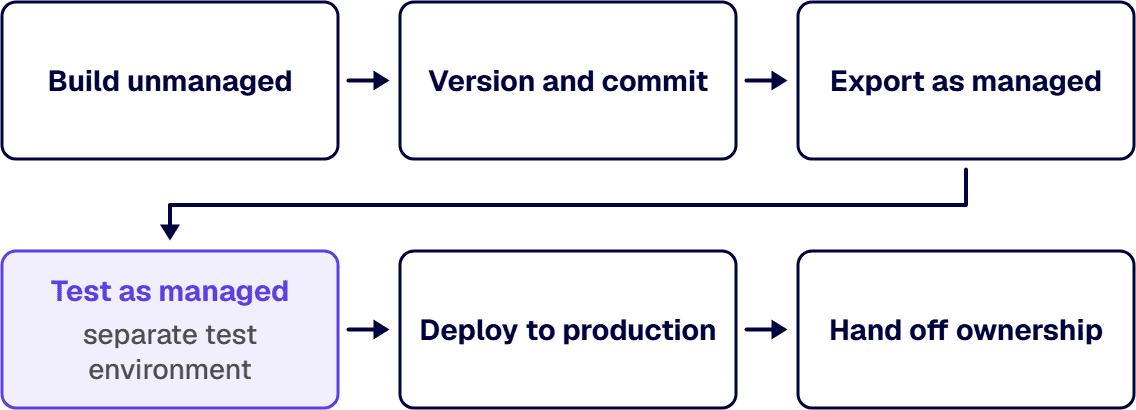
Maker-built solutions in unmanaged development environments look finished before they are governed. The move from unmanaged to managed is the move that puts the work under change control, gives it a repeatable release path, and produces the evidence a compliance review reads later. Skipping that move is how a working app becomes an unaudited dependency.
Components organized into named solutions under a custom publisher. The custom publisher is what lets multiple solutions coexist without namespace collisions, and it is what appears on every component the solution owns.
Exported files stored in source control with change history. Microsoft states that exported unmanaged versions of your solutions should be checked into your source control system. That commit is the audit anchor: the point in history a rollback deploys forward from.
The same solution re-exported as a managed artifact for deployment. Managed is how the solution enters non-development environments; unmanaged is what you edit.
Managed solution imported into a separate test environment for validation. Critically, Microsoft documents that you cannot import a managed solution into the same environment that contains the originating unmanaged solution. A separate test environment is a mechanical requirement, not a nice-to-have.
Unmodified artifact imported with environment-specific configurations. The artifact that lands in production is the same one that passed test; environment differences ride in configuration data, not in re-exported solutions.
Named business and technical owners receive the solution with documentation. Without the handoff, the solution belongs to whoever built it, and the build team owns operational risk indefinitely.
Unmanaged solutions are development environments where changes occur. They are what makers edit and what source control commits capture.
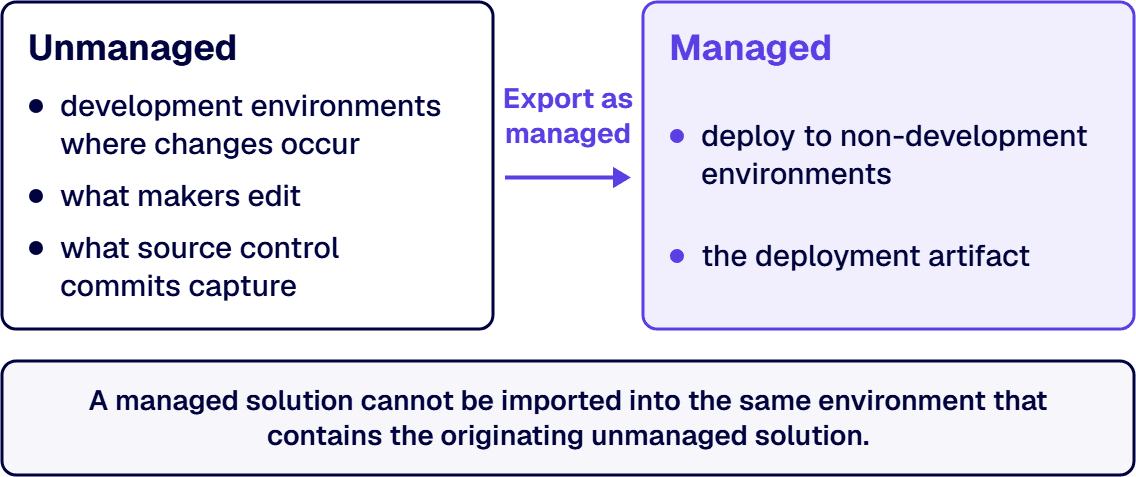
Managed solutions deploy to non-development environments. Microsoft’s constraint is explicit: a managed solution cannot be imported into the same environment that contains the originating unmanaged solution. Test infrastructure separate from development is therefore a requirement of the platform, not a preference of the practice.
The distance between a working app and a governed application is architecture, release control, and ownership. i3solutions’ Power Platform services are scoped and staffed at the senior level to close that distance on a schedule you can defend.
Three validation types precede each release, and each catches a different class of defect.
Static analysis via solution checker against best-practice patterns. Fastest to run, catches the mechanical mistakes that never should have shipped.
Deployment rehearsal through pipelines validating dependencies and configurations. This is where a missing dependency surfaces on a test import rather than a production one, at the cost of a test cycle rather than an outage.
Functional validation by personnel exercising the business logic as end-users. The tests the platform cannot write, done by the people who will suffer if they fail.
Recovery differs from reversal. Microsoft documents that when a managed solution is deleted, meaning uninstalled, all the customizations and extensions included with it are removed, including data in custom tables. Deletion is not a rollback strategy; it is a data-loss event.
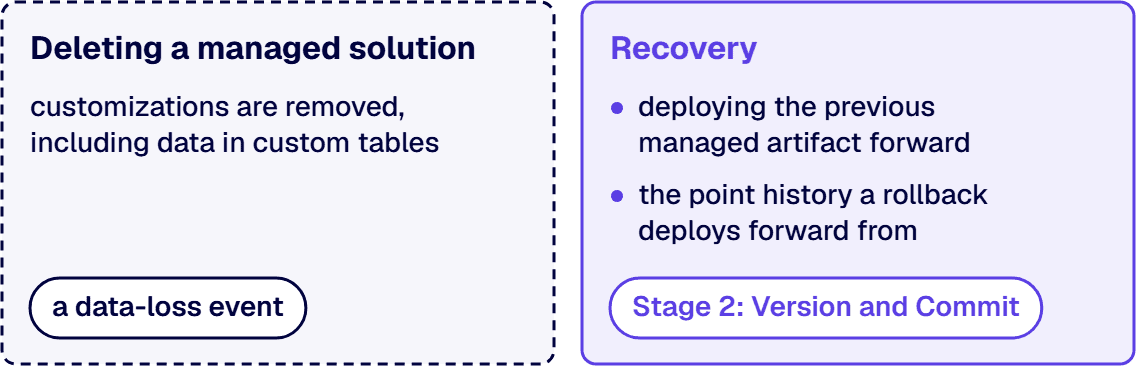
Recovery relies on deploying the previous managed artifact forward, not on uninstalling the current version. That is the practical purpose of Stage 2’s commit: the point history a rollback deploys forward from.
Sustainable solutions require four pieces at handoff. Dual ownership: a business owner accountable for whether the encoded process still fits, and a technical owner accountable for release management and environment integrity. Named deployment authority: who authorizes a promotion to production, and how the record shows they did. Source control access persistence: a maker’s departure cannot remove the team’s ability to build. And monitoring responsibility assignment: the person whose job it is to notice when the solution stops behaving as designed.
i3solutions has delivered on the Microsoft stack since 1997, with senior, 100 percent US-based teams. ALM runs the same discipline every governance-first program does: build under a custom publisher, commit before exporting, deploy the same artifact through test and production, and hand off with named owners and the evidence a review can read.

Michael Branson co-founded i3solutions 30 years ago and brings executive, operational, and technical perspective to organizations working in complex, secure, and mission-critical environments. His insights focus on business process consulting, automation, data analytics, collaboration, secure operating models, and the operational discipline required to turn technology investments into practical business systems with measurable value.
Connect on LinkedInPower Platform ALM moves a maker-built solution out of an unmanaged development environment and into managed production through solutions, source control, and a deployment path with its own test stage. It matters because skipping any of the three leaves an audit gap the next assessor will find, and because the moment a working application enters production without a release path is the moment operational risk transfers permanently to whoever last edited it.
Build unmanaged (components in named solutions under a custom publisher), version and commit (exported files in source control with change history), export as managed (the artifact deployed to non-development environments), test as managed (imported into a separate test environment because Microsoft does not allow importing a managed solution into the same environment as the originating unmanaged one), deploy to production (unmodified artifact with environment-specific configuration), and hand off ownership (named business and technical owners with documentation).
Unmanaged solutions are for the development environment where changes are made and where exported unmanaged versions should be checked into source control. Managed solutions are the deployment artifact used for non-development environments. Microsoft's key constraint is that you cannot import a managed solution into the same environment that contains the originating unmanaged solution: a separate test environment is a platform requirement, not a nice-to-have.
Three, each catching a different class of defect. Static analysis via solution checker against best-practice patterns. Deployment rehearsal through pipelines validating dependencies and configurations. Functional validation by personnel exercising the business logic as end-users. Skipping any of them shifts the discovery of the defect to production.
Recovery differs from reversal. When a managed solution is deleted, meaning uninstalled, all the customizations and extensions included with it are removed, including data in custom tables. Recovery relies on deploying the previous managed artifact forward, not on uninstalling the current version. That is the practical purpose of the source-control commit: the history point a rollback deploys forward from.
Ungoverned environments, unmanaged connectors, and apps on personal credentials surface at audits, not in demos. i3solutions' senior Power Platform advisors work with enterprise IT leaders who have found the exposure and want the remediation scoped.
Request a Power Platform Scoping Discussion
US-Based | Est. 1997
© i3solutions. All rights reserved.
US-Based | Est. 1997
© i3solutions. All rights reserved.


