

The rapid prototype vs production build decision turns on one question: which uncertainty is worth buying evidence about before the budget commits. Prototype when the answer would change what gets built; build for production when the requirement is settled and the risk sits in delivery. Four tests settle the decision, and when they disagree, the constraint test outranks all others.
This page settles one question: whether to prototype first or build for production directly. Downstream decisions about prototype success, readiness domains, and code hardening belong to other frames. The prototyping definition and paid prototyping services are addressed separately, as is enterprise application discovery before a rebuild.
A prototype obtains an answer to a question that was going to be answered anyway, bought earlier and cheaper than the build would have answered it.

Four kinds of question warrant a prototype:
What prototypes cannot provide: a schedule (single-operator testing on one dataset does not predict production timelines), an architecture (shortcuts made for speed would face review rejection), a support position (organizational structure decisions, not technical demonstrations), or a decision itself (evidence requires a named person to read it and rule).
The demo trap: a successful prototype meets enthusiasm but no actual ruling occurs, and the artifact quietly runs real processes without governance. This is the failure the four contract terms below prevent.
| Test | Prototype first when | Build for production when | Required artifact |
|---|---|---|---|
| Uncertainty | A named open question changes scope, not merely approach | Open questions only alter sequence and effort | Uncertainty register exported from backlog tool showing each question and its blocking decision |
| Decider | A named person will read results and rule go/no-go on a specific date | Approval already exists and budget is committed | Decision record naming the signer and the signing date |
| Cost-of-being-wrong | Building the wrong thing costs materially more than obtaining the answer first | Wrong answers are inexpensive to correct during build because disputed parts are small or late | Cost comparison showing prototype’s quoted price against rework exposure |
| Constraint | Representative testing can occur without production data and within existing compliance boundaries | Dated external commitments or data rules make throwaway artifacts unusable as evidence | Constraint list pairing dated commitments from contract register with data classifications |
When the tests disagree, the constraint test outranks all others. The decider test ranks second. The uncertainty test ranks third. The cost-of-being-wrong test breaks remaining ties and never overrides the first two independently.
Prototype path costs: the artifact build cost, the attention cost (time from the few who understand the actual process), and the decision cost (a meeting for the ruling, requiring a quorum that can actually say no).
Production build path costs: discovery (paid regardless of prior prototyping), architecture, environments, test coverage, release control, and the support position and SLAs the release requires.
The asymmetry that matters: a wrong prototype costs its own budget and, where its success measure was agreed before the run, returns a fact. A wrong production build costs its budget, the rework, and the operational exposure of a system a team has started to depend on. “Budget for twice” is the planning assumption when prototypes are truly throwaway, because the artifact is discarded and the production build starts from evidence rather than code.
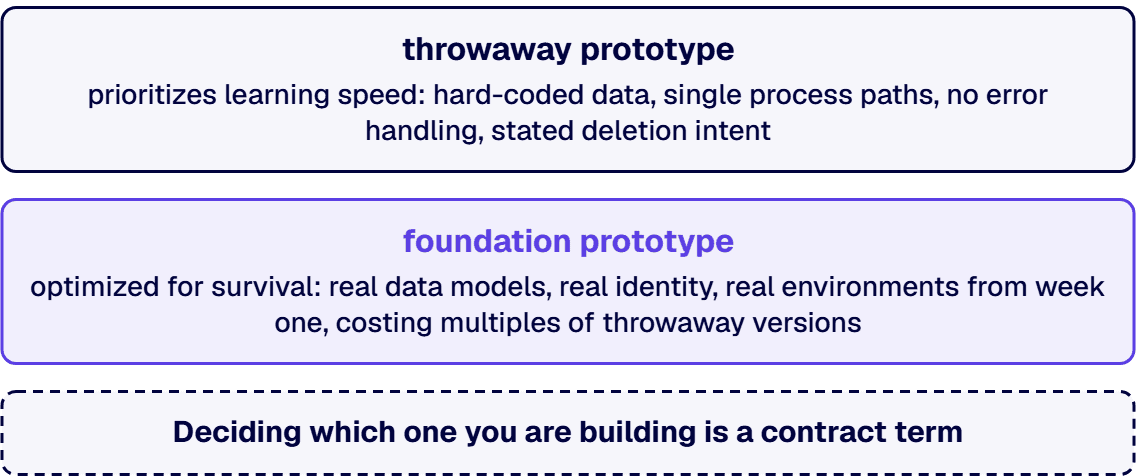
Throwaway versus foundation. A throwaway prototype prioritizes learning speed: hard-coded data, single process paths, no error handling, stated deletion intent. A foundation prototype is optimized for survival: real data models, real identity, real environments from week one, costing multiples of throwaway versions. Deciding which one you are building is a contract term, not an emergent property.
i3solutions designs and builds applications on the Microsoft stack with the architecture decided first, the scope defined, and the delivery owned by senior engineers.
Requirement is settled, argument concerns effort. Where process documentation exists, users are known, the data source is agreed, and disagreement is only about timeline, a prototype answers an unasked question. Signal: a backlog where open items are all estimates with no substantive questions.
Uncertainty is organizational. Where departments disagree about process ownership, or sponsors and operations leads want different outcomes, a working screen creates new artifacts for argument rather than resolving disagreement. Signal: workshop minutes showing process ownership as an open item, not process definition.
Evidence cannot be produced under applicable constraints. Where questions concern production data volumes or compliance positions the test environment lacks, prototypes answer questions about synthetic cases. Signal: success measures in scope documents requiring production data references.
Nobody waits for the answer. No decision date, no named signer, no budget round connection means evidence gets filed unread. Signal: absence of a calendar entry for the decision. This is the demo trap’s origin.
A prototype returning negative results (platform unfitness, integration target miss) succeeds perfectly. Programs treating negative findings as failure will abandon commissioning and carry the same uncertainty into the build.
Four contract terms are agreed before prototype work begins and signed by sponsor and delivery lead.
The question, one sentence with a measure. Not “test the concept” but a specific, measurable claim. Example: the approval step completes without leaving the application, or the nightly extract lands inside the window finance already works to.
The disposal term. Decided upfront: throwaway, reusable in part (naming which parts), or intended foundation. This determines cost and technical standards. Disposal terms are where prototypes get silently promoted unless actively enforced.
Audience and boundary. Who uses the artifact, on what data, for how many process cycles. Fails silently once shared environments make prototypes useful to unintended audiences.
The decision, its owner, and its date. A steering group entry exists before commission, with named decision authority. Without it, the ruling never happens and the artifact keeps running.
Prototype scoped to impress rather than inform. Demonstrates attractive paths while skipping exceptions, volumes, and integrations. Signal: scope written as a feature list with no open question named.
Success criteria written after the results. The prototype runs, the team approves, criteria are reconstructed to match. Signal: hypothesis in scope with no threshold: nothing can refute it.
Throwaway quietly promoted. No disposal term agreed, the artifact proves useful, departments start running work through it. Signal: prototype still operating past its stated end date.
Production discovery skipped because the prototype felt like discovery. Prototypes answer bounded questions; they do not recover business rules old systems encode, undocumented integrations, or reporting dependencies. Signal: build estimate whose requirements section cites only the prototype.
i3solutions has delivered on the Microsoft stack since 1997, with senior, 100 percent US-based teams. The prototype-or-build decision runs the same discipline every governance-first program does: apply the four tests in priority order, put the four contract terms in writing, and stop pretending a prototype has answered questions it was not scoped to.

Michael Branson co-founded i3solutions 30 years ago and brings executive, operational, and technical perspective to organizations working in complex, secure, and mission-critical environments. His insights focus on business process consulting, automation, data analytics, collaboration, secure operating models, and the operational discipline required to turn technology investments into practical business systems with measurable value.
Connect on LinkedInPrototype first when a named open question would change what gets built; build for production when open questions change only sequence and effort. Four tests settle this: uncertainty, decider, cost-of-being-wrong, and constraint. When tests disagree, constraint outranks others, decider ranks second, uncertainty third, and cost-of-being-wrong breaks remaining ties.
One claim, stated as a testable hypothesis with a threshold that could fail. Proof should demonstrate: workflow runs end-to-end for all roles including disputed exceptions; chosen platform meets requirements without reviewer-refused workarounds; integration, volume, or performance targets work against actual systems, not demonstration samples; and business owners can describe outcomes clearly enough to fund production work. Prototypes proving only easy paths while leaving integrations, volumes, and exceptions untested prove the wrong claims.
In four situations: when requirements already exist and disagreement concerns only effort; when uncertainty is organizational (screens create new argument artifacts rather than settling disagreements); when evidence cannot be produced under applicable constraints (results describe synthetic rather than real cases); and when nobody waits for answers (no decision date, no named signer). Negative results are not waste: refuting platform choices before builds avoids later rework.
Agree disposal terms before starting (throwaway, reusable-in-part with pieces named, or intended foundation) and have the sponsor sign. Enforce boundaries mechanistically: separate environments, distinct identity configuration, stated usage limits and data restrictions, and documented end dates. When units request extensions, treat requests as decisions with stated costs rather than silent continuations.
Different cost shapes, not different total sizes. Prototypes pay for artifact, attention from process experts, and the decision meeting. Production builds pay for discovery, architecture, environments, test coverage, release control, and the support position: costs that do not shrink when requirements prove simple. The deciding number is wrong-answer cost: wrong prototypes spend their budget and return a fact (if success criteria were pre-written); wrong builds spend budgets, pay rework costs, and expose systems people depend on.
Harden, rebuild, or retire is an architecture call with real money on every branch. i3solutions' senior application architects work with IT leaders who want that call made on evidence and carried into delivery.
Request an Application Scoping Discussion
US-Based | Est. 1997
© i3solutions. All rights reserved.
US-Based | Est. 1997
© i3solutions. All rights reserved.


