

Daily attendance for missions of up to 10,000 soldiers was keyed by hand into Excel spreadsheets.
The client is a state National Guard organization, a component of the United States National Guard, which serves both its state and the United States as a whole. This reserve component of the United States Armed Forces responds to emergencies, supports local communities, and assists in national defense efforts when called upon. In that setting, attendance is not clerical paperwork. It is the record that proves where soldiers were and the record that pays them.
Monitoring soldier attendance relied on manual processes using Excel spreadsheets uploaded into SharePoint. Daily attendance was logged by hand and consolidated into a master sheet spanning the entirety of the mission. Any discrepancy required management to create entirely new spreadsheets, which increased the likelihood of errors, and soldiers’ daily whereabouts, active-duty statuses, and personal details including rank and duty station were all entered by hand. The organization engaged i3solutions to replace that method with a solution capable of handling missions of varying scales, spanning multiple states, and accommodating diverse team sizes ranging from 50 to 10,000 soldiers.
A state National Guard tracked daily attendance for missions as large as 10,000 soldiers by hand in Excel before uploading it to SharePoint. i3solutions built a single mission tracker covering every scale of response, cutting manual data entry 60% and saving roughly $180,000.
Manual data entry dropped 60% for about $180,000 in annual staff-time savings, attendance reporting that once took hours now takes minutes, and audit-verified accuracy above 95% cut payroll discrepancies by roughly $250,000 a year.

The Attendance Record Is Also the Payroll Record
The tracking problem looked administrative and behaved financially. The primary goal was to enhance mission attendance tracking so it produced reliable documentation for payroll purposes, which meant the system had to carry more than presence. It also had to extract specific subject matter data to facilitate accurate payment based on factors like rank, duty, and marital status.
Hand-keyed spreadsheets could not hold that standard at mission scale. Every correction spawned another file, and the master sheet covering the entire mission was only ever as current as the last person to rebuild it. The organization decided the answer was a purpose-built system rather than tighter spreadsheet discipline, and it had to work the same way whether a mission fielded 50 soldiers or 10,000 across several states.
Treating attendance as a control rather than a spreadsheet is what removed the step that produced this organization’s errors. If your attendance or time tracking still runs on manually rebuilt spreadsheets, the same reframing usually points to the fix.
Entry Errors Arrive in Soldiers’ Pay
Manual entry sets a floor under the error rate, and here that floor was measurable: error rates once averaged around 1% per payroll cycle, with audit findings open against the process. Because a soldier’s pay is calculated from what the attendance record says about them, a keying error does not stay inside the data. It reaches a soldier’s paycheck and then an auditor’s report.
The cost compounded on the operations side too. Payroll discrepancies later proved worth approximately $250k per year, and reconciling spreadsheets consumed staff time later valued at approximately $180k annually. Neither figure was a one-time exposure. Both recurred with every mission, and the reporting burden grew with team size, which on the largest missions meant 10,000 soldiers tracked through a method built for a roster small enough to read on one screen.
The Same System at 50 Soldiers and at 10,000
The scale range was the hard constraint. The solution had to handle missions of varying scales, spanning multiple states, and accommodate diverse team sizes ranging from 50 to 10,000 soldiers, without the arrangement that works on a small mission breaking on a large one. That ruled out per-mission improvisation and called for a repeatable structure: a dedicated space for each mission, with attendance organized identically whatever the mission’s size.
The second constraint was who operates it. Entry and retrieval sit with mission personnel rather than with system administrators, and corrections have to be resolved by the people accountable for the roster. So the system needed a direct interface for data entry and retrieval, a correction path that routes to the roster manager or the reviewer, and a roll-up that produces the master record without anyone assembling it by hand.
Senior Microsoft Specialists with Proven Delivery Depth
The requirements pointed at custom development on SharePoint rather than configuration of an off-the-shelf attendance product: dedicated mission spaces, automated workflow for entry, correction requests, and roll-up, extraction of the data payroll calculates from, and reporting that holds up under audit. That is full-lifecycle work on the Microsoft stack, and the margin for error was narrow because the output feeds both pay and audit.
The organization engaged i3solutions, a Microsoft Partner with 30 years of delivery experience and 1,500+ Microsoft engagements, delivered by an all-senior, all US-based delivery team. The work was delivered as a SharePoint development engagement built on SharePoint, C#, and JavaScript, with workflow automation carrying attendance entry, correction requests, and roll-up into a master record covering the length of the entire mission.
i3solutions implemented a custom mission attendance tool designed around how missions actually run: one dedicated space per mission, attendance entered and corrected by the people accountable for the roster, and a master record that assembles itself.
PHASE 01
Attendance and Payroll Requirements Definition
i3solutions worked from the goal backward. Reliable documentation for payroll purposes meant identifying the specific subject matter data the record has to carry so payment could be calculated from it accurately, and it meant fixing the scale range the design had to survive, from 50 soldiers to 10,000 across multiple states.
PHASE 02
Mission Workspace Architecture on SharePoint
SharePoint was used to create dedicated spaces for each mission, giving attendance records organized storage and one interface for data entry and retrieval. Holding the record in a single place rather than in a file passed between people is what improves both collaboration among the people submitting attendance and the accuracy of what they submit.
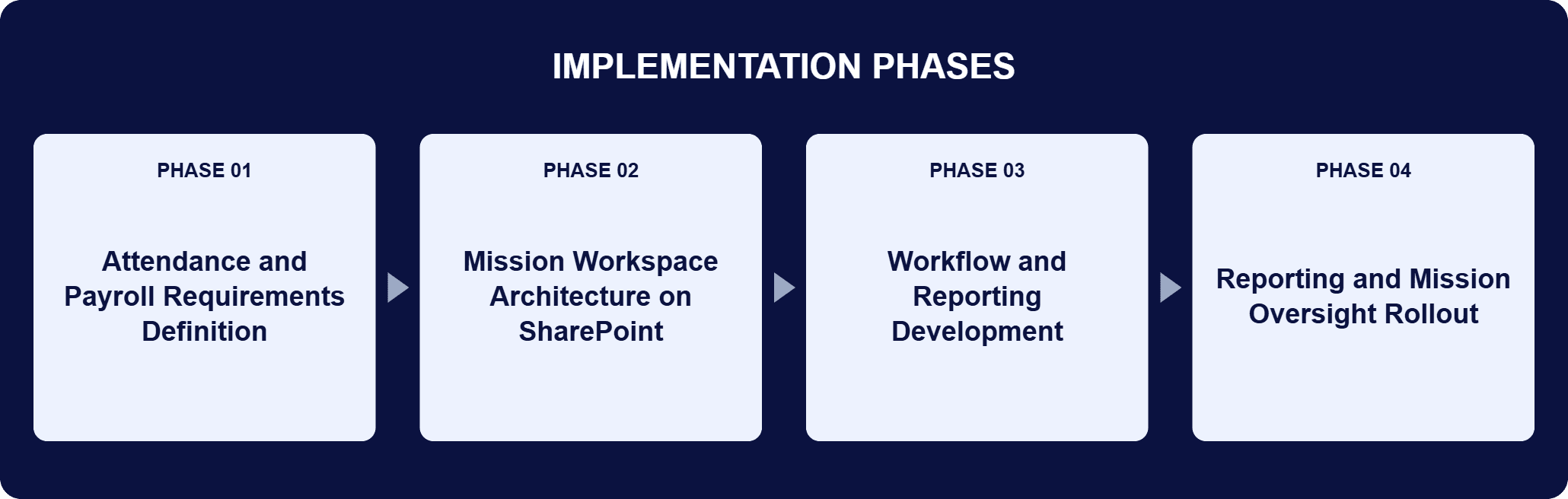
PHASE 03
Workflow and Reporting Development
i3solutions implemented the automated workflow process. Users enter mission attendance data, request corrections from either the roster manager or the reviewer, and daily reports roll into a master record that tracks attendance over the length of the entire mission. C# built the workflows and the integration between the SharePoint system and the rest of the solution; JavaScript delivered the interface behavior, including real-time updates, interactive elements, and responsive design.
PHASE 04
Reporting and Mission Oversight Rollout
Advanced reporting capabilities let users access data from the previous day instead of beginning each day from scratch, and gave mission managers an overall picture of mission data that is submitted, needs correction, and archived within the system. Entire task forces can be added rather than individual soldiers, which removed the duplicate entry that made large missions expensive to track.
SharePoint carries the record. It creates a dedicated space for each mission, so a 50 soldier mission and a 10,000 soldier mission are stored the same way instead of each getting its own spreadsheet, and it provides the one interface where mission personnel enter and retrieve data. C# built the workflows behind that interface and the integration between the SharePoint system and the rest of the solution. JavaScript enhanced the interface and drove dynamic interaction inside the attendance tool, enabling real-time updates, interactive elements, and responsive design. What the three produce together is a record that maintains itself. Attendance is entered once; a correction is a request routed to the roster manager or the reviewer rather than a new spreadsheet; and daily submissions roll into a master record covering the length of the entire mission. Reporting reads from that record, so a mission team pulls the previous day’s data instead of rebuilding it, and mission managers see what is submitted, what needs correction, and what is archived in one view. Because the same record carries the subject matter data payment depends on alongside presence, payroll calculates from it directly.

Manual Entry Down 60%
A dedicated SharePoint space per mission with automated roll-up workflows cut data entry and dropped reporting time from hours to minutes.
| Outcome | Before | After |
|---|---|---|
| Manual data entry | Daily attendance keyed into Excel spreadsheets uploaded into SharePoint | Reduced 60%, approximately $180k saved annually in staff time |
| Attendance reporting | Daily and cumulative reports taking hours and multiple clerks | Minutes, an estimated 40% to 50% improvement in operational throughput |
| Data accuracy | Error rates averaging around 1% per payroll cycle, audit findings open | 95%+ data accuracy rate, validated through audit logs |
| Payroll discrepancies | Corrections applied manually at the end of each mission | Reduced approximately $250k per year, audit-verified accuracy above 95% |
| Roster entry | Soldiers added one at a time | Entire task forces added at once, reporting time cut by more than half |
| Mission oversight | Master spreadsheet rebuilt whenever a discrepancy appeared | One master record showing submitted, needs-correction, and archived data |
The mission attendance solution reduced manual data entry by 60%, saving approximately $180k annually in staff time previously spent reconciling spreadsheets. The ability to add entire task forces instead of individual soldiers further minimized duplicate entry and cut reporting time by more than half. Automated workflows now handle attendance submission, corrections, and roll-up reporting, functions that once required multiple clerks and manual file management, and mission teams generate daily and cumulative attendance reports in minutes instead of hours, an estimated 40% to 50% improvement in operational throughput across missions.
Accuracy moved with the workload. By eliminating Excel-based inputs and pulling data directly from systems of record, the organization achieved a 95%+ data accuracy rate, validated through audit logs, and error rates that once averaged around 1% per payroll cycle were nearly eliminated, closing prior audit findings and ensuring compliance with federal reporting standards. Mission managers read one view of what is submitted, what needs correction, and what is archived, which is what informs decisions on where to send soldiers, how to pay them, and what to improve in the system next. Automated validation rules and integrated payroll logic reduced payroll discrepancies by approximately $250k per year while ensuring soldiers receive correct compensation based on rank, duty, and marital status, with far fewer manual corrections required at the end of each mission.
This engagement is relevant for
Less relevant for
Attendance Stops Being a Spreadsheet and Becomes a System of Record
The engagement established that attendance tracking is a payroll control rather than clerical work, and that it pays to build it like one. Putting a dedicated SharePoint space behind each mission, with workflow automation for entry, correction requests, and roll-up, removed the step that produced the errors: rebuilding a master spreadsheet by hand every time a discrepancy appeared.
The measured result was a 60% reduction in manual data entry worth approximately $180k annually in staff time, daily and cumulative reports produced in minutes instead of hours, and a 95%+ data accuracy rate validated through audit logs. Because the same record carries the pay-relevant detail alongside presence, automated validation rules and integrated payroll logic reduced payroll discrepancies by approximately $250k per year, and the design holds from a 50 soldier mission to one of 10,000.
It is a purpose-built system that records who was present on an operation, day by day, in a form both payroll and auditors can use. For this state National Guard organization, i3solutions built it on SharePoint, C#, and JavaScript: SharePoint creates a dedicated space for each mission and holds the attendance records, C# built the workflows and the integration between the SharePoint system and the rest of the solution, and JavaScript drives the interface behavior. What separates it from a shared spreadsheet is the workflow underneath. Attendance is entered once, correction requests route to the roster manager or the reviewer, and daily reports roll into a master record covering the length of the entire mission. Because the record also carries the subject matter data payment depends on, it supports accurate payment rather than only proving presence.
Missions of varying scales, spanning multiple states, with team sizes ranging from 50 to 10,000 soldiers. The structure is what makes that range workable. SharePoint creates a dedicated space for each mission, so a small mission and a large one are organized identically and neither needs a bespoke spreadsheet. On large missions, entire task forces can be added instead of individual soldiers, which minimizes duplicate entry exactly where it would otherwise be most expensive, and it is part of how reporting time was cut by more than half. Roll-up is automatic rather than manual, so a mission running across several states still produces one master record covering the length of the entire mission instead of a set of sheets somebody has to reconcile afterward.
Manual attendance tracking in Excel spreadsheets uploaded into SharePoint, consolidated into a master sheet spanning the entirety of the mission. Under that method any discrepancy meant creating entirely new spreadsheets, and soldiers’ daily whereabouts, active-duty statuses, rank, and duty station were all entered by hand. The new solution eliminated the Excel-based inputs and pulls data directly from systems of record. The practical difference shows up in what happens after a mistake. A correction is now a request routed to the roster manager or the reviewer and resolved against the existing record, rather than a fresh spreadsheet that becomes a second version of the truth for somebody to reconcile at the end of the mission.
Three steps, all inside one system. Users enter mission attendance data through the interface in the mission’s dedicated SharePoint space. Where something is wrong, they request a correction from either the roster manager or the reviewer, so the change is reviewed by a person accountable for the roster instead of being made unilaterally in a copy of a file. Daily reports then roll into a master record that tracks attendance over the length of the entire mission, and that record is what payroll and audit both read. Advanced reporting sits on top of it: users can access data from the previous day rather than starting each day from scratch, and mission managers see mission data that is submitted, needs correction, and archived within the system.
Yes. Each mission gets its own dedicated SharePoint space regardless of size, so a mission with dozens of participants and one with thousands both run on the same underlying structure rather than needing a different setup at scale. Automated roll-up workflows consolidate entry and corrections the same way in either case, which is what cut manual attendance entry by 60% across missions of very different sizes for this state National Guard, including ones spanning multiple states.
Automated validation rules and integrated payroll logic reduced payroll discrepancies by approximately $250k per year, while ensuring soldiers receive correct compensation based on rank, duty, and marital status. Audit-verified accuracy now exceeds 95%, with far fewer manual corrections required at the end of each mission. The mechanism behind the number is that the attendance record and the payroll inputs stopped being separate artifacts. The system extracts the specific subject matter data payment depends on, so calculation reads from the same record the mission maintains daily rather than from a reconciliation performed after the fact. An organization sizing a comparable return should start from its own discrepancy rate per payroll cycle and the staff time it currently spends correcting pay afterward.
i3solutions is a Microsoft Partner with 30 years of delivery experience and 1,500+ Microsoft engagements, with every engagement staffed by an all-senior, all US-based delivery team. This engagement shows what that profile is for. The output feeds pay and audit, so a design mistake is not a usability complaint; it is a payroll discrepancy and an audit finding. The delivered system covers the whole pattern: a dedicated SharePoint space per mission, workflow automation for entry, correction requests, and roll-up, reporting that mission managers act on, and payroll-relevant data carried in the same record, with measured results behind each. For organizations weighing similar work, a short scoping conversation establishes what the equivalent build would take in your environment.
The same record carrying pay-relevant detail alongside presence is what reduced payroll discrepancies by roughly $250K a year. We can talk through what a comparable system of record would look like for your organization.

US-Based | Est. 1997
© i3solutions. All rights reserved.
US-Based | Est. 1997
© i3solutions. All rights reserved.


