

Partners struggled to locate and access marketing, product, technical, and sales content in one place.
The client is a national building products manufacturer and a market leader in its product category across North America. The company has experienced significant growth and success, and it reaches its market through a network of dealers, distributors, and partners. That structure turns internal information into an external asset: the marketing materials, product data, technical resources, and sales content the company produces are worth something only once they are in the hands of the partners who sell and install the product. As the company scaled, it faced increasing challenges in managing and distributing that critical business and marketing information to its network. Timely and efficient communication with that network was essential, because brand loyalty, the selling capacity of the sales channel, and the company’s standing in its product category all depend on partners holding current information at the moment they need it.
The system the company had was cumbersome, time-consuming, and inefficient. Partners often struggled to locate and access the information they needed, which produced delays and lost productivity on the far side of the network, where the company has the least visibility. There was also no centralized way to target specific content to different partner groups, such as installers versus distributors, so segmentation depended on who sent what to whom. What the company needed was fast, secure access to partner-specific content, automated distribution of technical data and marketing materials, and a lower effort cost to manage all of it.
This building products manufacturer’s dealers and partners had to hunt across scattered systems for the marketing and sales materials they needed. i3solutions built a role-based portal, secured behind a single sign-on, that puts the right content in front of the right partner automatically.
Role-based access now segments content by partner group, so installers and distributors each see only what applies to them, and Entra ID single sign-on replaced multiple credentials with one login, with campaigns and product updates distributed automatically to targeted audiences.

Growth Turned a Content Problem Into a Channel Problem
The company’s difficulty was never a shortage of marketing and technical content. It was that the content had to travel. Every product update, campaign, and technical document had to reach dealers, distributors, and installers who work for other companies, on their own schedules, with no obligation to hunt for it. When the system holding that content was cumbersome and partners struggled to find what they needed, the failure landed where the company could not see it, in delays and lost productivity inside independent partner businesses.
Significant growth made the problem worse in two directions at once. More partners meant more people looking, and a broader body of marketing and product content meant more to look through, while the work of managing and distributing it stayed manual. Leadership set the requirement accordingly: fast and secure access to partner-specific content, automated distribution of technical data and marketing materials, and one place to manage the whole of it.
Partners weren’t struggling to find content because it didn’t exist, they were struggling because access wasn’t segmented by role. If your partner network has the same complaint, the fix is often access architecture, not more content.
The Channel Is Where the Brand Is Actually Delivered
Building products reach the end customer through the dealers, distributors, and installers who stock, sell, and install them, so brand loyalty, the effectiveness of the sales channel, and the company’s standing in its product category all run through people the company does not employ. Timely and efficient communication with that network was essential to all three. Leaving the existing system in place meant continuing to pay for it in delays and lost productivity every time a partner could not locate what it needed.
The second cost was the one that grows. The company was scaling, and the administrative effort of maintaining and distributing partner content was manual, which means it rises with the size of the network and the size of the catalog together. Without a way to segment content by partner role and push it automatically, every new dealer, distributor, and installer added to the same undifferentiated distribution problem, and staff hours went to redundant tasks rather than to the campaigns and product launches the content exists to support.
Secure Access for People Who Work for Someone Else
A partner portal is an external system holding internal content. The people using it are employees of independent dealers, distributors, and installers, which makes access control the load-bearing requirement: only relevant content can be accessible to each partner group, and access has to follow the partner’s role rather than a hand-maintained distribution list. The experience had to be simple at the same time, because a portal partners avoid leaves the company exactly where it started, and the previous system had already proven how quickly people give up on content they cannot locate.
Scope was the other complexity. The portal had to carry marketing materials, product information, technical resources, and sales content, plus a media library of high-resolution marketing images and promotional materials, and it had to distribute sales campaigns, product updates, and marketing collateral to targeted audiences automatically. Several of those components came from third-party software, so the build required close collaboration between the company, i3solutions, and third-party software vendors to integrate the portal’s parts into one working system.
Senior Microsoft Specialists with Proven Delivery Depth
The requirements defined the team profile: engineers who could build a partner-facing portal on the latest version of Microsoft SharePoint, implement role-based access control and single sign-on with Entra ID, write the custom web parts and backend logic the portal needed in .NET, put SQL Server behind partner and product data, and hold the result together across integrations with third-party software. This was custom development on a Microsoft platform, not configuration of a packaged partner-management product, and the users would be other companies’ staff, so it had to be right in public.
The company partnered with i3solutions, a Microsoft Partner with 30 years of delivery experience and 1,500+ Microsoft engagements, delivered by an all-senior, all US-based delivery team. That profile fit the work: senior engineers who have built secure SharePoint systems repeatedly, and who could carry the SharePoint, .NET, Entra ID, and SQL Server pieces as one design rather than four handoffs between specialists.
i3solutions designed and developed a secure, scalable Partner Portal on Microsoft SharePoint: one place where the company manages partner content, and one place where dealers, distributors, and installers reach the portion of it that applies to them.
PHASE 01
Partner Content and Audience Mapping
i3solutions worked through what the company actually distributes and to whom: marketing materials, product information, technical resources, and sales content, mapped against the partner groups that consume them, including the installer-versus-distributor distinction the previous system could not express. That mapping became the portal’s content model and the definition of its access roles.
PHASE 02
Portal Architecture on SharePoint
The portal was built on the latest version of Microsoft SharePoint as the foundation for secure content management, collaboration, and role-based access, with SQL Server as the primary database for partner data, marketing assets, and product information, and .NET carrying the custom web parts and backend logic behind dynamic content delivery.
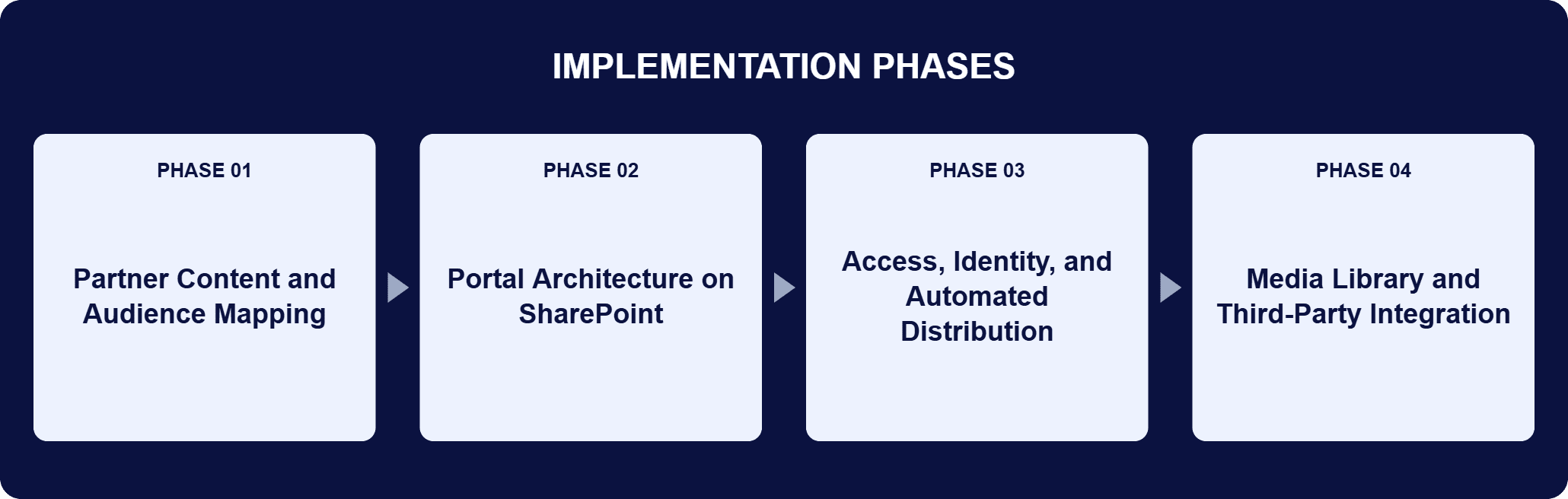
PHASE 03
Access, Identity, and Automated Distribution
Role-based access control was implemented so only relevant content is accessible to each partner group, with Entra ID handling user authentication and single sign-on so partners reach every resource they are entitled to through one login. Automated distribution was built on top: sales campaigns, product updates, and marketing collateral push directly to the appropriate audiences instead of being assembled and sent by hand.
PHASE 04
Media Library and Third-Party Integration
An advanced media library was added for managing and distributing high-resolution marketing images and promotional materials, putting current visual assets in partners’ hands on demand. Integration ran in close collaboration between the company, i3solutions, and third-party software vendors so the portal’s components operate as one unified system rather than a set of linked tools.
Microsoft SharePoint is the core platform, providing the foundation for secure content management, collaboration, and role-based access to marketing materials, product data, and technical resources. The .NET framework powers the portal’s custom web parts and backend logic, which is what makes content delivery dynamic, lets the portal integrate with other systems, and keeps the application performing as the partner network grows. Entra ID handles user authentication and role-based access control, so partners reach only the content their role permits, through single sign-on, at enterprise security levels. SQL Server is the primary database for partner data, marketing assets, and product information, supporting efficient queries, automated updates, and real-time content retrieval. The design point is that targeting became a property of the platform rather than of whoever sent the file: content is segmented by partner role, so a dealer, a distributor, and an installer signing into the same interface each land on the product updates, marketing materials, and technical resources that apply to them, with no separate distribution list maintained by hand for each group.

One Portal, Role-Based Access
A SharePoint Partner Portal behind a single Entra ID login now targets content by partner role, from installers to distributors.
| Outcome | Before | After |
|---|---|---|
| Partner access to content | Partners often struggled to locate and access the information they needed | Authorized access to marketing materials, product information, technical resources, and sales content in one portal |
| Content targeting by partner group | No centralized way to target specific content to different partner groups, such as installers versus distributors | Role-based access control, with content segmented so each partner group receives what applies to it |
| Partner sign-in | Multiple credentials and disparate systems to navigate | Single sign-on through Entra ID, one login for all relevant resources |
| Distribution of campaigns and updates | Manual effort to manage and distribute technical data and marketing materials | Automated distribution of sales campaigns, product updates, and marketing collateral to targeted audiences |
| Marketing image and asset delivery | Marketing images held in the same cumbersome, time-consuming system | Integrated media library of high-resolution marketing images and promotional materials, available in real time |
| Administrative workload | Redundant tasks and manual intervention to keep partner content current | Decreased administrative workload through automation, controlled from one management interface |
The change partners feel is access. Instead of searching a cumbersome system for content that may or may not apply to them, dealers, distributors, and installers sign in once through Entra ID and reach the marketing materials, product information, technical resources, and sales content authorized for their role. Because content is segmented by partner role, targeted delivery improves engagement and gets critical business content in front of the right partners faster, which is what makes decision-making across the partner network better informed.
The change the company feels is workload. Marketing assets, product information, and technical data sit in a single manageable system, and automated content distribution and updates cut the administrative effort of keeping it accurate, so staff hours move from manual updates to the campaigns and launches the content supports. Automating content updates, role-based access, and marketing delivery removes redundant tasks and minimizes manual intervention, which reduces both workload and operational cost. The outcome the company was buying, though, is capacity: the portal improves operational efficiency and positions the company to scale its partner network while maintaining effective communication with it.
This engagement is relevant for
Less relevant for
Partner Content Managed in One Place, Delivered by Role
The engagement established that a manufacturer’s channel communication problem is an access problem before it is a content problem. Built on Microsoft SharePoint with .NET custom web parts, Entra ID authentication, and SQL Server behind the data, the Partner Portal gives dealers, distributors, and installers authorized access to marketing materials, product information, technical resources, and sales content, segmented by partner role.
Single sign-on removed the multiple credentials and disparate systems partners had been navigating, and automated distribution replaced the manual work of pushing sales campaigns, product updates, and marketing collateral out to the network. What the company got back is centralized content management, targeted content delivery by partner role, and decreased administrative workload through automation, on a portal built to scale with the partner network rather than against it.
Yes, that was the exact pressure behind this portal. This building products manufacturer’s dealer network had outgrown manually distributed collateral and product updates, so the portal was built to segment content by partner group automatically and sit behind single sign-on, rather than add a second login for every new partner added. That’s what let the portal keep pace with a growing dealer network instead of turning every new partner into more manual distribution work.
The Partner Portal uses role-based access control, so only relevant content is accessible to each partner group. Content is segmented by partner role, which means dealers, distributors, and installers each receive the product updates, marketing materials, and technical resources that apply to them. Entra ID handles user authentication and role-based access, allowing partners to access only the content relevant to their roles while maintaining enterprise-level security. The practical difference from the previous arrangement is where the targeting decision lives. Before the portal, the company had no centralized way to target specific content to different partner groups, such as installers versus distributors, so who saw what depended on who sent what to whom. In the portal that decision is enforced by the platform at sign-in, on every piece of content, every time.
No. Single sign-on lets partners securely access all relevant resources through a single login, with authentication handled by Entra ID, which removes the need to juggle multiple credentials or navigate disparate systems. That matters more for a partner portal than for an internal application, because the people signing in work for independent dealers, distributors, and installers and use the portal alongside their own employer’s systems. Every extra credential is a reason to stop using the portal and go back to asking someone for the file. Single sign-on, an intuitive user interface, and navigation shaped around what each role needs are together what make the portal the fastest route to the content rather than one more place to look.
Marketing materials, product information, technical resources, and sales content, plus an integrated media library of high-resolution marketing images and promotional materials. The system automates the distribution of sales campaigns, product updates, and marketing collateral, so targeted information goes directly to the appropriate audiences rather than out by hand to a general list. The media library is the piece partners use most visibly: it gives them updated content in real time, which is what lets them run marketing campaigns with current imagery and keeps brand presentation consistent across an independent network. All of it is managed through the portal’s content management system, where the company controls the development and distribution of partner-specific content from one place.
Microsoft SharePoint is the core platform, providing the foundation for secure content management, collaboration, and role-based access to marketing materials, product data, and technical resources. The .NET framework powers the portal’s custom web parts and backend logic, enabling dynamic content delivery, integration with other systems, and applications built to the company’s specific needs rather than to a product’s defaults. Entra ID handles secure user authentication and role-based access control, giving partners single sign-on to the content their role permits at enterprise security levels. SQL Server is the primary database for partner data, marketing assets, and product information, supporting efficient queries, automated updates, and real-time content retrieval. The portal was built on the latest version of Microsoft SharePoint available at the time of the engagement.
The company partnered with i3solutions to design and develop the portal. The project involved close collaboration between the company, i3solutions, and third-party software vendors to ensure integration of the portal’s components, resulting in a unified and efficient system. That collaboration is the part most often underestimated on portal work. The platform, the identity layer, the database, and the third-party pieces each function on their own, and the engagement’s real job is making them behave as one system for a partner who signs in once and expects everything to be there. i3solutions carried the SharePoint, .NET, Entra ID, and SQL Server design as a single architecture and coordinated the third-party integration around it.
i3solutions is a Microsoft Partner with 30 years of delivery experience and 1,500+ Microsoft engagements, with every engagement staffed by an all-senior, all US-based delivery team. Partner-facing systems are an unforgiving place for junior work, because the users are other companies’ employees and any access mistake is visible outside your own organization. This engagement is representative of the pattern: a secure, scalable Partner Portal on Microsoft SharePoint, role-based access control with Entra ID single sign-on, custom .NET web parts, SQL Server behind partner and product data, an integrated media library, and automated distribution of campaigns and collateral, with third-party software integrated into one system. For a manufacturer weighing this class of work, a short scoping conversation establishes what a role-based partner portal would replace in your environment.
Single sign-on and role-based delivery are what cut this manufacturer’s administrative workload while improving partner experience. We can talk through what a comparable partner portal would look like for your network.

US-Based | Est. 1997
© i3solutions. All rights reserved.
US-Based | Est. 1997
© i3solutions. All rights reserved.


