

Leadership had no remote path to financial performance data and waited on manual report pulls.
The client is a financial software provider serving asset managers, life and pension companies, and other financial services firms. As the company continued to expand, it faced growing challenges in financial reporting and decision-making. Without real-time access to profitability insights, leadership had to make decisions about long-term growth and operational efficiency without a current read on either. The company needed instant visibility into financial performance so executives could monitor key metrics, identify trends, and respond to potential risks rather than learn about them after the fact.
The numbers themselves were never the problem. The company already ran a Deltek accounting system that held them. What it lacked was a way for its Board of Directors and senior leadership to reach real-time financial reports remotely, and the absence of that reporting infrastructure made it difficult for decision-makers to follow profitability and operational performance without delays. What the company wanted was one place to reach key financial metrics, built on the technology investments it had already made.
A financial services provider’s board had no way to check performance data remotely and had to wait on manually pulled reports to make decisions. i3solutions built a SharePoint reporting console tied directly into the company’s Deltek system, giving leadership real-time profit visibility.
Board members and executives can now review financial reports securely from anywhere, red/yellow/green status indicators give a real-time read on performance with drill-down into specific metrics, and the console was built on Microsoft tools the company already owned rather than a new reporting platform.

The Numbers Existed, The Access Did Not
This was not a data problem. The company’s Deltek accounting system already tracked what leadership needed to know about profitability and operational performance. The gap sat one layer above it: there was no efficient reporting infrastructure between the accounting system and the people making decisions, so getting a read on financial health meant asking someone to produce it.
Expansion is what turned that inconvenience into a trigger. As the company grew, financial reporting and decision-making grew harder with it, and without real-time access to profitability insights, leadership had no current read on profitability behind the calls it was making about growth and operational efficiency. The requirement that followed was specific rather than sweeping: instant visibility into financial performance, delivered on top of the financial platform the company already owned.
This provider’s Deltek system already held the data leadership needed; what was missing was the reporting layer between the system and the people accountable for it. If your organization has a similar reporting gap sitting on top of a system that already works, that’s a narrower fix than replacing the platform.
Decisions Waiting on a Report Pull
Left as it was, every executive read of the business carried a lag. Monitoring key metrics, identifying trends, and responding to potential risks all depended on manual data pulls, and each pull put time between a change in the business and anyone in a position to act on it. For a company whose leadership was trying to respond to risks before they affected profitability, that lag was the whole exposure.
The Board of Directors made the distance literal. Board members and senior leadership needed to review financial reports from wherever they were, and no remote path to those reports existed. So the reporting cycle did not just run late; it ran only where the reports could be assembled and handed over, which is a poor fit for the group accountable for the company’s financial direction.
Keep Deltek, Build the Reporting Layer
The first constraint was what could not change. Deltek was the core financial system and would stay the core financial system, so the engagement had to add a reporting layer that integrated with it rather than migrate financial data into something new. The company was explicit that the answer had to make use of the technology investments it already held, which ruled out buying a separate financial reporting platform and ruled in building on the Microsoft tools already in place.
The second constraint was who would read the result. A Board of Directors and senior leadership are not report analysts, so the console had to open with an assessment rather than a data table, and it had to be reachable securely from anywhere. At the same time it could not stop at a summary: the same interface needed to take a reader from a high-level read of financial health down into specific metrics to identify trends or potential risks, and it had to pull the reports and the profitability picture together from multiple queries to do it.
Senior Microsoft Specialists with Proven Delivery Depth
The requirements defined the vendor profile: a team that could build an executive-facing portal on Microsoft SharePoint, do the systems integration and data management work to connect it to an existing Deltek accounting system, and hold the financial data in SQL Server with the back-end functionality and API integration in .NET. That is one engagement spanning portal development, integration, and a data layer, and the reading audience was the Board of Directors, which leaves little room for a second attempt.
The company engaged i3solutions, a Microsoft Partner with 30 years of delivery experience and 1,500+ Microsoft engagements, delivered by an all-senior, all US-based delivery team. That profile matched the work: senior engineers who have built reporting consoles on the Microsoft stack and integrated them with existing financial systems, able to add the reporting layer without disturbing the accounting system the business runs on.
i3solutions designed and implemented a custom Executive Dashboard Reporting Console on Microsoft SharePoint, giving the company’s leadership secure, real-time access to critical financial data drawn from its existing Deltek accounting system.
PHASE 01
Reporting and Access Assessment
i3solutions established what leadership actually needed to see and where it already lived: which financial reports and profitability measures mattered to the Board of Directors and senior management, what the Deltek accounting system already held, and why the existing reporting path required manual data pulls. That defined the console’s scope and confirmed the boundary of the work, which was the reporting layer, not the financial platform.
PHASE 02
Console Design on SharePoint
The console was designed as a dynamic portal on Microsoft SharePoint, consolidating key financial reports and profitability insights into a single interface. SharePoint also carried the real-time data sharing and document management around the reports, and the design assumed secure remote access from the start because the Board of Directors was a primary reader.
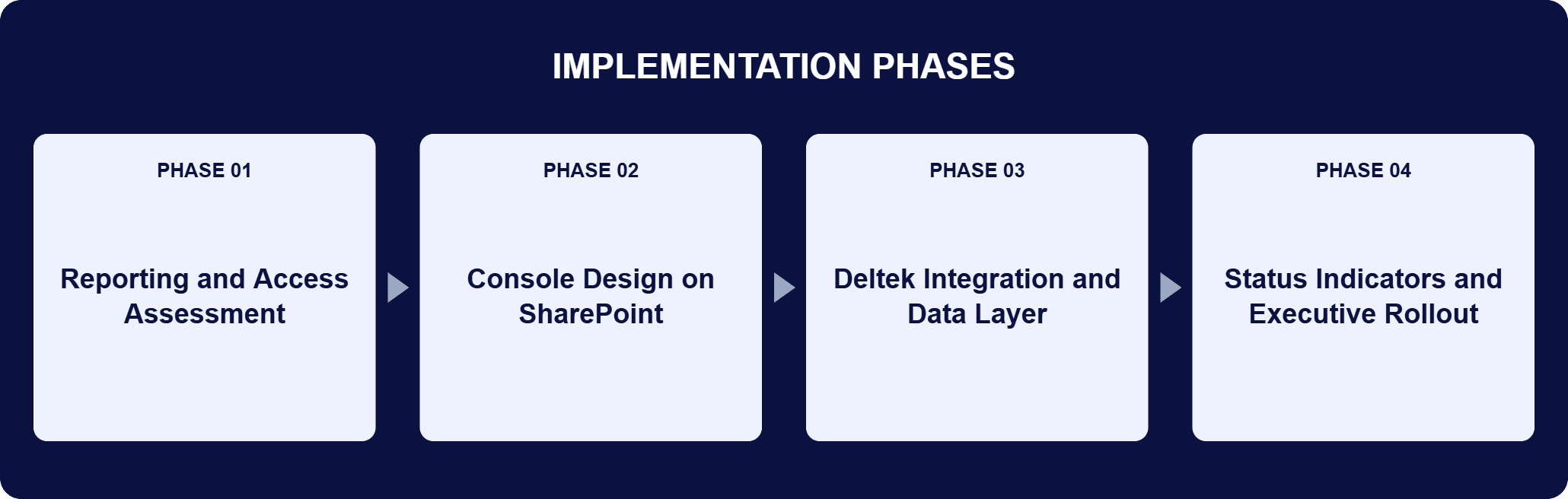
PHASE 03
Deltek Integration and Data Layer
The console was integrated with the company’s Deltek accounting system, with SQL Server storing and managing the financial data and .NET powering the back-end functionality and API integration. The dashboard aggregates data from multiple queries, which is what allows one interface to present financial health rather than a set of separate report runs.
PHASE 04
Status Indicators and Executive Rollout
Red, yellow, and green status indicators were added so senior management can assess profitability and operational performance quickly, with drill-down into specific metrics to identify trends or potential risks. With remote access in place, board members and executives review financial reports securely from anywhere, which removed the manual data pulls and delayed decision-making that came before the dashboard.
The console is a reporting layer built on Microsoft tools the company already owned. Microsoft SharePoint hosts the portal and handles the real-time data sharing and document management around it, which is what lets board members and executives review financial reports securely from anywhere instead of requesting a manual pull. The data path runs behind that: SQL Server stores and manages the financial data with security, performance, and analytics in mind, .NET powers the back-end functionality and the API integration between the pieces, and Deltek Costpoint remains the core financial system, integrated with SharePoint so profitability metrics, reporting, and financial insights surface inside the executive dashboard itself. The console aggregates data from multiple queries, which is what makes a single interface possible: key financial reports and profitability insights consolidate into one view rather than a set of separate report runs. Above that sit red, yellow, and green status indicators for assessing profitability and operational performance at a glance, with drill-down into specific metrics to identify trends or potential risks. Microsoft 365 carries the output onward, with data export to Excel for financial analysis, automated reporting with PowerPoint, and collaboration through Outlook and Teams.

One Console, Real-Time Visibility
A SharePoint dashboard integrated with the company’s Deltek system lets the Board and executives review financials securely from anywhere.
| Outcome | Before | After |
|---|---|---|
| Access to financial reports | No remote path for the Board of Directors and senior leadership | Board members and executives review financial reports securely from anywhere |
| Getting a read on profitability | Manual data pulls, with a delay in front of every decision | One console consolidating key financial reports and profitability insights |
| Assessing performance | No real-time view of profitability or operational performance | Red, yellow, and green status indicators, with drill-down into specific metrics |
| Financial platform | Deltek accounting system in place, reporting layer missing | Deltek kept as the core financial system, integrated with the console |
| Reporting spend | A new financial reporting platform as the alternative | Built on Microsoft tools the company already owned, reducing software expenditures |
The change leadership feels is where the reading happens. Board members and executives now review financial reports securely from anywhere, which removes the manual data pulls and delayed decision-making that came before the dashboard, and the console gives senior leadership access to profitability insights without a request in front of it. The reading itself is faster to start: red, yellow, and green status indicators show where profitability and operational performance stand, and the same interface drills down into specific metrics so an executive can follow a trend or a potential risk to the number behind it instead of commissioning another report.
The second result is what the engagement did not have to do. Deltek remains the core financial system, integrated with the console rather than replaced by it, so the company added a reporting capability without a platform migration underneath it. Because the console runs on Microsoft tools the company already owned, it arrived without the software expenditure a new financial reporting platform would have carried. Note on figures: the source engagement record carries no quantified outcome, so this page states the changes it can evidence and claims no percentage, duration, or dollar figure.

PENDING-CLIENT-QUOTE
This engagement is relevant for
Less relevant for
Financial Visibility Added Above the Accounting System, Not Instead of It
The engagement established that a reporting gap and a financial platform problem are two different problems. This financial software provider’s Deltek accounting system already held its profitability and operational data; what was missing was an efficient reporting infrastructure between that system and the people accountable for the results. An Executive Dashboard Reporting Console on Microsoft SharePoint, with SQL Server managing the financial data and .NET carrying the back-end functionality and API integration, brought the executive financial reporting into one interface and made it reachable securely from anywhere.
Red, yellow, and green status indicators start the read and drill-down finishes it. Deltek stayed the core financial system throughout, so the company gained the reporting capability on the Microsoft tools it already owned instead of buying and migrating to a new financial reporting platform.
Yes, that was the requirement here. This financial services provider’s board and senior leadership needed secure, remote access to profit and performance data, so the dashboard was built on SharePoint and integrated directly with Deltek, the accounting system already in place, rather than introducing a separate reporting platform. That’s what gave leadership real-time visibility from anywhere without a new system to license or maintain.
No. Deltek remains the core financial system, and the Executive Dashboard Reporting Console integrates with it. That boundary was deliberate. The company’s gap sat in the reporting layer above the accounting system, not inside it, so the work went into surfacing what Deltek already held rather than moving financial data somewhere new. Deltek Costpoint continues to serve as the core financial system behind the profitability metrics, reporting, and financial insights the dashboard presents, while SharePoint carries the interface, the real-time data sharing, and the document management around them. Because the console runs on Microsoft tools the company already owned, the reporting capability arrived without the software expenditure a new financial reporting platform would have carried. By integrating SharePoint and Deltek, the company kept Deltek and avoided a costly platform replacement.
Through the SharePoint console. Board members and executives can securely review financial reports from anywhere, which eliminates the manual data pulls and delayed decision-making that came before the dashboard. That matters because of who the readers are. A Board of Directors does not sit at the company’s desks, and before the console there was no way for the board and senior leadership to reach real-time financial reports remotely, even though the Deltek accounting system already held the numbers. The console closes that distance without loosening control of the data: it runs as a portal on Microsoft SharePoint, so access sits on the same platform the company already uses for data sharing and document management, and what each reader opens is the consolidated view the dashboard maintains rather than a copy someone exported and sent on.
It uses red, yellow, and green status indicators, so senior management can quickly assess profitability and operational performance and then drill down into specific metrics to identify trends or potential risks. The two halves work together. The indicators are a triage layer: they show an executive where to look before anyone reads a number, which is what makes a single view useful to a board reviewing the whole financial picture. The drill-down is what makes the triage actionable, because the console aggregates data from multiple queries and can therefore carry a reader from a status color to the specific metric behind it. Used that way, the dashboard supports addressing potential issues before they affect profitability rather than reporting on them afterward, which is the reason the reporting layer went on top of the accounting system.
Microsoft SharePoint hosts the console and handles real-time data sharing and document management. Microsoft 365 supports data export to Excel for financial analysis, automated reporting with PowerPoint, and collaboration through Outlook and Teams. SQL Server stores and manages the financial data, and .NET powers the back-end functionality and API integration. The console integrates with Deltek Costpoint as the core financial system. The division of labor is the useful part to understand: Deltek stays the system of record for the financials, SQL Server holds and manages the data behind the console with security and performance in mind, .NET carries the back-end processing and the API integration between the pieces, and SharePoint is where leadership actually reads the result. Microsoft 365 then takes the output into the tools executives already work in for analysis, reporting, and discussion.
The first question is where the gap actually sits. On this engagement the company already had its numbers in a Deltek accounting system; what it did not have was a way for the Board of Directors and senior leadership to reach profitability insights remotely and in real time. That framing set the scope: build the reporting layer, integrate it with the accounting system, and change nothing about the financial platform underneath. i3solutions designed and implemented the console on Microsoft SharePoint, aggregated data from multiple queries so the financial reporting sits in one interface, added red, yellow, and green status indicators with drill-down into specific metrics, and made access secure and remote for the readers who needed it. Building on the Microsoft tools the company already owned is what kept software expenditure out of the result.
i3solutions is a Microsoft Partner with 30 years of delivery experience and 1,500+ Microsoft engagements, with every engagement staffed by an all-senior, all US-based delivery team. Dashboard work for a finance function is less about the portal than about the integration behind it, and that is where senior delivery pays: this console had to reach an existing Deltek accounting system, hold the financial data in SQL Server, carry the back-end functionality and API integration in .NET, and present the result to a Board of Directors that would act on what it read. The engagement shows the pattern, combining SharePoint development with the systems integration and data management work needed to connect the console to Deltek while the company’s financial platform stayed in place. For a comparable reporting gap, a short scoping conversation establishes what the integration would take in your environment.
Reporting was solved without migrating off the accounting system this provider already owned and trusted. We’re glad to walk through whether the same approach applies to your existing financial systems.

US-Based | Est. 1997
© i3solutions. All rights reserved.
US-Based | Est. 1997
© i3solutions. All rights reserved.


