

Proposal assets lived scattered across network drives and folders, with no shared workspace for the teams building on them.
The client is a global engineering and government services contractor whose Proposal Management Team is charged with managing and maintaining all proposal related information and assets for the enterprise wide organization. For a government services contractor, proposals are the front end of the business, and that team runs them continuously rather than occasionally. Everything the work depends on, past proposals, reusable sections, who owns which piece and when it is due, lived in file folders.
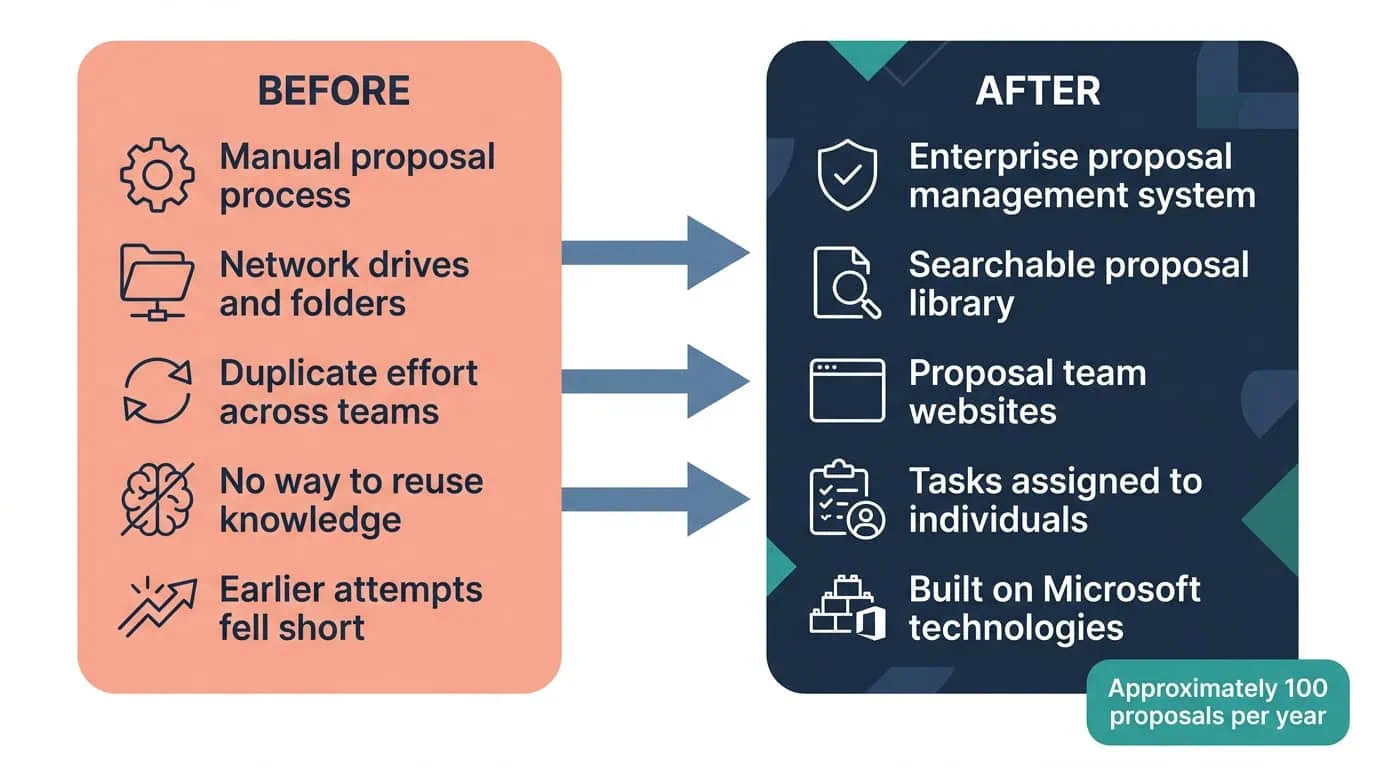
The company’s former proposal management process was largely manual, using network drives and folders to support the production of approximately 100 proposals per year. Proposal Managers were frustrated by the inefficiencies inherent in a manual system and felt they had no means of drawing on the deep knowledge amassed within the company. The company made several attempts to either internally develop a system or to bring in outside resources, but they had all failed to deliver a solution that could provide the set of functionality the company required.
A global engineering contractor’s proposal assets lived scattered across network drives and email threads, with no shared workspace for the teams building on them continuously. i3solutions built a searchable proposal library and task assignment platform to replace that coordination.
Proposal generation time dropped from easier asset retrieval alone, scheduling and meeting forums cut duplicate effort among people working the same proposal, and a searchable proposal library is now available to proposal groups worldwide.

Approximately 100 Proposals a Year, Managed by Hand
Volume is what turned a filing problem into a business problem. A team producing approximately 100 proposals per year starts new material constantly, and on network drives and folders every one of those starts began by hunting for the last proposal that answered the same question. The knowledge existed. Years of government procurement work had produced it, proposal by proposal. What the company did not have was any means of drawing on it.
The second trigger was that the company had already tried to fix this. Several attempts, some internal, some through outside resources, had all failed to deliver a solution that could provide the set of functionality the company required. That history changed what the next attempt had to be. Another partial tool covering one step would not clear the bar; the requirement was a system built around how proposals actually get developed and maintained here, with the specific nuances of government procurement designed into the features.
This contractor had already built a body of proposal knowledge it couldn’t reach; the fix was making that knowledge searchable, not producing more of it. If your proposal teams are rebuilding work that already exists somewhere in the organization, that’s the same problem.
Rewriting What the Company Already Knew
Left manual, the cost repeated on every proposal. The inefficiency was not only slow retrieval; it was work redone. Content someone in the company had already written got written again because the person who needed it could not find it, and the company’s own body of proposal knowledge stayed out of reach in proportion to how much of it there was. That is the shape of the problem the Proposal Managers described: not a shortage of expertise, a shortage of access to it.
The failed attempts raised the stakes further. Each had spent budget and internal credibility without delivering the functionality the company required, and the manual process stayed in place through all of them. Another failure would not have left the Proposal Management Team where it started; it would have left it there with less appetite for trying again, still producing approximately 100 proposals a year out of folders.
Government Procurement Sets the Requirements, Not a Product Roadmap
Proposal management for a government services contractor is not generic document management. i3solutions recognized the specific nuances of government procurement and developed features tailored to the company’s exact needs rather than adapted from a general purpose tool. Scale was the second half of that constraint: the Proposal Management Team is responsible for the enterprise wide organization, and the proposal library had to be shared across multiple groups all over the world, so a repository useful only inside one office would not have met the requirement.
The other constraint was continuity. The company was not looking to replace the technology it already ran. The system had to be built on Microsoft technologies and integrate with the company’s existing tech stack, staying compatible with established systems and preserving the value of investments already made. And because the prior attempts had failed specifically on functionality, the scope could not be trimmed to whatever was convenient: the proposal library, proposal teams and information websites, and the assignment of tasks and proposal sections all had to be in the delivered system.
Senior Microsoft Specialists with Proven Delivery Depth
The requirement history defined the vendor profile. Internal development and outside resources had both already failed, so the company needed a team that could carry the full span of the work, design and development of an enterprise proposal management system, and land the functionality the earlier attempts had not. It also needed a team fluent in the Microsoft technologies the company already ran, because integration with the existing tech stack was part of the requirement rather than a later phase.
The company engaged i3solutions, a Microsoft Partner with 30 years of delivery experience and 1,500+ Microsoft engagements, delivered by an all-senior, all US-based delivery team. That profile matched the work: senior engineers who have built knowledge repositories and collaboration platforms on Microsoft technologies repeatedly, and who could design features around government procurement instead of shipping a generic system and leaving the fit to the client.
i3solutions designed and developed an enterprise proposal management system to enhance and simplify the proposal development and maintenance process, with the proposal library at its center and the specifics of government procurement built into its features.
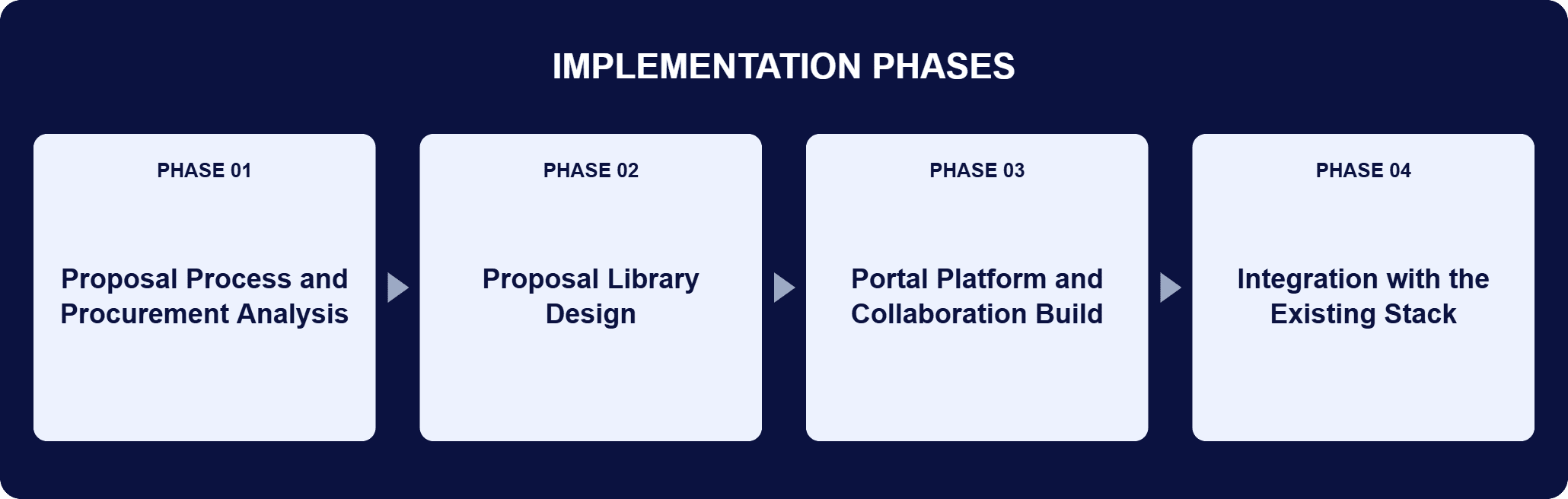
PHASE 01
Proposal Process and Procurement Analysis
i3solutions worked through how proposals actually get developed and maintained at the company: what the Proposal Management Team maintains on behalf of the enterprise wide organization, where proposal related information and assets sat across network drives and folders, and which specific nuances of government procurement the system would have to accommodate. That analysis set a feature list tailored to the company’s exact needs rather than taken from a general purpose product.
PHASE 02
Proposal Library Design
The major feature was designed first: a knowledge repository of past proposal documents for reference in developing new proposal materials. The design covered how library content is searched, browsed, found, previewed, and imported, and how one repository stays usable when proposal groups in every region draw on it.
PHASE 03
Portal Platform and Collaboration Build
i3solutions implemented the solution on a portal platform to promote data sharing and collaboration, then built the working features around it: the ability to create proposal teams and information websites, and the assignment of tasks and individual proposal sections to specific individuals or teams, with scheduling and meeting forums for the people working the same proposal.
PHASE 04
Integration with the Existing Stack
The system was built on Microsoft technologies and integrated with the company’s existing tech stack, so it stayed compatible with the systems the company already ran and preserved the value of those investments. Proposal production moved off network drives and folders and onto the system.
The system is an enterprise proposal management platform built on Microsoft technologies and integrated with the company’s existing tech stack, which is what lets it modernize proposal management without displacing what the company already runs. Its center is the proposal library: a knowledge repository of past proposal documents that proposal teams search, browse, preview, and import from when they build new material. Because that library reaches the company’s proposal groups worldwide, a section written for one pursuit is available to the next team that needs it, wherever that team sits. The collaboration layer runs on a portal platform for data sharing and collaboration, and it carries the working structure of a proposal: proposal teams and information websites for each effort, and the assignment of tasks and individual proposal sections to specific individuals or teams, so ownership is explicit rather than assumed. Scheduling and meeting forums cut duplicate effort among the people working the same proposal. Nothing in the design assumes generic document management; the features were developed for the specific nuances of government procurement.
Less Duplicate Work, Better Quality
A searchable proposal library and dedicated team sites cut duplicate effort and gave proposal teams the collaboration tools they’d been missing.
| Outcome | Before | After |
|---|---|---|
| Proposal generation time | Manual production out of network drives and folders | Demonstrated decrease, from the ability to easily locate and retrieve proposal assets |
| Duplicate effort | Repeated work among the people working the same proposal | Reduction of duplicate effort through scheduling and meeting forums |
| Proposal quality | A manual process with no collaboration or knowledge management tools | Increase in the overall proposal quality, from added collaboration features and knowledge management tools |
| Past proposal content | Documents spread across network drives and folders | A proposal library that can be searched, browsed, found, previewed, and imported from, available to proposal groups worldwide |
| Existing technology investments | Established systems the company already ran | Kept: built on Microsoft technologies and integrated with the existing tech stack |
The company has seen a demonstrated decrease in proposal generation time and an increase in the overall quality of its proposals. The mechanism behind each is specific. Generation time came down because proposal assets became easy to locate and retrieve instead of something to hunt for across network drives and folders. Quality came up because the system added collaboration features and knowledge management tools that a folder structure cannot provide. Duplicate effort came down through scheduling and meeting forums that keep the people working the same proposal from doing the same work twice.
What changed structurally is where proposal knowledge lives. Past proposal documents are no longer the private history of whoever wrote them; they are a repository any proposal team can search, browse, preview, and import from, wherever in the company that team sits. The Proposal Management Team, charged with all proposal related information and assets for the enterprise wide organization, now maintains that material in one system rather than across drives, and the client is pleased with the new user-friendly system.

PENDING-CLIENT-QUOTE
This engagement is relevant for
Less relevant for
Proposal Knowledge in One Library, Proposal Work Assigned by Name
The engagement established that proposal management at enterprise scale is a knowledge problem before it is a document problem. A company producing approximately 100 proposals per year out of network drives and folders had already built a body of proposal knowledge it could not reach; the enterprise proposal management system turned that knowledge into a library its teams search, browse, preview, and import from, open to its proposal groups worldwide.
Around the library, a portal platform carries the working structure of a proposal: teams and information websites, tasks and sections assigned to specific individuals or teams, and scheduling and meeting forums that cut duplicate effort. Built on Microsoft technologies and integrated with the company’s existing tech stack, the system produced a demonstrated decrease in proposal generation time and an increase in overall proposal quality without replacing the systems the company already ran.
An enterprise proposal management system is a purpose-built platform for how proposals get developed and maintained across a large organization, rather than a folder structure a proposal team maintains by hand. For this global engineering and government services contractor, i3solutions designed and developed one around a proposal library: a knowledge repository of past proposal documents that teams search, browse, find, preview, and import from when they build new material. Around that library sit the working mechanics of proposal production, proposal teams and information websites, and the assignment of tasks and individual proposal sections to specific individuals or teams, all on a portal platform that promotes data sharing and collaboration. The distinction that matters in this category is fit: the features were tailored to the company’s exact needs and to the specific nuances of government procurement, not adapted from a general purpose document tool.
Largely manual. The Proposal Management Team was producing approximately 100 proposals per year out of network drives and folders, with no practical way to draw on the deep knowledge already amassed within the company. Proposal Managers were frustrated by the inefficiencies inherent in that arrangement: proposal related information and assets for an enterprise wide organization were spread across file locations, and content the company had already written got written again because the person who needed it could not find it. The company had tried both internal development and external resources, and neither delivered the set of functionality the team required. That history is why the engagement was scoped as a full system rather than a tool covering one step of the process.
It acts as a knowledge repository of past proposal documents that teams reference when developing new proposal materials. Library content can be searched, browsed, found, previewed, and imported, and the repository is shared across multiple groups all over the world. The practical effect is that a team starting new material begins from what the company has already produced instead of from a blank document, which is where the demonstrated decrease in proposal generation time comes from: proposal assets are easy to locate and retrieve. It is also the direct answer to the problem the Proposal Managers described, because a company’s accumulated proposal knowledge is only useful if the next team can reach it. The library is the major feature of the system, designed first and built around.
i3solutions implemented the solution on a portal platform to promote data sharing and collaboration. It supports the creation of proposal teams and information websites, and tasks and individual proposal sections can be assigned to specific individuals or teams. Scheduling and meeting forums cut duplicate effort among the people working the same proposal. Because the proposal library serves the company’s proposal groups worldwide, a team in one location works from the same repository of past proposal documents as a team anywhere else. Distribution is what the design assumes rather than what it accommodates: the Proposal Management Team is charged with proposal related information and assets for the enterprise wide organization, so the system had to hold material for all of it.
No. The enterprise proposal management system is built on Microsoft technologies and integrates with the company’s existing tech stack, so it stays compatible with the established systems the company already ran and preserves the value of those investments. That was a requirement, not a convenience. Integration is what lets the system support data sharing, collaboration, and proposal workflows across the organization without a separate migration of everything the business depends on, and it is why modernizing proposal management did not turn into a wider replacement project. For organizations weighing a similar build, this is usually the difference between a system that goes live and one that stalls in front of the people who own the existing platforms.
i3solutions is a Microsoft Partner with 30 years of delivery experience and 1,500+ Microsoft engagements, with every engagement staffed by an all-senior, all US-based delivery team. This engagement shows why that profile matters: the company had already tried internal development and outside resources, and neither had delivered the functionality it required, so the next attempt had to work. The system had to be built on Microsoft technologies and integrate with a tech stack the company was keeping, designed around the specific nuances of government procurement, and usable by proposal groups all over the world. Senior engineers who have built knowledge repositories and collaboration platforms on Microsoft technologies repeatedly could commit to that scope. For companies weighing this class of work, a short scoping conversation establishes what the equivalent build would take in your environment.
Yes. The searchable proposal library and dedicated team sites give proposal teams in different locations access to the same past performance material and templates, instead of each location keeping its own separate archive. That shared access is what cut duplicate effort and gave this global engineering contractor’s distributed proposal teams the collaboration tools they had been missing, without consolidating teams into one location to get there.
The system integrated with technology this contractor already ran, rather than replacing it. We’re glad to discuss what a comparable proposal management system would look like for your environment.

US-Based | Est. 1997
© i3solutions. All rights reserved.
US-Based | Est. 1997
© i3solutions. All rights reserved.


