

More than thirty separately maintained systems sat behind one federal agency’s intranet.
The client is a federal manufacturing agency whose intranet provides enterprise-wide online access to a number of the agency’s applications, including directives and manuals, the telephone directory, and current agency news and announcements. The intranet reaches employees at PCs and at strategically located kiosks throughout the agency, making it the front door to agency information for the whole workforce.
Behind that front door sat more than thirty separate legacy systems, each supported and maintained just to keep the intranet up and running. Every system carried its own maintenance effort, its own data store, and its own failure modes, and the agency wanted out: a centralized system that would reduce the effort required to produce and maintain the intranet and provide a single web interface for accessing agency information.
A federal manufacturing agency’s intranet, the front door to information for its entire workforce, ran on more than 30 separate legacy systems behind it. i3solutions consolidated them into one centralized SharePoint portal reachable from any desk or kiosk.
Consolidating more than thirty separately maintained systems into one centralized SharePoint portal eliminated redundant data stores and recurring downtime, and the intranet stayed available throughout the build rather than going dark for a conventional cutover.

Thirty Systems to Keep One Capability Alive
The arithmetic had become indefensible: the agency was supporting and maintaining more than thirty separate systems so that one capability, the intranet, stayed available. Each system multiplied the maintenance surface, and the downtime that came with that sprawl was a recurring cost, not an occasional one.
The agency committed to a centralized replacement: one platform, one web interface, one place where agency information is maintained, with the existing intranet kept running for the entire duration of the build, because the workforce could not lose its front door while the new one was constructed.
This agency’s real cost wasn’t the number of systems, it was the administrative time, redundant upkeep, and downtime each one required. If your organization is maintaining a similar sprawl, the business case is usually stronger than the inventory suggests.
The Intranet Could Not Go Dark
The operational stake was continuity. The intranet carried directives, manuals, the telephone directory, and agency news for the entire workforce; downtime in any of the thirty-plus underlying systems degraded a service the whole agency depended on, and maintaining that sprawl consumed administrative time and cost that recurred every year.
The delivery stake was the transition itself. A consolidation that required taking the intranet offline, or that dropped the manuals, publications, databases, and reports accumulated in the old systems, would have traded one failure mode for another. The migration had to carry the content forward and keep the lights on simultaneously.
Build the New While Running the Old
The engagement’s defining constraint was the dual track. i3solutions took on responsibility for maintaining and troubleshooting the agency’s existing system, including web page development, intranet site enhancements, and other web development, while the new Microsoft .NET application and architecture for the single portal was designed and developed alongside it.
The content constraint was carry-forward, not rebuild. Manuals, publications, databases, and reports living in the legacy systems had to be converted onto the new platform rather than recreated, and the result had to serve the same access points the workforce already used: PCs and kiosks throughout the agency.
Senior Microsoft Specialists with Proven Delivery Depth
The agency needed a firm that could do two jobs at once without dropping either: operate and troubleshoot an aging intranet in daily use, and architect its replacement on Microsoft .NET and SharePoint, including the unglamorous conversion work that moves an agency’s accumulated manuals and publications onto a new platform.
The agency engaged i3solutions, a Microsoft Partner with 30 years of delivery experience and 1,500+ Microsoft engagements, delivered by an all-senior, all US-based delivery team. Consolidation engagements reward that experience: the failure modes live in the transition, and a team that has carried both tracks before plans for them.
i3solutions carried the existing intranet and built its replacement at the same time, so the agency never had to choose between keeping the intranet running and modernizing it.
PHASE 01
Sustain the Existing Environment
i3solutions maintained and troubleshot the agency’s existing intranet throughout the engagement, handling web page development, site enhancements, and day-to-day support of the aging systems while the replacement took shape.
PHASE 02
Portal Architecture on .NET and SharePoint
The new platform was architected as a single intranet portal: a customized SharePoint solution with application components built on the Microsoft .NET Framework, designed to centralize the information scattered across more than thirty systems.
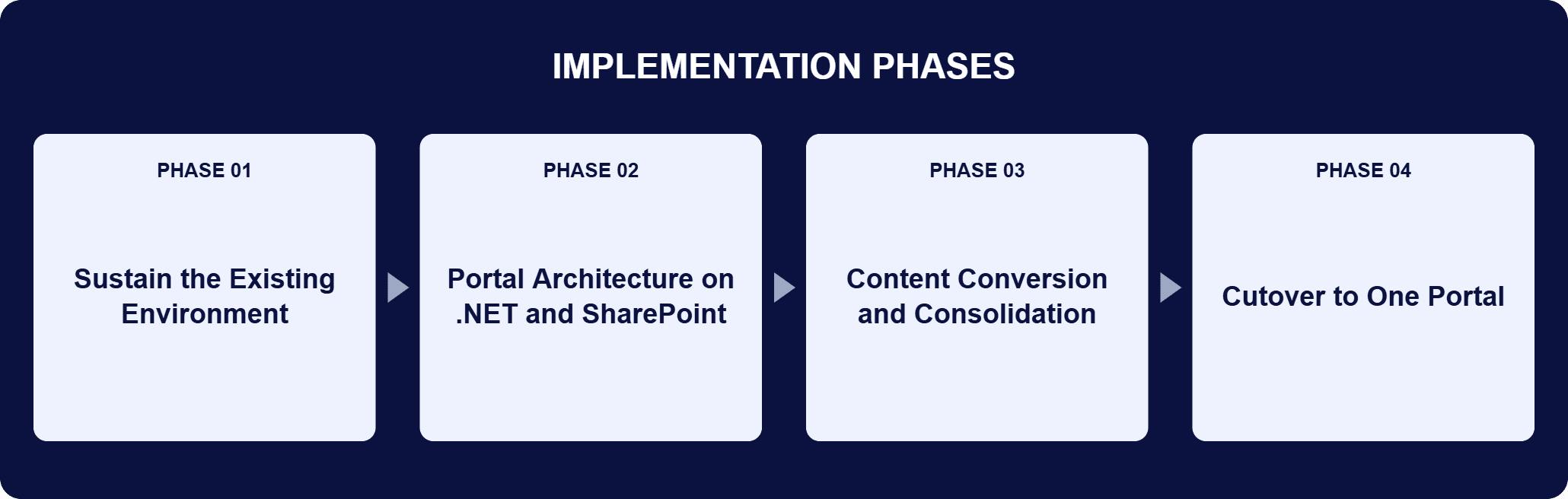
PHASE 03
Content Conversion and Consolidation
Manuals, publications, databases, and reports were converted from the legacy systems to carry forward onto the new platform, collapsing the redundant data stores spread through the organization into one maintained source.
PHASE 04
Cutover to One Portal
All agency applications and information became accessible through the single intranet portal, delivered through one web interface to PCs and kiosks throughout the agency, and the thirty-plus separately maintained systems were retired.
The rebuilt intranet runs on a customized SharePoint platform that gives the agency a centralized system for maintaining and sharing agency information, replacing the multiple data stores previously spread through the organization. Application components are built on the Microsoft .NET Framework in ASP.NET, C#, and VB.NET, and the interface is delivered in HTML5 to PCs and kiosks throughout the agency. Converted manuals and publications are published as Adobe Acrobat PDF documents, preserving the agency’s accumulated reference material in a consistent, accessible format. The consolidation is the architecture: information that once required its own system, its own store, and its own maintenance now lives in one place and reaches the workforce through one web interface. Directives and manuals, the telephone directory, and agency news and announcements (the content the workforce actually uses) are maintained centrally, and the platform carries the agency’s applications behind the same front door. What the agency maintains today is one platform rather than more than thirty systems, which is where the reductions in administrative time, redundancy, and downtime come from.

Thirty-Plus Systems Retired, One Platform Maintained
Consolidating onto a centralized SharePoint portal reduced administrative cost, redundancy, and downtime directly.
| Outcome | Before | After |
|---|---|---|
| Systems maintained | More than thirty separate legacy systems | One centralized SharePoint portal |
| Administrative time and cost | Multiplied across thirty-plus systems | Reduced |
| Data stores | Redundant stores throughout the organization | One maintained source, reduced redundancy |
| Downtime | Costly, recurring across the sprawl | Eliminated, with system stability ensured |
| Productivity | Drained by maintenance and duplicate upkeep | Increased |
| Intranet availability during the build | At risk in a conventional cutover | Maintained throughout; the intranet never went dark |
The result replaced more than thirty separately maintained systems with one centralized platform for managing and sharing agency knowledge. Information that once lived in scattered data stores is now maintained in a single place and delivered through one web interface, accessible from PCs and kiosks throughout the agency.
The centralized system reduced administrative time and cost, increased productivity, reduced redundancy, and eliminated the costly downtime that came with maintaining 30 different systems. Running both tracks at once mattered: the agency never had to choose between keeping the intranet running and modernizing it, and existing content was converted to carry forward rather than rebuilt from scratch.

[PENDING-CLIENT-QUOTE: Replace with approved direct or paraphrased statement from [role] at [organization type] before final publication. A missing client quote does not block publication but must be resolved within 30 days of go-live.]
[PENDING ATTRIBUTION]
[role], [organization type]
This engagement is relevant for
Less relevant for
Consolidation Is a Maintenance Decision
The engagement established that a thirty-system sprawl is not a technology inventory; it is a recurring cost structure, paid in administrative time, redundant upkeep, and downtime. Consolidating onto one SharePoint and .NET platform converted that structure into a single maintained system, and every reduction the agency measured, in cost, redundancy, and downtime, follows from that one architectural decision. It also established the transition pattern that makes consolidation survivable: run both tracks at once, carry the existing service without interruption, and convert the content forward rather than rebuilding it. The agency kept its front door open through the entire build and closed thirty doors behind it.
It is the replacement of the separate legacy systems behind an intranet with one centralized platform. In this engagement, a federal manufacturing agency was supporting more than thirty separate systems just to keep its intranet running: the service carrying directives and manuals, the telephone directory, and agency news to PCs and kiosks throughout the agency. i3solutions consolidated that estate onto a customized SharePoint solution with components built on the Microsoft .NET Framework, so all agency applications and information became accessible through a single intranet portal with one web interface, maintained in one place instead of thirty.
In this engagement, i3solutions ran both tracks at once. The agency could not take its intranet offline while the replacement was built, so i3solutions carried day-to-day maintenance, troubleshooting, and enhancement of the aging environment while designing and developing the new .NET and SharePoint platform alongside it. Content was converted to carry forward, manuals, publications, databases, and reports moved onto the new platform rather than being rebuilt from scratch. The approach means a consolidation engagement ends with the old systems retired and nothing lost in between: no service interruption, no content gap, no period where the workforce had to work without its intranet.
The portal runs on a customized SharePoint platform that centralizes the maintenance and sharing of agency information, eliminating the need for multiple data stores through the organization. Application components are built on the Microsoft .NET Framework in ASP.NET, C#, and VB.NET; the interface is delivered in HTML5; and converted manuals and publications are published as Adobe Acrobat PDF documents. Employees reach everything through one web interface from PCs and strategically located kiosks throughout the agency. Because information is maintained once and delivered everywhere, updates happen in one place, and the platform’s stability replaced the downtime that used to arrive through whichever legacy system failed next.
In this engagement the returns follow from the arithmetic of maintenance. Replacing more than thirty separately maintained systems with one platform reduced administrative time and costs, increased productivity, reduced redundancy, and eliminated the costly downtime that came with maintaining 30 different systems. The structure of the return matters: every one of those gains recurs annually, because the cost being removed was itself recurring. An organization sizing its own consolidation should inventory the systems it maintains per capability, the duplicate data stores those systems carry, and the downtime incidents attributable to the sprawl, because those three lines are where consolidation pays first.
i3solutions is a Microsoft Partner with 30 years of delivery experience and 1,500+ Microsoft engagements, with every engagement staffed by an all-senior, all US-based delivery team. Consolidation work rewards that depth because the risk lives in the transition: this engagement required operating an aging intranet in daily use while architecting its SharePoint and .NET replacement, then converting the agency’s manuals, publications, databases, and reports to carry forward. The agency never lost its intranet for a day. If your organization is maintaining dozens of systems to keep one capability alive, a scoping conversation maps which systems can fold into a single platform, what the sequence looks like, where the maintenance burden drops first, and comparable engagements to reference when you build the internal case.
Yes. i3solutions took on the dual responsibility of maintaining and troubleshooting the existing system while the new platform was developed, so agency staff kept access to directives, manuals, the telephone directory, and agency news throughout.
Yes, that was the constraint this federal manufacturing agency’s consolidation was built around. The centralized SharePoint portal replaced more than thirty separately maintained systems, but the build was sequenced so the existing service stayed available throughout rather than requiring a cutover window. That is what let IT leadership reduce administrative cost, redundancy, and downtime directly, without adding a service outage to get there.
The agency’s front door stayed open through the entire consolidation, with content converted forward rather than rebuilt. We’re glad to discuss what a comparable consolidation would look like for your environment.

US-Based | Est. 1997
© i3solutions. All rights reserved.
US-Based | Est. 1997
© i3solutions. All rights reserved.


