
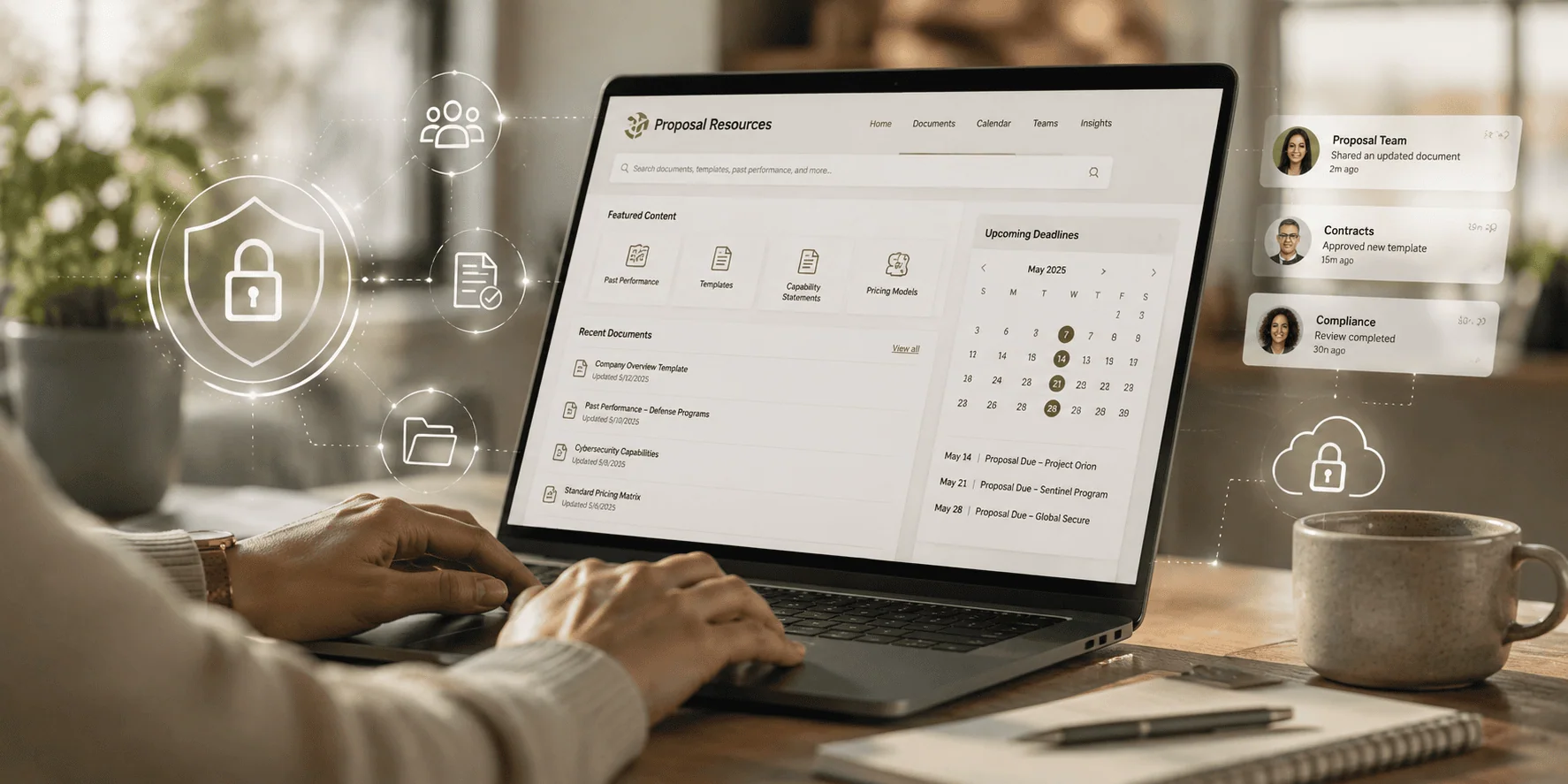
Proposals were assembled without version control or a central library of approved content.
A global aerospace and defense contractor was assembling proposals without version control, without a central library of approved content, and without one view of its bid pipeline. The client delivers advanced technologies that protect and support nations, governments, and critical infrastructures worldwide, and in that business work is won through proposals, each assembled from the same institutional material: past performance documents, boilerplate templates, capability matrices, vendor information, resumes, legal documents, and standard pricing. The company sought to enhance its information-sharing capabilities to improve its success rate with winning proposals, because the way that material was stored and shared had become the constraint on the bids themselves.
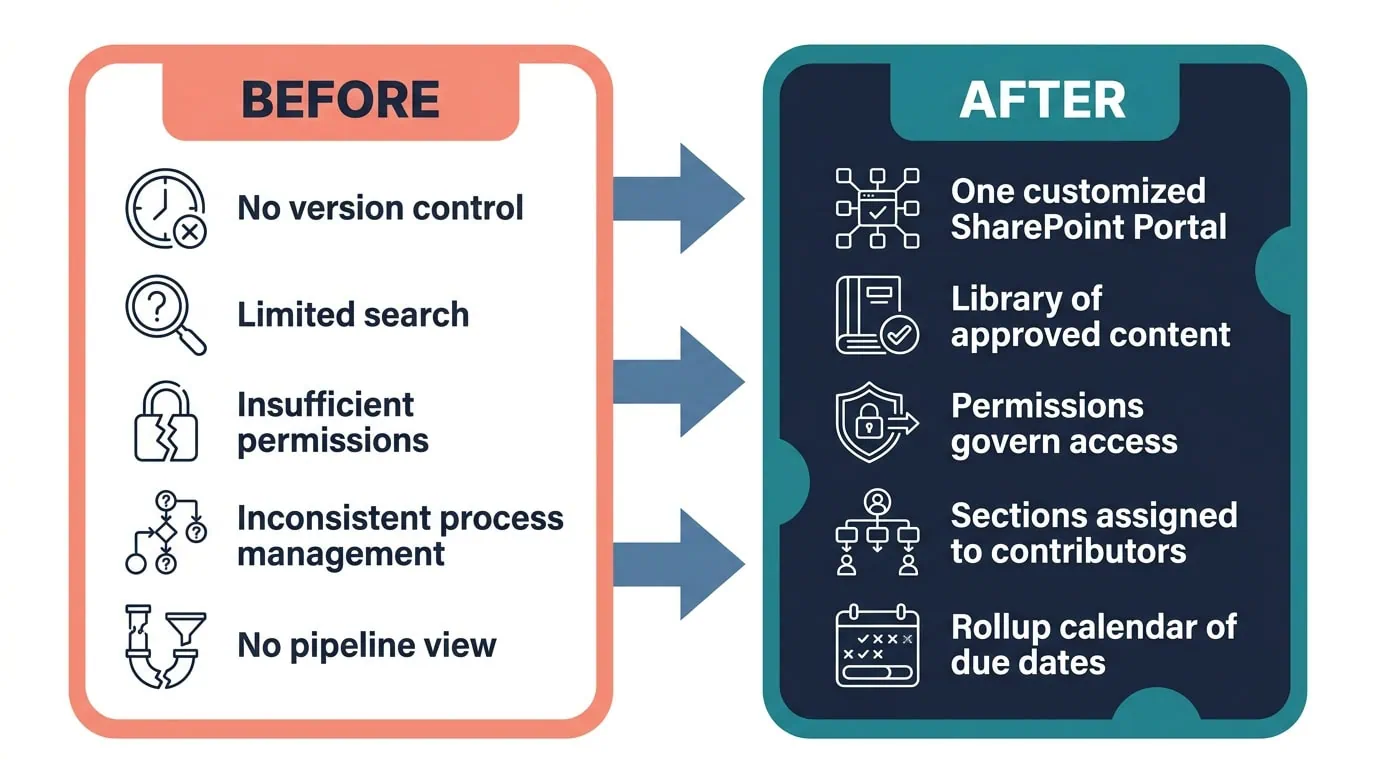
The proposal process was hindered by six specific problems: limited search functionality for up-to-date information, lack of version control, insufficient security permissions for viewing and updating proposals, inconsistent process management, absence of a centralized proposal pipeline, and difficulty accessing critical information. Proposals were being assembled without a central library of approved content and without one view of the bid pipeline, so contributors spent effort tracking down information, nobody could be certain which version of a document was the approved one, and management decided which proposals to bid on without an accurate view of what was already in flight.
A global defense contractor assembled proposals without version control or a single source of approved content, leaving teams to guess which draft was current. i3solutions built a centralized, searchable proposal library with a portal-wide calendar tracking every deadline.
Proposal approvals now run through a streamlined, lower-cost process against a library that carries only current, approved content, and a portal-wide rollup calendar assigns sections to individual contributors and tracks every proposal deadline so none get missed.
The Proposal Team Was Rebuilding What the Company Already Knew
Every bid drew on content the company already possessed: past performance write-ups, boilerplate, capability matrices, resumes, standard pricing. With limited search functionality for up-to-date information and difficulty accessing critical information, contributors searched for material they knew existed and could not reliably surface the current version. The lack of version control compounded the problem: a contributor who did locate a document had no way to confirm it was the approved one, and insufficient security permissions for viewing and updating proposals meant the access model obstructed the people doing the work.
Leadership framed the goal at the information-sharing layer rather than at the individual bid: enhance the company’s information-sharing capabilities to improve its success rate with winning proposals. That framing pointed at a platform answer, and the company engaged i3solutions to build a proposal generation tool that would reduce the effort required to assemble and review proposals.
The fix here wasn’t more proposal staff, it was one searchable library of approved content and a rollup calendar showing the whole pipeline. If your teams are still assembling proposals without either, that’s the same starting point.
In a Bid-Driven Business, Content Friction Is Priced in Wins
For a contractor whose revenue arrives through proposals, these were not back-office annoyances. Every hour spent tracking down information needed for a proposal came out of the bid schedule, and content that was outdated or unapproved had to be caught in review, which lengthened the approval process and slowed proposals on their way out the door. Inconsistent process management meant sections, owners, and due dates were tracked differently from bid to bid, with deadline risk on every one.
The absence of a centralized proposal pipeline raised the stakes from the individual bid to the portfolio. Without one accurate view of every proposal in motion, management was making bid decisions with incomplete information, and resource allocation across simultaneous proposals generated recurring issues. Left in place, the same friction would tax every future bid, in a business where the proposal win rate is the number everything else depends on.
Approved Content, Governed Access, Many Organizations
The solution had to make content trustworthy, not merely available. A searchable repository that surfaced outdated or unapproved material would move the problem rather than fix it, so the proposal library had to carry current, approved content and nothing else. Access carried the same discipline: security permissions had to govern who could view and update proposals, closing the permission gaps the company started with while keeping the material within direct reach of the proposal team that needed it.
Scale added the second dimension. The company comprises various organizations, and the platform had to serve them individually as well as collectively: portal team sites with their own document libraries, sharing information, news, events, and calendars with a specific group or with the entire organization. All of it had to run on a customized SharePoint Portal, one platform carrying the proposal workspace, the content library, the process management, and the team sites together.
Senior Microsoft Specialists with Proven Delivery Depth
The requirements defined the vendor profile: a team that could customize SharePoint Portal into a proposal generation system rather than deploy it as generic document storage, build process management and role-appropriate security into the same platform, and structure a searchable library spanning every artifact type a proposal draws on, from past performance documents and capability matrices to resumes, legal documents, and standard pricing. This was platform customization in service of a specific business process, and it had to hold up under the volume and stakes of a global contractor’s bid operation.
The company engaged i3solutions, a Microsoft Partner with 30 years of delivery experience and 1,500+ Microsoft engagements, delivered by an all-senior, all US-based delivery team. That profile matched the work: senior engineers who have shaped SharePoint into line-of-business systems repeatedly, and who could deliver the proposal portal as one coherent platform rather than a set of disconnected sites.
i3solutions built the Proposal Generator and Management Portal on a customized SharePoint Portal: a proposal generation tool with one purpose, reducing the effort required to assemble and review proposals.
PHASE 01
Portal Customization and the Proposal Site
i3solutions customized SharePoint Portal and created an initial proposal site tailored to the client’s needs, giving the proposal team one place to work. The customization streamlined document sharing and management while improving the ability to search for the critical information essential to developing new proposals.
PHASE 02
The Approved Content Library
The portal became the central, searchable repository for the material proposals are assembled from, giving the proposal team direct access to essential resources: past performance documents, boilerplate templates, capability matrices, vendor information, process guidelines, resumes, legal documents, and standard pricing, with the library restricted to current, approved content.
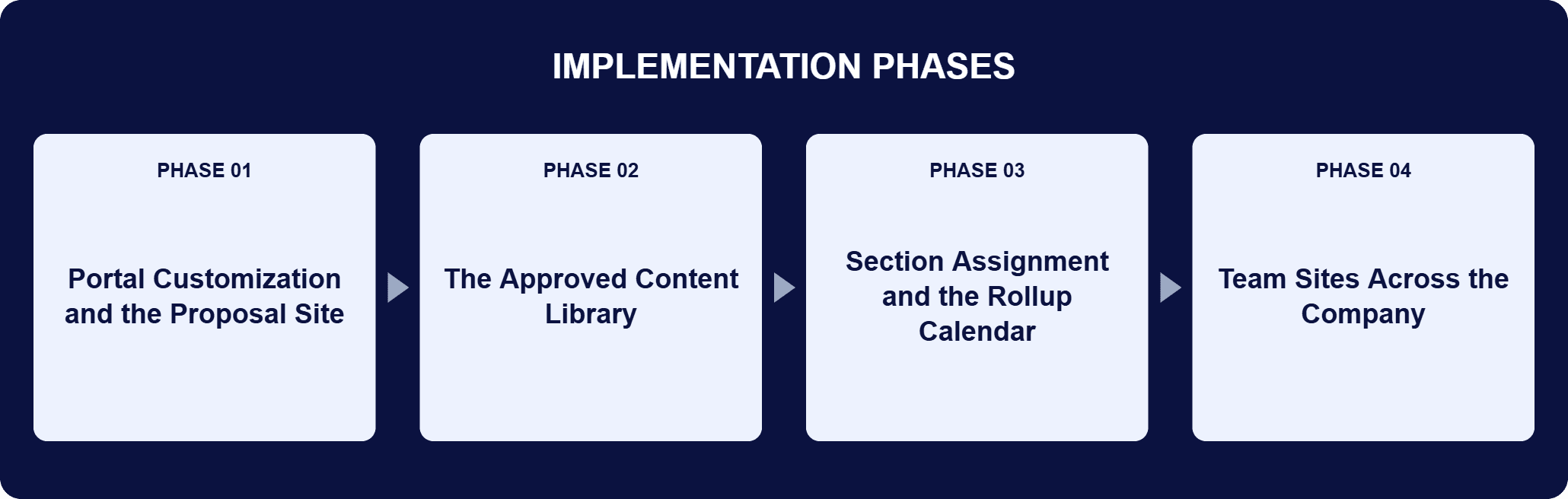
PHASE 03
Section Assignment and the Rollup Calendar
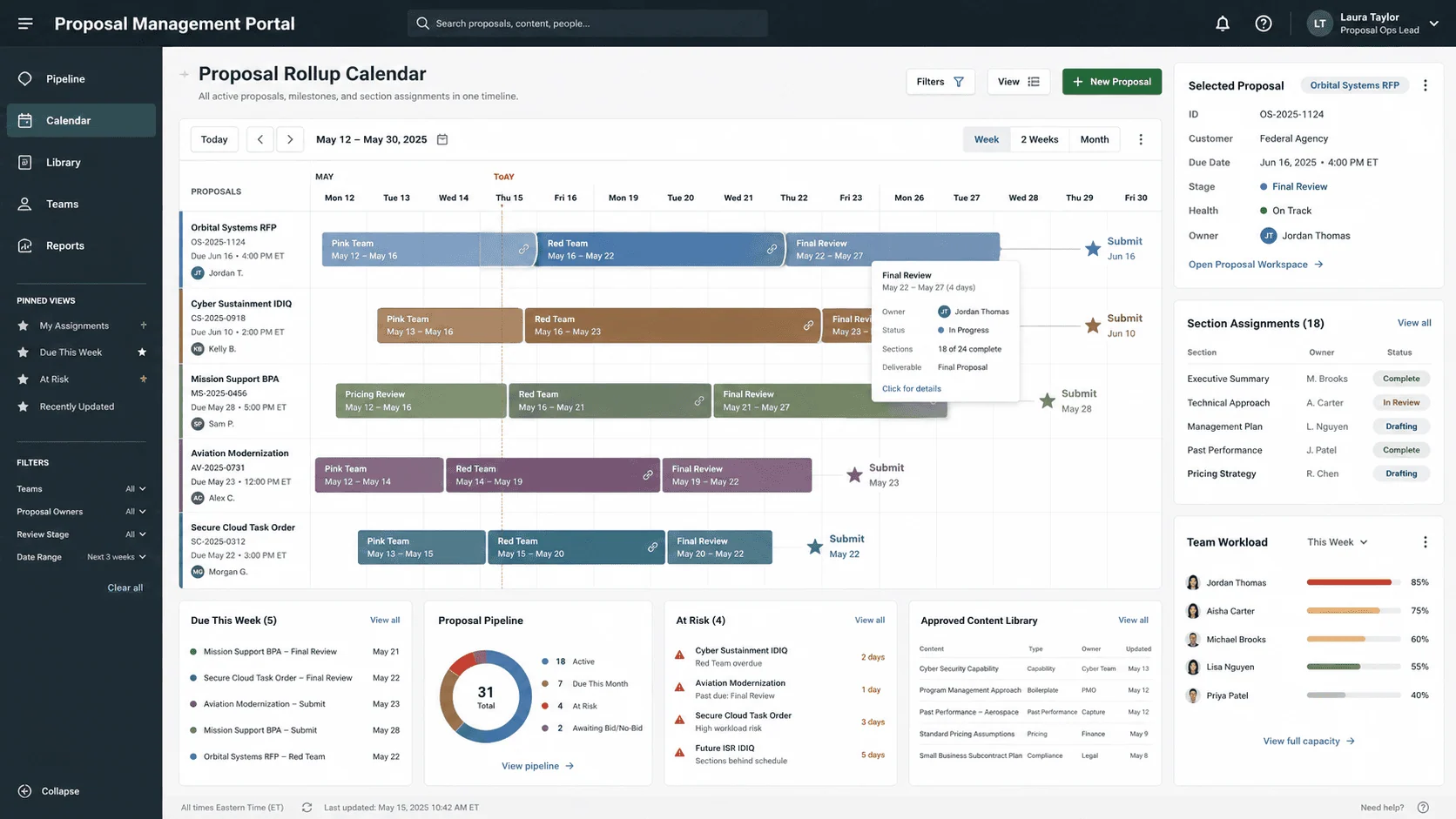
Process management moved into the same portal. Team members assign specific proposal sections to individual contributors, and a rollup calendar tracks timelines and critical milestones, consolidating every due date into a single management calendar so status is visible and no deadlines are missed.
PHASE 04
Team Sites Across the Company
i3solutions established portal team sites for the various organizations within the company, each with document libraries housing that organization’s files and documents, enabling targeted sharing of information, news, events, and calendars with specific groups or the entire organization.
The Proposal Generator and Management Portal is a customized SharePoint Portal, and each layer of it answers one of the problems the company started with. The proposal site is the workspace: the team assembles and reviews proposals in one place instead of across scattered files. The content library is the searchable home for everything a proposal is built from, past performance documents, boilerplate templates, capability matrices, vendor information, process guidelines, resumes, legal documents, and standard pricing, and every item in it is current and approved, which is what shortens the approval cycle. Security permissions govern who can view and update proposals, replacing the insufficient permissions that had obstructed the work. The process layer assigns specific proposal sections to individual contributors and tracks timelines and critical milestones on a rollup calendar that consolidates every due date into a single management calendar, which doubles as the pipeline view management had been missing. Portal team sites extend the same platform across the company’s organizations, each with its own document libraries and targeted sharing of information, news, events, and calendars, so collaboration and proposal production run on one system.
One Searchable Library, Fewer Bottlenecks
A single repository of current, approved content replaced scattered files, cutting the time spent finding and trusting proposal material.
| Outcome | Before | After |
|---|---|---|
| Finding proposal content | Limited search and difficulty accessing critical information | Increased access to past proposals, resumes, marketing collateral, images, and past performances in one searchable repository |
| Content trust | Lack of version control; no central library of approved content | Proposal library carries only the most up to date and approved content |
| Approval and cost | Outdated or unapproved content caught in review | Streamlined proposal approval process and reduced proposal development costs |
| Sections and deadlines | Inconsistent process management | Sections assigned to individual contributors; status tracked through the proposal calendar so no deadlines are missed |
| Bid pipeline visibility | Absence of a centralized proposal pipeline | Consolidated calendar of due dates in a single management calendar showing the whole pipeline |
| Business results | Issues surrounding resource allocation for different proposals | More efficient use of resources, accurate proposal submissions, a higher proposal win rate, and growing revenues |
The portal gives the proposal team a central repository for past proposals, resumes, images, and other key proposal components, and reduces the time and effort spent on tracking down information needed for proposals. Because the proposal library ensures that only the most up to date and approved content is being used, the approval process is shorter and proposals get out the door faster, with reduced proposal development costs. Individual team members are assigned sections of the proposal to complete, and status is tracked through the proposal calendar to ensure no deadlines are missed.
For management, the calendar provides a quick, accurate view of the proposal pipeline and allows better, more informed decisions on which proposals to bid on, and it eliminated the issues surrounding resource allocation for different proposals. The Proposal Generator streamlined the entire proposal process, which is resulting in efficient use of resources, accurate proposal submissions, a higher proposal win rate, and growing revenues.

PENDING-CLIENT-QUOTE
This engagement is relevant for
Less relevant for
Proposal Content, Process, and Pipeline on One Portal
The engagement established that a bid-driven contractor does not have to choose between proposal speed and proposal control. A customized SharePoint Portal put the content proposals are assembled from into one searchable library of approved, current content, with security permissions governing who can view and update proposals.
Sections are assigned to individual contributors, a rollup calendar consolidates every due date into a single management view of the pipeline, and portal team sites extend the platform to every organization in the company. The streamlined process is resulting in more efficient use of resources, accurate proposal submissions, a higher proposal win rate, and growing revenues.
A proposal generation and management portal is a customized SharePoint Portal that holds both the content proposals are assembled from and the process they are assembled by. For this global aerospace and defense contractor, i3solutions built the Proposal Generator and Management Portal: a proposal site for the team to work in, plus a central, searchable repository giving direct access to essential resources, past performance documents, boilerplate templates, capability matrices, vendor information, process guidelines, resumes, legal documents, and standard pricing. Two design choices define the category. First, the library admits only approved, current content, so the approval step shrinks because reviewers stop catching outdated material. Second, process management lives in the same portal: sections are assigned to individual contributors and a rollup calendar consolidates every due date into one management view of the bid pipeline.
The six the company started with: limited search functionality for up-to-date information, lack of version control, insufficient security permissions for viewing and updating proposals, inconsistent process management, absence of a centralized proposal pipeline, and difficulty accessing critical information. Each maps to a portal capability. Search and access are answered by the central searchable repository of proposal content. Version control is answered by the proposal library, which keeps only the most up to date and approved content in use, and that same property lessens the approval process and gets proposals out the door faster. Permissions are answered by security settings governing who can view and update proposals. Process management is answered by section assignments and the proposal calendar, and the missing pipeline by the rollup calendar that consolidates due dates into a single management calendar.
Individual team members are assigned specific sections of a proposal, and status is tracked through the proposal calendar so no deadlines are missed. The rollup calendar consolidates due dates into a single management calendar, tracking timelines and critical milestones across every active bid. That one view does double duty. For the proposal team it is deadline control: every section has an owner and every due date is visible in the same place, replacing the inconsistent process management the company started with. For management it is the pipeline: a quick, accurate view of every proposal in motion, which is what allows better, more informed decisions on which proposals to bid on. Before the portal, that pipeline view did not exist anywhere, so the same calendar that keeps a single bid on schedule also informs the decision to pursue the next one.
Yes. The solution establishes portal team sites for the various organizations within the company. Each team site includes document libraries to house all files and documents associated with its respective organization, and each enables targeted sharing of information, news, events, and calendars with a specific group or with the entire organization. This matters for two reasons. Operationally, it improves collaboration and centralizes access to critical materials within each organization rather than only at the corporate level. Structurally, it means the proposal portal is not an island: the same customized SharePoint Portal that runs proposal generation also carries each organization’s working sites, so the cohesive platform enhances both team coordination and the overall efficiency of the proposal process rather than adding one more disconnected system to the company’s landscape.
The engagement records more efficient use of resources, accurate proposal submissions, a higher proposal win rate, and growing revenues, with the streamlined proposal process as the mechanism behind each. The portal increased access to past proposals, resumes, marketing collateral, images, and past performances, reducing the time and effort spent tracking down information needed for proposals. The proposal library keeps outdated and unapproved content out of circulation, which streamlined the proposal approval process and reduced proposal development costs. The consolidated management calendar eliminated issues surrounding resource allocation for different proposals and gives management an accurate view of the proposal pipeline for deciding which proposals to bid on. Behind each result sits a specific operational change: sections have named owners, every due date sits on one management calendar, and outdated or unapproved content stays out of proposals.
i3solutions is a Microsoft Partner with 30 years of delivery experience and 1,500+ Microsoft engagements, with every engagement staffed by an all-senior, all US-based delivery team. That profile fits proposal portal work, where the platform customization only pays off if it matches how bids actually get assembled: what content contributors reach for, who may view and update a proposal, and what management needs to see before committing to a bid. This engagement is representative of the pattern: a customized SharePoint Portal carrying a searchable library of approved content, section assignments and a rollup calendar for process control, team sites for each organization, and a proposal process whose streamlining is resulting in a higher win rate and growing revenues. For companies weighing this class of work, a short scoping conversation establishes what a proposal portal would take in your environment.
Yes. The portal supports per-business-unit team sites on the same platform, so each unit works from its own site while still drawing on the shared, version-controlled content library. Sharing is targeted rather than all-or-nothing: a business unit can open specific folders or templates to another unit without exposing its entire site. That is what let this global defense contractor run one proposal platform across multiple business units instead of standing up a separate system for each.
A centralized, current content library is what raised this contractor’s win rate, not a new sales process. We can talk through what a comparable library would take to stand up in your environment.

US-Based | Est. 1997
© i3solutions. All rights reserved.
US-Based | Est. 1997
© i3solutions. All rights reserved.


