

A costly third-party service managed vehicle inventory and search, with downtime the dealership group didn’t control.
The client is a regional automotive retail group specializing in vehicle sales. To stay competitive, the company needed to offer potential customers a straightforward way to browse its constantly changing vehicle inventory, and that inventory information is critical: it includes photographs, features, condition, and pricing for every vehicle across all of the company’s locations. Whatever system held that data had to keep it accurate in real time, because the inventory it describes changes constantly.
The company ran that operation through a costly third-party service that managed inventory levels and operated a separate web-based search database. The arrangement was both expensive and prone to downtime. Recognizing the need for a more reliable and economical solution that could be maintained by its existing staff, the company set out to develop an in-house online vehicle search database: a system that would lower operational costs, reduce service disruptions, and give the company greater control over its inventory management.
An automotive retail group relied on a costly third-party service for vehicle inventory and search, with downtime it had no control over. i3solutions built an in-house .NET and SQL Server application giving every location real-time inventory and eliminating the recurring vendor fees.
Recurring vendor fees are gone now that inventory data is hosted on the company’s own web servers, every location gets real-time inventory updates instead of relying on a separate outsourced search database, and staff can make changes themselves rather than routing them through the vendor.

Paying a Vendor Every Month for Control of Its Own Inventory
Vehicle inventory data is the center of this company’s retail operation, and it sat with an outside vendor. The company sought to enhance customer service and increase accuracy by regaining control of its real-time vehicle inventory levels and replacing the costly outsourced solution. Every month the arrangement continued, the company paid recurring fees for a system its own team could operate, and every service disruption happened on infrastructure it did not control.
Leadership decided the answer was not a better vendor contract but a different model: an in-house, web-based application that the company’s existing staff could maintain. To achieve these goals, the company partnered with i3solutions to develop a system that would reduce costs and simplify operations, with full control over inventory data as the explicit outcome.
This retail group was paying a third-party vendor to manage inventory it could run itself on a single database. If a similar vendor dependency exists in your operations, in-housing it is often more straightforward than it looks.
Recurring Fees and Downtime on a Vendor’s Schedule
Left in place, the costs recurred indefinitely. The third-party service was expensive by the company’s own assessment, and its fees came due regardless of how the retail business performed. The downtime exposure compounded the cost: the outsourced approach was prone to downtime, and when the vendor’s web-based search database was unavailable, so was the straightforward inventory browsing experience the company needed to offer potential customers to stay competitive.
The replacement carried its own risk. An in-house system only delivers its economics if the company’s existing staff can actually maintain it; a custom application that requires outside specialists to operate would trade one dependency for another. Maintainability by existing staff was therefore not a preference but the condition the whole business case rested on.
Built for Existing Staff, Accurate Across Every Location
The system’s operators would be the company’s own staff, not a vendor’s technicians, so the tooling had to fit the way the work actually happens. Staff needed to take vehicle photographs and upload details directly from handheld devices, at the vehicle, and then edit and approve that information through an administrative tool with a simple web interface. Importing and updating had to run through a user-friendly interface the company’s own staff could work without specialist training, a design requirement rather than a refinement.
The data constraint was scale across locations. The photographs, features, condition, and pricing for every vehicle had to consolidate from all of the company’s locations into one centrally managed interface and stay current in real time. The application also had to bring the previously separate web-based search database in-house, hosted securely on the company’s own servers and website.
Senior Microsoft Specialists with Proven Delivery Depth
The requirements defined the vendor profile: a team that could design and build a web-based inventory management and search application on Microsoft .NET with a single SQL Server database, consolidate data from multiple locations into one centrally managed interface, and deliver a system the company’s existing staff could maintain without the third party. This was full-lifecycle custom application development, replacing a commercial service outright, and it had to hold up in daily retail operations from the start.
The company engaged i3solutions, a Microsoft Partner with 30 years of delivery experience and 1,500+ Microsoft engagements, delivered by an all-senior, all US-based delivery team. That profile matched the work: senior engineers who have built data-centric web applications on the Microsoft stack repeatedly, and who could hand the finished system to the company’s own staff rather than build a new dependency.
i3solutions built the company an in-house, web-based vehicle inventory management and search application through custom application development, replacing the costly third-party service the company had been paying to manage inventory levels and run a separate web-based search database.
PHASE 01
Inventory Operations Assessment
i3solutions worked through how inventory management actually ran: what the third-party service managed, what a vehicle record carries (photographs, features, condition, and pricing), how data originated at each of the company’s locations, and what the company’s existing staff would need to operate the system independently.
PHASE 02
Application Design and Architecture
The system was architected as a web-based application built on Microsoft .NET and powered by a single SQL Server database, bringing together inventory data from the company’s multiple locations into one centrally managed interface.
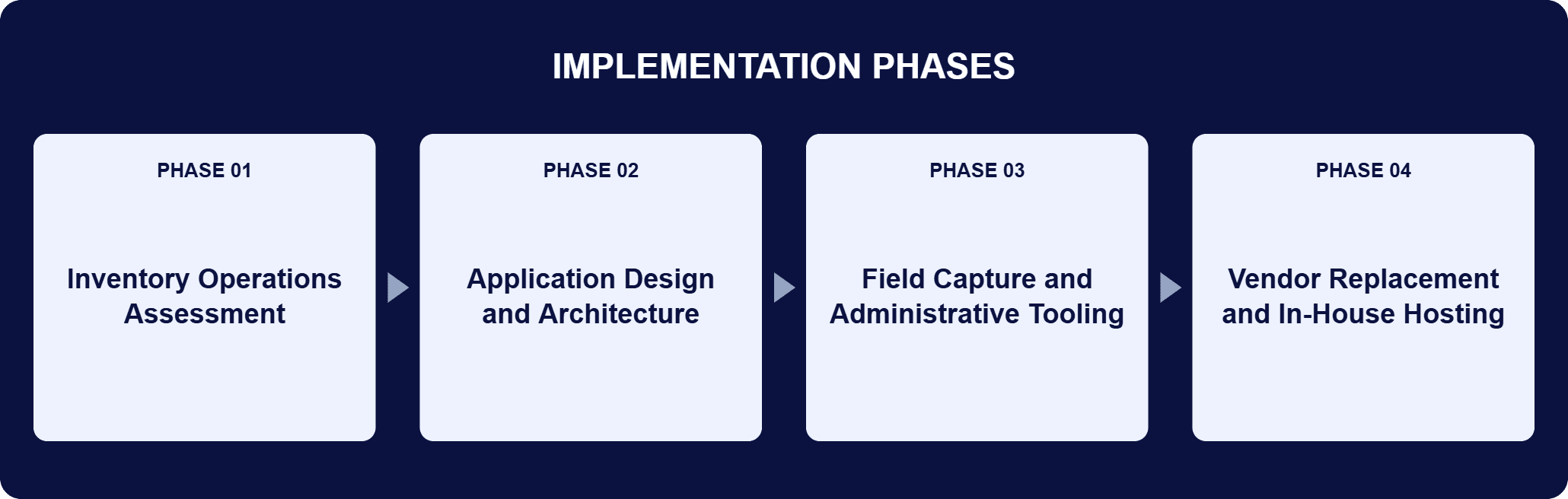
PHASE 03
Field Capture and Administrative Tooling
i3solutions built the capture workflow around the staff who do the work: vehicle photographs and details upload directly from handheld devices, and an administrative tool with a simple web interface lets staff edit and approve information before it publishes.
PHASE 04
Vendor Replacement and In-House Hosting
Inventory management and the web-based vehicle search moved onto the in-house application, with all data hosted securely on the company’s own servers and website. The move eliminated recurring vendor fees, ensured real-time inventory updates, and gave staff the tools to manage operations independently.
The application is a deliberately compact Microsoft stack. Built on Microsoft .NET and powered by a single SQL Server database, it brings together inventory data from the company’s multiple locations into one centrally managed interface, which is the direct answer to the operational problem: inventory control and real-time information management across an entire retail group. The data model carries what a vehicle retailer actually sells: photographs, features, condition, and pricing for every vehicle across all locations. Capture happens where the vehicles are. Staff take vehicle photographs and upload details directly from handheld devices, then use an administrative tool with a simple web interface to edit and approve information, so the importing and updating process stays streamlined without sacrificing accuracy. The web-based search database that a vendor previously operated as a separate system now runs on the same application and the same database, which is what makes real-time inventory updates possible. All data is hosted securely on the company’s own servers and website, giving the company greater control over downtime, and enhanced reporting capabilities support improved inventory management.

Real-Time Inventory, In-House
A web-based .NET application now runs inventory across every location on the company’s own servers, with recurring vendor fees eliminated.
| Outcome | Before | After |
|---|---|---|
| Vendor dependence | A costly third-party service managing inventory and search | An in-house application; recurring vendor fees eliminated |
| Downtime control | An outsourced arrangement prone to downtime | Data hosted on the company’s own web servers and website |
| Inventory currency | A separate, vendor-operated web-based search database | Real-time inventory updates across all locations |
| Change turnaround | Changes and updates handled through the outsourced service | Reduced turnaround times for changes and updates |
| Operational ownership | Operations dependent on an external vendor | Staff equipped with the tools to manage operations independently |
The headline result is structural: the company stopped paying an outside vendor to run its own inventory operation. The delivered application eliminated the recurring expenses associated with external vendors and reduced the company’s reliance on them entirely, while hosting all data securely on the company’s own servers and website gave the company greater control over downtime, the specific weakness of the outsourced arrangement it replaced.
The operational gains landed with the staff. The company’s team gained the tools to manage operations independently: streamlined importing and updating processes through a user-friendly interface, real-time inventory updates across every location, and reduced turnaround times for changes and updates. Enhanced reporting capabilities round out the platform, supporting improved inventory management on data the company now fully controls.

PENDING-CLIENT-QUOTE
This engagement is relevant for
Less relevant for
Inventory In-House, Vendor Fees Off the Books
The engagement established that a retail group does not have to rent its own inventory operation from a third-party vendor. A custom web-based application on Microsoft .NET, powered by a single SQL Server database, consolidated inventory data from all of the company’s locations into one centrally managed interface.
Staff photograph vehicles and upload details directly from handheld devices, edit and approve information through a simple web interface, and the data is hosted securely on the company’s own servers and website. The result eliminated recurring vendor fees, ensured real-time inventory updates, reduced turnaround times for changes and updates, and gave the company’s staff the tools to manage operations independently.
An in-house vehicle inventory management system is a custom web-based application that a retailer owns and operates itself, replacing the third-party services many dealer groups pay to manage inventory levels and run customer-facing search databases. For this regional automotive retail group, i3solutions built the application on Microsoft .NET with a single SQL Server database, consolidating inventory data from all of the company’s locations into one centrally managed interface. The record for every vehicle carries photographs, features, condition, and pricing, and the same application powers the web-based search that customers use to browse the constantly changing inventory. Because the company hosts all data on its own servers and website, it controls uptime and update timing directly. The defining economics are ownership: recurring vendor fees are eliminated, and the company’s existing staff manage the system independently.
The starting point is what the outsourced service actually does, because the in-house replacement has to cover all of it from day one. In this engagement, the third-party service managed inventory levels and operated a separate web-based search database, so i3solutions designed one application that does both: inventory management and customer-facing vehicle search on a single Microsoft .NET application with a single SQL Server database. The second design input is who will run it. The company needed a solution its existing staff could maintain, so the delivered system pairs handheld-device capture of vehicle photographs and details with an administrative tool built on a simple web interface for editing and approving information. The goals the company set at the outset, from lower operational costs to greater control over inventory management, defined the acceptance criteria for the build.
Updates start at the vehicle. Company staff take vehicle photographs and upload details directly from handheld devices, so a vehicle’s record, its photographs, features, condition, and pricing, originates where the information is observed rather than being transcribed later. From there, an administrative tool with a simple web interface lets staff edit and approve the information before it reaches the customer-facing search database. Because the application runs on a single SQL Server database that consolidates data from all of the company’s locations into one centrally managed interface, an approved update is reflected in real time everywhere the inventory appears. That workflow is what streamlined the importing and updating processes and reduced turnaround times for changes and updates compared with routing everything through the outsourced service the application replaced.
In this engagement, that was a requirement, not an aspiration. The company specifically needed a more reliable and economical solution that could be maintained by its existing staff, because an in-house system that required outside specialists to operate would simply replace one vendor dependency with another. The delivered application meets the requirement through its tooling: a user-friendly web interface makes importing and updating routine work, handheld devices put capture in the hands of the staff who work with the vehicles, and the administrative tool keeps editing and approval simple. The outcome the company measured was independence: its staff gained the tools to manage operations without relying on the external vendor, and the recurring expenses associated with that vendor were eliminated. In this engagement, staff maintainability was the acceptance criterion the economics rested on: the vendor fees only stay eliminated if the company never has to bring the vendor back.
The application is built on Microsoft .NET and powered by a single SQL Server database that brings together inventory data from the company’s multiple locations into one centrally managed interface. All data is hosted securely on the company’s own servers and website rather than on a vendor’s infrastructure. That hosting decision carries operational weight: the previous outsourced arrangement was prone to downtime the company could not control, and hosting the information on its own web servers gave the company greater control over downtime and service disruptions. It also closes the loop on ownership, since the company’s inventory data, including the photographs, features, condition, and pricing for every vehicle, now lives entirely on systems the company operates. Enhanced reporting capabilities run against that same consolidated database, supporting improved inventory management across the retail group.
i3solutions is a Microsoft Partner with 30 years of delivery experience and 1,500+ Microsoft engagements, with every engagement staffed by an all-senior, all US-based delivery team. That profile fits vendor-replacement work, where the custom application must match a commercial service’s function on day one and then run in the hands of the client’s own staff. This engagement is representative of the pattern: a web-based inventory management and search application on Microsoft .NET and a single SQL Server database, consolidating every location’s data into one centrally managed interface, hosted on the company’s own servers, with recurring vendor fees eliminated and real-time inventory updates ensured. For organizations weighing this class of work, a short scoping conversation establishes what bringing your system in-house would take in your environment.
Yes, that’s the switch this project made. This automotive retail group was paying recurring fees to a third-party inventory service before i3solutions built an in-house .NET application, running on the company’s own servers, that its existing staff maintain directly, including keeping fast-changing inventory such as photos, features, condition, and pricing accurate in real time across every location. That’s what let the company drop the vendor fees without adding specialized staff to operate the replacement.
Staff now manage inventory directly from handheld devices on infrastructure the company owns outright. We’re glad to discuss what a comparable in-house build would look like for your operations.

US-Based | Est. 1997
© i3solutions. All rights reserved.
US-Based | Est. 1997
© i3solutions. All rights reserved.


