

An internal cost-estimating tool pricing hundreds of estimates a year hadn’t kept pace with the business it supported.
The client is a global aerospace and defense engine manufacturer that designs, produces, and services aircraft engines for both commercial and military applications. Much of its cost estimating, the discipline that prices hundreds of estimates a year and feeds critical program decisions, ran through an internal tool that had not kept pace with the engineering it served: an outdated estimating tool built on cumbersome Excel spreadsheets.
As data volume and complexity grew, the tool’s limitations became a daily tax. Teams struggled with version control, inconsistent calculations, and limited visibility into the latest data, producing delays, errors, and rework across departments. Approval cycles ran up to five days. The company committed to transforming the outdated system into a modern, web-based solution.
An aerospace engine manufacturer priced hundreds of cost estimates a year through an aging Excel tool prone to version conflicts and manual reconciliation. i3solutions rebuilt it as a governed web platform, cutting rework 30% and recovering $1.1 million a year in engineering time.
Rework fell 30% from eliminated version mismatches, each engineer recovers about 8 hours a month once lost to spreadsheet conflicts, and the changes add up to more than $1.1 million in organization-wide productivity gains a year.

The Spreadsheet Became the Bottleneck
The estimating tool sat on the critical path of the business: hundreds of estimates each year, feeding decisions about programs measured in the tens of millions. Every version conflict and broken formula rippled outward as rework, and every five-day approval cycle held program decisions hostage to reconciliation.
The company decided against digitizing the workbook as-is. It committed to rebuilding the process as a platform: a scalable, web-based solution designed to improve collaboration, eliminate manual inefficiencies, and scale with evolving business needs.
This manufacturer didn’t get Excel on the web, it got validation, role-based access, and real-time collaboration where none of those existed before. If a critical process in your organization still runs on a shared workbook, that distinction is worth making before you scope the fix.
Program Decisions Rode on Unverifiable Numbers
The measurable cost was already running: rework that would later be reduced by 30%, roughly $250k a year in rework-related labor, and engineer hours lost to spreadsheet conflicts that would later total more than $1.1 million a year in recovered productivity. Those figures, measured after the fix, are the price the company had been paying to keep estimating on Excel.
The deeper stake was confidence. Broken formulas and unauthorized edits meant leadership was making critical program decisions on cost data whose integrity nobody could fully trace, in a market where an estimate feeds contract bids and program commitments.
Rebuild the Process, Not the Workbook
The defining design constraint was scope discipline: the engagement rebuilt the estimating process as a platform rather than transplanting the existing workbook onto the web. That meant re-engineering calculation logic with validation, centralizing data handling, and designing role-based access, while keeping the tool recognizable enough that estimating teams could adopt it.
The environment set the rest: secure access from any internet-enabled device for distributed teams, real-time updates so simultaneous collaboration replaced serialized spreadsheet handoffs, integration with the company’s other enterprise tools, and central updating so users never again depended on downloading the right version.
Senior Microsoft Specialists with Proven Delivery Depth
The company partnered with i3solutions as an Excel-to-web application development firm: the specific discipline of converting spreadsheet-driven business processes into scalable web applications on the Microsoft stack, without losing the logic the business runs on.
The company engaged i3solutions, a Microsoft Partner with 30 years of delivery experience and 1,500+ Microsoft engagements, delivered by an all-senior, all US-based delivery team, working in an Agile approach with frequent collaboration and direct communication with the company’s stakeholders to keep the build aligned with exact business needs.
i3solutions led the transformation from spreadsheet-driven Excel application to scalable web platform, rebuilding the process rather than digitizing the workbook.
PHASE 01
Estimating Process Analysis
i3solutions worked through how estimates actually moved, where version conflicts arose, which calculations drifted, and what approvals required, defining the platform the process needed rather than a copy of the workbook it had.
PHASE 02
Platform Architecture on the Microsoft Stack
The application was engineered on ASP.NET with MVC and Razor for structure, Entity Framework for data access, SQL Server for a secure and efficient database, jQuery for interface interactivity, and Power BI for dashboards and cross-proposal reporting.
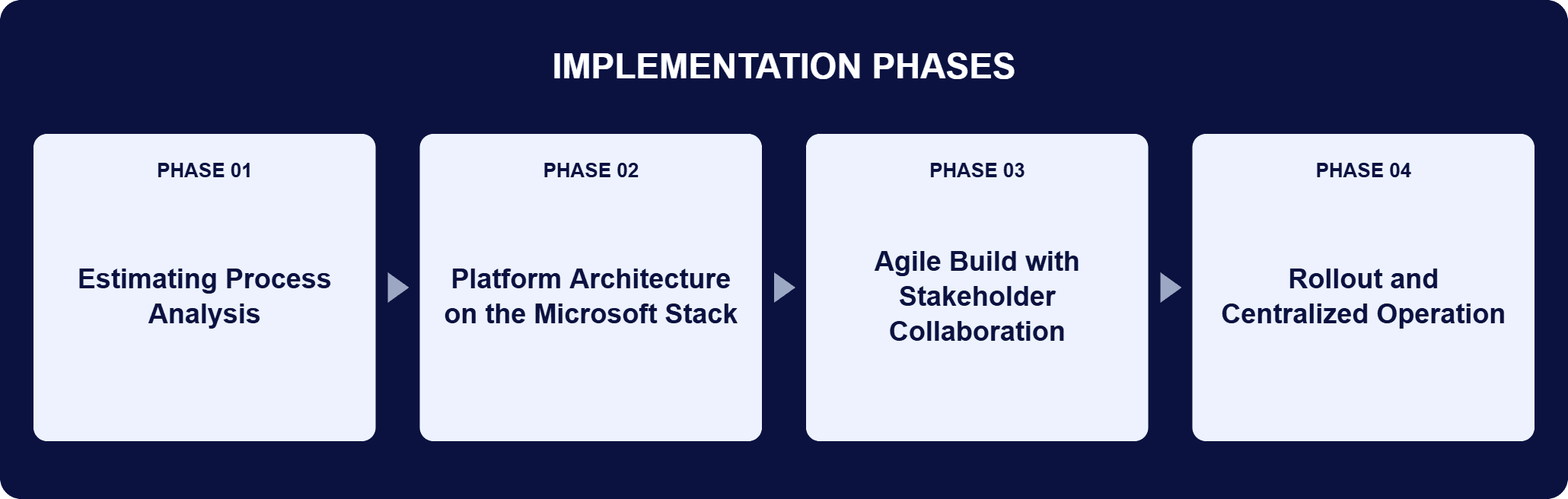
PHASE 03
Agile Build with Stakeholder Collaboration
Working in Agile iterations with direct stakeholder communication, i3solutions built the dashboard where users add, view, edit, compare, and approve estimates in real time, with automated validation, data integrity checks, and role-based reporting.
PHASE 04
Rollout and Centralized Operation
The web application replaced the spreadsheets with centrally updated, centrally customized software: secure access from any internet-enabled device, no local versions to install, and workflows standardized so approvals complete in one day instead of five.
The application runs on the Microsoft technology stack. ASP.NET is the foundation, with a Razor MVC application providing modern, efficient structure. Entity Framework handles data access and management against SQL Server, which provides the secure and efficient database behind centralized data handling. jQuery powers the interface interactivity, and Power BI provides interactive dashboards and cross-proposal reporting for decision-making. From one dashboard, users add, view, edit, compare, and approve estimates in real time, with role-based standard and custom reports behind it. Automated validation and data integrity checks replaced the broken formulas and manual reconciliation of the spreadsheet era, and controlled role-based access ended unauthorized edits, strengthening traceability across the hundreds of estimates the company produces each year. The application integrates with the company’s other web-based tools and services, cutting manual steps out of the workflow, and it is updated and customized centrally, so users never download or install versions to stay current. Teams reach it securely from any internet-enabled device, collaborating simultaneously where spreadsheet handoffs once serialized the work.

Rework Down 30%, Approvals in a Day
The rebuilt platform cut approval cycles from up to five days to one, with more than $1.1 million in annual productivity gains.
| Outcome | Before | After |
|---|---|---|
| Rework | Version mismatches, manual reconciliation | Reduced by 30% |
| Engineer time | Lost to spreadsheet conflicts | 8 hours per month recovered per engineer |
| Organization-wide productivity | Drained by conflicts and reconciliation | More than $1.1 million gained annually |
| Approval cycles | Up to five days | One day |
| Data integrity | Broken formulas, unauthorized edits | Validated logic, role-based access, audit-ready version control |
The web-enabled estimating tool reduced rework by 30%, eliminating version mismatches and manual reconciliation across teams. Engineers now generate accurate cost estimates in a fraction of the time, saving approximately $250k annually in rework-related labor. By enabling simultaneous collaboration and eliminating spreadsheet conflicts, engineers save an average of 8 hours per month each, resulting in over $1.1 million in annual productivity gains across the organization.
Validated logic and controlled role-based access eliminated broken formulas and unauthorized edits, strengthening data integrity and traceability across hundreds of estimates each year. Centralized version control ensures every calculation is consistent and audit-ready, giving leadership full confidence in the accuracy of cost data used for critical program decisions, and standardized workflows reduced approval turnaround from five days to one.

[PENDING-CLIENT-QUOTE: Replace with approved direct or paraphrased statement from [role] at [organization type] before final publication. A missing client quote does not block publication but must be resolved within 30 days of go-live.]
[PENDING ATTRIBUTION]
[role], [organization type]
This engagement is relevant for
Less relevant for
Rebuild the Process, and the Numbers Follow
The engagement established the difference between digitizing a workbook and rebuilding a process. The company did not get Excel on the web; it got a platform, with validation where formulas used to break, role-based access where anyone could once edit, real-time collaboration where versions used to fork, and central updates where installs used to drift. The measured results followed from that design choice: 30% less rework, $250k in annual labor savings, 8 hours a month returned to every engineer, more than $1.1 million in annual productivity gains, and approvals in one day instead of five. For organizations still estimating in spreadsheets, the pattern transfers exactly as built.
Yes, that was the requirement behind this rebuild. This aerospace engine manufacturer’s cost-estimating tool had outgrown its original spreadsheet design, with version conflicts and manual reconciliation stretching approval cycles out to days; rebuilding it as a web platform added the access control and audit trail leadership needed before estimate data could feed program decisions, cutting rework 30% and approval cycles from five days to one. If audit-readiness is the gap in your own estimating process, that’s the same bar this project was built to clear.
In this engagement, i3solutions rebuilt the process rather than the workbook. The team worked through how estimates actually moved and where the spreadsheet failed, then engineered a platform around those realities: centralized data handling so versions cannot fork, automated validation and integrity checks so calculations stay consistent, role-based access so edits are controlled, and integrations that cut manual steps from the workflow. Development ran on an Agile approach with frequent, direct stakeholder collaboration, which kept the build aligned with the company’s exact business needs and let priorities shift without derailing delivery.
The application is built on ASP.NET with a Razor MVC structure, Entity Framework for data access, and SQL Server as the secure central database. From one dashboard, users add, view, edit, compare, and approve estimates in real time; jQuery drives the interface, and Power BI provides interactive dashboards and cross-proposal reporting with role-based standard and custom reports. Automated validation and data integrity checks run on every calculation, and centralized version control means every estimate is consistent and audit-ready. Teams access the tool securely from any internet-enabled device, and updates deploy centrally, so no user ever works from a stale local copy.
This engagement’s measured returns: rework fell 30%, saving approximately $250k annually in rework-related labor; engineers recovered an average of 8 hours per month each, worth more than $1.1 million in annual productivity gains across the organization; and approval cycles dropped from up to five days to one. The pattern behind the numbers is what transfers: the savings come from eliminating version conflicts, reconciliation, and rebroken formulas, costs that recur every cycle a spreadsheet-driven process runs. A company sizing its own return should count hours spent reconciling versions, the rework rate on spreadsheet outputs, and the elapsed time of its approval cycles.
i3solutions is a Microsoft Partner with 30 years of delivery experience and 1,500+ Microsoft engagements, with every engagement staffed by an all-senior, all US-based delivery team. Excel-to-web modernization is a specific discipline within that record: extracting the business logic a company actually runs on from its spreadsheets, then rebuilding it as a validated, access-controlled, centrally operated web platform. This engagement, serving a global aerospace and defense engine manufacturer’s estimating operation across hundreds of estimates a year, is representative. A scoping conversation maps your spreadsheet-driven process, what a web rebuild would replace, and comparable engagements to reference when you build the internal case.
No. Updates roll out centrally without downloads or version tracking, so the platform evolves with business priorities instead of accumulating conflicting spreadsheet copies.
The engagement began with a discovery phase: stakeholder interviews and an assessment of the tool’s underlying logic, workflows, and pain points. Delivery then followed an Agile process with short iterations and direct collaboration against the company’s requirements.
These results followed directly from the design choice to rebuild the process, not just move it online. We’re glad to discuss what a comparable rebuild would look like for your workbook-based process.

US-Based | Est. 1997
© i3solutions. All rights reserved.
US-Based | Est. 1997
© i3solutions. All rights reserved.


