
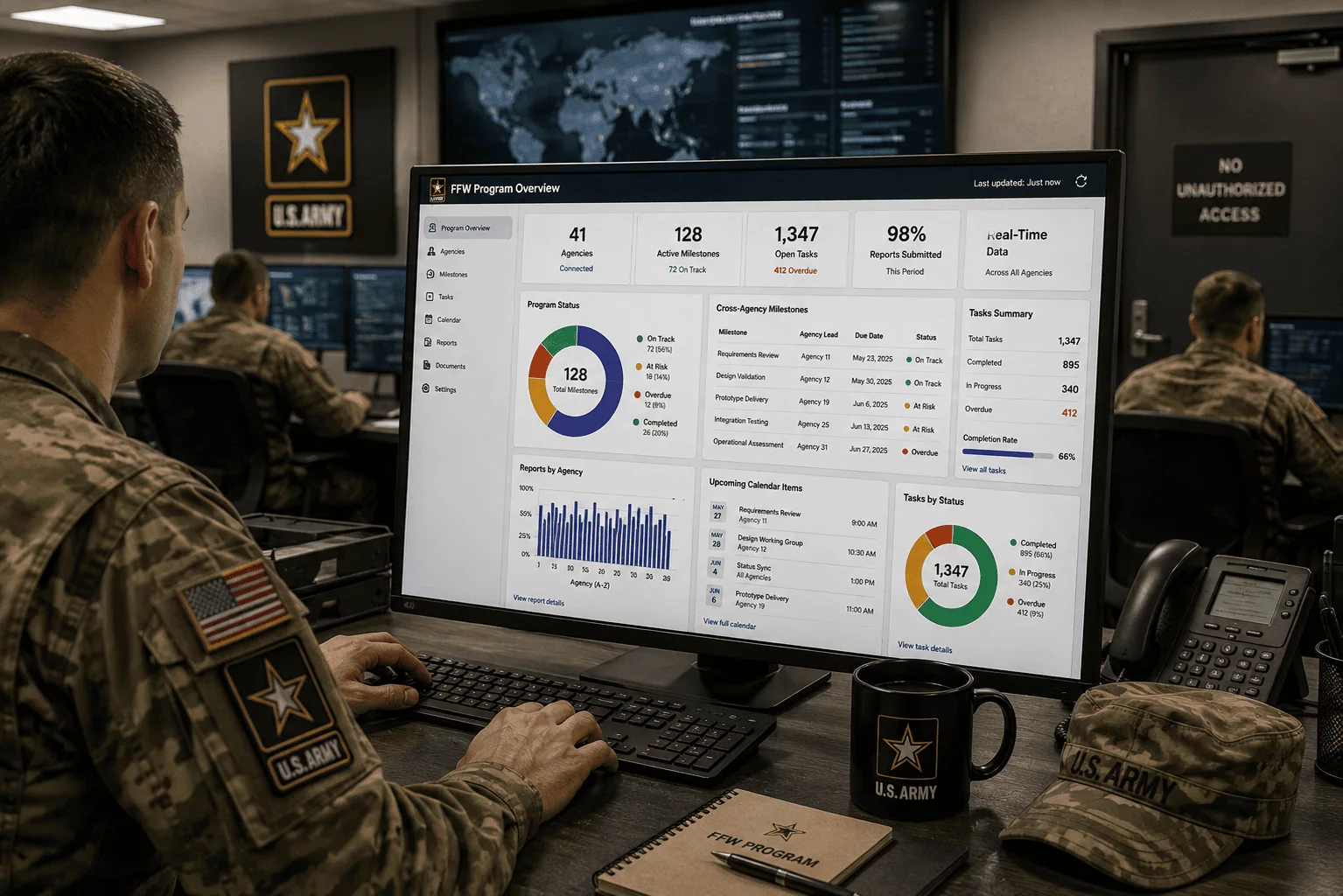
Consolidating task and status updates from 41 subcontracting agencies took several weeks of manual work each cycle.
The client is a US Army program management office responsible for a program delivered through 41 different subcontracting agencies. Its project tasks and deadlines were tracked through a highly manual process spread across numerous Excel spreadsheets, and the spreadsheets were limited because there were no dependencies or links between the different task items and/or project areas. Consolidating all program tasks and action items for the Program Management Office was taking the Army several weeks, so the program picture leadership worked from was weeks old by the time it existed.
In addition, the Army did not have a tool to consolidate and manage all of their data and shared calendars across 41 different subcontracting agencies for this program. No consolidated knowledge repository held the program’s documents, and no centralized reporting system existed to draw on. The Army needed to find a solution that could replace their manual system for task and project management, develop a consolidated knowledge repository for documents across all areas of this program, and develop a centralized reporting system.
An Army program office spent weeks each reporting cycle manually consolidating updates from 41 subcontracting agencies across disconnected spreadsheets. i3solutions built automated SQL Server reporting that pulls every agency’s data into one central repository in real time.
Program task and action item consolidation that once took several weeks of manual work each cycle now updates in real time through the Executive Information System, task items that had no dependencies or links now roll up to reflect the true status of every deliverable and milestone, and all 41 subcontracting agencies now collaborate, meet online, and share team calendars in one centralized area instead of managing data separately.
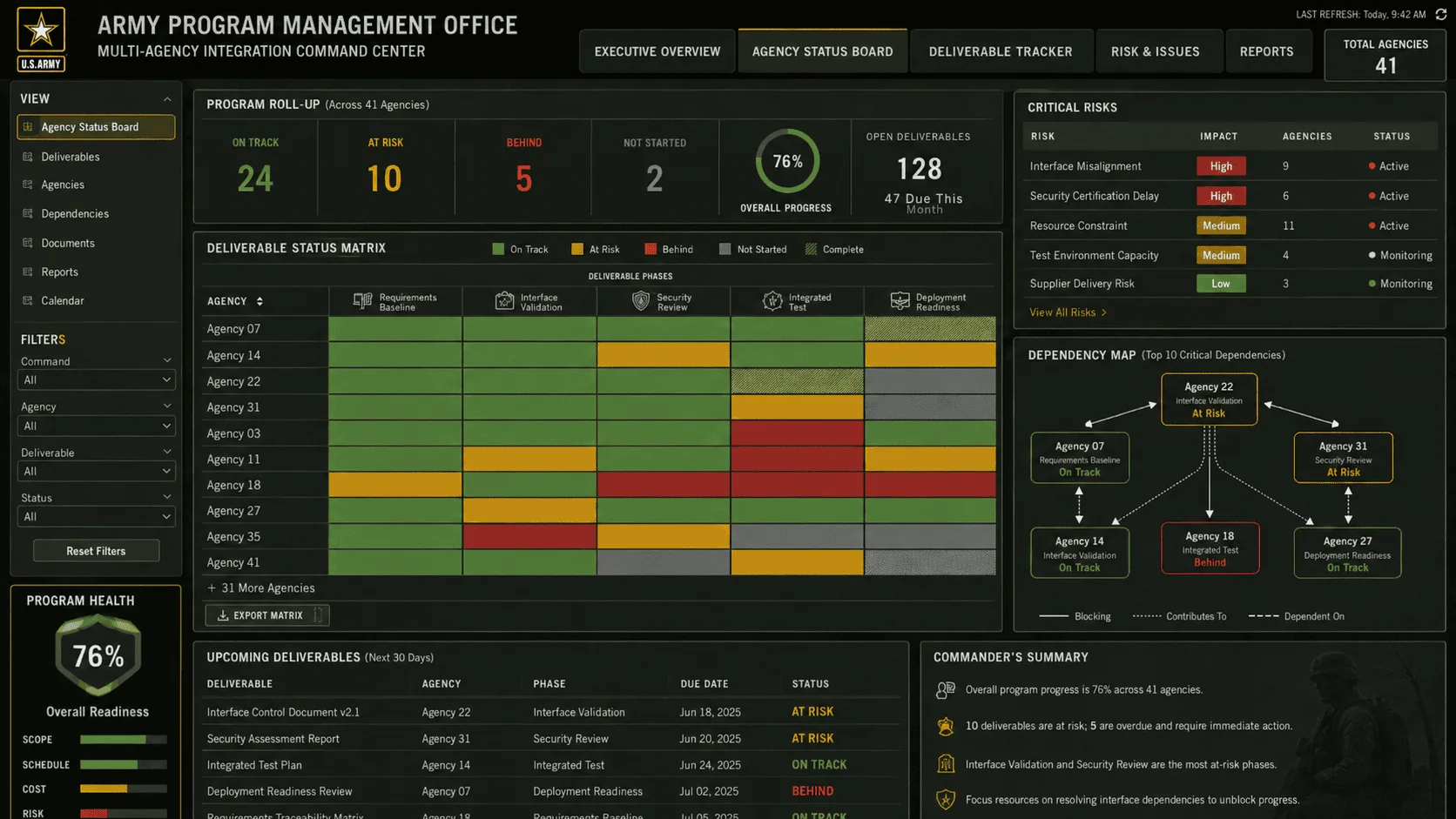
Program Status Took Weeks to Assemble and Was Stale on Arrival
The spreadsheet mechanics guaranteed the delay. Because the different task items and project areas carried no dependencies or links between them, nothing rolled up on its own: every consolidated view of the program had to be rebuilt by hand, spreadsheet by spreadsheet, and that rebuild took several weeks each time. The Program Management Office was not short of data; it was short of a system that could turn 41 agencies’ task lists into one current answer about the program.
Leadership defined the replacement in three requirements: a solution that could replace the manual system for task and project management, a consolidated knowledge repository for documents across all areas of the program, and a centralized reporting system. All three point at the same decision, which is consolidation: one platform holding the tasks, the documents, and the reporting, rather than a faster way to keep merging spreadsheets.
This program office was spending weeks each cycle assembling status from 41 subcontracting agencies by hand. If your organization is doing the same manual rollup across multiple groups, that’s a solvable reporting architecture problem.
A Program Managed on Weeks-Old Numbers
Left manual, the consolidation tax came due before every status cycle, and what it bought was already stale. With no roll-up across the spreadsheets, the office could not determine the true status of a deliverable or milestone at the moment a decision needed it; problems surfaced only after the weeks-long consolidation that revealed them. Proactive management of the program was structurally out of reach, because the information reached key management personnel after the fact.
The scale multiplied the exposure. The data and shared calendars of 41 different subcontracting agencies sat outside any common tool, no system enforced standard practices across the teams, and finding a relevant data file meant searching across the entire project by hand. Every one of those gaps recurred continuously for as long as the manual process survived.
41 Agencies, One Program Picture
The collaboration requirement cut in two directions at once. Each group on the program needed its own working space for documents, calendars, discussions, meetings, and task and action item lists, while the Program Management Office needed all of it to roll up into one view of program status. The solution had to serve cross company and cross team collaboration across 41 subcontracting agencies without flattening them into a single shared pile, and it had to give the management team direct insight into the current status of all levels of the program.
The reporting requirement had the same double character. Reports had to generate in numerous formats and reach the Product and Management Teams automatically, audit and compliance reports had to track whether Product Team tasks were updated in a timely manner, and the executive view could not stop at top-level numbers: management teams needed to drill down on the numbers to find the source of a problem or perform a more detailed analysis to discover trends in the data.
Senior Microsoft Specialists with Proven Delivery Depth
The requirements defined the vendor profile: a team that could design and deliver a consolidated project management solution on Microsoft SharePoint Portal technology, build an executive dashboard with real drill-down rather than a static report page, automate report generation and delivery through SQL Server Reporting Services, and structure a central repository that 41 subcontracting agencies could actually work in. This was platform consolidation at program scale, and it had to hold up in front of contracting managers and executives from day one.
The program office engaged i3solutions, a Microsoft Partner with 30 years of delivery experience and 1,500+ Microsoft engagements, delivered by an all-senior, all US-based delivery team. That profile matched the work: senior engineers who have consolidated task tracking, document management, and reporting onto the SharePoint platform repeatedly, delivering for an Army program office with a delivery team based entirely in the United States.
i3solutions developed an Executive Information System (EIS) to replace the inefficient manual task tracking system: a consolidated project management solution built on Microsoft SharePoint Portal technology, delivered as an Executive Dashboard, automated reporting, and a central repository for all project documents.
PHASE 01
Consolidated Platform Foundation
The EIS was built on Microsoft SharePoint Portal technology as one consolidated project management solution, replacing the manual tracking spread across numerous Excel spreadsheets. Program work items moved onto the platform where they roll up, eliminating much of the manual tracking the Program Management Office had been paying for in weeks of consolidation effort.
PHASE 02
Executive Dashboard Development
The Executive Dashboard interface puts program information in front of key management personnel in real time, so key decision makers can proactively manage the program. The dashboard does not stop at the executive management view: management teams drill down on the numbers to find the source of a problem, perform more detailed analysis to discover trends in the data, or isolate one section of the data that may be tarnishing the overall results.
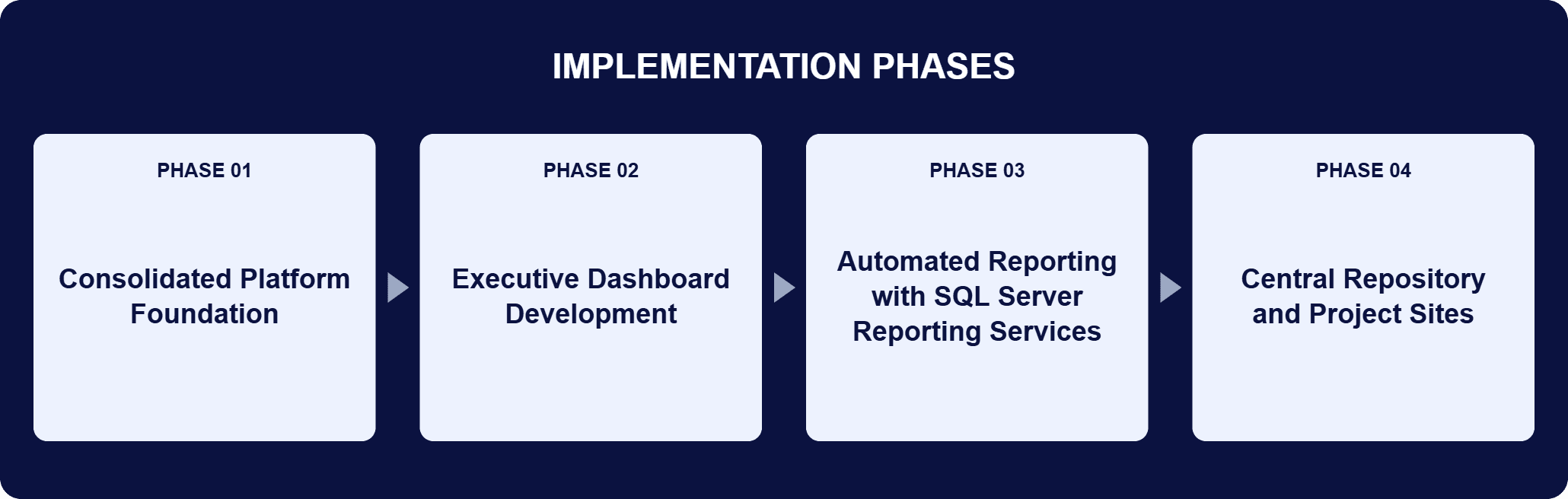
PHASE 03
Automated Reporting with SQL Server Reporting Services
The EIS uses SQL Server Reporting Services to automate the generation of reports in numerous formats, delivered automatically to the Product and Management Teams. Audit and compliance reports track whether Product Team tasks are updated in a timely manner, so the reporting layer polices its own inputs instead of relying on manual follow-up.
PHASE 04
Central Repository and Project Sites
A central repository for all project documents completes the system, with a project site created for each group to allow cross company and cross team collaboration. Each site includes calendar rollups, discussion groups, meeting planners, and task and action item lists, giving the management team direct insight into the current status of all levels of the program.
The Executive Information System is a consolidation of three functions onto Microsoft SharePoint Portal technology. Task and project management is the first: work items live on the platform and roll up, which is what lets the office read a deliverable’s real status without rebuilding it by hand from Excel. Presentation is the second: the Executive Dashboard supplies real-time information, progress, and status reports to the contracting managers, and the same interface lets management teams move from a roll-up down to the underlying numbers, whether to find the source of a problem, discover a trend, or isolate one section of data skewing an overall result. Reporting and collaboration complete the system. SQL Server Reporting Services automates report generation in numerous formats with automatic delivery to the Product and Management Teams, plus audit and compliance reports that track whether Product Team tasks are updated in a timely manner. The central repository gives each group its own project site, with calendar rollups, discussion groups, meeting planners, and task and action item lists, and the EIS enforces standard practices across all the teams while making the search for relevant data files across the entire project far simpler.
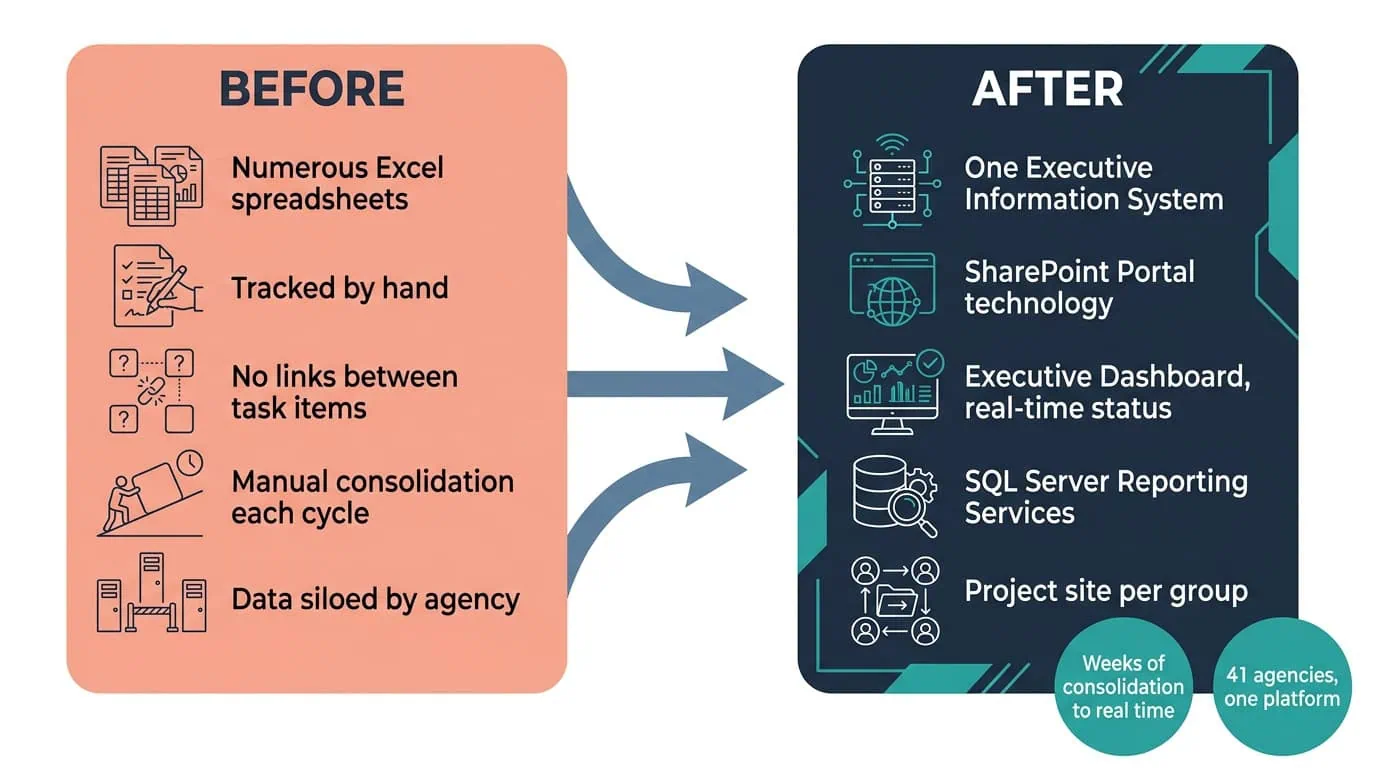
Weeks of Consolidation to Real-Time
An Executive Information System with automated SQL Server reporting now rolls up every task and milestone to a true, real-time status.
| Outcome | Before | After |
|---|---|---|
| Program task and action item consolidation | Several weeks of manual consolidation each cycle | Real-time updates through the Executive Information System |
| Status of deliverables and milestones | No dependencies or links between task items; no roll-up | Tasks and action items roll up to the true status of a deliverable or milestone |
| Cross-agency collaboration | Data and shared calendars unmanaged across 41 different subcontracting agencies | One centralized area where all 41 agencies collaborate, meet online, and share team calendars |
| Report generation and delivery | Status reports assembled by hand from spreadsheets | SQL Server Reporting Services generates reports in numerous formats, delivered automatically to the Product and Management Teams |
| Executive visibility | Program picture weeks old on arrival | Executive Dashboard with real-time status and drill-down to the source of a problem |
Status changed shape. A consolidation process that previously took weeks now produces real-time updates, and the Executive Dashboard supplies real-time information, progress, and status reports to the contracting managers as the program runs. The EIS provides a centralized area where 41 different agencies can collaborate, share information, conduct online meetings, manage documentation and key information, view task and action item roll-ups, and share team calendars. None of that existed while every agency’s data sat in its own files.
A centralized repository and project sites enhance collaboration among 41 subcontracting agencies, enabling seamless document sharing, task management, and calendar roll-ups across all teams. The system also disciplines the program around the data: the EIS enforces standard practices across all the teams, audit and compliance reports track whether Product Team tasks are updated in a timely manner, and the process for generating status reports and searching for relevant data files across the entire project runs through one platform instead of many hands.

PENDING-CLIENT-QUOTE
This engagement is relevant for
Less relevant for
One Program Picture, Produced in Real Time Instead of Assembled Over Weeks
The engagement established that a program spread across 41 subcontracting agencies does not have to buy its status picture with weeks of manual consolidation. An Executive Information System on Microsoft SharePoint Portal technology consolidated task and project management, the program’s documents, and its reporting onto one platform.
The Executive Dashboard puts real-time status in front of key management personnel with drill-down to the source of a problem, SQL Server Reporting Services delivers reports in numerous formats to the Product and Management Teams automatically, and a project site per group carries the calendars, discussions, meetings, and task lists each team works from. What the Program Management Office gained is the ability to answer the question the spreadsheets never could at the moment it is asked: the true status of a deliverable or milestone, current as of now.
When program status is assembled by hand, the answer to where the program stands is always weeks old. An Executive Information System removes the assembly step: one consolidated project management platform for tasks, documents, and reporting. For this US Army program management office, i3solutions built the EIS on Microsoft SharePoint Portal technology with three working parts: an Executive Dashboard that puts program status in front of key management personnel in real time, SQL Server Reporting Services automating report generation in numerous formats, and a central repository holding every project document, organized as a project site for each group. The defining property is consolidation. Tasks and action items roll up, so management can determine the true status of a deliverable or milestone directly, instead of waiting for a consolidation pass across numerous Excel spreadsheets that carried no dependencies or links between task items.
By replacing how status is produced, not adding a tool on top of the manual process. In this engagement the starting point was a Program Management Office spending several weeks consolidating the program picture by hand, so each part of the EIS removes a piece of that production line: work items roll up on the platform instead of being merged manually, SQL Server Reporting Services generates and delivers reports automatically instead of report assembly by hand, and a central repository with a project site per group replaces documents scattered across 41 subcontracting agencies. The system also carries the program’s discipline with it: the EIS enforces standard practices across all the teams, and audit and compliance reports track whether Product Team tasks are updated in a timely manner.
The executive management view is the starting point, not the limit. The Executive Dashboard supplies real-time information, progress, and status reports to the contracting managers, and key decision makers use it to proactively manage the program. From any roll-up, management teams drill down on the numbers to the underlying task and action item records. That drill-down is where the dashboard earns its place: it is how a team finds the source of a problem rather than just its symptom, performs a more detailed analysis to discover trends in the data, or isolates the one section of data that may be tarnishing the overall results. Armed with that detail, executives can address a problem directly instead of commissioning another round of manual investigation across the program’s spreadsheets.
Through a central repository structured as a project site for each group, designed for cross company and cross team collaboration. Every agency works in its own site, and all of them share one centralized area where the 41 agencies collaborate, share information, conduct online meetings, manage documentation and key information, view task and action item roll-ups, and share team calendars. Each project site includes calendar rollups, discussion groups, meeting planners, and task and action item lists, so the working artifacts of every team live where the rest of the program can see them. The result for the Program Management Office is direct insight into the current status of all levels of the program, without collecting that picture agency by agency.
Automatically. SQL Server Reporting Services generates reports in numerous formats and delivers them to the Product and Management Teams without a manual assembly step, and audit and compliance reports track whether Product Team tasks are updated in a timely manner, so the data feeding the reports stays current. The Executive Dashboard supplies real-time progress and status reports to the contracting managers on top of the delivered documents. The contrast with the prior process is the point: status consolidation that took the office several weeks per cycle now produces real-time updates, and searching for a relevant data file across the entire project runs through one platform. Reporting stopped being a project of its own and became a property of the system the program already works in.
i3solutions is a Microsoft Partner with 30 years of delivery experience and 1,500+ Microsoft engagements, with every engagement staffed by an all-senior, all US-based delivery team. That profile fits program-scale consolidation work, where the system has to stand up in front of executives, contracting managers, and dozens of participating organizations at once. This engagement is representative of the pattern: an Executive Information System on SharePoint Portal technology that replaced weeks of manual spreadsheet consolidation with real-time status, automated report delivery through SQL Server Reporting Services, and a central repository serving 41 subcontracting agencies. For a program office weighing this class of work, a short scoping conversation establishes what a consolidated reporting and collaboration platform would take in your environment.
Yes. The Executive Information System consolidates task and status updates from all 41 subcontracting agencies in this program into one real-time view, with automated SQL Server reporting behind it. Leadership can drill from a roll-up number down to the records behind it rather than reconciling separate spreadsheets from each agency by hand, which is what replaced a cycle that used to take several weeks of manual consolidation.
Real-time dashboards and automated reporting are what let this office answer a question spreadsheets never could. We’re glad to discuss what a comparable executive information system would look like for your organization.

US-Based | Est. 1997
© i3solutions. All rights reserved.
US-Based | Est. 1997
© i3solutions. All rights reserved.


