

Production connections belong to identities that never leave the organization: dedicated service accounts for user-authenticating connectors, or service principals where the connector supports them. Never a maker's personal account for anything the business depends on. Ownership is enforced at the connection layer through connection references in solutions, solution-aware flows with co-owners, and connection-layer data policies.
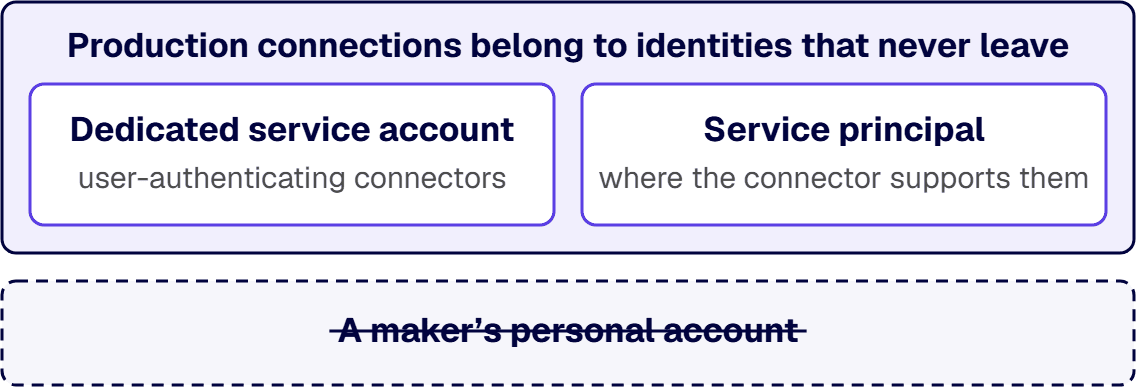
Production connections belong to identities that never leave the organization, never a maker’s personal account. Options are dedicated service accounts (for connectors that authenticate as users) or service principals (where the connector supports them). Connection references in solutions let credentials change without editing the flows that use them, and solution-aware flows with co-owners on every production flow, plus connection-layer data policies, are what enforce proper ownership.
Service principal availability is checked per connector at design time rather than assumed universally. Business-critical flows that require a specific person’s authentication are a documented dependency on that individual, not a neutral default.
This page addresses one connection and its identity. Related decisions belong elsewhere: detecting silent flow failures, the security posture around Power Automate, DLP policy design, the production operating model and support tiers, joiner-mover-leaver identity governance, and premium licensing implications each have their own frame.
Connector is the proxy in front of an API. Connection is Microsoft’s term for a stored authentication credential for a connector, for example OAuth credentials for the SharePoint connector. Connection reference is a solution component that contains a reference to a connection. Solution-aware flows bind to references instead of directly to connections.
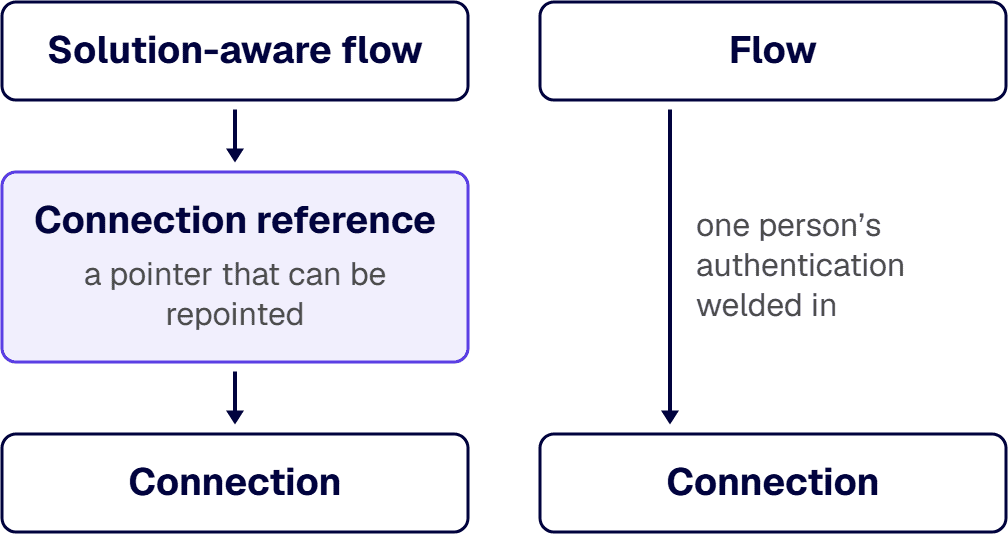
Two consequences follow from that binding. During solution import, Microsoft states, a connection is provided for all the connection references so any referencing flows can be turned on automatically after the import completes: flows built with connection references move between environments as components with credentials supplied on arrival. And a flow that binds to a connection reference has a pointer that can be repointed; a flow that binds directly to a connection has one person’s authentication welded in.
Permission and binding are distinct. Microsoft’s guidance: if someone other than the flow owner provides connections, the flow needs to be turned on by the owner of those connections or the connections need to be shared with the user who is turning on the flow. Once a co-owner enables the flow, any co-owner of the flow can turn on the flow afterwards. Somebody has to authenticate initially and whenever flows are edited to use new connections.
Named user account. The default when a maker signs in. Appropriate for a flow that automates one person’s own work; inappropriate for anything the business depends on.
Dedicated account used as a service account. A user account not used for daily sign-in, with documented ownership and credential access. Fits connectors that authenticate as users but remains a licensed account inheriting conditional access and MFA.
Service principal. An application identity rather than a person. Microsoft notes that OAuth connections can only be explicitly shared with a user representing a service principal. Connector support decides availability.
Decision rule: the identity no departure removes wins. Where two candidates survive, the narrower permission set wins. Business-critical flows requiring a specific person’s authentication are an explicit, documented dependency on that individual.
i3solutions consolidates ungoverned automation into architecture with named owners, source control, and an audit trail, without stopping the processes it carries.
Microsoft’s guidance is precise: if the shared flow still has an active owner, the flow continues to run. But if the flow uses any active or embedded connections that belong to the user who left the organization, those specific actions might fail. Failure is action-level, tied to the credentials behind those actions.
| Failure mode | What it looks like | What it needs | Evidence location |
|---|---|---|---|
| Orphaned ownership | No active owner remains; nobody can edit, turn on, or hand over | Change owner before flow edits or handover | Owner list in flow properties and Power Platform admin center flow list |
| Broken connection | Flow runs; specific actions fail using the departed person’s connection | Update connection credentials or repoint the connection reference | Connection status in the environment’s connections list; red exclamation mark on flow details |
| Unrepointable flow | Flow not solution-aware; nothing to repoint; ownership cannot change in place | Recreate flow under new owner; add to solution; update to use connection references | Whether the flow appears inside a solution in the Solutions area |
| Policy-blocked repair | Repair fails because connector replacement is blocked by data policy | Settle the policy question first, then repair the connection | Data policy list in Power Platform admin center; design-time errors when updating connections |
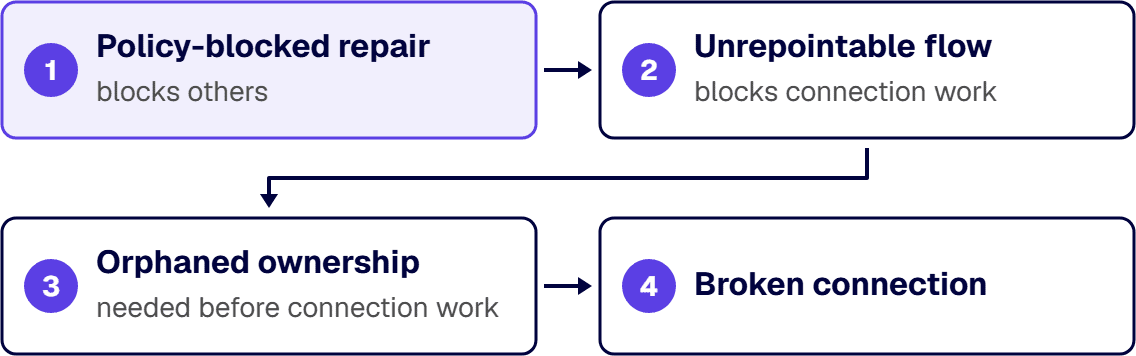
These are independent issues, not sequential. One flow can present multiple simultaneously. Microsoft documents that changing solution-aware flow ownership works via Details > Edit > Owner, but for a non-solution-aware cloud flow, in-place ownership change is not available because the owner is part of the flow identity: the fix is export/import, Save as, or Send a copy.
Remediation sequence when multiple failure modes exist: policy-blocked repair first (blocks others), then unrepointable flow (blocks connection work), then orphaned ownership (needed before connection work), then broken connection. Skipping the order means fixing what the next fix will undo.
Runtime effects. Any resources that are running and attempting to use an inactive connection, action, trigger, or MCP server that is blocked, fail at runtime.
Design-time effects. When makers attempt to update their connection to fix it, they get an error in the design-time experience that the connector is blocked by policy. This blocks repairs conducted by users unaware of the policy.
Retroactive enforcement. Microsoft records that enforcing data policies will disable existing connections that violate any data policies and enable any previously disabled connections that no longer violate any data policies. A disabled connection is not corrupted; it needs policy resolution.
The design consequences are that the connectors flows depend on are policy dependencies belonging in the flow ownership records; policy changes are readable against dependent flows before enforcement; and connection repairers need routes to policy administrators.
Confirm the failure mode using the evidence column above. Establish whether the flow is solution-aware. Resolve any policy blocks: connection work is impossible while a connector is disabled. Add a second owner while the current owner is still employed (owner changes require creator or owner status). Establish the connection under the target identity (the connection owner must enable the flow before a co-owner can). Repoint the connection references.
Branch for non-solution-aware flows: move the flow into a solution and update it to use connection references first. Microsoft documents this as a flow checker action on the details page that removes connections to enable connection references, or via export/import through unmanaged solutions. This is a connection change requiring testing, not a new build.
Preventive habits: record each business-critical flow’s connection identity and dependent connectors; read leaver reports and policy changes against this inventory; treat departures as scheduled events with named handovers.
The flow automates one person’s task with no downstream dependencies: leaving it on a personal connection is correct. Flows are already failing estate-wide with no visibility: prioritize detection first. The debate is about cost rather than continuity: address licensing separately. The estate has hundreds of unowned apps with no registry: inventory work comes first.
i3solutions has delivered on the Microsoft stack since 1997, with senior, 100 percent US-based teams. Connection and flow ownership decisions run the same discipline every governance-first program does: name the identity that carries production credentials, build with connection references from day one, and treat departures as scheduled handovers rather than outages.

Michael Branson co-founded i3solutions 30 years ago and brings executive, operational, and technical perspective to organizations working in complex, secure, and mission-critical environments. His insights focus on business process consulting, automation, data analytics, collaboration, secure operating models, and the operational discipline required to turn technology investments into practical business systems with measurable value.
Connect on LinkedInLess than folklore suggests, at a more specific location. Microsoft states that if the shared flow still has an active owner, the flow continues to run. What fails is narrower: if the flow uses active or embedded connections that belonged to the user who left, those specific actions might fail. A departure produces up to four problems: orphaned ownership, broken connection, unrepointable flow, and policy-blocked repair. A flow with a co-owner and a connection reference whose connection belongs to a dedicated account or service principal survives the first three.
The production connection identity should be one nobody offboards. Dedicated accounts used as service accounts are available for connectors that authenticate as users; the cost is that they remain licensed accounts inheriting conditional access. Service principals are stronger where connectors support them. Microsoft notes that OAuth connections can only be explicitly shared with a user representing a service principal, so support is checked per connector at design time. Business-critical flows requiring named-person authentication are a documented dependency on that person, not a neutral default.
A connection is a stored authentication credential for a connector. A connection reference is a solution component containing a reference to a connection, and solution-aware flows bind to references instead of directly to connections. This decides two things: deployment (solution import provides connections for automatic flow enablement) and continuity (reference-bound flows have replaceable pointers; direct-bound flows have welded-in authentication).
Confirm the failure mode, then work in unblocking order: settle policy blocks first (disabled connectors cannot re-authenticate), add a second owner while the current one is employed, create the connection under the target identity, then repoint connection references. Branch for non-solution-aware flows: move into a solution and update to use connection references first, because in-place ownership change for non-solution-aware cloud flows is not available; the owner is part of the flow identity.
Only if it is governed as one. Production-grade accounts require no day-to-day human sign-in, named team ownership, accessible credentials, and deliberate authentication posture. Generic accounts with multiple known passwords fail the last two and create accountability gaps. The test: could an offboarding accidentally disable it? The sign-in log shows whether humans are behind it.
It acts on credentials, not flows. Where a policy blocks the whole connector, the platform sets the connection to a disabled state, and any resources attempting to use it fail at runtime. Design-time effects catch repairers: makers get an error that the connector is blocked by policy. Administrators can enforce policies against existing connections, which disable existing connections that violate any data policies. A disabled connection needs policy resolution, not rebuilding.
When automation runs business processes, ownership, error handling, and monitoring are production requirements. i3solutions' senior workflow advisors work with IT leaders ready to put engineering discipline around the automation the business already depends on.
Talk to a Senior Workflow Advisor
US-Based | Est. 1997
© i3solutions. All rights reserved.
US-Based | Est. 1997
© i3solutions. All rights reserved.


