

Workflow error handling and recovery is a design-time decision: classify how a workflow can fail, then choose a handling pattern for each class. Without deliberate design, the platform's default becomes the error strategy by omission. Five failure classes (transient failure, poison input, refusal, partial completion, and false success) each need their own pattern, and idempotency is what makes retry safe.
A workflow without deliberate error handling has an error strategy. It is the platform’s default, chosen by omission, and it is almost never the right one. Retry that never gives up. Failures that alert nobody. Duplicate records because a retry ran twice against a system that was not safe to receive the same request twice. Each of these is a design decision the design skipped.
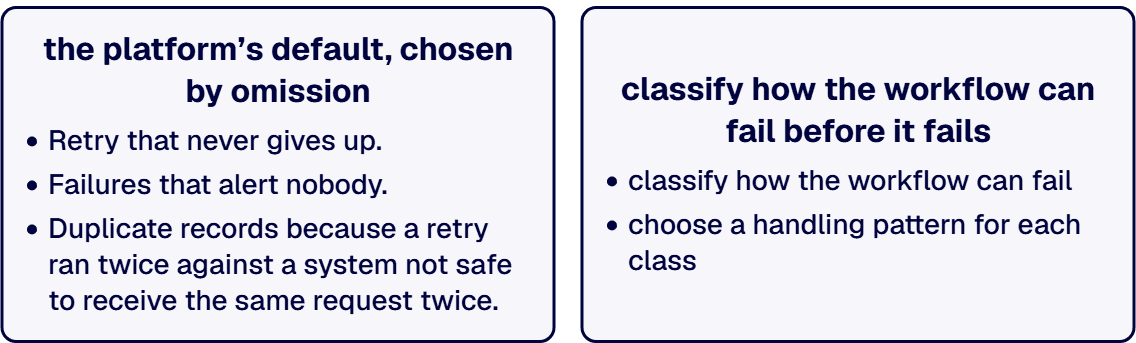
The alternative is to classify how the workflow can fail before it fails, then choose a handling pattern for each class. That is the whole of it. What follows is the classification and the patterns.
Temporary problems that resolve on their own: timeouts, throttles, a downstream service momentarily unavailable. The pattern is retry with backoff, capped attempts, and idempotency at the receiving end so a retry does not duplicate work. Escalation happens only when the retry ceiling is reached.
Malformed data that will fail every time it is retried. The pattern is bounded retry (in case the malformation was itself transient) followed by storage in a failure queue for human triage. Poison input that stays in a retry loop consumes request budget and blocks the queue behind it.
The downstream system rejects the request for a stated reason: a business rule violation, a missing permission, a validation failure. Refusals are never retried; they route to human review because the fix is a decision, not a repeat attempt.
Some steps succeeded while others failed. The pattern is compensation (undo the succeeded steps) or recording the gap so a downstream reconciliation catches it. Partial completion without compensation or gap-recording is the failure mode that leaves the receiving system in an inconsistent state nobody sees.
The workflow completes successfully, but the work did not actually happen. A downstream system returned 200 to a request it dropped. A file was written but was empty. The pattern is a post-write verification step that compares the intended effect against the observed state.
When a personal automation becomes a business process, it needs an engineering owner before it needs new features. i3solutions provides senior specialists who rebuild critical flows on governed, supportable foundations.
Every retry is another call, and every retry against a system that is not safe to receive the same request twice creates duplicate records. Idempotency at the receiving end is what closes that failure mode. Four mechanics carry it:
Correlation keys from source data. Every message carries an ID the receiving system can check against records already written. A request that duplicates a key is discarded silently rather than written again.
Pre-write destination checks. Before writing, ask whether the target already exists. Read-before-write is slower than write-and-hope; it is also the pattern that prevents duplicates in every system where the write is unsafe.
Keyed upsert operations. Where the receiving system supports it, upserts collapse insert and update into one operation keyed on the correlation ID. A retry updates the same row rather than inserting a new one.
State assertions rather than increments. Set the field to a value; do not increment it by one. Retries of an increment produce the wrong final number; retries of an assertion converge on the correct one.
Alerts routed by failure class reach the person who can act on them. Transient failures escalate to the platform team when the retry ceiling is reached. Poison input alerts the data owner because the fix is a data correction. Refusals alert the process owner because the fix is a business decision. Partial completions alert both the platform team (for the compensation) and the process owner (for the reconciliation).
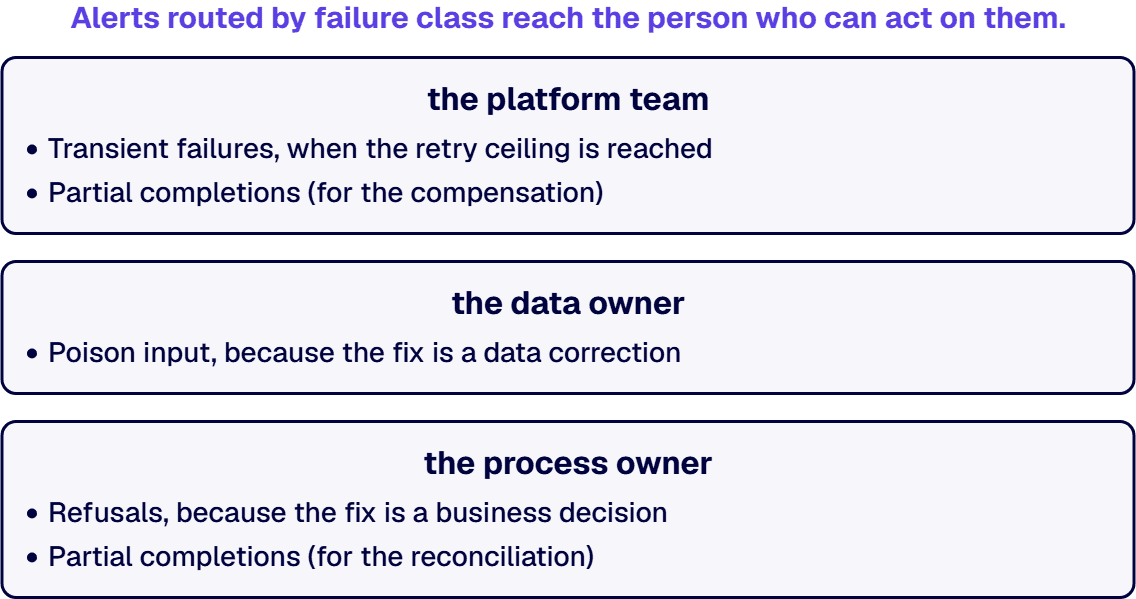
Undifferentiated alerts (every failure to the same distribution list) train the recipients to ignore the alerts, and the alerts that mattered arrive alongside the ones that did not.
Failed items that need human triage need somewhere to go. Dedicated storage carries the correlation key, the failure class, the error payload, the timestamp, and an operator-updatable status. The storage lives outside the flow so that clearing the queue is a separate operational task with its own owner, and the operator’s actions (resubmit, reject, escalate) are recorded against the item.
A dead-letter store nobody clears is a dead-letter store that fills, and full is a state that eventually surfaces as a new outage. Ownership and clearance cadence are part of the design.
Test error paths deliberately. Simulate a transient failure and verify that the retry backoff behaves as designed. Send poison input and confirm it lands in the failure store. Force a refusal and check that the process owner receives the alert. Trigger a partial completion and verify that compensation runs. Introduce a false success and confirm reconciliation catches it.
Error paths that are not tested are error paths that will surface in production, at the moment nobody has time to figure out why they were skipped.
i3solutions has delivered on the Microsoft stack since 1997, with senior, 100 percent US-based teams. Workflow error handling runs the same discipline every governance-first program does: classify the failure modes, choose the pattern per class, wire the notification routing to the person who can act, and test the error paths deliberately before production sees them for the first time.

Michael Branson co-founded i3solutions 30 years ago and brings executive, operational, and technical perspective to organizations working in complex, secure, and mission-critical environments. His insights focus on business process consulting, automation, data analytics, collaboration, secure operating models, and the operational discipline required to turn technology investments into practical business systems with measurable value.
Connect on LinkedInA design-time decision to classify how a workflow can fail, then choose a handling pattern for each class. Without deliberate design, the platform's default becomes the error strategy by omission: retry that never gives up, failures that alert nobody, duplicates because a retry ran twice against a system that was not safe to receive the same request twice.
Transient failure (temporary, resolves on retry with backoff and idempotency); poison input (malformed data, bounded retry then dead-letter for human triage); refusal (downstream rejection for a stated reason, never retried, routed to human review); partial completion (some steps succeeded, needing compensation or gap-recording); and false success (workflow completed but the work did not actually happen, needing post-write verification).
Idempotency at the receiving end. Four mechanics carry it: correlation keys from source data so the receiving system can discard duplicates; pre-write destination checks so writes are conditional on existing state; keyed upsert operations that collapse insert and update into one operation; and state assertions rather than increments so retries converge on the correct value rather than accumulating.
Different owners for different failure classes. Transient failures escalate to the platform team when the retry ceiling is reached. Poison input alerts the data owner. Refusals alert the process owner. Partial completions alert both the platform team (for compensation) and the process owner (for reconciliation). Undifferentiated alerts train recipients to ignore them, so class-based routing is what preserves attention.
Dedicated storage outside the flow that holds failed items needing human triage, carrying correlation key, failure class, error payload, timestamp, and operator-updatable status. Clearing the queue is a separate operational task with its own owner and cadence, because a dead-letter store nobody clears is a dead-letter store that fills, and full is a state that surfaces as a new outage.
Deliberately break things. Simulate transient failures and verify retry backoff. Send poison input and confirm it lands in the failure store. Force a refusal and check the alert routing. Trigger a partial completion and verify compensation runs. Introduce a false success and confirm reconciliation catches it. Error paths that are not tested are error paths that surface first in production.
Approvals, escalations, and integrations added one at a time become an orchestration layer with no owner and no test plan. i3solutions' senior workflow advisors work with enterprise IT leaders who need that layer redesigned as deliberate architecture.
Schedule a Workflow Automation Scoping Discussion
US-Based | Est. 1997
© i3solutions. All rights reserved.
US-Based | Est. 1997
© i3solutions. All rights reserved.


