

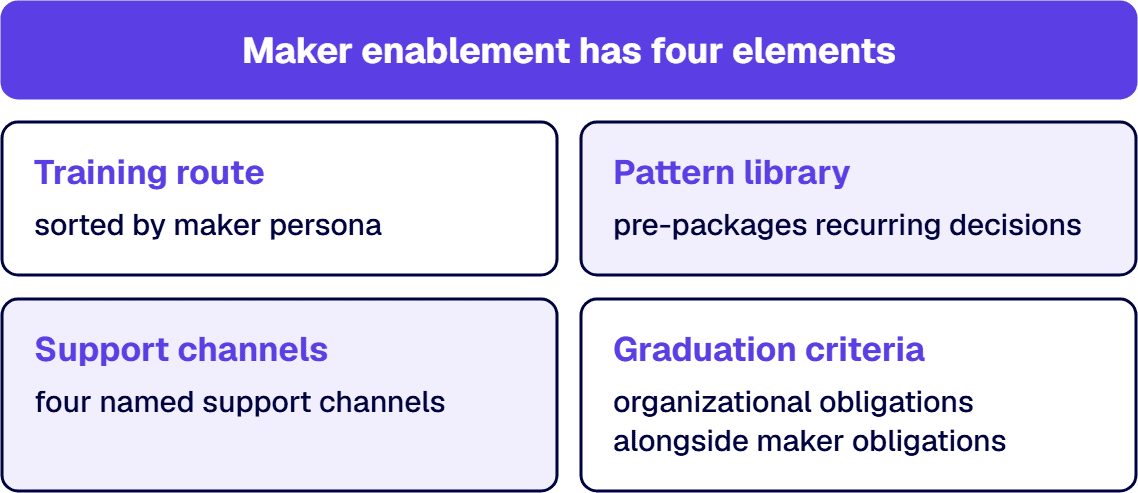
Controls define what is forbidden but leave makers without guidance on proper practices, who to contact when blocked, when their applications outgrow their capacity, or what happens next. Enablement is the half of governance that runs toward makers: a training route sorted by maker persona, a pattern library that pre-packages recurring decisions, four named support channels, and graduation criteria that name organizational obligations alongside maker obligations. The goal is to make compliance the easier path than workarounds.
Controls define what is forbidden but leave makers without guidance on proper practices, who to contact when blocked, when their applications outgrow their capacity, or what happens next. This creates two outcomes: enthusiastic builders stop working, and determined ones circumvent controls using unmonitored tools.
Answering only the control question leaves an incomplete solution. Makers need to know where they should learn proper techniques, whom to contact when connectors are blocked, when applications become business-critical, and what organizational support looks like on the other side of that threshold.
Makers bypass IT when going through IT exceeds deadline requirements. An analyst facing a Tuesday deadline with a blocked connector chooses between a request with unknown response time and a workaround completable tonight. That is not weighing policy against convenience; it is weighing a real deadline against a queue with no stated response times.
Makers build in wrong locations when no initial routing exists. The default environment represents an absence of guidance rather than an intentional choice. Enablement programs that fail to publish a first-day route leave the product’s default to determine environment strategy.
Makers conceal applications when graduation appears punitive. If admitting six colleagues depend on an application results in it being taken away, reviewed, or rebuilt by others, withholding becomes rational. This creates exactly what organizations most need to see: undeclared business-critical applications supported by one person unwilling to disclose them.
Graduation paths with costs but no benefits produce non-disclosure by design. Adding supported environments, accessible support contacts, and relief from sole-person responsibility reverses this dynamic, making declaration the economically sensible choice.
Individual users solving their own problems. Training need: a clear statement of guardrails, delivered once and plainly. Delivery method: a hands-on workshop where participants build solutions in a single day, plus self-paced resources available for late-night troubleshooting. Attach one reference page explaining where business data may and may not go, making connector policy concrete rather than abstract.
Users transforming departmental workflows and driving team success. Training need: patterns, not features: prebuilt examples, workflows, and components that shape what gets built. Delivery method: sample applications to build from, named storage approaches beyond spreadsheets within applications, and graduation criteria stated before applications cross thresholds. Makers learning criteria upfront build compliant applications; makers learning criteria at review require rebuilding.
Leaders driving innovation and mentoring colleagues. Training need: standards and access: connector practices, code review discipline, application lifecycle management, and certification. Delivery method: formal training in platform standards, plus access to tools and documentation. Champions often become informal support providers voluntarily, functioning as the least-expensive support tier.
Implementation requirements: a published first-day route naming the environment new makers should use and the primary constraint they must observe; training records maintained in existing learning and development systems, integrated with Microsoft Learn progress tracking, so completion can be verified before graduation is considered.
Every citizen-built app IT inherits is a staffing decision someone skipped. i3solutions’ senior specialists put environment strategy, DLP, and lifecycle control around Power Platform work while it ships.
Sanctioned patterns are organizational decisions pre-packaged so makers inherit them by starting from them. Control value emerges as a side effect of convenience: makers starting from sanctioned patterns already comply with embedded decisions.
Stock from recurring mistakes, not from organizational pride. Predictable recurring decisions in Power Platform estates include data storage location, application authentication to source systems, access request procedures, and failure handling when sources become unavailable.
Assign ownership and review schedules. Unowned patterns age into outdated guidance people copy without verification. Maintain records stating: the pattern’s purpose, when alternatives apply, the owner’s identity, and the last verification date against current platform capabilities.
Build libraries where platforms are actively maintained. Microsoft states the Power Platform CoE Starter Kit is no longer actively maintained, with core capabilities now in the Power Platform admin center. New enablement programs should build against current tools rather than deprecated resources.
Ensure sanctioned routes are faster than alternatives. If sanctioned storage requires forty minutes of setup while unsanctioned connections take four, makers choose the faster option. Patterns slower than workarounds become preferences rather than standards.
Library placement decides usage. A pattern library filed in document management systems becomes invisible to makers under deadline. Libraries must sit where makers pass while building.
Those operating-model questions need an answer before the first sanctioned pattern ships, because a pattern promoted by hand is a pattern no one can version. i3solutions runs client Power Platform work on a multi-tenant Center of Excellence model with separate Dev, Test, UAT, and Production environments promoted through managed solutions. i3solutions delivery includes ALM practices with Power Platform pipelines or Azure DevOps integration, environment separation strategies, and change control processes.
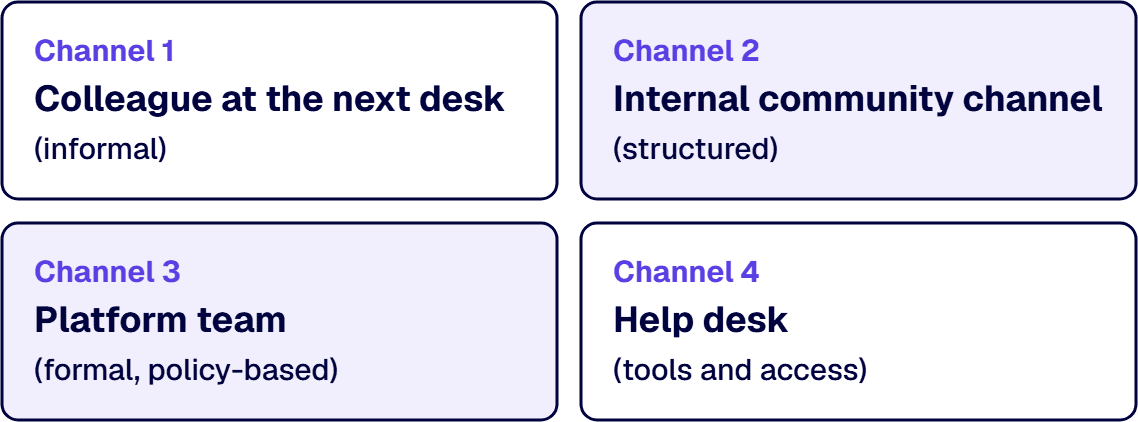
Channel 1: Colleague at the next desk (informal). Operates whether deliberately designed or not. Intentional implementation names which people in each function accept such questions.
Channel 2: Internal community channel (structured). Scales effectively when located where people already work, monitored for unanswered questions, and used to redirect private questions to the public channel. One answered question becomes available to future makers with the same problem.
Channel 3: Platform team (formal, policy-based). Handles questions only the team can settle: blocked connectors, environment requests, data classification guidance. This channel creates a queue, and queue length determines whether training, patterns, and other channels matter: two-week request times teach makers that compliance is the slow path.
Channel 4: Help desk (tools and access). Handles mechanical issues: tool access, licensing, desktop component installation. Needs one routing rule clarifying which questions belong here versus the platform team, redirecting rather than queuing misdirected requests.
When two channels could answer a question, the less expensive one answers and redirects only when needed. When community and platform team disagree, the platform team’s answer governs, with the correction posted in the community channel.
Applications acquire owners, environments, and support paths when they graduate. Without a graduation path, training and patterns are incomplete.
Second user: the day someone besides the maker depends on the application’s output. Regulated data: the first regulated field, measured against organizational data classification. Unattended execution: flows running on someone else’s behalf while unattended.
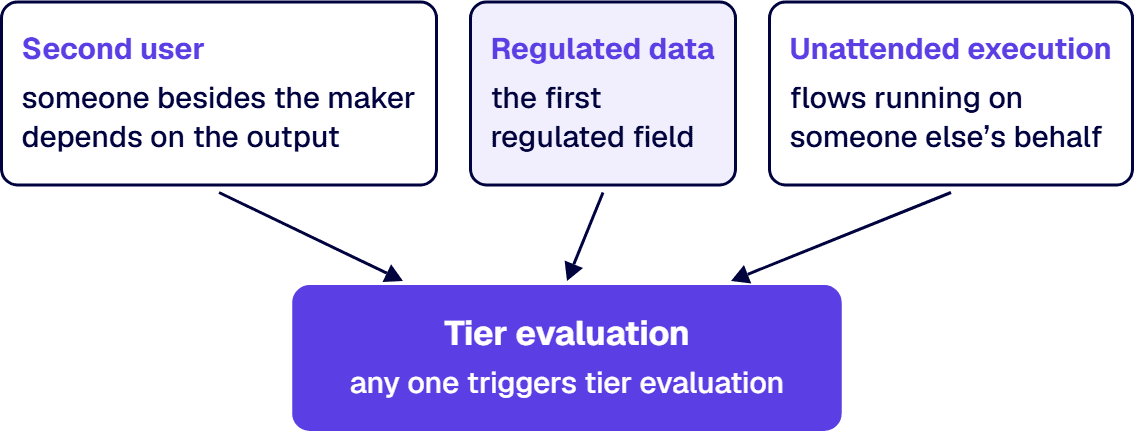
One condition is enough. An application trivial against two measures can hold the payroll record. Any crossing initiates tier determination.
When the maker’s account and the platform record disagree, the record decides tier. A maker stating two colleagues use the application while the sharing record lists nineteen is not usually evasive: the application was shared once and spread organically. Read reach from the sharing record in Power Apps and flow owners from the Owners section on flow details; set the tier from what the record shows.
| Tier | Crossing conditions | Maker obligations | Organizational obligations |
|---|---|---|---|
| Productivity | Maker and direct colleagues only | Build within the tier’s environment; keep business data outside excluded connectors | Provide tools, training, help channels; no lifecycle management required; self-supported |
| Important | Multiple teams, stopped processes, or regulated fields | Named business owner besides the maker; move application to tier-required environment | Dedicated development environment; release process access; second person who can open the application |
| Critical | Complex business applications, enterprise initiatives, mission-critical workloads with significant business impact during downtime | Hand over the artifact; remain process subject-matter expert; cease being sole failure point | Managed environments; full lifecycle process; formal support at agreed response level |
Two tier properties create intended incentives. First: maker obligations decrease while organizational obligations increase as tiers rise, so the top tier makes makers hand over burdens rather than surrender assets. Second: the last column names surfaces third parties (including auditors) can open, making the tier verifiable rather than claimed.
Declared applications crossing thresholds move to a higher tier while keeping the maker involved. Undeclared applications discovered through monitoring also move to a higher tier with the maker involved. Making outcomes identical prevents declaration from costing the maker more than being discovered does. Once declaration costs more than discovery, reactive discovery becomes the default, and it is the expensive approach because it finds applications after dependencies have formed.
Where nothing has been inventoried, enablement trains makers while the underlying estate remains invisible; inventory work precedes enablement. Where environments and connector policies are unset, graduation criteria point toward nonexistent destinations. Where citizen development is prohibited for specific workloads, enablement is the wrong instrument: workload restrictions are policy decisions settled before enablement budgets.
i3solutions has delivered on the Microsoft stack since 1997, with senior, 100 percent US-based teams. Maker enablement runs the same discipline every governance-first program does: publish a first-day route, stock the pattern library from the most-repeated mistakes, staff the four support channels so the fast lane is the sanctioned one, and make graduation the sensible economic move rather than the punitive one.

Michael Branson co-founded i3solutions 30 years ago and brings executive, operational, and technical perspective to organizations working in complex, secure, and mission-critical environments. His insights focus on business process consulting, automation, data analytics, collaboration, secure operating models, and the operational discipline required to turn technology investments into practical business systems with measurable value.
Connect on LinkedInBuild the half of enablement running toward makers, not only the half running at them. Four elements: a training route sorted by maker persona (Explorer, Innovator, Champion), a pattern library that pre-packages the decisions makers repeatedly get wrong so starting from approved patterns means compliance without policy reading, four support channels (colleague, community, platform team, help desk), and clear criteria for when applications stop being personal, with organizational obligations stated alongside maker obligations. Control comes from environment and connector policy guardrails; enablement adds the crucial element of making compliance the easier path.
Training matched to maker stage. Explorers building personally need guardrails stated once, clearly, delivered through hands-on workshops plus self-paced resources. Innovators building for teams need patterns shaping what gets built: prebuilt examples, named non-spreadsheet storage approaches, and graduation criteria stated before applications reach review. Champions teaching others need standards and access: connector practices, code review standards, lifecycle discipline, certification. Publish a first-day route naming the correct starting environment and maintain training completion records in existing learning systems.
By crossing one of three conditions triggering tier placement: a second person depending on output, a first regulated field against organizational classification, or unattended operation on someone else's behalf. One condition suffices. Three tiers exist: productivity, important, critical. Maker obligations decrease and organizational obligations increase as tiers rise, so the top tier makes makers hand over burdens rather than surrender assets. Assign tier from the application's sharing record, not from the maker's recollection.
Sanctioned patterns are organizational decisions pre-packaged as starting points (sample applications, workflows, components) so using them is faster than reworking decisions independently. Stock them from the most-repeated mistakes (data storage location, system authentication, access request procedures, source-unavailability handling). Each pattern needs a named owner, a statement of when alternatives apply, and a verification date against current platform capabilities. Patterns only matter when they are faster than alternatives; sanctioned routes taking forty minutes while unsanctioned ones take four become preferences rather than standards.
Different disciplines support makers building versus users of graduated applications. Maker support (colleague, community, platform team, help desk) is measured by how quickly stuck makers regain productivity. Graduated application support concerns ticket answering, alternate access holders, formal support response levels, and staff transition procedures when creators leave. Enablement runs through the graduation point (tier assignment and business owner identification) then transitions to the support model.
Enablement without those two is training makers while the underlying estate remains invisible, or pointing graduation criteria at nonexistent destinations. Inventory precedes enablement. Environment and connector decisions precede tier design. Skipping either produces enablement that runs correctly against a foundation nobody defined, which is the shape of a governance program that looks busy and moves nothing.
Dataverse, release control, support ownership, and licensing sized to the real user population are decisions that hold the application up for years. i3solutions' senior Power Platform advisors work with IT leaders who want those decisions made once, correctly, by people who have made them before.
Talk to a Senior Power Platform Advisor
US-Based | Est. 1997
© i3solutions. All rights reserved.
US-Based | Est. 1997
© i3solutions. All rights reserved.


