
By Michael Branson
Build your Power Apps in GCC High if they will handle ITAR or DFARS-governed data, and plan for your Microsoft 365 identity to be in GCC High too; build in a commercial tenant only for apps that touch no such data, which needs no eligibility validation and avoids the government-cloud feature exceptions. Data and identity decide it.
Suppose a compliance officer or a contracting officer has asked you to defend where your organization’s Power Apps are built. The defensible answer does not treat Power Apps as a separate choice: it follows the data each app touches and the tenant your users already sign in to.
If you need the answer in Microsoft’s own words, its Power Apps US Government documentation, read on 2026-09-22, states: “We anticipate our US Department of Defense contractor customer base and other Federal agencies currently using Microsoft 365 GCC High to use the Power Apps US Government GCC High deployment option, which enables and requires the customer to use Microsoft Entra Government for customer identities, in contrast to GCC which uses Public Microsoft Entra ID.” Microsoft’s Power Apps US Government page states that “Microsoft operates the service in a manner that enables these customers to meet ITAR commitment and DFARS acquisition regulations, as documented and required by their contracts with the US Department of Defense.”
It also describes what the government offering changes about the data itself: “Your organization’s customer content is physically segregated from customer content in Microsoft’s commercial Power Apps services,” and “Access to Power Apps US Government customer content by Microsoft administrators is restricted to personnel who are US citizens.” For a contractor whose Microsoft 365 already runs in GCC High and whose apps touch regulated data, GCC High is the deployment option Microsoft describes for that customer base. For apps that touch no regulated data, a commercial tenant is the simpler placement.
Run each app through three tests, and answer each one from a document you can open: the app’s data sources, your tenant’s identity configuration, and the contract language that governs the data.
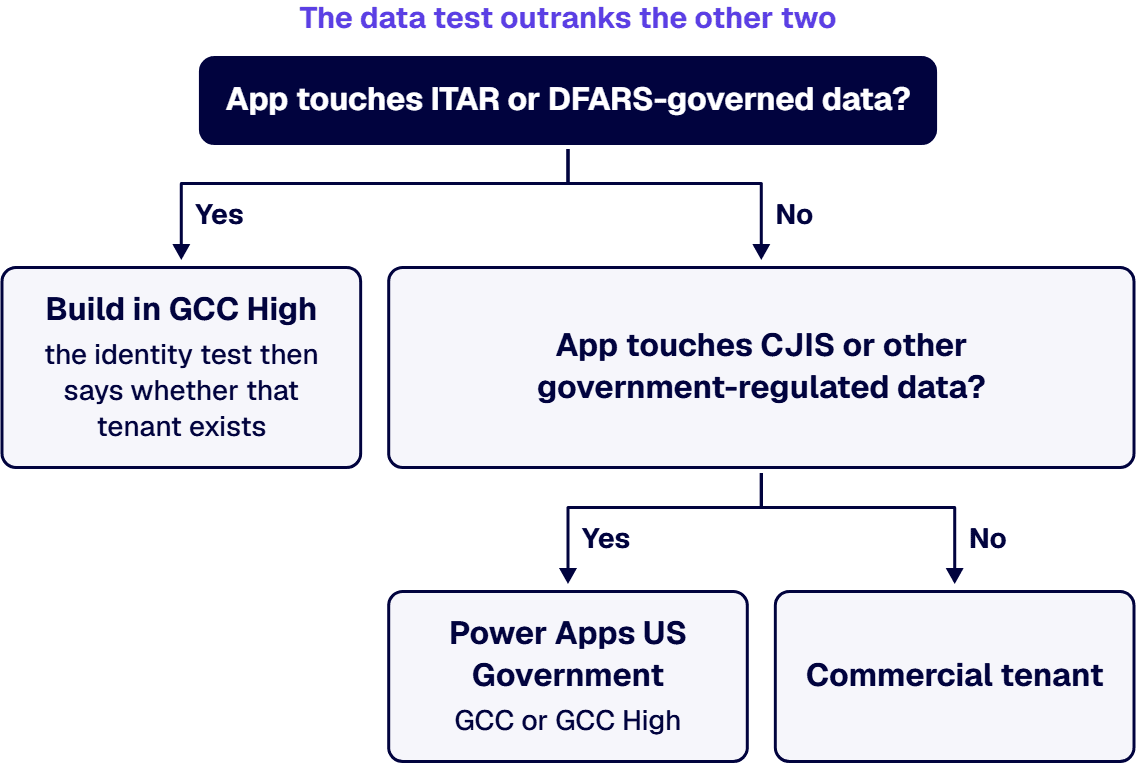
Data test. Which data does the app read or write? Microsoft’s Power Apps US Government documentation, read on 2026-09-22, says that “Validation of eligibility by Microsoft includes confirmation of handling data subject to International Traffic in Arms Regulations (ITAR), law enforcement data subject to the FBI’s Criminal Justice Information Services (CJIS) policy, or other government-regulated or controlled data.” An app that touches ITAR or DFARS-governed data makes the case for GCC High; an app that touches none of it gives no data reason to leave a commercial tenant. An app that touches CJIS or other government-regulated data that is not ITAR or DFARS still points to Power Apps US Government rather than commercial: Microsoft’s documentation states that “The Power Apps GCC environment provides compliance with federal requirements for cloud services, including FedRAMP High, DoD DISA IL2, and requirements for criminal justice systems (CJI data types).” Whether that is GCC or GCC High is the whole-tenant question compared on the pages linked below.
Identity test. Where do the app’s users sign in today? Per the same Microsoft page, the GCC High option enables single sign-on and integration with Microsoft 365 GCC High deployments, and it requires Microsoft Entra Government for customer identities, where GCC uses public Microsoft Entra ID. If your Microsoft 365 tenant already runs in GCC High, a GCC High Power Apps environment shares that identity; if it runs commercial, the identity the GCC High option requires is not yet in place. If the open question is really which Microsoft 365 cloud your organization belongs in, that is a whole-tenant decision, compared in Microsoft 365 GCC vs GCC High: Which Government Cloud Does Your Organization Need? and GCC vs GCC High vs Commercial Microsoft 365 for CUI: An Evaluation Matrix.
Eligibility test. Can your organization show Microsoft the eligibility it asks for? Microsoft’s documentation states that Power Apps US Government is available to government entities and to “other entities that handle data that’s subject to government regulations and requirements and where use of Power Apps US Government is appropriate to meet these requirements, subject to validation of eligibility,” and that “Upon renewal of a customer’s contract for Power Apps US Government, revalidation of eligibility is required.” It adds: “Note that Power Apps US Government DoD is only available to DoD entities.”
When the tests point different ways, the data test outranks the other two, because an app with no government-regulated data has no data reason to sit in GCC High, though for an organization whose Microsoft 365 runs only in GCC High, a commercial placement carries the cost of a second tenant and a second identity. Where the data test points to GCC High, the identity test tells you whether the app lands in a tenant you already run, and the eligibility test tells you whether Microsoft will accept the placement.
Before you commit an app to GCC High, note that Microsoft states on its Power Apps US Government page that “There are exceptions to the principle of maintaining product functional parity within the US Government clouds,” and links to a downloadable availability summary, Business Applications, Feature Experience Parity Exceptions and Roadmap in US Government clouds, dated May 2026. The document says its information “is updated and published every 4-6 weeks and represents our projections at that time,” so each row below is a planning fact on its read date, not a permanent verdict on the product.
Read on the rendered document on 2026-09-22, the IL4 US GCC High column lists both Power Apps “Push Notifications” rows, the one for Android and the one for IOS, as Not Available, where the IL2 US GCC column lists both as Available. The same column lists “Test Studio” and “Power Apps / Dataverse native integration with Git (ALM)” as Not Available, and lists “Custom Connectors”, under Power Automate, as Available.
Three more differences come from the Power Apps US Government page itself, read on the same date:
If one cloud does not fit every app, placement does not have to be all or nothing, and a split is possible: regulated workloads in GCC High and the rest in a commercial tenant. One assessment for a contractor reached that shape for Microsoft 365, and it concerned the productivity suite, not Power Apps. The assessment recommended partial-variant adoption with email and document storage on GCC High and the remainder of the productivity suite on Commercial; the contractor’s licensing economics improved materially relative to a full GCC High migration. What Power Apps licensing costs in each cloud is set out in What Does Power Apps Licensing Cost in GCC Compared to the Commercial Cloud?. For Power Apps in a split estate, the three tests run down the app inventory one app at a time for the same reason: each app follows its own data and its own users.
If more than a handful of apps are undecided, or the placement has to be defended to a contracting officer, the three tests are worth running as a structured review of the app inventory, because the officer will ask for the reasoning app by app. Where the answer includes moving Microsoft 365 into GCC High, a certified AOS-G supplier provisions the GCC High tenant. We manage GCC High migrations end-to-end: from eligibility validation and licensing coordination with your AOS-G supplier through identity architecture, data migration, security baseline configuration, and post-migration governance. i3solutions plans and runs these migrations for regulated defense organizations, structuring each phase around the compliance evidence assessors expect. Delivery is senior and US-based.
Once GCC High is chosen, Building on Microsoft 365 GCC High: What Changes covers what the build involves, and Hire a Microsoft 365 GCC High Implementation Firm: How to Vet One Before You Commit a Tenant covers choosing a partner. The Power Apps practice is set out on Enterprise Power Apps Development Services for Secure, Governed Application Delivery, within Enterprise Power Platform Development & Implementation Services for Governed Operations.
If you are a defense or federal contractor, build in GCC High when the apps touch ITAR or DFARS-governed data and your organization’s Microsoft 365 tenant is already in GCC High, because according to Microsoft the GCC High option is the one it anticipates for its US Department of Defense contractor customers using Microsoft 365 GCC High, and it requires Microsoft Entra Government identities. Build in a commercial tenant when the apps touch no government-regulated data, since it needs no eligibility validation and avoids the feature exceptions Microsoft documents for its US Government clouds. Decide app by app with three tests: the data test, the identity test and the eligibility test.
Per Microsoft, the GCC High option requires Microsoft Entra Government for customer identities and integrates with Microsoft 365 GCC High deployments; if your Microsoft 365 tenant already runs in GCC High, a GCC High Power Apps environment shares that identity, and if it runs commercial, that identity is not yet in place. Whether your organization or its data is eligible for Power Apps US Government at all is answered in Who Do We Hire to Ensure Federal Compliance in Power Apps Development?
If you are weighing GCC High, read Microsoft’s US Government availability summary, which according to Microsoft is updated every 4-6 weeks; its May 2026 edition, read on 2026-09-22, lists Power Apps push notifications for Android and IOS, Test Studio, and native Git integration for Power Apps and Dataverse as Not Available in GCC High, while the Power Automate row Custom Connectors is listed as Available. Microsoft also states that third-party services an app connects to can sit outside the Power Apps US Government compliance and data protection commitments.

US-Based Microsoft System Integrator | Est. 1997
© i3solutions. All rights reserved.
US-Based Microsoft System Integrator | Est. 1997
© i3solutions. All rights reserved.


