

Manual spreadsheet tracking left promotion and career reviews slow and disconnected from HR systems.
The client is a national security technology contractor specializing in cybersecurity, software development, and enterprise IT services. It sells software development for a living, and inside the company career progression ran on hand-maintained spreadsheets with review cycles measured in weeks. The organization lacked an internal system that allowed employees to explore career development opportunities in an interactive and meaningful way, and while employees were eager to advance, they lacked clear visibility into the necessary steps, skills, and benchmarks required for career progression.
The company had already looked outside for an answer. Existing third-party solutions failed to meet the company’s specific needs for a platform that would support continuous development. What existed internally was manual: career and promotion tracking maintained in spreadsheets, with reporting that took weeks to assemble. Without a tailored internal tool, both employees and managers struggled to align growth objectives, limiting career advancement opportunities. The company wanted a platform that would both let employees monitor their career paths and attach recognition and rewards to the steps they took toward advancement.
A national security contractor ran career progression on hand-maintained spreadsheets disconnected from its HR systems, stretching promotion reviews to three weeks on average. i3solutions built a custom career tracking platform with automated HRIS integration that cut that to three days.
Promotion review turnaround dropped from three weeks to three days (an 85% improvement), HR reporting effort fell 20% for roughly $150,000 in annual savings, and managers gained real-time visibility into promotion readiness that didn’t exist before.

A Workforce Ready to Advance With No Map to Follow
The company sells cybersecurity, software development, and enterprise IT services, all of it staffed by people whose careers depend on visible skill progression. Employees were eager to advance. What they did not have was any view of what advancement required: not the steps, not the skills, not the benchmarks. Development conversations happened without a shared reference, and neither side of those conversations could point at the same data.
The tracking that did exist widened the gap rather than closing it. Career and promotion data sat in spreadsheets someone had to maintain by hand, and turning that data into a promotion decision took an average of three weeks. Leadership decided the answer was not more diligent spreadsheet work but a different instrument: an internal platform that made progression explicit, rewarded it, and ran the approval path automatically against the HRIS the company already operated.
This contractor’s promotion delays weren’t a policy issue, they were a data integration issue between HR systems and a manual spreadsheet. If your promotion or career tracking still runs through spreadsheets, the same fix applies.
Advancement Paths Nobody Could See Cost More Than Administrative Time
The direct cost was administrative and it recurred with every cycle. Promotion cycles ran on manual reporting, consuming HR effort that the platform later cut by 20%, worth roughly $150K each year in administrative time. Average review turnaround sat at three weeks. None of that expense produced a better promotion decision at the end of it; it only produced the decision later.
The larger exposure was retention, and the size of it is visible in what fixing it returned. Clearer advancement paths reduced attrition-related costs by more than $1M annually, and voluntary turnover dropped 5% within six months of the platform going in. Read backwards, those figures are the standing cost of a workforce that was eager to advance and could not see how. Employees who cannot find the benchmark are also the employees most able to go somewhere that publishes one.
Points, Approvals, and Rules That Change Without a Release
The platform had to be a decision system, not a record of activity. Employees submit career-enhancing activities from a predefined list, each assigned a specific point value; a manager approves the submission; approved points accumulate toward an overall score; and employees who reach a designated threshold earn Elite Status recognition. That chain carries real consequences for a person’s advancement, so the point value behind every approval has to be consistent, and the approval itself has to be recorded where the career data lives.
The second constraint was change. Point thresholds, expiration periods, roles, and policies were not going to hold still, and a code release for every threshold adjustment is not an operating model an HR function can run on. The platform needed configurable parameters that let the organization customize point thresholds and expiration periods on its own, and it had to sit against the HRIS the company already ran, retiring manual spreadsheet tracking rather than adding one more system to maintain by hand.
Senior Microsoft Specialists with Proven Delivery Depth
The requirements defined the vendor profile: a team that could build custom business logic and point calculations on the .NET Framework, run submissions, tasks, and approval workflow on SharePoint, deliver an Angular front end that employees and managers would use without training, and integrate the result with the company’s HRIS so manual spreadsheet tracking could be retired. The client builds software for a living, which raises the bar on delivered work rather than lowering it.
The company engaged i3solutions, a Microsoft Partner with 30 years of delivery experience and 1,500+ Microsoft engagements, delivered by an all-senior, all US-based delivery team. That profile matched the work: senior engineers who have built SharePoint workflow and HRIS integration repeatedly, and who could deliver a platform the organization configures itself rather than one that returns to the backlog every time a policy changes.
i3solutions built Elite Status, a reward-based career tracking application on SharePoint where employees submit career-enhancing activities for managerial approval and accumulate points toward Elite Status recognition, and backed it with the workflow automation and automated HRIS systems integration that replaced the company’s manual spreadsheet tracking.
PHASE 01
Career Progression and Data Assessment
i3solutions worked through how career progression actually ran: which activities counted toward advancement, what employees could and could not see about the steps, skills, and benchmarks ahead of them, where career and promotion data sat across spreadsheets, and what the HRIS already held. The assessment defined the predefined activity list, the point values attached to it, and the integration scope.
PHASE 02
Application and Point Model Development
The application was built on the .NET Framework for the business logic and custom calculations behind configurable parameters and point tracking, with SharePoint as the repository for all submissions and tasks, and Angular, JavaScript, and MVC for the interface employees and managers work in.
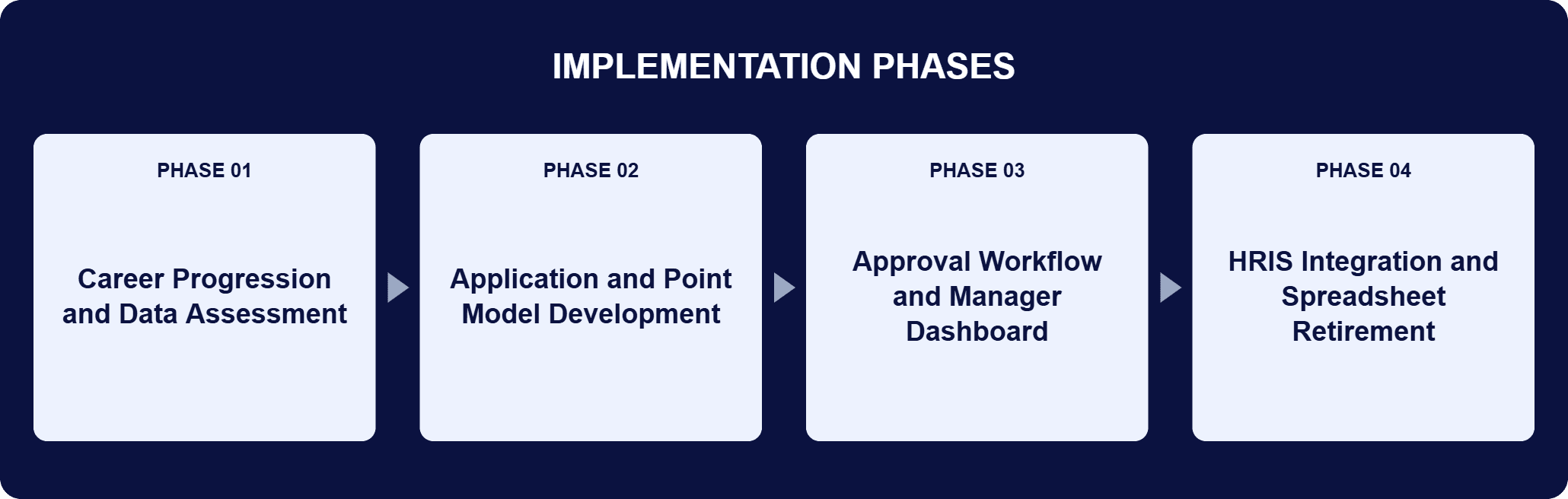
PHASE 03
Approval Workflow and Manager Dashboard
i3solutions automated the submission and approval path so managers review and approve submissions in the system, and built the managerial dashboard that lets supervisors track employee progress and manage Elite Status awards. Configurable parameters put point thresholds and expiration periods in the organization’s hands.
PHASE 04
HRIS Integration and Spreadsheet Retirement
The automated HRIS integration eliminated manual spreadsheet tracking, reclaiming over 1,000 staff hours annually, and automated workflows replaced weeks of manual reporting, cutting average turnaround time from three weeks to three days.
The .NET Framework carries the business logic, because a point system is a calculation problem once thresholds and expiration periods are configurable rather than fixed: activity values, accumulated scores, expiry, and the threshold test that awards Elite Status recognition all resolve there. SharePoint provides the repository for all submissions and tasks and carries the workflow automation that routes a submission to the approving manager and records the decision against the same data. Angular, JavaScript, and MVC build the front end, from an employee choosing an activity off the predefined list through the managerial dashboard where supervisors review and approve submissions, track progress, and manage Elite Status awards. The integration layer is what removed the manual work: an automated HRIS integration replaced spreadsheet tracking, so the platform runs against the HR system of record instead of a hand-maintained copy of it. Because the parameters are configurable, the platform adapts to new roles, point systems, and policies without code changes, which is the property that keeps a career framework describing the organization it was built for.

Three Weeks to Three Days
Automated HRIS integration reclaimed more than 1,000 staff hours a year and cut promotion review turnaround by 85%.
| Outcome | Before | After |
|---|---|---|
| Promotion review turnaround | Three weeks on average | Three days on average, promotion reviews sped by 85% |
| Career and promotion tracking | Manual spreadsheet tracking | Automated HRIS integration, over 1,000 staff hours reclaimed annually |
| HR reporting | Weeks of manual reporting | HR reporting effort down 20%, roughly $150K saved each year in administrative time |
| Manager visibility | No standing view of promotion readiness | Real-time visibility into promotion readiness through the managerial dashboard |
| Employee engagement and retention | No interactive way to explore career development | Engagement scores up 12%, voluntary turnover down 5% within six months |
| Attrition and administrative cost | Advancement paths employees could not see | Attrition-related costs down by more than $1M annually, combined savings above $1.15M annually, full ROI in the first fiscal year |
The fastest-moving number is turnaround. Automated workflows cut average turnaround time from three weeks to three days and sped promotion reviews by 85%, because the approval path now runs in the system rather than through a reporting exercise. The automated HRIS integration eliminated manual spreadsheet tracking, reclaiming over 1,000 staff hours annually, and managers gained real-time visibility into promotion readiness, reducing HR reporting effort by 20% and saving roughly $150K each year in administrative time.
The retention result is the larger one. Career transparency and an interactive, reward-based experience boosted employee participation and morale: engagement scores rose 12%, and voluntary turnover dropped 5% within six months. Employees now see clear advancement paths and recognition milestones, and this transparency reduced attrition-related costs by more than $1M annually. Combined savings from reduced attrition and HR time exceeded $1.15M annually, with full ROI achieved within the first fiscal year and continued engagement improvements validated in year-end surveys.

PENDING-CLIENT-QUOTE
This engagement is relevant for
Less relevant for
Career Progression Made Explicit, Rewarded, and Decided in Days
The engagement established that career development is a workflow and integration problem before it is an HR policy problem. A SharePoint application with .NET business logic turned advancement into something an employee can act on: submit an activity from a predefined list, earn its point value on managerial approval, accumulate toward the threshold that earns Elite Status recognition, all of it visible to the manager who has to make the call.
The automated HRIS integration eliminated manual spreadsheet tracking, reclaiming over 1,000 staff hours annually, while automated workflows cut average turnaround time from three weeks to three days and sped promotion reviews by 85%. Combined savings from reduced attrition and HR time exceeded $1.15M annually, with full ROI achieved within the first fiscal year.
A reward-based career tracking platform is an internal application that makes advancement explicit and measurable instead of leaving it to conversation. In this engagement, i3solutions built one on SharePoint: employees submit career-enhancing activities from a predefined list, each assigned a specific point value; a manager approves the submission; approved points accumulate toward an overall score; and employees who reach a designated threshold earn Elite Status recognition. Two properties separate it from a spreadsheet. First, the activity list and its point values are published in advance, so the steps, skills, and benchmarks required for progression are visible before an employee acts rather than after a review. Second, the parameters are configurable: point thresholds and expiration periods change as roles and policies change, without new development.
The first question is where the career data already lives and how much of it is being maintained by hand. At this national security technology contractor, career and promotion tracking ran on manual spreadsheets and the reporting built on them took weeks, so the integration was the point of the engagement rather than an accessory to it: an automated HRIS integration eliminated manual spreadsheet tracking and reclaimed over 1,000 staff hours annually. The application was then designed around the decisions people actually make. Employees submit activities against a published list; managers review, approve, and track progress from a dashboard; the organization tunes point thresholds and expiration periods itself. i3solutions delivered the workflow automation and the systems integration together, which is why average turnaround fell from three weeks to three days.
Yes. Configurable parameters let organizations customize point thresholds and expiration periods, and the SharePoint-based platform adapts to new roles, point systems, and policies without code changes. This was a design constraint rather than a convenience. A career framework that cannot be adjusted stops describing the organization as roles and policies move, and if every adjustment requires a release, the framework either goes stale or the platform turns into a standing maintenance line. Handling it in configuration is part of why the .NET Framework carries the business logic: complex calculations and rule changes belong in code written to expect them, not in a new build each cycle. The practical result is a platform the organization operates directly instead of queueing changes with developers.
Manual spreadsheet tracking. The platform’s automated HRIS integration eliminated manual spreadsheet tracking, reclaiming over 1,000 staff hours annually, and automated workflows replaced weeks of manual reporting. The significance goes past the hours. A spreadsheet is a copy of the HR record, so it is out of date the moment the source changes, and every promotion discussion that runs on one starts by reconciling versions instead of assessing a person. Running the tracking through an integrated platform means submissions, approvals, and point balances sit against the HR system of record rather than beside it. SharePoint holds all submissions and tasks in a single repository, which is what let reporting stop being an assembly job.
Automated workflows cut average turnaround time from three weeks to three days and sped promotion reviews by 85%. HR reporting effort fell by 20%, saving roughly $150K each year in administrative time. The speed came from deleting the manual reporting step, not from asking managers to work faster: submissions arrive with their point values already attached, approvals are recorded where the data lives, and the managerial dashboard shows progress without anyone building a report first. Because the cycle recurs, so does the saving. A review that used to occupy three weeks of elapsed time now resolves in three days, which changes what it costs the organization to make a promotion decision at all.
That was the starting condition for this engagement. Off-the-shelf career development platforms didn’t match this national security contractor’s actual promotion criteria and point thresholds, so the reward-based tracking platform was built around the organization’s own advancement rules instead of forcing its process into a generic tool. That is why point thresholds can change without new development, and why the automated HRIS integration cut promotion review turnaround from three weeks to three days rather than digitizing a process that didn’t fit in the first place.
i3solutions is a Microsoft Partner with 30 years of delivery experience and 1,500+ Microsoft engagements, with every engagement staffed by an all-senior, all US-based delivery team. This engagement is representative of the pattern: a SharePoint application holding submissions, tasks, and workflow automation; .NET Framework business logic behind configurable point thresholds and expiration periods; an Angular, JavaScript, and MVC front end for employees and managers; and an automated HRIS integration that retired manual spreadsheet tracking and reclaimed over 1,000 staff hours annually. The client is itself a software development and enterprise IT services firm, which is the harder audience for delivered work. For organizations weighing this class of engagement, a short scoping conversation establishes what it would take in your environment.
Automated HRIS integration is what cut turnaround from three weeks to three days for this contractor. If a similar reclaimed-hours case exists in your organization, we’re glad to talk through the specifics.

US-Based | Est. 1997
© i3solutions. All rights reserved.
US-Based | Est. 1997
© i3solutions. All rights reserved.


