

Maintenance requests were arriving faster than a spreadsheet-and-phone-call process could route them.
Maintenance requests were arriving faster than a spreadsheet-and-phone-call process could route them, and tenants were watching response times slip. That was the situation facing the client, a privately held regional commercial real estate firm specializing in the design, development, leasing, and management of industrial and office properties. Its business runs on tenant service: reputation, renewals, and growth depend on responding to maintenance requests quickly and visibly, and as the portfolio grew, the volume of work orders grew with it.
The existing system for handling work requests could not keep up. It was outdated and inefficient, relying on manual processes and cumbersome spreadsheets that produced delays, miscommunications, and real difficulty tracking outstanding maintenance issues. Requests routed through spreadsheets and phone calls. Tenants had limited visibility into the status of their requests, so they called to ask. Maintenance teams struggled to track assignments and resolutions across the portfolio. The firm needed a cloud-based system that put the whole work order life cycle in one place: submitted online by tenants, assigned and dispatched from the office, and closed out from the field.
A real estate firm’s maintenance requests moved through a spreadsheet-and-phone-call process that couldn’t keep pace with tenant expectations. i3solutions built a cloud work order system synced to the firm’s property management platform, cutting response times 40%.
Maintenance response times fell 40% and team productivity rose 30%, with 90% of the MRI property-management data now accessible via the web, and field teams acknowledging, updating, and closing work orders from handheld devices as the work happens.

Response Times Slipped, and Tenants Noticed
Every request that entered through a phone call had to be transcribed, assigned by hand, and chased through spreadsheet copies; every status question from a tenant became another phone call into the same queue. The manual system that had been merely inefficient at a smaller portfolio size became a visible service problem at scale.
The trigger reached beyond daily operations. This is a firm that competes on service quality in industrial and office property management, and it treats tenant satisfaction as the product. Leadership committed to a modern, cloud-based work order platform because the alternative was letting the request backlog define the tenant experience.
This firm didn’t replace its property management system, it built the missing workflow layer around it. If replacing your core system feels like overkill for the problem you actually have, that’s worth a conversation before you scope a bigger project than you need.
Tenant Satisfaction Was the Product at Risk
For a commercial property firm, the maintenance request is the tenant relationship in miniature. A tenant who submits a request and then hears nothing forms a judgment about the landlord, and forms it long before the work order closes. With limited status visibility, every open request generated follow-up inquiries, and every follow-up call consumed staff time while confirming the tenant’s suspicion that nobody quite knew where things stood.
Internally, the cost compounded. Dispatchers worked from spreadsheets that aged as they were read. Maintenance teams could not see a current picture of what was assigned, outstanding, or resolved. A firm that sells high-quality tenant service across an industrial and office portfolio could not keep delivering it on a tracking system that made its best people look unresponsive.
The MRI System Had to Stay
The firm ran its business on Management Reports International (MRI) property management software, and that system held the enterprise data the work order process depended on. Replacing it was not on the table. The constraint that shaped the whole engagement was integration: the new platform had to extend MRI data to a modern web interface rather than duplicate it, so that work orders, properties, and tenants stayed consistent with the system of record. Done right, that meant 90% of enterprise data remained accessible without major infrastructure changes.
The user base added its own complexity. The system had to serve three very different audiences at once: tenants submitting and tracking requests online from outside the firm, dispatchers assigning work to employees and vendors from the office, and maintenance staff in the field who needed to acknowledge, update, and close orders from handheld devices, not from a desk.
Senior Microsoft Specialists with Proven Delivery Depth
The engagement’s requirements defined the vendor profile: the ability to integrate with a production MRI system rather than rip it out, Microsoft-stack depth across SharePoint, ASP.NET, the .NET Framework, and SQL Server, and practical experience delivering wireless, field-usable applications. The firm also required a partner who could start with analysis: before any build, it wanted its departmental processes reviewed and an action plan recommended for which technologies were worth adopting.
The firm engaged i3solutions, a Microsoft Partner with 30 years of delivery experience and 1,500+ Microsoft engagements, delivered by an all-senior, all US-based delivery team. That profile matched the work: senior engineers who integrate new platforms with the systems a business already runs, on exactly the Microsoft technologies this solution required.
i3solutions delivered a cloud-based work order management system that integrates directly with the firm’s existing MRI property management software, structured to move intake, dispatch, and field close-out into one platform that updates as the work happens.
PHASE 01
Strategic Process Review
i3solutions conducted a complete strategic review and analysis of the firm’s processes across all departments and recommended an action plan for incorporating new technologies. The review established where work orders actually stalled: intake by phone, assignment by spreadsheet, and status questions with no self-service answer.
PHASE 02
Platform and Integration Architecture
The solution was architected on the Microsoft stack: SharePoint as the centralized platform for managing work requests, the .NET Framework powering back-end logic and real-time processing, SQL Server storing work order data for fast retrieval and secure access, and integration extending MRI property management data to a web interface without major infrastructure changes.
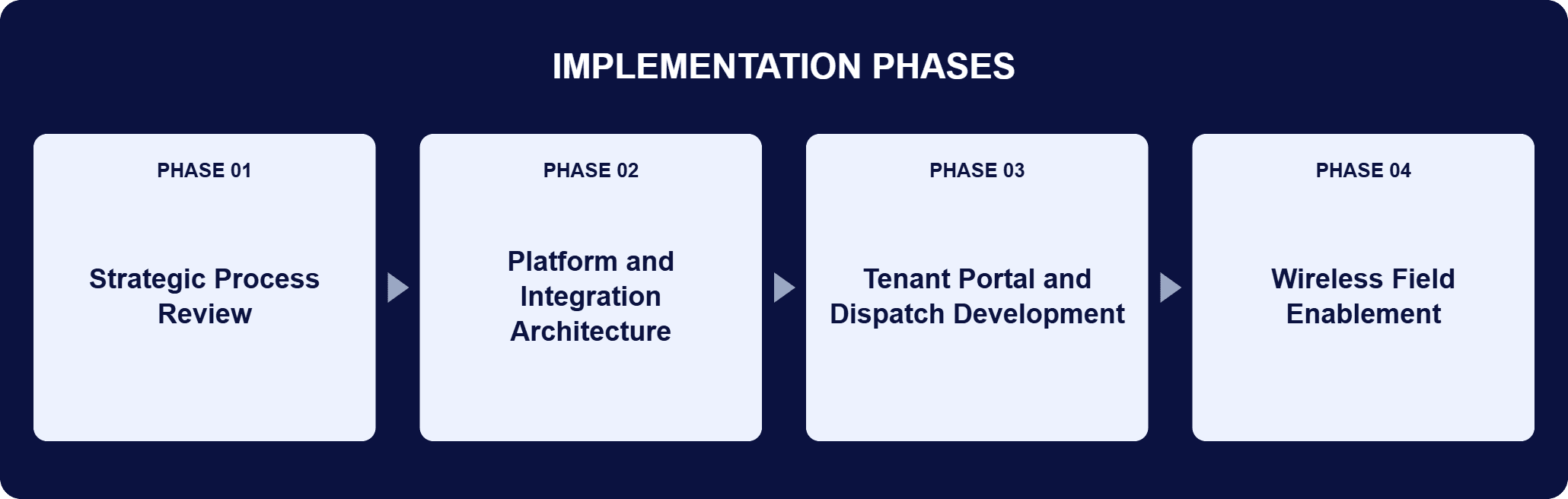
PHASE 03
Tenant Portal and Dispatch Development
i3solutions built the web experience in JavaScript and ASP.NET: tenants submit work requests online and track their status in real time, while dispatchers assign tasks to employees or vendors and send notifications instantly, replacing the phone-and-spreadsheet intake path.
PHASE 04
Wireless Field Enablement
The platform’s wireless interface puts assignments in maintenance technicians’ hands: staff acknowledge, update, and close work orders from handheld devices in the field, so the record of what is outstanding and what is resolved stays current without anyone returning to a desk.
The architecture extends what the firm already owns. MRI property management software remains the system of record, and the work order platform extends its data to a modern web interface, keeping 90% of enterprise data accessible without major infrastructure changes. SharePoint provides the centralized platform for managing work requests, with tracking and reporting built in. The .NET Framework powers the back-end logic, processing work order requests and assignments in real time, with SQL Server storing work order data for fast retrieval and secure access. The front end, built with JavaScript and ASP.NET, delivers a responsive web interface serving both tenants and employees: tenants submit requests and watch their status change, dispatchers assign work to employees or vendors and send notifications instantly. The wireless layer completes the loop. Maintenance staff acknowledge, update, and close work orders from field devices the moment status changes, so the platform’s picture of outstanding work is the actual state of the portfolio, visible to everyone at once.

Response Times Down 40%
An MRI-integrated work order platform lets tenants track requests online and field teams close them from handheld devices.
| Outcome | Before | After |
|---|---|---|
| Maintenance response times | Requests routed through spreadsheets and phone calls | Reduced by 40% |
| Maintenance team productivity | Manual assignment and resolution tracking | Increased by 30% |
| Enterprise data accessibility | MRI data confined to the property management system | 90% accessible via the web, no major infrastructure changes |
| Work request intake | Phone calls and spreadsheet entries | Online submission with real-time status tracking |
| Field close-out | Status chased through spreadsheet copies | Acknowledged, updated, and closed from field devices as work happens |
| Administrative workload | Complex spreadsheets and manual inefficiencies | Automated assignment, notification, and tracking |
The operational change is bigger than the three headline numbers. A work order now lives in one place from tenant submission to field close-out, and every party can see it: the tenant who filed it, the dispatcher who assigned it, and the technician holding the device it closes on. That transparency reduced follow-up inquiries directly, because tenants no longer have to call to learn where a request stands.
By extending MRI property management data to a modern interface, 90% of enterprise data remained accessible without major infrastructure changes. That is the pattern i3solutions applies in systems integration work: keep the system of record, extend its data to the people and devices that need it, and measure the result in response times and productivity rather than in replaced software.

i3solutions conducted a complete strategic review and analysis of our processes across all departments and recommended an action plan to incorporate new technologies to improve our processes. i3solutions provided us with a solution incorporating cutting edge web and wireless technologies, enabling us to provide real time services to our clients. This partnership, in the early stages, helped us improve upon our current business process; improved the image of the Customer Services department; and provided better and more efficient tracking of work requests.
Vice President, a regional commercial real estate firm
This engagement is relevant for
Less relevant for
Keep the System of Record, Put the Workflow Online
The engagement established that a firm does not have to replace its property management system to modernize how work gets requested, dispatched, and closed. MRI stayed. Around it, i3solutions built the cloud workflow the firm’s tenants and technicians actually touch: online submission, instant dispatch notifications, and close-out from devices in the field.
The measured results are the argument: response times down 40%, maintenance productivity up 30%, and 90% of enterprise data accessible from the new interface without major infrastructure changes. It also established a transferable pattern for i3solutions’ workflow automation practice: find where a process leaves its system of record and falls into spreadsheets and phone calls, and put that stretch of the workflow online without disturbing what already works.
A cloud-based work order management system moves the full life of a maintenance request online: tenants submit and track requests through a web portal, dispatchers assign work to employees or vendors and send notifications instantly, and maintenance staff acknowledge, update, and close orders from mobile devices as they complete the work. The system replaces the spreadsheet-and-phone-call pattern that breaks down as a portfolio grows, where intake is manual, assignment is untracked, and tenants have no visibility into status. Because every party works from the same live record, response times fall and follow-up inquiries drop. In this engagement, the platform also integrated with the firm’s existing MRI property management software, so the work order system extended the data the business already ran on instead of duplicating it.
By extending the system of record the firm already runs. In this engagement the firm ran Management Reports International (MRI) property management software, and i3solutions built the work order platform to integrate with it directly, extending MRI data to a modern web interface. That approach kept 90% of enterprise data accessible without major infrastructure changes. The engagement also started upstream of the software, with a review of the firm’s processes department by department that produced a recommended action plan. The build then concentrated on the workflow itself, online intake, instant dispatch, and wireless field close-out, on a Microsoft stack of SharePoint, ASP.NET, the .NET Framework, and SQL Server that the delivery team has implemented for decades.
Tenants submit work requests online and watch the status change live through the cloud-based portal, which removed the need to phone the office to ask where a request stands and reduced follow-up inquiries. On the operations side, dispatchers assign each task to an employee or a vendor and send notifications instantly. Maintenance staff carry the system with them: through the wireless interface they acknowledge new assignments, post updates, and close completed work orders on the spot from devices in the field. Every action updates the same record, stored in SQL Server and surfaced through SharePoint’s tracking and reporting, so the picture of outstanding and resolved work is always current for employees and tenants alike.
No. Replacing MRI was never part of the engagement. i3solutions built the work order platform to integrate with the MRI software the firm already ran, extending its property management data to a modern web-based interface so that employees and tenants could view request statuses against live enterprise data. That integration approach kept 90% of enterprise data accessible without requiring major infrastructure changes, which matters twice: once in avoided cost and disruption, and again in data quality, because work orders reference the same properties and tenants the business manages in its system of record. For a firm evaluating modernization, this is the central lesson of the engagement: the system of record can stay while the workflow around it moves to the cloud.
Three results were measured. By integrating wireless technology, the firm reduced response times by 40%, allowing maintenance teams to resolve tenant requests more efficiently. The cloud-based platform, by letting maintenance teams update and complete work orders in real time, produced a 30% increase in productivity. And extending MRI property management data to a modern interface kept 90% of enterprise data accessible without major infrastructure changes. Beyond the three numbers, automating the work order system eliminated the complex spreadsheets and manual inefficiencies that had consumed administrative time, and the tenant portal’s status visibility reduced follow-up inquiries.
i3solutions is a Microsoft Partner with 30 years of delivery experience and 1,500+ Microsoft engagements, with every engagement staffed by an all-senior, all US-based delivery team. This engagement shows why that profile fits workflow automation: the work required integrating with a production MRI system rather than replacing it, building for three audiences at once (tenants, dispatchers, and field technicians on mobile devices), and grounding the work in an upfront review of how requests actually moved through each department. That combination of analysis and senior Microsoft engineering delivered the results on this page: 40% faster response times, 30% higher maintenance productivity, and 90% of enterprise data accessible without major infrastructure changes. For organizations weighing similar work, a short scoping conversation establishes what it would take in your environment.
No. The work order platform was built to integrate with MRI, not replace it. MRI stays the system of record for the property portfolio, while the new interfaces give tenants a way to submit and track requests online and give field maintenance teams mobile tools for assignment, notification, and close-out. That division, keep the system of record and modernize the workflow around it, is what let this firm cut response times 40% without a system migration project.
The measured results here came from putting the request-to-close workflow online, not from new infrastructure. We’re glad to talk through what a comparable workflow layer would look like for your systems.

US-Based | Est. 1997
© i3solutions. All rights reserved.
US-Based | Est. 1997
© i3solutions. All rights reserved.


