

Contracting, purchasing, and delivery tracking across a national bank network ran on manual processes with no real-time pricing access.
The client is a national network of wholesale banks. Five of its participating district banks provide funding, community lending, and other banking services that meet their communities’ credit needs, expand housing opportunities, and drive economic development, and they sit inside a national network of more than 7,700 financial institutions and 12 District Banks, supporting community-based financial institutions nationwide by offering loans and essential services. The mortgages the district banks purchase do not arrive from one counterparty: they are delivered by member banks, credit unions, and other financial institutions across that network, and every one has to be contracted for, purchased, and tracked through to delivery.
That contracting, purchasing, and tracking work is what the district banks needed to automate. To enhance operational efficiency, they required a web-based system to manage the delivery of mortgages from their member institutions, one that would streamline processes, improve accountability, and ensure timely mortgage delivery across their vast network. Run manually, the same work meant intervention at every step, errors in loan data, and a transaction cycle that moved only as fast as the people pushing it.
A wholesale bank network’s member institutions handled contracting, purchasing, and delivery tracking through manual processes with no real-time pricing access. i3solutions built a platform automating that entire cycle, which today manages more than $40 billion in mortgages.
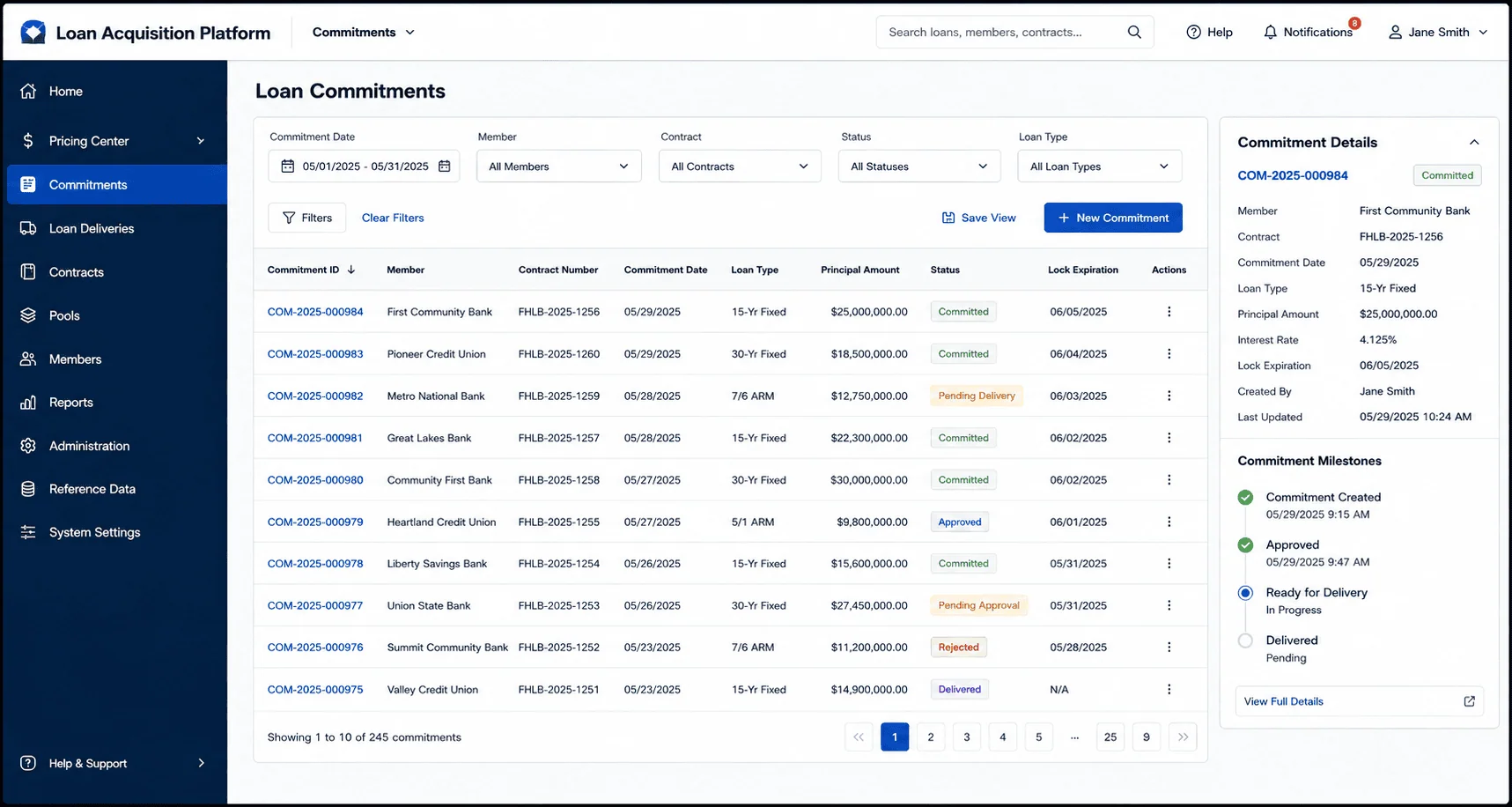
Every loan upload now validates automatically against mortgage industry standards with instant feedback, member institutions retrieve real-time pricing directly from the district banks, and the system manages more than $40 billion in mortgages with comprehensive pipeline tracking end to end.
Mortgage Delivery at Network Scale Had Outgrown Manual Processes
The district banks’ position in the network defines the problem’s shape. They purchase mortgages from member institutions of widely varying size, and every purchase runs the same cycle: a delivery contract, a commitment against current pricing, a loan pool delivered, and every loan in the pool checked against stringent mortgage industry standards. Run manually, each step costs intervention time, and every check is a chance for an error to pass through or a delivery to slip.
Leadership’s requirement was therefore not an adjustment to existing tools but a web-based system that would automate the contracting, purchasing, and tracking work outright, so that accountability and timely mortgage delivery across the vast network stopped depending on manual effort, with loan validation moved from people to a system built to do it.
Member institutions in this network were retrieving pricing and committing to contracts through separate, manual channels before one platform consolidated it. If your organization coordinates a similar network of member institutions, that same consolidation question is worth raising early.
Accountability Was Only as Strong as the Manual Process Behind It
The costs of staying manual recur with every transaction. Manual intervention slows the cycle; errors in loan data surface downstream instead of at intake; and tracking mortgage delivery by hand means accountability depends on people reconciling records rather than a system enforcing them. Across counterparties as varied as member banks, credit unions, and other financial institutions, those per-transaction costs compound into exactly the operational inefficiency the district banks set out to eliminate.
The stakes on the other side of the engagement were scale. Whatever replaced the manual work would carry the district banks’ wholesale mortgage purchasing itself, the system today manages over $40 billion in mortgages, and it would have to validate loan information automatically against stringent mortgage industry standards, because checking at that volume cannot depend on manual review catching everything.
Stringent Standards, Counterparties of Every Size, Both Sides on One Platform
The system had to serve two audiences at once. Participating Financial Institutions (PFIs) needed to retrieve current pricing from the district banks, commit to delivery contracts, and deliver loan pools, with instant feedback on whether each upload succeeded and descriptive information on any issues encountered. The district banks needed the other side of the same transactions: automated contracting, purchasing, and tracking, management of the loan warehouse, and timely and actionable reports.
The validation requirement set the technical bar. Every uploaded loan had to be validated automatically against stringent mortgage industry standards, and the platform had to accept deliveries from member banks of any size, so both large and small financial institutions could participate fully. A system that served only the largest members, or returned validation results slowly, would simply have moved the manual work somewhere else.
Senior Microsoft Specialists with Proven Delivery Depth
The requirements defined the vendor profile: a team that could design and build an online custom web application carrying a complex rules engine, automated validation against stringent mortgage industry standards, online analytic tools, loan warehouse management, and reporting, and stand it up as the platform carrying the district banks’ wholesale mortgage purchasing. This was full-lifecycle custom application development, not product configuration, and the counterparties depending on it would span a national network.
The district banks engaged i3solutions, a Microsoft Partner with 30 years of delivery experience and 1,500+ Microsoft engagements, delivered by an all-senior, all US-based delivery team. That profile matched the work: senior engineers who have built transaction and records systems on the Microsoft platform repeatedly, and who could deliver a rules engine that financial institutions on both sides of a loan purchase would trust with their data.
i3solutions built the Loan Acquisition System (LAS), an online custom web application that carries the full mortgage acquisition cycle: PFIs retrieve current pricing, commit to delivery contracts, and deliver loan pools, while the district banks purchase loans, manage the loan warehouse, and track every delivery.
PHASE 01
Acquisition Operations Assessment
i3solutions worked through how the mortgage acquisition cycle actually ran: how delivery contracts were made and tracked, where loan data arrived from member banks, credit unions, and other financial institutions, what the stringent mortgage industry standards required of each loan record, and what feedback PFIs needed at upload. The assessment defined the platform’s scope and the rules the validation engine would enforce.
PHASE 02
Platform and Rules Engine Architecture
The system was architected as an online custom web application with a complex rules engine at its center. The engine validates every uploaded loan and returns instant feedback on whether the upload succeeded or failed, with descriptive information on any issues encountered, so problems surface at intake rather than downstream in the transaction cycle.
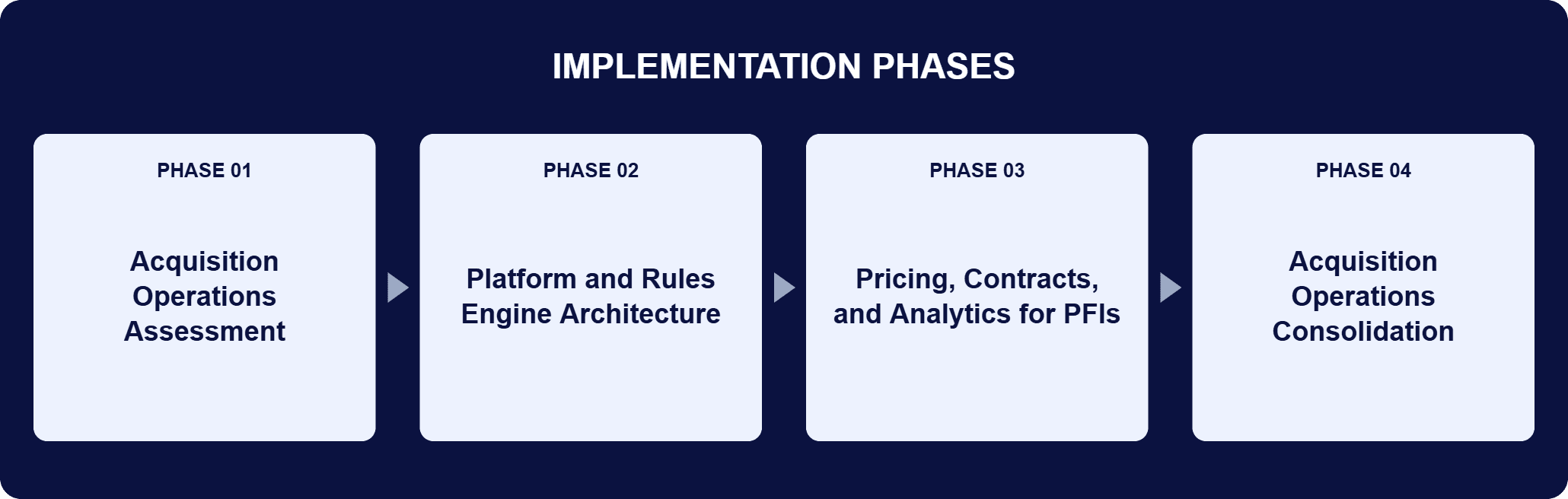
PHASE 03
Pricing, Contracts, and Analytics for PFIs
i3solutions built the counterparty-facing side of the platform: PFIs retrieve current pricing from the district banks, commit to delivery contracts, and deliver loan pools, and online analytic tools show each PFI which of its loans best fit the criteria outlined in each delivery contract, supporting both decision making and contract fulfillment.
PHASE 04
Acquisition Operations Consolidation
Contracting, purchasing, and delivery tracking moved onto the automated platform, along with loan warehouse management, automatic validation against stringent mortgage industry standards, and timely and actionable reports. The system now manages over $40 billion in mortgages for the district banks.
The Loan Acquisition System is an online custom web application built around one architectural conviction: validation belongs at intake. Its complex rules engine checks every loan a PFI uploads and returns instant feedback on success or failure, with descriptive information on any issues encountered, so an error is corrected by the institution that introduced it, at the moment it appears, instead of surfacing later in the transaction cycle. Automatic validation against stringent mortgage industry standards runs inside the same intake step. Around that core, the platform carries both sides of the acquisition business. PFIs retrieve current pricing from the district banks, commit to delivery contracts, and deliver loan pools, and online analytic tools show them which of their loans best fit the criteria in each delivery contract. The district banks purchase loans, manage the loan warehouse, track the mortgage pipeline comprehensively at every stage, and generate timely and actionable reports. Real-time pricing access and streamlined data transfer replace manual exchange between counterparties, which is how the system reduces manual intervention, minimizes errors, and accelerates the overall transaction cycle across over $40 billion in managed mortgages.
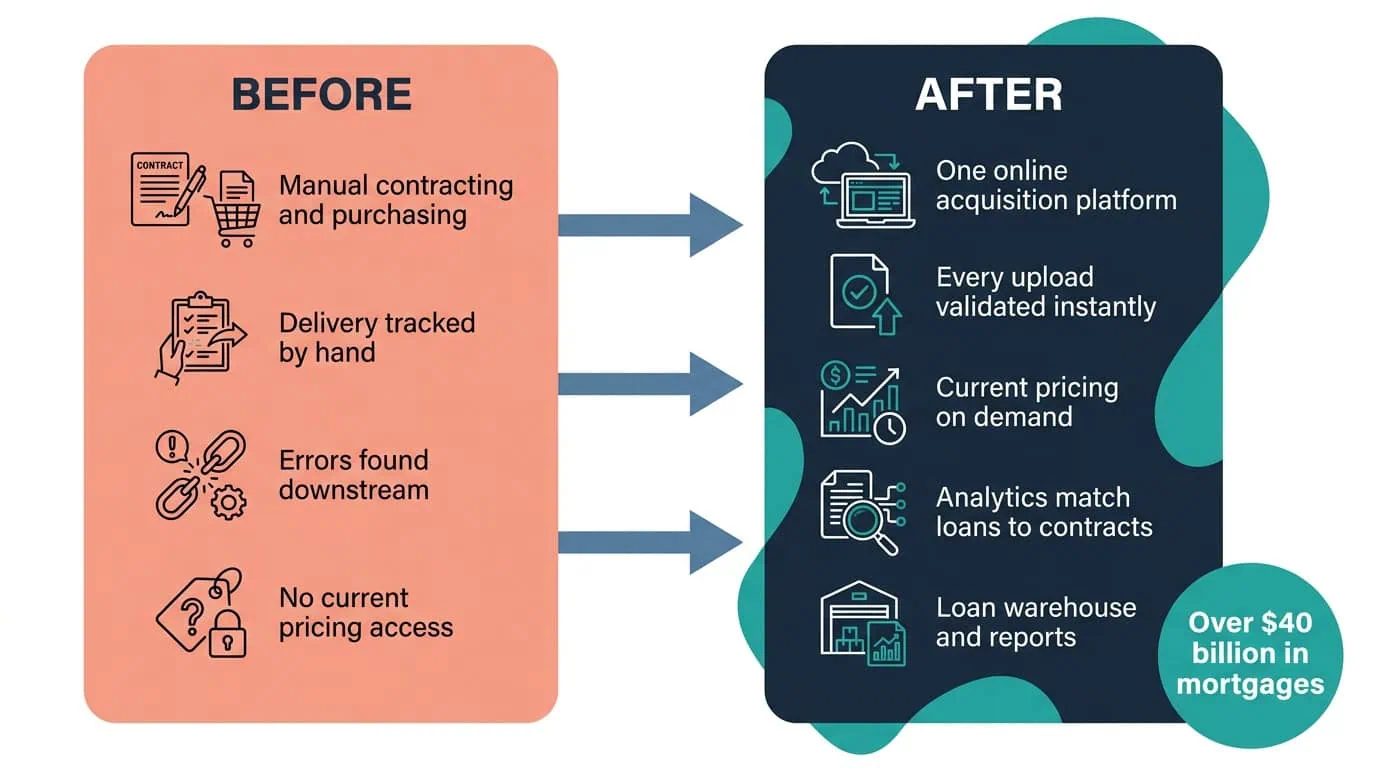
$40 Billion Managed, Validated Automatically
A single web-based platform now validates every loan upload against mortgage industry standards and gives member institutions real-time pricing.
| Outcome | Before | After |
|---|---|---|
| Mortgage portfolio managed | Manual contracting, purchasing, and delivery tracking | One system managing over $40 billion in mortgages |
| Loan validation | Not automated against industry standards | Every upload validated automatically against stringent mortgage industry standards, with instant feedback |
| Pricing access for PFIs | No immediate access to current pricing | Real-time pricing retrieval from the district banks |
| Pipeline visibility | Delivery status reconciled by hand | Comprehensive tracking of every stage of the mortgage pipeline |
| Transaction cycle | Slowed by manual intervention and errors | Reduced manual intervention, minimized errors, accelerated overall transaction cycle |
The headline number is scale: the district banks run their wholesale mortgage operation on a system that manages over $40 billion in mortgages. Within that portfolio, LAS grants Participating Financial Institutions real-time access, generates timely and actionable reports, tracks and analyzes loans comprehensively, and automatically validates information against stringent mortgage industry standards. The platform automates the complex tasks and runs the compliance checks itself, and the administrative time and cost that used to go into them come back to the district banks and their member institutions.
The reach of the system matters as much as its size. LAS lets the district banks purchase mortgages from member banks of any size, so both large and small financial institutions participate fully and on the same terms, which broadens the scope of mortgage products available to the network. Real-time pricing and streamlined data transfer improve transparency and trust while reducing errors and accelerating transaction times, and the hours that manual exchange used to consume now go to the district banks’ strategic priorities and to serving their customers.

PENDING-CLIENT-QUOTE
This engagement is relevant for
Less relevant for
Mortgage Acquisition on One System, Validation at the Point of Intake
The engagement established that a wholesale mortgage operation spanning a national network can run on one purpose-built platform. The Loan Acquisition System carries the full cycle, current pricing, delivery contracts, loan pool delivery, purchasing, loan warehouse management, and reporting, with a complex rules engine validating every uploaded loan against stringent mortgage industry standards and returning instant, descriptive feedback.
Member banks of any size participate fully, PFIs see which of their loans best fit each delivery contract before they deliver, and the district banks track the mortgage pipeline comprehensively at every stage. The measure of the result is the scale it operates at: over $40 billion in mortgages managed, with less manual intervention, fewer errors, and a faster overall transaction cycle than the manual processes it replaced.
A custom loan acquisition system is a purpose-built web application that carries the full cycle by which a wholesale lender purchases loans from its counterparties: pricing, delivery contracts, loan delivery, validation, purchasing, and tracking. For this national network of wholesale banks, i3solutions built the Loan Acquisition System (LAS), an online platform where Participating Financial Institutions retrieve current pricing from the district banks, commit to delivery contracts, and deliver loan pools. Two design choices define the category. First, validation is automated and immediate: a complex rules engine checks every uploaded loan against stringent mortgage industry standards and returns instant feedback with descriptive information on any issues. Second, both sides of the transaction work in the same system: the district banks purchase loans, manage the loan warehouse, and generate timely and actionable reports from the platform their counterparties deliver through. The system manages over $40 billion in mortgages.
The defining fact of a wholesale banking network is that the counterparties are many and varied: these district banks purchase mortgages from member banks, credit unions, and other financial institutions inside a national network of more than 7,700 financial institutions and 12 District Banks. i3solutions designed LAS around that reality. The platform accepts deliveries from member banks of any size, so both large and small institutions participate fully. Validation moved from people to a complex rules engine, so errors surface at intake with descriptive feedback rather than downstream in the transaction cycle. Online analytic tools show each PFI which of its loans best fit the criteria in each delivery contract, and the district banks get automated contracting, purchasing, and tracking with timely and actionable reports. The delivery target was operational from the start: contracting that runs itself, accountability the system enforces, and mortgages delivered on time.
A complex rules engine checks each upload and returns instant feedback on whether it succeeded or failed, along with descriptive information on any issues encountered, so the institution that delivered the loan can correct problems immediately. LAS also validates loan information automatically against stringent mortgage industry standards, which puts the compliance check inside the same intake step rather than in a separate manual review. The effect on the transaction cycle is direct: automated validation takes manual intervention and its errors out of the cycle and shortens it, because a loan that clears intake has already been checked instead of waiting on downstream reconciliation. Ahead of intake, online analytic tools help PFIs choose which loans to deliver in the first place, showing which of their loans best fit the criteria outlined in each delivery contract before an upload ever happens.
PFIs use LAS to retrieve current pricing from the district banks, commit to delivery contracts, upload and validate loans, and deliver loan pools. The platform gives them real-time access rather than routed requests: current pricing is immediately available, and streamlined data transfer replaces manual exchange, which improves transparency and trust while reducing errors and accelerating transaction times. Online analytic tools show which of their loans best fit the criteria outlined in each delivery contract, which supports both decision making and contract fulfillment. And because LAS lets the district banks purchase mortgages from member banks of any size, both large and small financial institutions can participate fully, which broadens the scope of available mortgage products across the network. The result for the PFI is a smoother client experience on every delivery.
LAS provides comprehensive tracking of the mortgage pipeline, with detailed visibility into each stage of the process, so the district banks can see a bottleneck forming before it slows a delivery and adjust the workflow on current data rather than reconstruction. The same platform manages the loan warehouse, generates timely and actionable reports, and tracks and analyzes loans comprehensively across a portfolio of over $40 billion in mortgages. Visibility runs in both directions: Participating Financial Institutions get real-time access on their side of each transaction, so status is read from the system rather than requested from a counterparty. The tracking, the loan warehouse, and the reports run on the same automation that handles compliance, so the administrative time and cost of pipeline oversight drop for the district banks and their PFIs alike.
i3solutions is a Microsoft Partner with 30 years of delivery experience and 1,500+ Microsoft engagements, with every engagement staffed by an all-senior, all US-based delivery team. That profile fits systems financial counterparties have to trust: this engagement produced a platform that manages over $40 billion in mortgages, validates every uploaded loan automatically against stringent mortgage industry standards, and serves member institutions of every size across a national network. The engagement is representative of the pattern: a custom web application with a complex rules engine at intake, real-time pricing and online analytics for counterparties, and automated contracting, purchasing, tracking, and reporting for the institution that owns the platform. For organizations weighing this class of work, a short scoping conversation establishes what a purpose-built acquisition system would take in your environment.
Yes. The Loan Acquisition System serves Participating Financial Institutions across that full range on one platform, validating every uploaded loan against mortgage industry standards at intake so errors surface immediately rather than downstream. District banks get real-time visibility into pricing and the mortgage pipeline regardless of the size of the institution submitting the loan, which is how this wholesale bank network manages $40 billion in mortgage volume through one delivery point instead of institution-specific processes.
A validation rules engine is what let this platform manage $40 billion in mortgage volume without manual review at every step. We’re glad to talk through what a comparable validation layer would look like for your environment.

US-Based | Est. 1997
© i3solutions. All rights reserved.
US-Based | Est. 1997
© i3solutions. All rights reserved.


