

Member records, dues, and the organization’s flagship annual event ran on spreadsheets and manual coordination.
The client is a nonprofit women’s volunteer organization dedicated to promoting volunteerism, empowering women, and improving communities through the leadership and action of trained volunteers. With a focus on literacy and community engagement, the organization manages a diverse membership base and organizes numerous events, including its annual placement event, where the year’s volunteer placements are coordinated. The majority of the organization’s leadership serves in a voluntary capacity, which shapes everything about how its systems must work: every hour spent on administration is an hour taken from people who volunteered to serve the mission, not to maintain spreadsheets.
Membership operations ran on exactly those spreadsheets. Member records, dues tracking, report generation, and placement event coordination all relied on cumbersome spreadsheets and manual tasks, and the inefficiencies significantly impacted productivity. The annual placement event alone consumed three weeks of administrative effort. The organization also wanted a stronger online presence: a website redesign providing better communication with members and better access to organizational resources. It needed a modern, web-based membership management system that would take the administrative burden off its volunteer leadership.
A nonprofit managed its member records, dues, and flagship annual event entirely through spreadsheets and manual coordination. i3solutions consolidated it all onto one ASP.NET and SharePoint platform, cutting event administration workload by 90%.
Placement event administration dropped from three weeks to two days, a 90% reduction in manual effort on a task that recurs every year, and members now update their own information online instead of routing changes through staff.

Volunteer Hours Were Going to Spreadsheets Instead of the Mission
The organization’s operating model made the spreadsheet problem sharper than it would be at a staffed company. Because the majority of its leadership serves in a voluntary capacity, administrative overhead is not absorbed by salaried staff; it lands directly on volunteers, and it is paid in the same hours the organization exists to direct toward literacy and community engagement. Every manual dues update, every hand-built report, and every week of placement event coordination came out of that budget.
The placement event made the cost concrete: three weeks of manual administrative effort, every year, to run one event. Leadership decided the answer was not more volunteer diligence but a different system: a centralized, web-based platform that would consolidate membership management onto one system, reduce administrative burdens, and improve member engagement, built at a cost a volunteer-run nonprofit could justify.
The choice this nonprofit faced wasn’t spreadsheets versus a commercial platform, it was overhead versus a right-sized custom system. If that’s the same choice in front of your organization, it’s worth a direct comparison rather than a default to either extreme.
A Mission Taxed by Its Own Administration
Left manual, the costs recurred on a fixed schedule. Three weeks of placement event administration came due every year, and the daily drag of spreadsheet-based member records, dues tracking, and report generation came due continuously. Those inefficiencies significantly impacted productivity, and in a volunteer-led organization, lost productivity is not an accounting line: it is trained volunteer leaders doing data entry.
The engagement risk cut the other way too. Commercial membership management platforms existed, but at a price that mattered to a nonprofit budget. The organization needed the efficiency of a purpose-built system without the cost profile of the commercial suites, which is the constraint the eventual solution was measured against: it was delivered at a fraction of the cost of other commercial membership management platforms.
Built for Volunteers, Priced for a Nonprofit
The system’s primary users would be volunteers and members, not trained administrative staff, so usability was a hard constraint. Administrators needed a content management tool that made routine updates fast; members needed to update their personal information themselves online; and selected committee members needed their own web pages with real-time access to critical updates and reports. Access could not be one-size-fits-all either: the platform had to enforce defined access levels based on organizational roles, so membership data stayed secure while remaining available to the people responsible for it.
The second constraint was scope on a nonprofit budget. The engagement covered the full span of membership operations, member tracking, dues management, report generation, and placement event administration, plus the improved online communication the organization wanted, and it had to land at a fraction of the cost of commercial membership management platforms rather than replicate their pricing.
Senior Microsoft Specialists with Proven Delivery Depth
The requirements defined the vendor profile: a team that could design and implement a custom web-based system across ASP, .NET, and SharePoint; build role-based security and member self-service into it from the start; and deliver the whole platform at a cost a volunteer-run nonprofit could carry. This was full-lifecycle custom application development, not product configuration, and it had to be right the first time because the organization had no in-house development staff to maintain a half-finished system.
The organization engaged i3solutions, a Microsoft Partner with 30 years of delivery experience and 1,500+ Microsoft engagements, delivered by an all-senior, all US-based delivery team. That profile matched the work: senior engineers who have built membership and records systems on the Microsoft web stack repeatedly, and who could deliver a secure, cost-effective platform without the overhead a nonprofit cannot fund.
i3solutions designed and implemented a custom membership management system tailored to the organization’s needs: one centralized platform for tracking members, managing dues, generating reports, and running the annual placement event.
PHASE 01
Membership Operations Assessment
i3solutions worked through how membership operations actually ran: where member records, dues, reports, and placement event coordination lived across spreadsheets and manual tasks, who touched each artifact, and which organizational roles needed what level of access to membership data. The assessment defined the platform’s scope and its role-based security model.
PHASE 02
Platform Design and Architecture
The system was architected as a web-based platform on ASP and .NET, with HTML and scripts providing a structured, dynamic user interface, and SharePoint serving as the core of the document management and collaboration solution: centralized storage, team-specific portals, version control, and shared documents, calendars, and tasks.
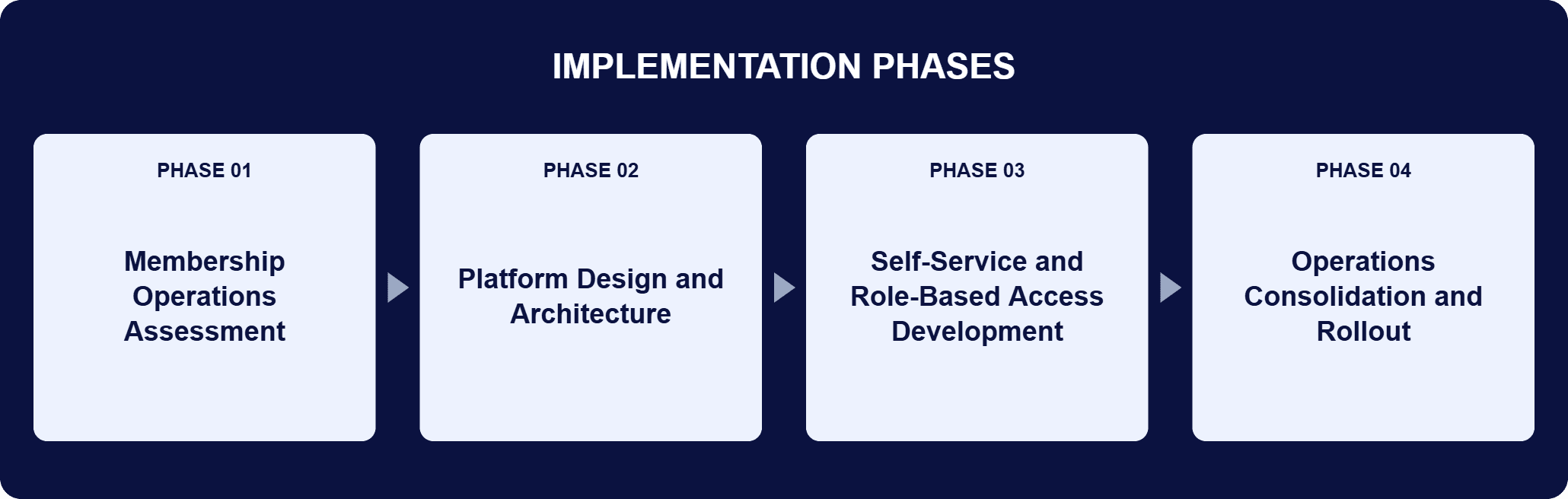
PHASE 03
Self-Service and Role-Based Access Development
i3solutions built the platform’s defined access levels based on organizational roles, developed a user-friendly content management tool so administrators can update information quickly, created dedicated web pages giving selected committee members real-time access to critical updates and reports, and gave members the ability to update their personal information online.
PHASE 04
Operations Consolidation and Rollout
Member tracking, dues management, report generation, and placement event administration moved onto the centralized platform, eliminating the manual spreadsheets. The first measured result: the placement event’s administrative workload dropped from three weeks to two days.
The platform is a deliberately practical Microsoft web stack. ASP and .NET power the web-based application and its interaction with membership data; HTML and scripts provide a structured, dynamic user interface that makes navigation and content updates straightforward; and SharePoint serves as the core of the document management and collaboration solution, providing centralized storage, team-specific portals, version control, and tools for sharing documents, calendars, and tasks across departments. Security is role-shaped rather than flat: defined access levels based on organizational roles govern who can manage membership data, so the system stays secure without blocking the people responsible for the work. The self-service layer removes the manual record-keeping entirely: members update their personal information through the web, administrators maintain content through a user-friendly management tool instead of editing spreadsheets, and selected committee members work from dedicated web pages with real-time access to critical updates and reports. The same platform tracks members, manages dues, generates reports, and administers the annual placement event, replacing the disconnected spreadsheets that previously held each of those functions.

Three Weeks to Two Days
One centralized platform now handles members, dues, and reports, cutting placement event administration by 90%.
| Outcome | Before | After |
|---|---|---|
| Placement event administration | Three weeks of manual effort | Two days (90% reduction in manual effort) |
| Member records and dues | Cumbersome spreadsheets and manual tasks | One centralized platform for members, dues, and reports |
| Member information updates | Manual record-keeping | Members update their own information online |
| Committee visibility | Updates routed through staff | Dedicated web pages with real-time access to updates and reports |
| Platform cost | Commercial membership management platform pricing | A fraction of the cost of commercial platforms |
The headline number is the placement event: its administrative workload was reduced from three weeks to just two days, a 90% reduction in manual effort, on an event that recurs every year. The daily change is quieter but broader: member tracking, dues management, and report generation moved from hand-maintained spreadsheets to one centralized platform, members gained real-time access to updates, upcoming activities, and organizational resources without needing to contact staff, and leadership now updates membership information directly instead of relying on outdated manual processes.
The cost side of the result matters as much as the time side. The organization got a secure, purpose-built system at a fraction of the cost of other commercial membership management platforms, which is what made the modernization viable for a volunteer-run nonprofit at all. The engagement stayed affordable because the platform was built to the organization’s actual operations rather than to a commercial suite’s feature list, and because self-service moved record maintenance to the members themselves.

“Thanks guys, you really are #1. Although our job may not be i3’s biggest job ever, and certainly not your only current job (it’s HUGE to us and you’ve been great throughout), certainly making us feel as though we are your one and only focus!”
Volunteer leader, a nonprofit women’s volunteer organization
This engagement is relevant for
Less relevant for
Membership Operations on One Platform, Administration Off the Volunteers
The engagement established that a volunteer-run nonprofit does not have to choose between spreadsheet overhead and commercial platform pricing. A custom system on the Microsoft web stack, built with ASP and .NET and SharePoint for document management and collaboration, consolidated member tracking, dues, reports, and placement event administration onto one centralized platform, with access defined by organizational role.
Members now maintain their own records online, committee members read real-time updates instead of requesting them, and the annual placement event that took three weeks of administration now takes two days. Delivered at a fraction of the cost of commercial membership management platforms, the system returned its most important resource directly: trained volunteer leaders’ hours, redirected from administration back to literacy and community engagement.
A custom membership management system is a purpose-built web platform that consolidates the operations a membership organization otherwise runs in spreadsheets: member records, dues management, report generation, and event administration. For this nonprofit volunteer organization, i3solutions built the platform on ASP and .NET with SharePoint providing document management and collaboration, so one system holds the authoritative membership record instead of copies scattered across manual artifacts. Two design choices define the category. First, access levels are based on organizational roles, so data stays secure while remaining available to the people responsible for it. Second, self-service replaces manual record-keeping: members update their own information online rather than routing changes through staff. Built to purpose, such a system can land at a fraction of the cost of commercial membership management platforms, which is what makes it viable for volunteer-run organizations.
The defining fact of a volunteer-run organization is that administration competes directly with the mission for the same hours, so the system has to remove work, not add a new kind of work. In this engagement, i3solutions designed the platform around that constraint: a user-friendly content management tool so administrators update information quickly, online self-service so members maintain their own records, dedicated web pages giving selected committee members real-time access to critical updates and reports, and defined access levels based on organizational roles so security does not depend on manual gatekeeping. The scope covered the full span of membership operations, from member tracking and dues to reports and the annual placement event, and the delivery target was explicit: a secure, cost-effective solution at a fraction of the cost of commercial membership management platforms.
Access levels are defined by organizational role, so what a person can see and manage in the membership data follows the responsibility they hold, and the platform enforces it rather than relying on whoever holds the spreadsheet. Self-service operates at two tiers. Members update their personal information through the web directly, which eliminates manual record-keeping: the record maintains itself at the point where the change originates. Selected committee members get a second tier: dedicated web pages with real-time access to critical updates and reports, so the people running organizational activities read current information instead of requesting it. Administrators work through a user-friendly content management tool that reduces the time required for routine tasks. SharePoint underpins the collaboration layer with centralized storage, team-specific portals, version control, and shared documents, calendars, and tasks.
The annual placement event’s administrative workload was reduced from three weeks to just two days, resulting in a 90% reduction in manual effort. That is the measured, headline saving, and because the event recurs every year, the saving recurs with it. The broader time recovery is spread across daily operations and is harder to put a single number on: member tracking, dues management, and report generation moved off cumbersome spreadsheets and manual tasks onto one centralized platform; members now update their own information online instead of routing changes through manual record-keeping; and leadership updates membership information directly rather than relying on outdated manual processes. For an organization whose leadership serves in a voluntary capacity, every one of those recovered hours goes back to the mission rather than to a payroll line.
In this engagement, yes, and the comparison was direct: the organization modernized its operations at a fraction of the cost of other commercial membership management platforms. The affordability came from building to purpose rather than licensing breadth. The organization needed member tracking, dues management, report generation, placement event administration, role-based access, and member self-service, so that is what was built, on a practical Microsoft web stack of ASP, .NET, and SharePoint, without paying for a commercial suite’s feature surface. The return side of the equation strengthens the case: the placement event alone gave back the difference between three weeks and two days of administrative effort every year, and the reduced administrative workload freed the organization’s volunteer leadership to focus on the mission it exists to serve.
i3solutions is a Microsoft Partner with 30 years of delivery experience and 1,500+ Microsoft engagements, with every engagement staffed by an all-senior, all US-based delivery team. That profile fits membership system work for nonprofits, where there is no in-house development staff to absorb mistakes: the system has to arrive secure, usable by volunteers, and complete. This engagement is representative of the pattern: a centralized platform on ASP, .NET, and SharePoint covering members, dues, reports, and events; role-based access and member self-service built in from the start; a 90% reduction in the placement event’s manual effort; and delivery at a fraction of commercial platform cost. For organizations weighing this class of work, a short scoping conversation establishes what a purpose-built membership system would take in your environment.
This was built for exactly that constraint. The organization runs on volunteer leadership, not a paid IT department, and the system was scoped and priced around that reality rather than around commercial membership-platform licensing. Role-based access and member self-service reduce the ongoing administrative load, which matters more for a volunteer-run organization than for one with staff to absorb it. The result cut what had been weeks of event administration to about two days, time that goes back to the volunteers running the organization rather than to a platform maintaining itself.
Consolidating member tracking, dues, and event administration onto one platform is what returned volunteer leaders’ hours to the mission instead of the paperwork. We can walk through what a comparable consolidation would look like for your organization.

US-Based | Est. 1997
© i3solutions. All rights reserved.
US-Based | Est. 1997
© i3solutions. All rights reserved.


