

Proposal content was scattered across individual hard drives with no version control.
The client is a large nonprofit behavioral and social science research organization. Dedicated to using the best scientific approaches to enhance everyday life, the organization manages a wide range of research projects, and proposals are how that research gets funded. That makes the proposal management process core infrastructure, and the organization needed a system that would consolidate the creation, management, and storage of proposal documents onto one platform.
The existing process was fragmented and inefficient. Proposal materials were scattered across individual hard drives with no version control, making it difficult to locate accurate and up-to-date information. Collaboration among teams was minimal: employees relied on email to share documents, leading to duplicated efforts and inconsistent messaging. Without a centralized system, proposal generation was time-consuming, prone to errors, and lacked the tracking capabilities to monitor past performance and key metrics. The organization sought an automated solution that would enable collaboration, document management, and process efficiency in one place.
A behavioral research nonprofit’s proposal content, the infrastructure funding its research, sat scattered across individual hard drives and email with no version control. i3solutions built a shared, searchable library and collaborative workspace to replace it.
Reusing past proposals and standardized content through the shared library cuts creation time and error risk, and the collaborative workspace gives real-time visibility into each proposal’s value, timeline, and win/loss results, building a knowledge base the team had never had before.
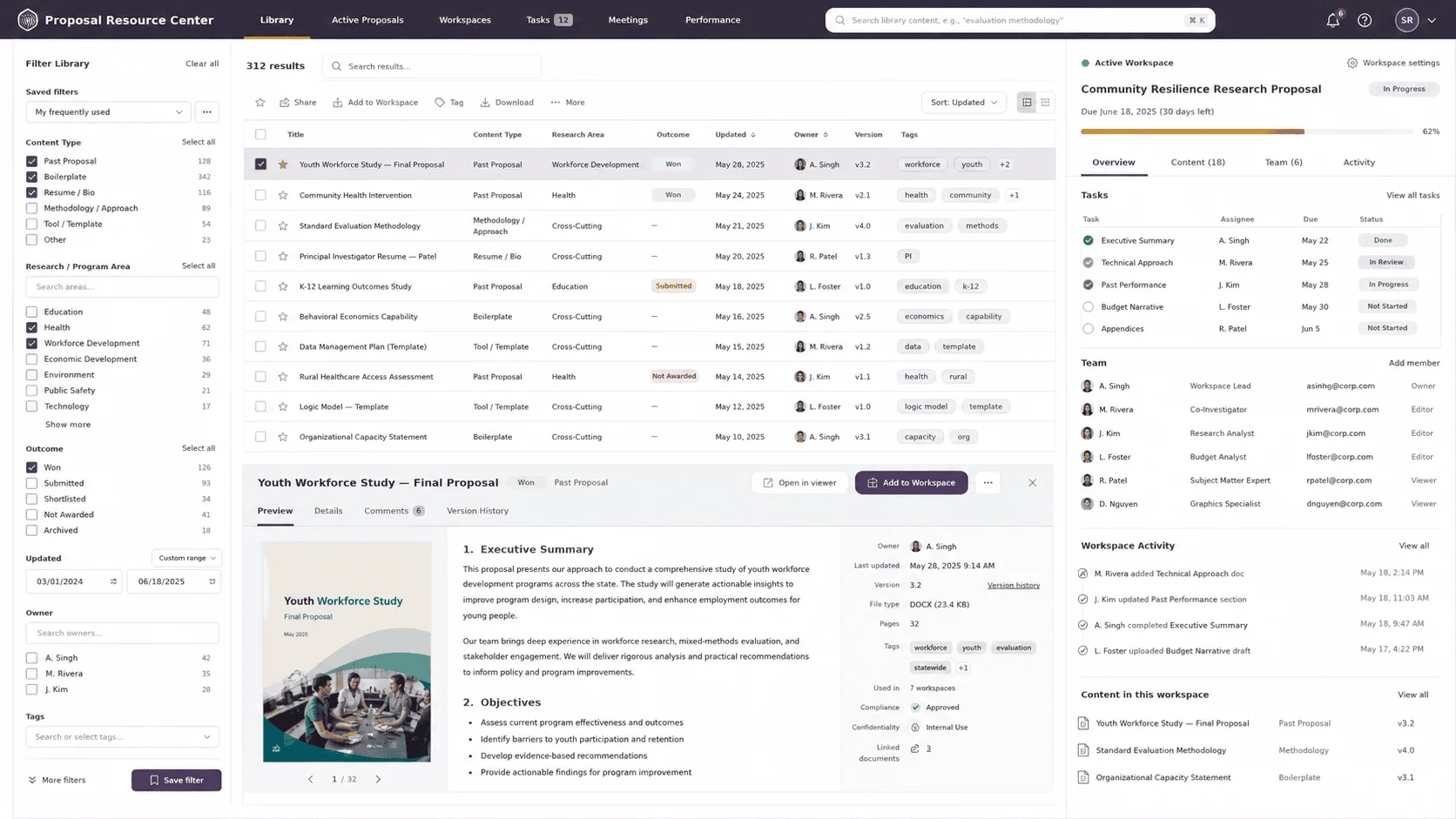
Proposals Fund the Research, and the Process Could Not Keep Up
For a research organization, a proposal is not paperwork. It is the mechanism that secures funding and advances research initiatives. That made the state of the process a strategic problem rather than an administrative one. Every proposal team started by hunting across individual hard drives for the last accurate version, every document exchange ran through email, and every finished proposal disappeared into the same fragmentation it came from, with no record of value, dates, or outcome to learn from.
Leadership concluded the fix was structural, not procedural. Asking teams to email more carefully would not create version control, and no amount of diligence produces win/loss tracking from files on personal drives. The organization decided to commission an automated platform built around its proposal workflow: one system to store, search, and reuse proposal content, one shared workspace for the teams producing it, and tracking built in from the start.
This organization’s proposal content was scattered across individual hard drives, not because staff weren’t careful, but because there was no shared system. If the same fragmentation exists in your proposal process, that’s the actual thing to fix.
Fragmentation Compounds with Every New Proposal
Left alone, the problems recurred with every submission. Proposal generation stayed time-consuming and prone to errors because each effort began without reliable access to accurate, up-to-date material. Duplicated effort and inconsistent messaging kept coming out of email-based collaboration. And the absence of version control meant the risk was not hypothetical: the organization could not be sure the content in front of a funder was the right version.
The quieter cost was institutional memory. Without tracking of past performance and key metrics, each proposal was written as if it were the first: no record of what a proposal was worth, when it ran, or whether it won informed the next effort. For an organization whose research portfolio depends on winning proposals, operating without that record meant the most valuable byproduct of every submission, the knowledge of what worked, was being discarded.
One System for Many Research Programs
The organization manages a wide range of research projects, so the platform had to serve many programs and proposal teams at once, in a secure, shared environment rather than a departmental silo. Adoption was a hard constraint: the system would only end the email habit if proposal teams preferred working in it to their inboxes, and it had to accommodate the organization’s own proposal management best practices rather than force a generic process onto them.
The scope spanned the full lifecycle of a proposal. The platform had to cover proposal documents from drafting through storage; collaboration among the teams producing them; workflow automation for task assignments and document tracking; and the performance record the organization had never had on its own proposals. A partial fix, a repository without collaboration or collaboration without tracking, would have left the fragmentation standing.
Senior Microsoft Specialists with Proven Delivery Depth
The requirements defined the vendor profile: a team that could build an automated proposal management platform on SharePoint, with SQL Server as its database, InfoPath for structured forms, and a .NET Framework back end, and shape it to how the organization actually produces proposals rather than configure a generic product. The platform also had to encode the organization’s own best practices, which takes engineers who can translate working process into system behavior.
The organization engaged i3solutions, a Microsoft Partner with 30 years of delivery experience and 1,500+ Microsoft engagements, delivered by an all-senior, all US-based delivery team. That profile matched the work: senior engineers who have built document management, collaboration, and workflow systems on the Microsoft stack repeatedly, and who could integrate industry best practices with an interface proposal teams would actually adopt.
i3solutions developed and implemented the Enterprise Proposal Management System, an automated platform tailored to the organization’s specific proposal management needs: a Proposal Resources Library where proposal content is stored, searched, and reused, paired with a Collaborative Workspace where teams produce it.
PHASE 01
Proposal Operations Assessment
i3solutions worked through how proposal management actually ran: where materials lived across individual hard drives, how teams exchanged documents over email, which content was worth reusing, and what tracking leadership lacked on past performance and key metrics. The assessment defined the platform’s scope and the best practices it would encode.
PHASE 02
Platform Design and Architecture
The system was architected on SharePoint as the centralized document management and collaboration platform, with SQL Server as the database storing proposal information for fast searches and data retrieval, InfoPath providing structured electronic forms for capturing proposal-related data, and the .NET Framework powering the back-end logic.
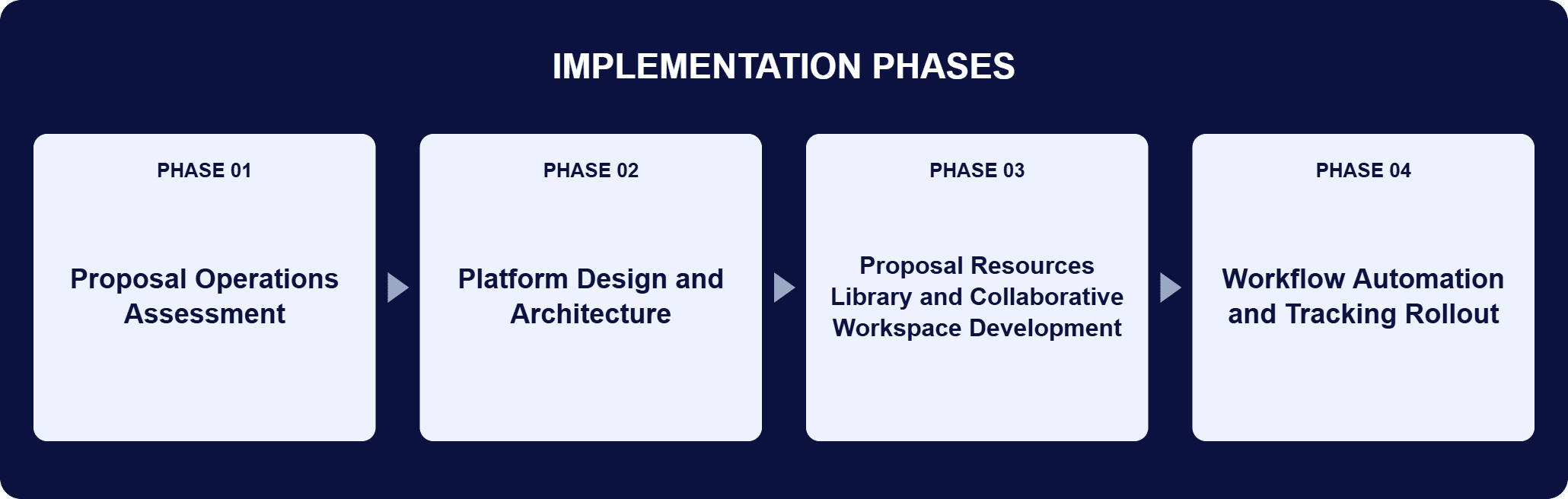
PHASE 03
Proposal Resources Library and Collaborative Workspace Development
i3solutions built the repository where users store, search, and retrieve past proposals and related materials, enabling reuse of high-quality content, and the virtual workspace where team members assign tasks, schedule meetings, and communicate in a secure, shared environment.
PHASE 04
Workflow Automation and Tracking Rollout
Workflow automation took over task assignments and document tracking, and proposal activity became visible in real time: proposal value, start and end dates, and win/loss results. Over time the library has evolved into a knowledge base tracking proposal performance, win/loss data, and key business insights.
The platform is a four-part Microsoft stack with SharePoint at its core. SharePoint provides the document management and collaboration layer, giving proposal teams easy access to proposal resources that previously sat on individual hard drives. SQL Server serves as the database for storing proposal information, built for fast searches and data retrieval, so locating accurate, up-to-date material is a query rather than a hunt. InfoPath enabled the creation of structured electronic forms for capturing and managing proposal-related data, replacing free-form documents with consistent, structured inputs. The .NET Framework powers the back-end logic, enabling the workflow automation that carries task assignments and document tracking. On top of that stack sit the system’s two working surfaces: the Proposal Resources Library, a single searchable repository where past proposals and related materials are stored, retrieved, and reused, and the Collaborative Workspace, a secure shared environment where team members assign tasks, schedule meetings, and communicate without routing documents through email. The same data layer gives leadership real-time visibility into proposal activity as it happens.
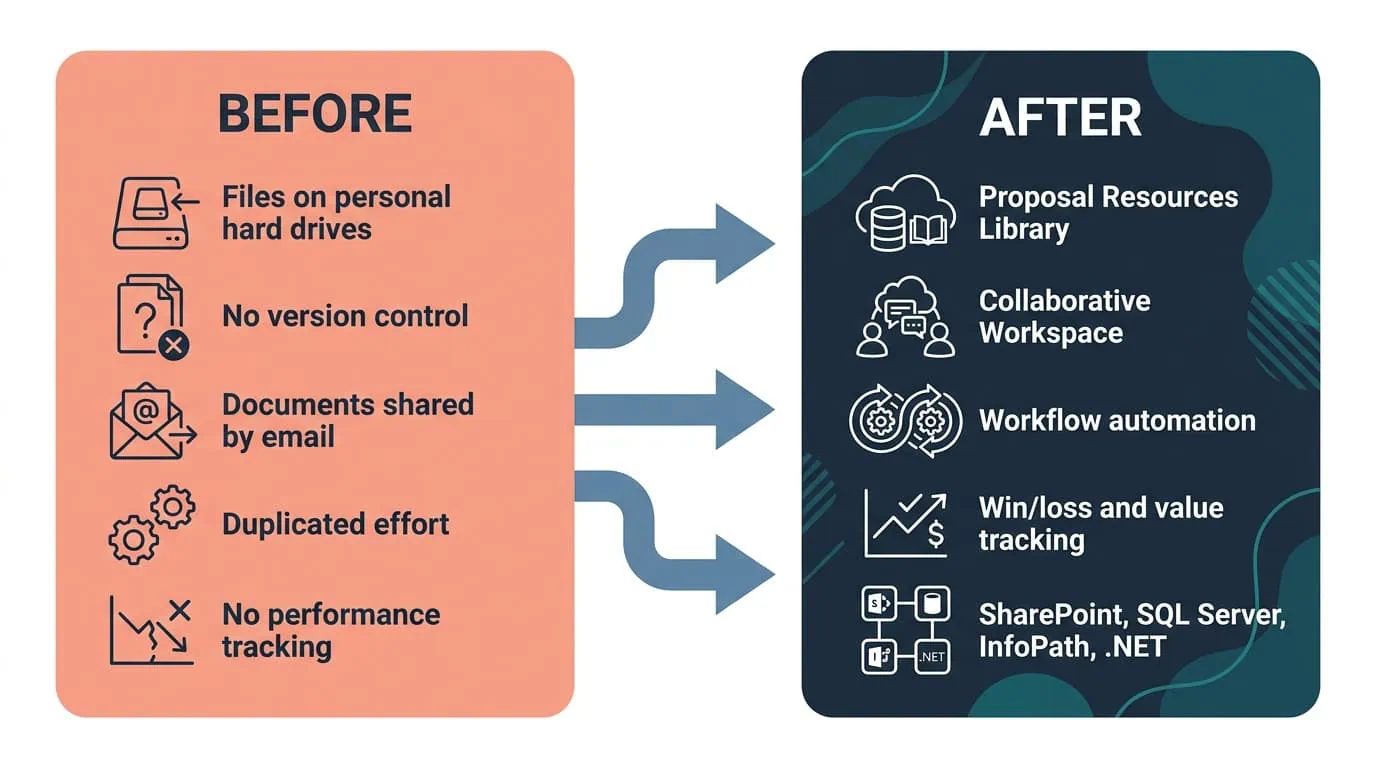
One Library, One Shared Workspace
A Proposal Resources Library and Collaborative Workspace replaced email-shared documents and let teams reuse past proposals directly.
| Outcome | Before | After |
|---|---|---|
| Proposal content | Scattered across individual hard drives with no version control | One searchable Proposal Resources Library |
| Team collaboration | Documents shared over email, with duplicated efforts and inconsistent messaging | Collaborative Workspace: tasks, meetings, and communication in one secure shared environment |
| Proposal generation | Time-consuming and prone to errors | Reuse of past proposals and standardized content reduces creation time and error risk |
| Visibility and tracking | No tracking of past performance or key metrics | Real-time insight into proposal value, start and end dates, and win/loss results |
| Institutional knowledge | Finished proposals lost to fragmentation | Library evolved into a knowledge base of proposal performance, win/loss data, and business insights |
The new system significantly reduces the time required to create proposals by providing easy access to past proposals and standardized content. Reusing that high-quality content also keeps messaging consistent and reduces the risk of errors. The Collaborative Workspace replaced email exchanges with a secure shared environment for tasks, meetings, and communication, and the Proposal Resources Library ended the document fragmentation and version control problems by consolidating all proposal materials into a single, searchable repository.
Visibility is the gain that never existed before: proposal activity can now be watched in real time, and leadership uses that record to refine strategies and improve future proposals. That data accumulates in the Proposal Resources Library, which has evolved into a knowledge base of proposal performance, win/loss data, and key business insights, so each submission now compounds the organization’s ability to win the next one.

“The Enterprise Proposal Management Suite provided us a flexible platform to build our dedicated Proposal Resource Center that supports the proposal management needs of our entire company. The system allows us to use our specific proposal management best practices and adopt them into the system. [It] helps one program to know what others are doing and promotes collaboration across the firm.”
Director of the Proposal Resource Center, a large nonprofit behavioral and social science research organization
This engagement is relevant for
Less relevant for
Proposal Content in One Library, Proposal Teams in One Workspace
The engagement established that proposal fragmentation is a solvable systems problem, not a discipline problem. A custom platform on SharePoint, SQL Server, InfoPath, and the .NET Framework consolidated proposal materials from individual hard drives into a single searchable Proposal Resources Library, moved team coordination from email into a secure Collaborative Workspace, and put task assignments and document tracking on workflow automation.
The organization gained visibility it did not have before into what its proposals are worth, when they run, and whether they win, and the library has evolved into a knowledge base that makes every past proposal an asset for the next one. For an organization whose research is funded through proposals, the next submission now starts from the library instead of from a search of personal drives.
An enterprise proposal management system is a purpose-built platform that holds an organization’s proposal documents and the process around them, which otherwise scatter across individual hard drives and email threads. For this large nonprofit behavioral and social science research organization, i3solutions built the Enterprise Proposal Management System on SharePoint with SQL Server as its database, InfoPath for structured proposal data, and a .NET Framework back end. Two components define the category. The Proposal Resources Library is one repository where users store, search, and retrieve past proposals and related materials, so high-quality content is reused rather than rebuilt. The Collaborative Workspace is a secure shared environment where team members assign tasks, schedule meetings, and communicate, replacing email-based document exchange. Workflow automation carries the task assignments and document tracking between them.
The defining decision in this engagement was to tailor the platform to the organization’s own proposal process rather than force a generic process onto working teams. i3solutions integrated the organization’s own proposal management best practices into the system, then paired them with industry best practices, because a proposal system only ends the email habit if teams prefer working in it. The scope covered the full lifecycle: a single library for storing, searching, and reusing proposal content; a collaborative workspace for tasks, meetings, and communication; workflow automation for task assignments and document tracking; and the performance tracking leadership had never had on value, dates, and outcomes. The result: proposal work moved off personal drives and inboxes onto one platform built around how the organization already wins work.
The Proposal Resources Library is the content half: one repository where users store, search, and retrieve past proposals and related materials. It ended the document fragmentation and version control problems the organization had when files lived on individual hard drives, and reusing its high-quality content keeps proposal messaging consistent while reducing the time required to create new proposals. The Collaborative Workspace is the coordination half: a virtual workspace where team members assign tasks, schedule meetings, and communicate in a secure, shared environment instead of emailing documents around, which is what had produced duplicated effort and inconsistent messaging. Between them, workflow automation powered by the .NET Framework back end carries task assignments and document tracking, so a proposal moves through people and deadlines without anyone routing it by hand.
Proposal activity is visible in real time, including proposal value, start and end dates, and win/loss tracking, none of which the organization could monitor before the system existed. That record works at two levels. Operationally, leadership can see current proposal activity as it happens rather than reconstructing it from email threads and personal drives. Strategically, the record accumulates: the Proposal Resources Library has evolved into a knowledge base tracking proposal performance, win/loss data, and key business insights, and the organization uses it to refine strategies and improve future proposals. For a nonprofit research organization whose projects are funded through proposals, that turns past submissions into reusable business insight instead of files lost on individual hard drives, whether a given proposal won or lost.
The system runs on four Microsoft technologies, each with a defined job. SharePoint provides the centralized document management and collaboration platform, enabling easy access to proposal resources. SQL Server serves as the database for storing proposal information, allowing fast searches and data retrieval. InfoPath enabled the creation of structured electronic forms for capturing and managing proposal-related data. The .NET Framework powers the back-end logic, enabling workflow automation, task assignments, and document tracking. The stack choice matters less than the assembly: SharePoint holds and shares the content, SQL Server makes it findable, the structured forms keep proposal data consistent at the point of capture, and the .NET workflow layer moves work between people without manual routing. It is a deliberately practical enterprise stack, built and tailored by i3solutions to the organization’s proposal operations.
i3solutions is a Microsoft Partner with 30 years of delivery experience and 1,500+ Microsoft engagements, with every engagement staffed by an all-senior, all US-based delivery team. That profile fits proposal management work, where the platform has to encode an organization’s own best practices, not just store its files: it takes senior engineers to translate a working process into system behavior across SharePoint, SQL Server, InfoPath, and .NET. This engagement is representative of the pattern: a Proposal Resources Library and Collaborative Workspace replacing hard-drive fragmentation and email collaboration, workflow automation carrying task assignments and document tracking, and real-time visibility into proposal activity and outcomes. For organizations weighing this class of work, a short scoping conversation establishes what a proposal platform built to your operations would take in your environment.
Yes. The Collaborative Workspace replaces email-based document sharing with one shared, version-controlled environment, and it runs on the same Microsoft platform teams already use day to day, so the shift is a change in where files live, not a new tool to learn from scratch. That is what let this behavioral research nonprofit move off individual hard drives and shared folders without adding training overhead on top of the transition.
The library this organization built has evolved into a knowledge base, not just a storage location. We can talk through what a comparable proposal library would look like for your organization.

US-Based | Est. 1997
© i3solutions. All rights reserved.
US-Based | Est. 1997
© i3solutions. All rights reserved.


