

Legacy infrastructure could no longer support secure, connected work across a national membership organization’s staff and members.
The client is a national membership organization for education professionals, representing public school teachers and other educators throughout the country. It recognized that its legacy infrastructure was no longer meeting its organizational needs, especially around data security, regulatory compliance, and communication among members and staff. That is an organization running on infrastructure that predates its current security and compliance obligations, holding sensitive member and staff data, and serving educators and administrators spread across the country instead of staff sitting in one building.
Seeking a solution to address these shortcomings, the organization aimed to modernize its systems with updated, secure platforms capable of facilitating real-time collaboration and engagement. By implementing modern technologies that adhere to stringent cybersecurity standards, it set out to keep sensitive information protected while giving educators and administrators a user-friendly experience for accessing important materials and connecting with peers. Both halves of that had to be true at once, because a security posture that blocks the people it exists to serve does not last long across a national membership.
A national education association’s legacy infrastructure could no longer support secure, connected work for its staff and members, with manual processes slowing every team down. i3solutions rebuilt identity management, content governance, and search, raising productivity more than 50%.
Automating business processes raised productivity more than 50%, organization-wide information moved into a centralized, searchable environment in place of disconnected systems, and knowledge management tools now let teams share documents and insights instead of duplicating effort.

The Obligations Moved and the Infrastructure Did Not
The organization did not go looking for a platform. It went looking for compliance, security, and a way for members and staff to talk to each other, and found that its legacy infrastructure could not deliver any of the three. Data security and regulatory compliance were the stated drivers, and both are properties of the systems that hold the data, not of the policies written above them. Sensitive information belonging to public school teachers and other educators sat on that infrastructure.
Rather than start from a product, the engagement started with an assessment of the systems the association already ran. That assessment identified critical gaps in compliance, security, and user collaboration, which converted a general sense that the infrastructure was dated into a specific, findable list. Once the gaps were named, the decision in front of leadership was no longer whether to modernize but which environment could close all three categories at once.
This engagement started with an assessment that named the compliance, security, and collaboration gaps before anything was designed against them. If that sounds like where your own environment stands, that same first step is worth 30 minutes.
Sensitive Member Data on Systems That Predate the Rules
Left as it was, the infrastructure kept holding sensitive member and staff data under obligations it was never designed for, and those gaps stayed open. Compliance gaps do not resolve on their own and they do not stay quiet forever; they wait for the event that makes them visible. For an organization representing public school teachers and other educators throughout the country, the data at stake belongs to people who never chose the platform holding it.
A second cost ran quieter and continuously. Communication among members and staff crossed disconnected systems, which meant redundant effort across teams, no streamlined route to organization-wide information, and knowledge that existed somewhere in the organization but not where the next person needed it. Every week that continued was a week of duplicated work that a single platform would have absorbed.
Secure Enough for the Obligations, Usable Enough for Educators
The platform had to protect sensitive data and meet regulatory requirements, and it had to be operated by educators and administrators, not by security specialists. Those pull against each other in most designs. Members and staff needed to reach important materials and connect with peers on a platform built to the cybersecurity standards the organization is held to, which ruled out both a locked-down system nobody would adopt and an easy one that could not hold the compliance line.
Consolidation was the second constraint. Identity management, content governance, collaboration and discussion, and search all had to arrive on one platform, because the point of the engagement was to minimize the need for separate systems rather than to add a better one to the pile. The compliance and security work and the member and staff communication work also had to move in parallel, since the organization needed both and could not sequence one behind the other.
A Partner That Assessed the Systems Already in Place Before Proposing New Ones
The requirements defined the vendor profile. The organization needed a team that would start by understanding the systems it already ran instead of by naming a destination platform, because those gaps had to be established before anything was designed against them. It needed architecture ability across identity management and content governance, not just deployment ability, and it needed the collaboration and communication work built by the same team so the result would be one environment instead of two projects sharing a login.
The organization engaged i3solutions, and the engagement’s first move was an assessment of the association’s existing technology landscape that identified the critical gaps in compliance, security, and user collaboration. What followed was a secure, scalable environment designed to protect sensitive data, meet regulatory requirements, and provide streamlined workflows for routine processes, with identity management systems and content governance frameworks treated as parts of the architecture rather than as additions on top of it.
i3solutions replaced the organization’s legacy infrastructure with a single, secure digital workplace, built in two parallel tracks: the secure platform itself, and the communication features that members and staff would use on it.
PHASE 01
Assessment of the Existing Technology Landscape
i3solutions began with an assessment of the association’s existing technology landscape, identifying critical gaps in compliance, security, and user collaboration. The assessment defined what the new environment had to close and set the reference points the rest of the engagement was designed against.
PHASE 02
Secure, Scalable Environment Design
The team developed a secure, scalable environment designed to protect sensitive data, conform to regulatory requirements, and offer streamlined workflows for routine processes. Identity management systems and content governance frameworks were designed as components of that architecture, so the compliance posture came from the structure, not from controls layered on afterward.
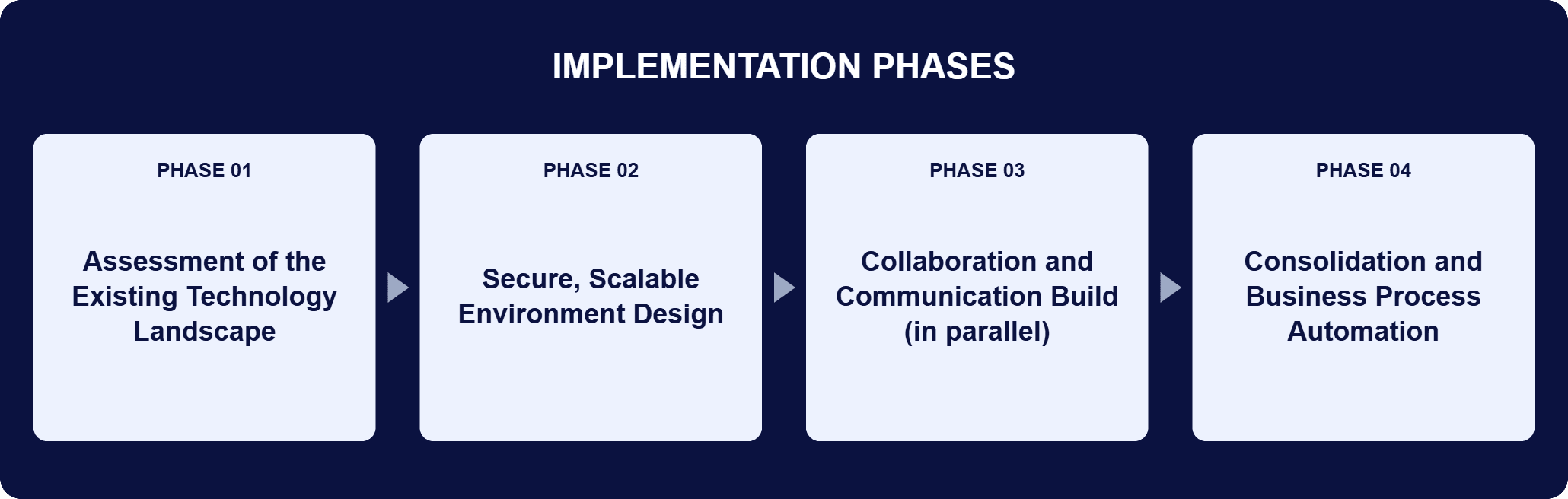
PHASE 03
Collaboration and Communication Build (in parallel)
In parallel with the platform work, i3solutions implemented features geared toward enhancing communication among the organization’s members and staff: intuitive collaboration tools and discussion forums that enable real-time interaction, knowledge sharing, and faster decisions, built into the same platform, not bolted alongside it.
PHASE 04
Consolidation and Business Process Automation
Internal communications and data storage were centralized onto the platform, with dedicated work areas established for team collaboration and fast search enabled across the environment. Business process automation followed, producing productivity gains of more than 50%, and what shipped laid the groundwork for future phases and enhancements.
A scattered set of systems became one environment, not a better collection of separate ones. Four capabilities sit inside a single architecture: identity management governs who a person is and what they may reach; content governance frameworks define how organizational content is held and controlled; real-time collaboration tools and discussion forums carry the interaction between members and staff, including knowledge sharing; and fast, intuitive search runs across all of it. Building those as components of one architecture rather than as additions on top of a base platform is what lets the security posture and the user experience hold at the same time, because the structure that protects sensitive data is the same structure that makes content findable. Internal communications and data storage were centralized onto that platform, with dedicated work areas for team collaboration, and streamlined workflows for routine processes were designed in, not documented around it. Business process automation on top of the consolidated platform produced productivity gains of more than 50%. The build was scalable by design, so later phases extend it instead of replacing it.

Productivity Up More Than 50%
Automated business processes replaced manual, redundant effort across teams, with faster search and centralized collaboration behind it.
| Outcome | Before | After |
|---|---|---|
| Business process productivity | Manual processes and redundant effort across teams | Automated business processes, productivity up by more than 50% |
| Internal communications and data storage | Spread across disconnected systems | Centralized, with dedicated work areas for team collaboration |
| Access to organization-wide information | Routed through systems that did not connect | Streamlined access to organization-wide information |
| Retrieving data for new proposal materials | No organization-wide search | Fast, intuitive search across the environment |
| Cross-team knowledge | Redundant efforts repeated team by team | Documents and insights shared across teams through knowledge management and collaboration tools |
| Security and compliance posture | Critical gaps in compliance, security, and user collaboration | An environment designed to protect sensitive data and meet regulatory requirements, with identity management and content governance in the architecture |
The headline number is business process automation, which boosted productivity by more than 50%. The rest of the result is broad rather than singular: staff gained streamlined access to organization-wide information, fast and intuitive search for retrieving data used in developing new proposal materials, document and insight sharing across teams, and fewer duplicated efforts through knowledge management and collaboration tools. Communication improved on the same footing, through shared documents and search rather than through a new channel added to the ones already in use.
Underneath those, the structural change is the one that keeps paying. Internal communications and data storage were centralized, with dedicated work areas established for team collaboration, which is what turned a scattered set of systems into a single digital workplace. The environment was designed to protect sensitive data and to meet regulatory requirements, closing the gaps the assessment had named, and the first release did that without consuming the whole modernization at once.

PENDING-CLIENT-QUOTE
This engagement is relevant for
Less relevant for
Assessment First, Then One Secure Platform with Compliance and Collaboration in the Same Architecture
The engagement established that a national membership organization does not have to choose between a compliance posture and a workplace its members will actually use. An assessment of the systems the association already ran named the critical gaps in compliance, security, and user collaboration, and the environment built afterward closed them inside one architecture: identity management, content governance, real-time collaboration tools and discussion forums, and fast search on a single platform.
Internal communications and data storage were centralized with dedicated work areas for team collaboration, business process automation raised productivity by more than 50%, and redundant effort across teams was removed. What shipped closed the gaps the assessment had named and left the groundwork for future phases and enhancements in place.
A secure digital workplace is one platform that carries the work an organization otherwise spreads across fragmented systems, with the security posture built into its structure, not added afterward. For this national membership organization for education professionals, i3solutions brought four things together on a single platform: identity management, content governance, real-time collaboration tools and discussion forums, and fast search. Two properties define the category. First, consolidation: internal communications and data storage are centralized, with dedicated work areas for team collaboration, so there is one place the organization’s information lives. Second, compliance by architecture: the environment is designed to protect sensitive data and meet regulatory requirements, with identity management and content governance treated as components of the design. Business process automation on top of that consolidated environment is what produced this engagement’s productivity gains of more than 50%.
It starts with the systems already in place, not with a destination platform. On this engagement, i3solutions first assessed the association’s existing technology landscape and identified critical gaps in compliance, security, and user collaboration, which gave leadership a specific list rather than a general sense that the infrastructure was dated. The environment was then designed against that list: secure and scalable, built to protect sensitive data, conform to regulatory requirements, and provide streamlined workflows for routine processes. The communication work ran in parallel, not in a later phase, because members and staff needed real-time interaction and knowledge sharing from the same platform that held the security controls. Building both tracks at once is what avoided replacing one set of disconnected systems with another.
The engagement started with an assessment of the systems already in place to find the critical gaps in compliance, security, and user collaboration. The environment built afterward was designed to protect sensitive data and meet regulatory requirements, with identity management and content governance frameworks treated as part of the architecture rather than as additions on top of it. That distinction matters in practice: controls that sit above a platform depend on people applying them consistently, while controls that are part of the structure apply whether anyone remembers them or not. Which requirements apply to your organization is one of the first things an assessment settles, and the assessment comes before any design work rather than after a platform has been chosen.
Internal communications and data storage were centralized, with dedicated work areas for team collaboration. Business process automation raised productivity by more than 50%. Staff also gained streamlined access to organization-wide information, fast and intuitive search for retrieving data used in new proposal materials, document and insight sharing across teams, and fewer duplicated efforts through knowledge management and collaboration tools. Communication improved through those shared documents and search capabilities rather than through an additional channel. Underneath all of it, the organization moved from legacy infrastructure that no longer met its needs to a single, secure digital workplace designed to protect sensitive data and meet regulatory requirements.
It does not have to be. At this association the secure platform work and the member and staff communication features were implemented in parallel, and what shipped centralized internal communications and data storage while laying the groundwork for future phases and enhancements. Sequencing works because the assessment produces a list of gaps in priority order, so the first release can be scoped to the ones that matter most instead of to everything at once. It also works because a platform designed to be scalable absorbs later phases without being rebuilt, which is why the later enhancements were left as later enhancements and not pulled into the first delivery to avoid rework.
They are components of the architecture rather than layers on top of it, which is the design decision the compliance posture rests on. Identity management governs who a person is and what they are permitted to reach, so access follows the role someone holds in the organization instead of following whoever set up a share. Content governance frameworks define how organizational content is held and controlled, which is what makes centralized data storage safe to centralize in the first place. The collaboration side runs on the same foundation: the discussion forums, the dedicated work areas, and fast intuitive search all operate inside those controls, so the platform stays protected without blocking the educators and administrators who use it daily.
Because the first deliverable is a list of your gaps, not a destination platform. On this engagement, i3solutions replaced a national membership organization’s legacy infrastructure with a single, secure digital workplace, beginning with an assessment of the systems the association already ran and naming the gaps before designing anything against them. What followed brought identity management, content governance, collaboration and discussion, and search onto one platform, centralized internal communications and data storage, and carried business process automation that raised productivity by more than 50%. It was scoped to lay the groundwork for future phases instead of ending the modernization. For organizations weighing this class of work, a short scoping conversation establishes what the equivalent build would take in yours.
Consolidating identity, governance, and collaboration into one architecture produced this organization’s 50%+ productivity gain. If your environment carries similar obligations on infrastructure that predates them, we can walk through what would transfer.

US-Based | Est. 1997
© i3solutions. All rights reserved.
US-Based | Est. 1997
© i3solutions. All rights reserved.


