

A portal replacement had to go live mid-acquisition, with information unable to cross-pollinate between divisions.
The client is a global business advisory firm with leading practices in financial restructuring, litigation support, engineering, and scientific investigation. As a growing organization, the firm needed collaboration that worked across practices, knowledge shared in real time, and reuse of the intellectual property its teams had already produced, because in advisory work that reuse is where its edge comes from. Effective communication across divisions was essential to ensure employees had access to the right information at the right time, supporting efficiency and informed decision-making. In a firm whose divisions span four distinct practices, the intellectual property one team produces is only an asset if the others can find it.
The firm’s existing communication portal fell short of those goals. It lacked the ability to effectively share and cross-pollinate information between employees and departments, which led to inefficiencies and missed opportunities for collaboration. The timing then removed any slack: the firm was undergoing an acquisition and needed the incoming company integrated into its existing infrastructure rapidly, with continuity maintained and communication facilitated throughout. What the firm required was one intranet that would simplify internal operations, improve information accessibility, and keep pace with its growth, acquisitions included.
An advisory firm needed its newly combined divisions working from one knowledge base in the middle of an acquisition, with no shared way to reuse each other’s expertise. i3solutions delivered a SharePoint intranet live in under three weeks to unify them.
Deployment landed in under three weeks, timed inside the acquisition window itself, giving the newly combined divisions real-time access to business data in one place plus built-in document sharing, version control, and workflow automation.
An Acquisition Put a Deadline on a Known Problem
The portal’s shortcomings were a standing cost the firm had been carrying: information that would not cross-pollinate between employees and departments, inefficiencies, and missed opportunities for collaboration in an organization whose edge depends on reusing the intellectual property its practices have already produced. A growing firm can tolerate that drag for a while. What it cannot do is bring an entire acquired company into it.
The acquisition converted a known weakness into a dated requirement. The firm needed a solution that could rapidly integrate the new company into its existing infrastructure while maintaining continuity and facilitating communication, which meant the replacement intranet had to be scoped, built, and deployed on an acquisition timeline rather than a portal-project timeline. Leadership set the bar accordingly: one scalable intranet, delivered fast, that both companies would use as a single communication interface.
This firm deployed a new intranet in under three weeks in the middle of an acquisition, not months later. If timing is the reason you’ve delayed a similar replacement, that constraint is often narrower than it appears.
Knowledge That Cannot Be Found Is an Edge That Cannot Be Kept
The firm’s own framing of the problem defined the downside. Its advantage rested on collaboration across practices, knowledge shared in real time, and the reuse of intellectual property its teams had already produced; the portal that fell short of those goals was producing inefficiencies and missed opportunities for collaboration in the meantime. Left in place, it meant employees continuing to work without access to the right information at the right time, and decisions made without the information that supports them.
The acquisition sharpened the failure mode. Without a platform that could absorb the incoming company rapidly, the firm faced running two companies on disconnected infrastructure, exactly the break in continuity and communication the integration was required to avoid. Every week the portal replacement took was a week the combined firm operated without a shared interface, so deployment speed was not a nice-to-have on this engagement: it was the difference between an integration and a gap.
Rapid Delivery, Live Infrastructure, and a Platform That Must Keep Growing
Integration depth came first. The portal had to put information held in multiple back-office systems in front of employees in real time, which meant systems integration against the firm’s existing IT infrastructure rather than a standalone site, and it had to slot into that infrastructure smoothly enough to maintain operational continuity through the acquisition. Document handling had the same shape: creation, review, and publishing had to get simpler across divisions, not just move to a new address.
Time and trajectory pulled in opposite directions. The acquisition demanded rapid deployment, but the platform could not be a throwaway built for speed: the firm needed a foundation that would carry future enhancements, further growth, and the acquisitions still to come. The engagement had to deliver both, a portal live in weeks and an architecture the firm would still be building on years later.
Senior Microsoft Specialists with Proven Delivery Depth
The requirements defined the vendor profile: a team that could design and build a corporate intranet portal on Microsoft SharePoint, develop custom features with Active Server Pages, put SQL Server behind the content and business data, and integrate the portal with multiple back-office systems, all at a pace set by an acquisition rather than by a project plan. There was no room for a partner learning the platform on the firm’s timeline.
The firm engaged i3solutions, a Microsoft Partner with 30 years of delivery experience and 1,500+ Microsoft engagements, delivered by an all-senior, all US-based delivery team. That profile matched the work: senior engineers who have built SharePoint intranets and the integrations behind them repeatedly, and who could commit to a deployment measured in weeks and hold it.
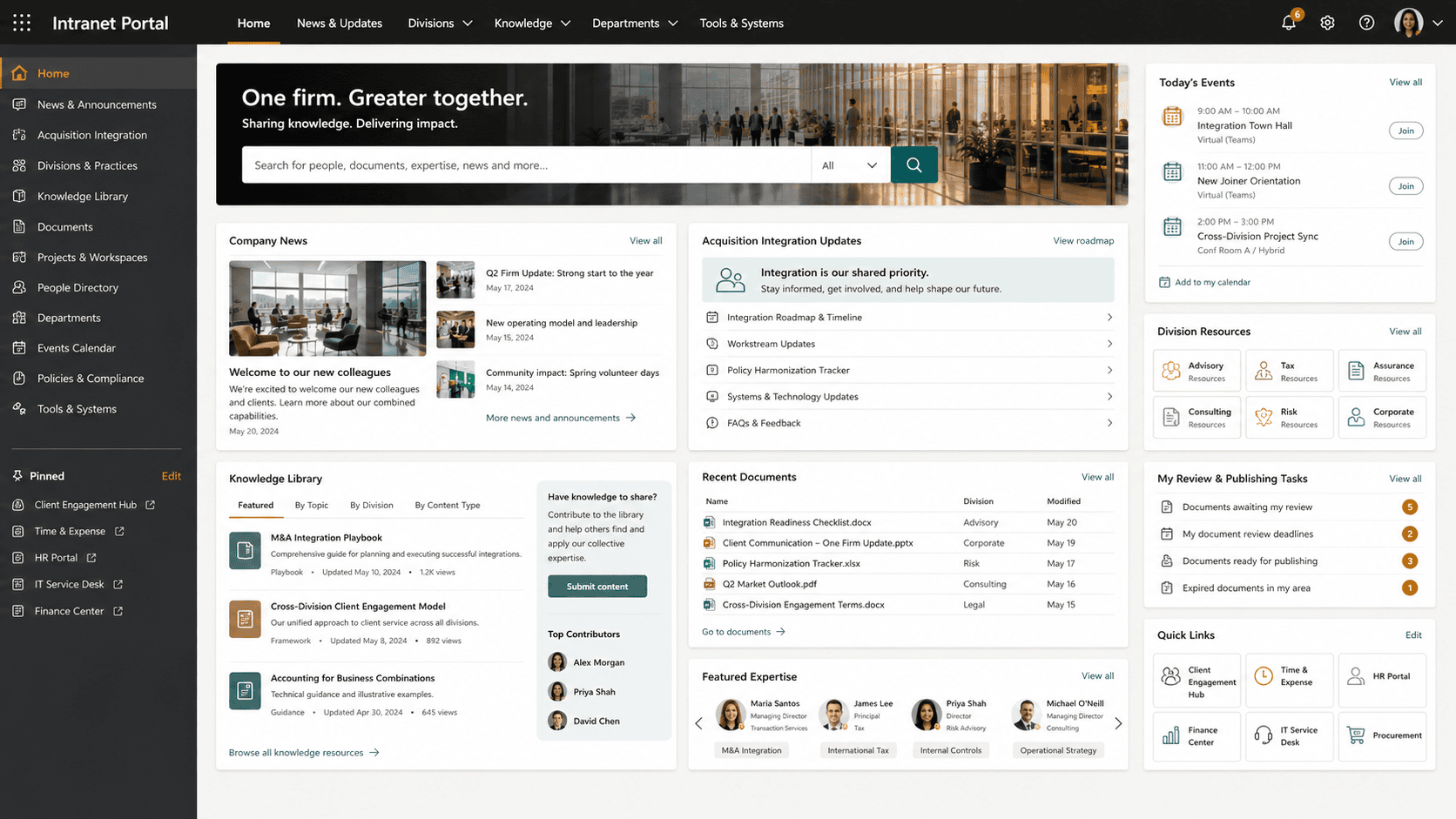
i3solutions designed and built a corporate intranet portal on Microsoft SharePoint: one platform giving employees real-time access to critical business information from multiple back-office systems and simplifying how documents are created, reviewed, and published across divisions.
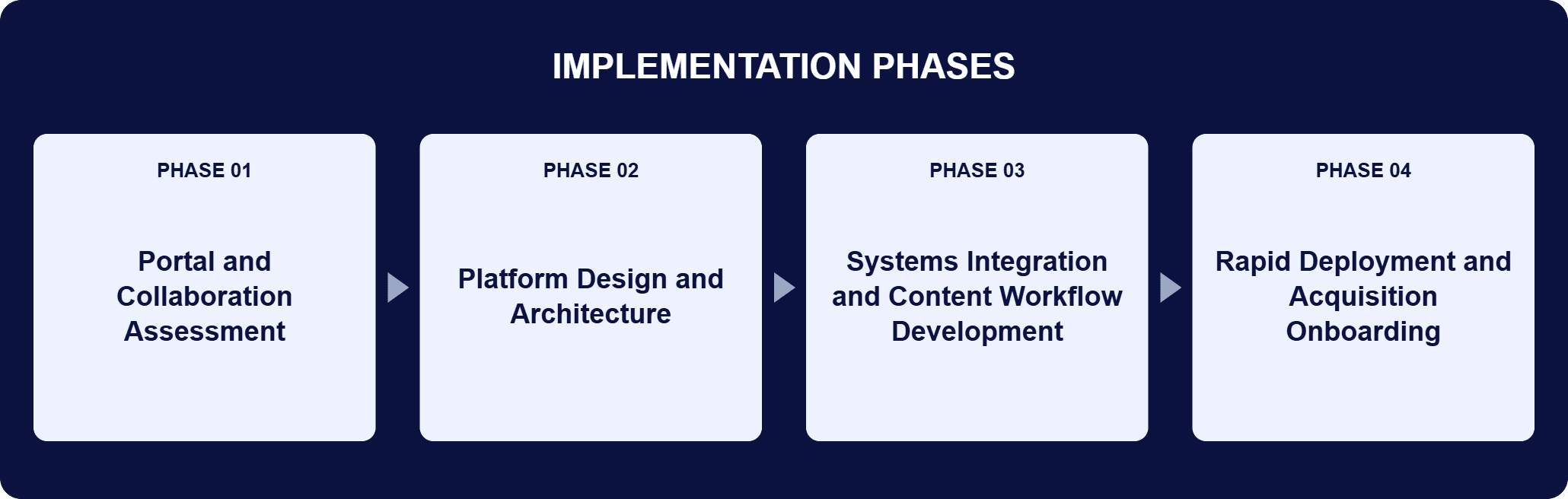
PHASE 01
Portal and Collaboration Assessment
i3solutions worked through how information actually moved between the firm’s divisions and where it stalled: what the existing communication portal could not share or cross-pollinate, which back-office systems held the critical business information employees needed in real time, and what the acquisition required of the platform for the incoming company to land without a break in continuity.
PHASE 02
Platform Design and Architecture
The portal was architected on Microsoft SharePoint as the intranet platform for knowledge sharing, document management, and collaboration, with Active Server Pages supporting custom features and dynamic web functionality, and SQL Server providing the database for the content and business data behind the portal.
PHASE 03
Systems Integration and Content Workflow Development
i3solutions connected the portal to the firm’s multiple back-office systems so information from those systems reaches employees in real time in a single location, and built the document framework on what SharePoint ships out of the box: sharing, versioning, workflow automation, search and aggregation, and content publishing.
PHASE 04
Rapid Deployment and Acquisition Onboarding
The portal was deployed in under three weeks, while the firm was mid-acquisition. It integrates with the firm’s existing IT infrastructure, which let the incoming company move onto the same communication interface with continuity maintained, and it is now the firm’s single communication interface, the foundation for the enhancements and acquisitions still ahead.
The portal is a pragmatic three-layer Microsoft stack. SharePoint serves as the intranet platform where knowledge sharing, document management, and collaboration happen; Active Server Pages supported the custom features and dynamic web functionality built on top of it; and SQL Server provides the database managing the content and business data behind the portal. Systems integration ties the portal to the firm’s multiple back-office systems, so employees reach the business information those systems hold in one place instead of a separate stop per department. The document lifecycle runs on SharePoint’s out-of-the-box functionality, from shared documents through version control and automated workflow to publishing, with search and aggregation across all of it, so documents are created, reviewed, and published the same way in every division. The architecture matters as much as the features. It integrates with the firm’s existing IT infrastructure, which is what allowed the incoming company to move onto the same communication interface during the acquisition without a break in continuity, and it is flexible enough to scale as the organization grows, with future acquisitions and further enhancements building on it rather than starting over.
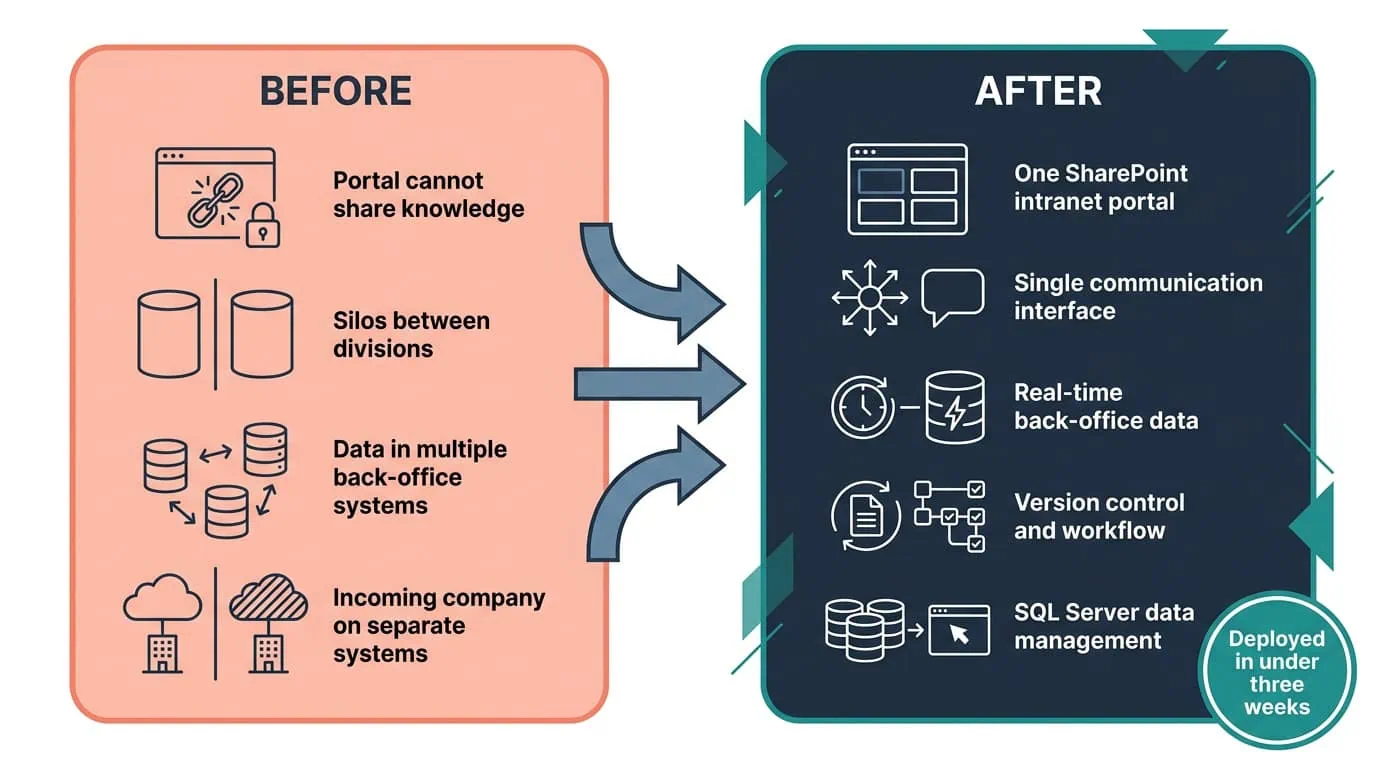
Live in Under 3 Weeks
A SharePoint intranet with ASP custom features gave every division real-time access to knowledge and business data that had been locked in separate systems.
| Outcome | Before | After |
|---|---|---|
| Intranet deployment | A portal replacement needed mid-acquisition | Live in under three weeks |
| Cross-division knowledge sharing | Information unable to cross-pollinate between employees and departments | One intranet for sharing knowledge and managing documents across divisions |
| Access to business data | Critical information held in multiple back-office systems | Real-time access in one place through systems integration |
| Document lifecycle | Inefficiencies in managing company resources | Document sharing, version control, and workflow automation out of the box |
| Acquisition onboarding | An incoming company on separate infrastructure | The same communication interface, with operational continuity maintained |
Deployment took under three weeks, timed inside the acquisition window rather than after it, and that timing was the requirement itself. The incoming company came onto the same communication interface with operational continuity maintained, instead of running on disconnected infrastructure while a longer portal project caught up. For the firm’s employees, the daily change is a single place holding current business information from multiple back-office systems, replacing a portal that could not move information between departments.
The structural results compound from there. SharePoint’s out-of-the-box document sharing, version control, and workflow automation reduced the inefficiencies in managing company resources; the intranet eliminated silos between departments; and the flexible architecture lets the firm scale the platform as the organization grows, supporting future acquisitions and business priorities. The firm now runs on SharePoint as its single communication interface, with room built in for the enhancements, growth, and acquisitions still ahead.

PENDING-CLIENT-QUOTE
This engagement is relevant for
Less relevant for
Knowledge Management and Collaboration on One Interface, Deployed at Acquisition Speed
The engagement established that a corporate intranet replacement does not have to move at portal-project speed, even for a global firm mid-acquisition. A SharePoint intranet portal, with Active Server Pages behind the custom features and SQL Server managing the content and business data, was deployed in under three weeks and became the firm’s single communication interface.
Employees across financial restructuring, litigation support, engineering, and scientific investigation practices now work from one interface with real-time access to business information from multiple back-office systems, and documents are created, reviewed, and published through one simplified framework instead of division-by-division habits. The incoming company landed on that same interface with continuity intact, and the architecture scales for the growth and acquisitions still ahead.
A corporate intranet portal is one internal platform where employees find business information, share knowledge, and manage documents, instead of hunting across departmental silos and separate systems. Built on Microsoft SharePoint, as i3solutions built it for this global business advisory firm, the portal puts the firm’s documents, knowledge, and collaboration in one place, with workflow automation, version control, and document sharing out of the box. Two things distinguish a portal from a static internal site. First, systems integration: this portal gives employees real-time access to critical business information from multiple back-office systems in one location. Second, the content framework: powerful search and aggregation plus simplified content publishing, so documents are created, reviewed, and published consistently across divisions. Custom features run on Active Server Pages, and SQL Server manages the content and business data behind the portal.
An acquisition changes what an intranet engagement is. The platform is no longer just a collaboration upgrade; it is the interface two companies will share, and it has to arrive before disconnected infrastructure hardens into a break in continuity. On this engagement, the firm needed the incoming company integrated into its existing infrastructure rapidly, so i3solutions treated speed and continuity as requirements equal to the feature set: the portal was designed to integrate with the firm’s existing IT infrastructure, deployed in under three weeks, and established as the single communication interface for the combined organization. Just as important, the platform was not built narrowly to the deadline. Its flexible architecture scales as the organization grows, which means the next acquisition lands on a foundation designed for it rather than restarting the portal conversation.
Yes, and on this engagement that was the core of the portal’s value. Through systems integration, the portal gives employees real-time access to critical business information from multiple back-office systems, in one centralized location instead of a separate stop per department. The mechanics sit in the portal’s three layers: SharePoint is the intranet platform employees work in; Active Server Pages supported the custom features and dynamic web functionality built on top of it; and SQL Server provides the scalable database managing the content and business data behind the portal. SharePoint’s search and aggregation capabilities then work across what the integrations bring in, so finding information does not require knowing which back-office system holds it. That is the difference between an intranet that posts announcements and one that carries the business information the firm actually runs on.
Under three weeks, and the timing is the point of the number: the firm was in the middle of an acquisition and needed the incoming company on its communication interface without a break in continuity, so the deployment window was set by the business event, not by the project. Two decisions made that speed possible. First, the platform choice: SharePoint’s out-of-the-box functionality already covered sharing, version control, and automated workflow for documents, plus search, aggregation, and content publishing, none of it custom construction. Second, custom work went only where it earned its place, with Active Server Pages supporting the custom features and dynamic functionality the firm actually needed. Rapid did not mean provisional: the same portal became the firm’s single communication interface, sized for the enhancements and acquisitions ahead.
Because the firm’s requirements mapped onto what SharePoint already does well, and the acquisition left no time to rebuild those capabilities from scratch. SharePoint gave the firm powerful search and aggregation, simplified content publishing and workflow automation, and integration with the systems it already ran, all as platform capabilities rather than custom deliverables. That is a large part of how the portal deployed in under three weeks. Custom development still had a place: Active Server Pages supported the custom features and dynamic web functionality specific to the firm, with SQL Server managing the content and business data. The build-versus-platform question is really a question about where engineering effort should go, and on this engagement it went to systems integration and the firm’s specific features, not to re-implementing document management a platform already provides.
i3solutions is a Microsoft Partner with 30 years of delivery experience and 1,500+ Microsoft engagements, with every engagement staffed by an all-senior, all US-based delivery team. This engagement shows why that profile matters for intranet work: the firm needed a SharePoint portal with real systems integration behind it, delivered in under three weeks while an acquisition was in flight, and a wrong architectural guess would have cost time the business event did not allow. Senior engineers who have built corporate intranets repeatedly could commit to that window and hold it, deliver the ASP custom features and SQL Server data layer behind the portal, and leave the firm with a scalable foundation for future acquisitions rather than a rushed one-off. For firms weighing similar work, a short scoping conversation establishes what the equivalent build would take in your environment.
It went live in under three weeks for this advisory firm, timed specifically to an acquisition where the incoming division needed real-time access to shared knowledge and business data without a gap in continuity. The SharePoint intranet surfaces data from other back-office systems directly, so employees stop making a separate stop per department, which matters most exactly when two organizations are trying to operate as one on a compressed timeline.
Both the original firm and the company it acquired worked from the same interface without disruption. We’re glad to discuss what a comparable deployment timeline would look like for your organization.

US-Based | Est. 1997
© i3solutions. All rights reserved.
US-Based | Est. 1997
© i3solutions. All rights reserved.


