

Multiple legacy SharePoint farms and scattered logins put a 4,000-user firm at risk during a required platform move.
The client is a nonprofit government consulting firm. It primarily serves federal civilian agencies, the Department of Defense, and state and local governments, and provides expertise in logistics, supply chain management, information management, and other areas critical to government operations. Its services include consulting, research, analysis, and implementation support to help government agencies improve efficiency, effectiveness, and innovation in their operations. The firm advises agencies on how to run better, which is what made the state of its own internal operations a problem worth fixing.
The presenting issue was identity. Users faced the inconvenience of logging in multiple times across various platforms, and the firm needed single sign-on that would let people reach their applications without repeating that. Behind it sat a second problem the first one could not be solved without touching: the firm’s SharePoint infrastructure was multiple farms running diverse web applications, spread across more than one older SharePoint version. It needed that estate migrated to a modern instance, integrated with its existing systems, and moved without disrupting ongoing operations.
A government consulting firm’s 4,000 employees were split across multiple legacy SharePoint farms and separate logins, driving unnecessary licensing and support costs. i3solutions consolidated everything into one Office 365 environment with Okta single sign-on, saving $300,000 a year.
Multifactor authentication reached 95% enrollment across 4,000 users within 60 days, password reset tickets dropped 40% (eliminating more than 4,000 annual IT support requests and about $100K in helpdesk time), on top of the roughly $300K saved per year in infrastructure and licensing.

Repeated Logins Were a Standing Tax on Consulting Work
Nothing here produced an outage report, which is exactly why it lasted. Users logged in multiple times across various platforms as a matter of routine, and the cost was paid in small amounts by the same people who deliver the firm’s consulting, research, analysis, and implementation support. Multiplied across a workforce of 4,000, a few seconds of friction per application per day stops being an annoyance and becomes an operating expense the firm was carrying without a line item for it.
The identity problem could not be solved in isolation. Okta had to be integrated within the Office 365 ecosystem, and the firm’s applications were not in Office 365 yet: they were spread across multiple legacy SharePoint farms running different older versions. Fixing sign-on therefore meant deciding the migration path at the same time, which is why the engagement was scoped as one project rather than two.
Before any migration work started here, usage reports decided what to move, retire, or archive, which is what kept the cutover to zero critical outages. If your own SharePoint estate hasn’t had that inventory step, it’s worth doing before the migration plan.
Two Problems That Only Get More Expensive Apart
The infrastructure side accrued cost on a fixed schedule. The outdated infrastructure and licenses the firm was still running are the same ones whose retirement later saved approximately $300K per year, and the maintenance and licensing overhead behind them is the same overhead that later dropped by about 25%. Every year the multi-farm estate stayed in place, the firm paid that bill again, and the eventual migration had more version drift to absorb.
The identity side carried risk rather than a recurring invoice. The firm was operating with critical authentication gaps, and the breach risk exposure attached to them was valued at over $1M annually. A migration that moved the applications but left sign-on alone would have carried those gaps into the new environment intact, which is the failure mode a project sequenced in the wrong order produces.
Farms Built Years Apart, and No Room to Take Them Offline
The hard constraint was continuity. The firm’s applications were running on multiple legacy farms spanning more than one older SharePoint version, and staff needed uninterrupted access to them while the estate moved. That ruled out a direct jump from each legacy farm to SharePoint Online. It also ruled out a single cutover weekend: the version spread had to be resolved before the cloud move, not during it.
The second constraint was deciding what deserved to move at all. A multi-farm estate accumulates sites that no one uses, and migrating them would have added complexity and time for nothing. That made usage evidence a prerequisite rather than a nicety, and it made workflow analysis part of the migration scope, because the business processes running on those farms had to come through the move working at least as well as they went in.
Senior Microsoft Specialists with Proven Delivery Depth
The requirement list defined the team profile. The work needed SharePoint farm migration at version-spread scale, direct content database migration between SQL Servers, the ShareGate migration tool for the long tail of smaller sites, Office 365 information architecture using Site Collections, Hub Sites, and Groups, and Okta identity integration inside that same environment. Those are not adjacent specialties that a firm can pick up mid-project, and the sequencing between them is where a migration of this shape usually goes wrong.
The firm engaged i3solutions, a Microsoft Partner with 30 years of delivery experience and 1,500+ Microsoft engagements, delivered by an all-senior, all US-based delivery team. That profile matched the work: senior engineers who have staged SharePoint migrations across farm versions before, who can decide what to retire instead of move, and who could put single sign-on into the new environment as part of the same plan rather than as a follow-on project.
i3solutions migrated the firm’s SharePoint sites into one Office 365 environment, integrated Okta within that environment for single sign-on, and built a custom landing page listing all relevant projects for each user.
PHASE 01
Usage Reporting and Workflow Analysis
i3solutions generated usage reports on the firm’s existing SharePoint environments to establish site usage patterns, content relevance, and potential areas for optimization, so the migration strategy was set by evidence rather than assumption. Business Process Management was applied in the same phase to identify and optimize workflows, so the move preserved and improved the business processes running on the old farms.
PHASE 02
Retirement and Archiving Decisions
Sites that were no longer actively used or essential to ongoing operations were identified, categorized, retired, and archived rather than migrated. That decision was made before any content moved, which kept the migration focused on relevant and current data and took complexity out of every phase after it.
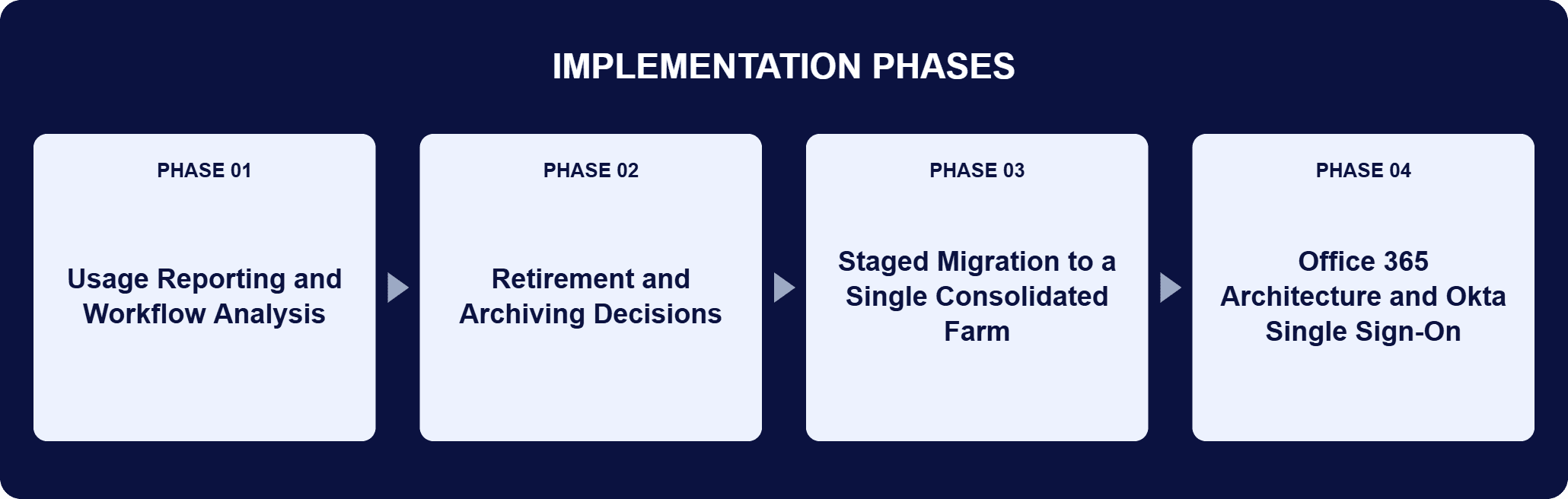
PHASE 03
Staged Migration to a Single Consolidated Farm
All applications were migrated to a single consolidated on-premises farm on a supported SharePoint version before being transitioned to SharePoint Online, so the version spread across the old farms was resolved once, on one platform, ahead of the cloud move. Large sites moved by direct content database migrations between SQL Servers; smaller sites moved with the ShareGate migration tool.
PHASE 04
Office 365 Architecture and Okta Single Sign-On
The new environment was built with Site Collections, Hub Sites, and Office 365 Groups based on Microsoft’s recommendations, with a custom landing page listing all relevant projects for each user. Okta was integrated within the Office 365 ecosystem for single sign-on, and Okta SSO with multifactor authentication reached 95% enrollment across 4,000 users within 60 days.
What went in was multiple legacy SharePoint farms running diverse web applications, spread across more than one older version. What came out is one Office 365 environment on SharePoint Online. The path between them was staged rather than direct: every application moved first to a single consolidated on-premises farm on a supported SharePoint version, and only then to SharePoint Online, so the version spread was resolved on a known platform before the cloud move. Two mechanisms carried the content. Large sites moved by direct content database migrations between SQL Servers. Smaller sites moved with the ShareGate migration tool, which handled the data transfers, site restructuring, and data integrity with minimal manual intervention. The destination environment is organized with Site Collections, Hub Sites, and Office 365 Groups, implemented based on Microsoft’s recommendations: Site Collections organize and manage related sites, Hub Sites restructure the framework of the firm’s web applications so navigation is connected across platforms, and Office 365 Groups support collaboration within designated groups. Okta sits in front of all of it, integrated within the Office 365 ecosystem, and a custom landing page lists all relevant projects for each user.

Zero Critical Outages, One Login
Consolidation onto SharePoint Online with Okta SSO closed authentication gaps and delivered 99.9% uptime through the cutover.
| Outcome | Before | After |
|---|---|---|
| Cutover reliability | Multiple legacy farms running applications on more than one older SharePoint version | Zero critical outages and 99.9% uptime during cutover |
| Sign-on | Users logging in multiple times across various platforms | Logins from three systems consolidated into one with Okta SSO |
| Multifactor authentication | Critical authentication gaps, breach risk exposure valued at over $1M annually | 95% enrollment across 4,000 users within 60 days |
| IT support load | Password reset tickets running at the multi-login volume | 40% fewer password reset tickets, more than 4,000 annual IT support requests eliminated, approximately $100K saved in helpdesk time each year |
| Infrastructure and licensing cost | Outdated infrastructure and licenses across multiple farms | Approximately $300K saved per year, ongoing maintenance and licensing overhead down about 25%, full ROI within the first year |
| Daily user experience | Repeated logins and downtime incidents | Login times cut and downtime incidents reduced by over 35% across 4,000+ users |
The migration itself is measured by what did not happen. i3solutions’ migration approach to Microsoft 365 ensured a transition from legacy systems with zero critical outages and 99.9% uptime during cutover, and staff maintained uninterrupted access to collaboration tools, preventing an estimated $50K+ in productivity losses during the transition. That is the number that justifies the staging step: routing every application through a single consolidated on-premises farm before SharePoint Online cost an extra hop and bought a cutover nobody had to work around.
The identity half of the project is where the recurring savings sit. By consolidating logins from three systems into one and enabling Okta Single Sign-On with 95% MFA adoption, the firm reduced password reset tickets by 40%, eliminating more than 4,000 annual IT support requests and saving approximately $100K in helpdesk time each year. Retiring outdated infrastructure and licenses saved approximately $300K per year, the move to Microsoft 365 and Okta SSO reduced ongoing maintenance and licensing overhead by about 25%, and the engagement delivered full ROI within the first year. Unified access across Microsoft 365 applications cut login times and reduced downtime incidents by over 35%, producing a notable boost in daily efficiency across 4,000+ users company wide.

PENDING-CLIENT-QUOTE
This engagement is relevant for
Less relevant for
One Environment, One Login, and the Retirement Decisions Made Before the Migration Started
Usage reports decided what was worth moving and what was retired and archived, which took work out of every phase that followed. Staging every application through a single consolidated on-premises farm before SharePoint Online produced zero critical outages and 99.9% uptime during cutover, with staff keeping uninterrupted access to their collaboration tools.
Okta single sign-on with multifactor authentication reached 95% enrollment across 4,000 users within 60 days and cut password reset tickets by 40%, while retiring outdated infrastructure and licenses returned approximately $300K per year and the engagement delivered full ROI within the first year. What the sequencing settled is that the estate move and the sign-on model were a single piece of work, decided together.
It involves three decisions made in order. First, what moves: usage reports on the existing environments show site usage patterns and content relevance, and sites that are no longer actively used or essential to ongoing operations are retired and archived instead of migrated. Second, the path: when farms run older versions that are years apart, applications move to a single intermediate farm first, in this engagement a consolidated on-premises farm on a supported version, and only then to SharePoint Online. Third, the mechanism: large sites move by direct content database migrations between SQL Servers, and smaller sites move with a migration tool such as ShareGate. The destination is then organized deliberately, in this case with Site Collections, Hub Sites, and Office 365 Groups implemented based on Microsoft’s recommendations.
The migration was staged. The firm’s SharePoint infrastructure was multiple legacy farms running web applications on more than one older version, so all applications were migrated to a single consolidated on-premises farm before being transitioned to SharePoint Online. Large sites moved by direct content database migrations between SQL Servers and smaller sites moved with the ShareGate migration tool. The approach produced zero critical outages and 99.9% uptime during cutover, and staff kept access to their collaboration tools throughout. The retirement pass in front of the migration helped here too: sites that were no longer actively used were archived rather than moved, so the content that had to survive a cutover window was the content people were actually using.
Yes. Users had been logging in multiple times across various platforms, and i3solutions integrated Okta within the Office 365 ecosystem for single sign-on. Logins from three systems were consolidated into one, and Okta SSO with multifactor authentication achieved 95% enrollment across 4,000 users within 60 days. The effect showed up on the helpdesk before it showed up anywhere else: password reset tickets fell by 40%, which eliminated more than 4,000 annual IT support requests and saved approximately $100K in helpdesk time each year. Unified access across Microsoft 365 applications also cut login times and reduced downtime incidents by over 35%, so the change was visible in daily work across 4,000+ users, not only in the identity configuration.
Yes. This firm’s migration and identity model were decided together rather than sequenced as separate projects. Moving onto SharePoint Online with Okta SSO closed the authentication gaps that had been driving helpdesk volume, giving 4,000 users one login instead of several, and the consolidation delivered 99.9% uptime through the cutover and roughly $300,000 a year in savings.
With Site Collections, Hub Sites, and Office 365 Groups, implemented based on Microsoft’s recommendations. Site Collections organize and manage related sites, Hub Sites restructure the framework of the firm’s web applications so navigation is centralized and connected, and Office 365 Groups support collaboration within designated groups. A custom landing page sits on top of it and lists all relevant projects for each user, which is what turns the information architecture into something a consultant notices: rather than knowing which site holds which engagement, a user opens one page and sees the projects that apply to them. Okta single sign-on removes the other half of that friction, so reaching those projects does not mean authenticating again.
They were retired and archived. i3solutions generated usage reports on the existing environments, identified and categorized sites that were no longer actively used or essential to ongoing operations, and retired those sites rather than moving them. That kept the migration focused on relevant and current data and reduced its complexity. The same planning phase applied Business Process Management to identify and optimize workflows, so the processes that were worth keeping came through the move intact rather than being rebuilt on the far side. Retiring the infrastructure and licenses behind those sites is also part of where the approximately $300K in annual savings came from, so the archiving decision paid twice: once in migration effort and once in recurring cost.
i3solutions is a Microsoft Partner with 30 years of delivery experience and 1,500+ Microsoft engagements, with every engagement staffed by an all-senior, all US-based delivery team. That profile matters on work of this shape, where the migration path and the identity model constrain each other and the sequencing decision is made once. This engagement is representative: multiple legacy farms spanning more than one older SharePoint version staged through a single consolidated on-premises farm into SharePoint Online, direct content database migrations between SQL Servers alongside ShareGate for smaller sites, Site Collections, Hub Sites, and Office 365 Groups in the destination, and Okta SSO with MFA at 95% enrollment across 4,000 users within 60 days. For organizations weighing this class of work, a short scoping conversation establishes what the equivalent move would take in your environment.
Consolidating onto SharePoint Online with Okta SSO is what returned roughly $300K annually in retired infrastructure and licensing. We can talk through what a comparable consolidation would look like for your environment.

US-Based | Est. 1997
© i3solutions. All rights reserved.
US-Based | Est. 1997
© i3solutions. All rights reserved.


