
By Scot Johnson, Founder / CEO, i3solutions. Scot Johnson co-founded i3solutions 30 years ago with a focus on expert-led delivery, strategic advisory, and complex Microsoft-centered solutions for organizations where technology decisions carry operational, financial, and mission risk.
Ongoing Dynamics 365 support has a published floor and a quoted ceiling. The floor is Microsoft’s own plans: baseline subscription support is included with any Dynamics 365 purchase, and Professional Direct support is $9.00 per user per month, paid yearly with a 20 user minimum, on Microsoft’s published US pricing. The ceiling is quoted, not listed: Microsoft Unified Enterprise support and partner-delivered managed services are both priced on scope, and for a mid-sized enterprise the partner layer usually lands in the tens of thousands of dollars per year rather than the hundreds.
The honest structure of this budget is three layers, and most cost confusion comes from mixing them: what Microsoft includes, what Microsoft sells, and what a partner does that Microsoft does not do at all. This page prices each layer with the sources named, and gives you the drivers that decide the quoted parts. The recurring licensing underneath it is covered in our Dynamics 365 licensing cost guide.
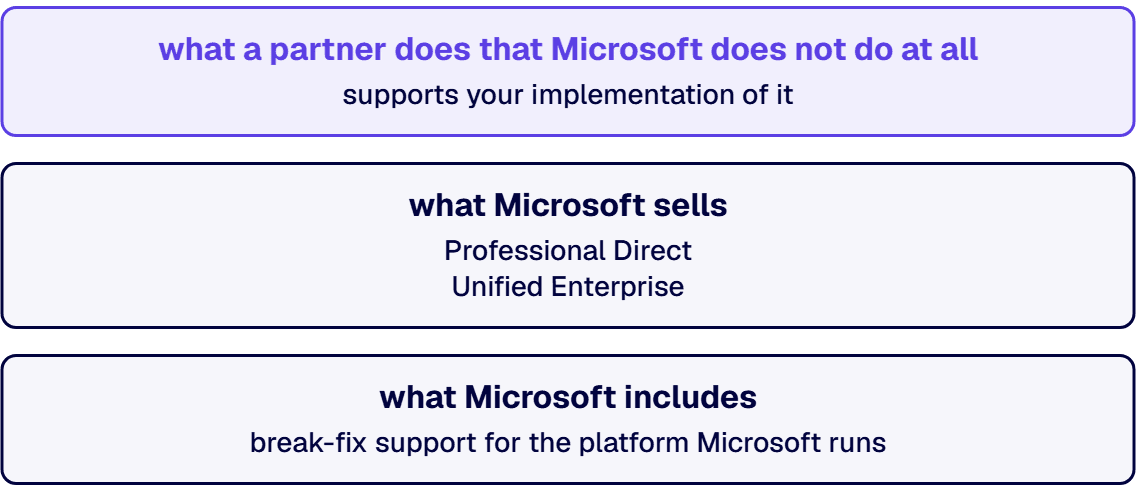
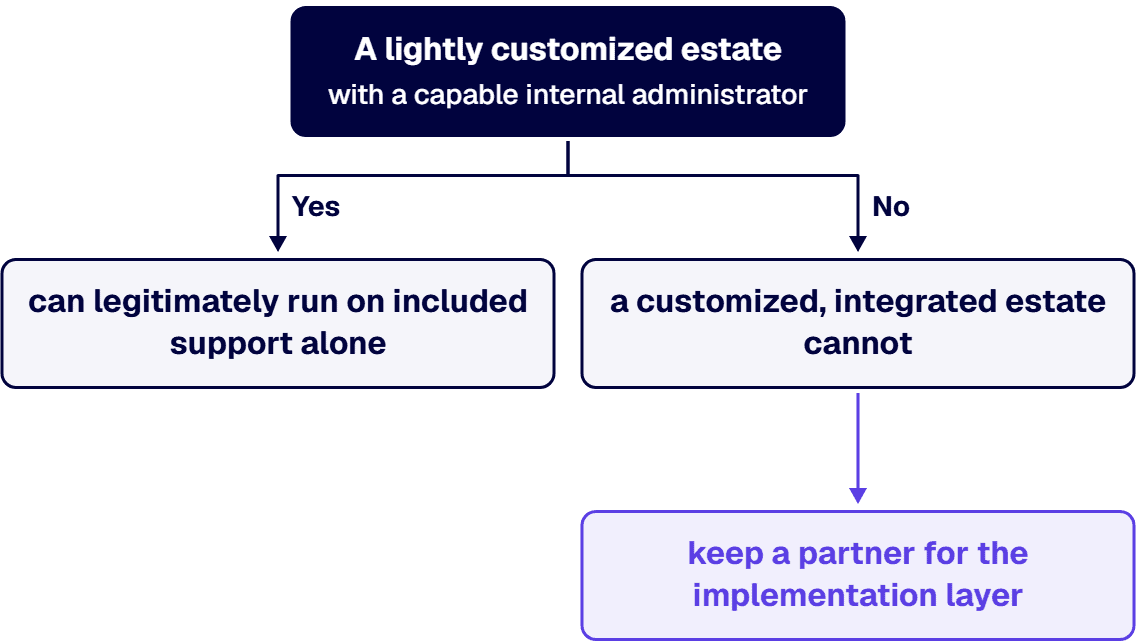
Every Dynamics 365 subscription includes baseline support at no additional cost: the ability to raise technical support requests, self-help resources, and community channels, listed on Microsoft’s Dynamics 365 support plans page as included with any Dynamics 365 purchase. It is break-fix support for the platform Microsoft runs. What it is not is support for anything you built on the platform: your customizations, your integrations, your data quality, and your users’ questions are explicitly outside its scope. For a lightly customized deployment with a capable internal admin, included support plus that admin is a legitimate operating model, and it is worth saying so before anyone quotes you a managed service.
Microsoft sells two levels above the included baseline, and only one of them has a public price. Professional Direct is $9.00 per user per month, paid yearly with a 20 user minimum, which buys faster initial response times, escalation management, and access to proactive advisory services and on-demand workshops. For a 100 user deployment that is $10,800.00 per year, a number worth knowing before it is presented to you as a rounding error. Unified Enterprise, Microsoft’s organization-wide support agreement, has no published list price: Microsoft’s own Unified support page describes pricing that scales with your Microsoft spend, quoted through your account team, and the agreement covers your whole Microsoft estate rather than Dynamics 365 alone. If your organization already holds a Unified agreement, your Dynamics 365 environment is already inside it, and buying Professional Direct on top duplicates coverage you own.
Microsoft’s plans support the platform. A partner supports your implementation of it, and the gap between those two sentences is where most ongoing cost actually lives. The recurring work a Dynamics 365 estate generates has little to do with platform outages:
Partner-delivered support is sold in three shapes, and knowing which one you are being quoted matters more than the headline number. Per-user-per-month pricing scales with headcount and suits stable estates with predictable ticket volume. Prepaid blocks of hours suit small estates with occasional needs, though unused hours quietly expire and heavy months blow through the block. Monthly retainers with a defined scope, the model most mid-sized and regulated enterprises end up on, fix the cost of a named service catalog: response times, release wave testing, administration, and a set number of enhancement hours.
What moves the quote is not user count but four structural drivers: the size of your customization surface, the number of integrations that must be monitored and retested, the compliance obligations attached to the environment, and whether the partner is also expected to deliver enhancements or only keep the lights on. As an attested reference point from our own delivery practice: IT consulting costs for a mid-sized enterprise typically range from $40K-$150K annually depending on scope and engagement model. A quote far below that band for a customized, integrated, regulated estate is usually pricing a narrower scope than you think you are buying, and the gap surfaces at the first release wave.
A handful of early decisions control the recurring number more than any later negotiation does. Hold the customization boundary during implementation, because every extension you decline to build is a permanent subtraction from the maintenance bill. Invest in your own administrator, because a capable internal admin absorbs the how-do-I layer at a fraction of partner rates and makes the partner hours you do buy senior ones. Budget release wave testing explicitly, because the estates that treat it as an unplanned event pay for it as an emergency instead of a routine. And match the support model to the estate’s actual volatility: a stable, lightly customized deployment on a heavy retainer is overpaying, and a heavily integrated one on a small hour block is underinsured.
Read a managed services agreement for what it obligates, not what it advertises. It should name response and resolution targets by severity, state plainly whether release wave regression testing is inside the scope or billed separately, define how enhancement work is requested and approved, and commit to knowledge transfer so your team gets more capable over time rather than more dependent. That last clause is the one most agreements omit, and it is the difference between buying support and renting a dependency. An i3solutions engagement does not produce managed-service ownership, a replacement for the internal team, open-ended scope expansion, or vendor lock-in. If a proposed agreement cannot say the same in writing, price the exit before you sign the entry.
i3solutions is a Microsoft Solutions Partner. All i3solutions Dynamics 365 developers and consultants are U.S. based, which matters for regulated estates where offshore access to the environment is a compliance finding rather than a saving. We structure ongoing support as senior engineering capacity against a defined catalog: release wave testing on Microsoft’s published cadence, customization and integration maintenance, and enhancement work approved through your governance rather than discovered on an invoice. Our teams maintain dedicated compliance specialists who understand CMMC, HIPAA, SOC 2, and financial services regulations within Microsoft environments, providing audit trail documentation and access control frameworks that reduce audit preparation time by 60%. The engagement is built to leave your internal team stronger each quarter, and the selection questions that separate a support partner from a dependency are the same ones we lay out in our Dynamics 365 partner cost guide.
Baseline subscription support is included with any Dynamics 365 purchase at no additional cost. Microsoft’s Professional Direct plan is $9.00 per user per month, paid yearly with a 20 user minimum, and Microsoft Unified Enterprise support is custom quoted against your organization-wide Microsoft estate. Partner-delivered support and managed services are quoted on scope; as an attested reference point, IT consulting for a mid-sized enterprise typically runs $40K to $150K annually depending on scope and engagement model.
Two plans carry Microsoft’s name on the invoice. Professional Direct is $9.00 per user per month on Microsoft’s published US pricing, paid yearly with a 20 user minimum, adding faster response, escalation management, and advisory services on top of the baseline every license already carries. Unified Enterprise has no public list price and is quoted by your Microsoft account team, covering your entire Microsoft estate rather than Dynamics 365 alone.
Platform break-fix, essentially: the ability to raise technical support requests against the service itself, plus self-help resources and community channels. It does not cover your customizations, integrations, data, or user questions, which is the layer where most real-world support demand concentrates. A lightly customized estate with a capable internal administrator can legitimately run on included support alone; a customized, integrated estate cannot.
There is no honest single number, because the quote is driven by customization surface, integration count, compliance obligations, and whether enhancements are in scope, not by user count. The three pricing shapes are per-user-per-month, prepaid hour blocks, and defined-scope monthly retainers, with retainers the norm for mid-sized regulated estates. Treat a quote that undercuts the market sharply as a narrower scope, and check specifically whether release wave regression testing is inside it.
Unified covers the platform across your Microsoft estate, with proactive services and escalation paths, but it does not maintain your customizations, monitor your integrations, or run release wave regression testing against your specific configuration. Estates with real customization keep a partner for the implementation layer even under Unified. What you should not do is pay twice for the same layer: under Unified, buy implementation support, not another platform plan.
Access control does. When the environment holds regulated data, the people supporting it must satisfy your compliance regime, which for defense work generally means U.S. persons and background checks, and audit evidence must be produced for changes rather than just changes made. That narrows the labor pool and adds documentation discipline, which is why regulated support carries a structural premium and why offshore-priced quotes are frequently unusable in these estates. The compliance program that imposes those requirements has its own price tag, which we break down in our CMMC compliance cost guide.

US-Based | Est. 1997
© i3solutions. All rights reserved.
US-Based | Est. 1997
© i3solutions. All rights reserved.


