

Generating reports for member schools consumed at least 140 staff hours a year on a legacy Cold Fusion platform.
The client, a national healthcare licensing organization, develops and administers a national licensing examination for licensed practitioners and practitioner assistants in all 50 states, the District of Columbia, Puerto Rico, and the Virgin Islands. In an effort to expand its service offerings and improve core business operations, the organization aimed to introduce a subscription-based reporting service designed for educational institutions in the discipline, an initiative intended to enhance customer relations by increasing the range of services available to member schools.
The demand signal was already on the table: the organization was confronted with multiple requests from school administrators to make reports available on demand, rather than at the predetermined intervals on which reports were generated and mailed. Behind that delivery schedule sat manual work, at least 140 man-hours of staff effort per year dedicated to manual report generation, plus the recurring costs of generating and mailing reports. The project scope covered a user-friendly website for school administrators, retention of existing reports for staff reference, migration of current reports to the new platform, and the creation of additional reports, all without replacing the legacy application platform built in Cold Fusion.
A healthcare licensing organization’s staff spent well over 100 hours a year manually generating reports for member schools on an aging platform. i3solutions layered in a subscription reporting service that lets schools pull their own reports on demand, adding new recurring revenue.
The subscription reporting service turned member reports into a new revenue stream, cut the cost of generating and mailing paper reports, and interfaces cleanly with the existing Cold Fusion platform rather than requiring its replacement.
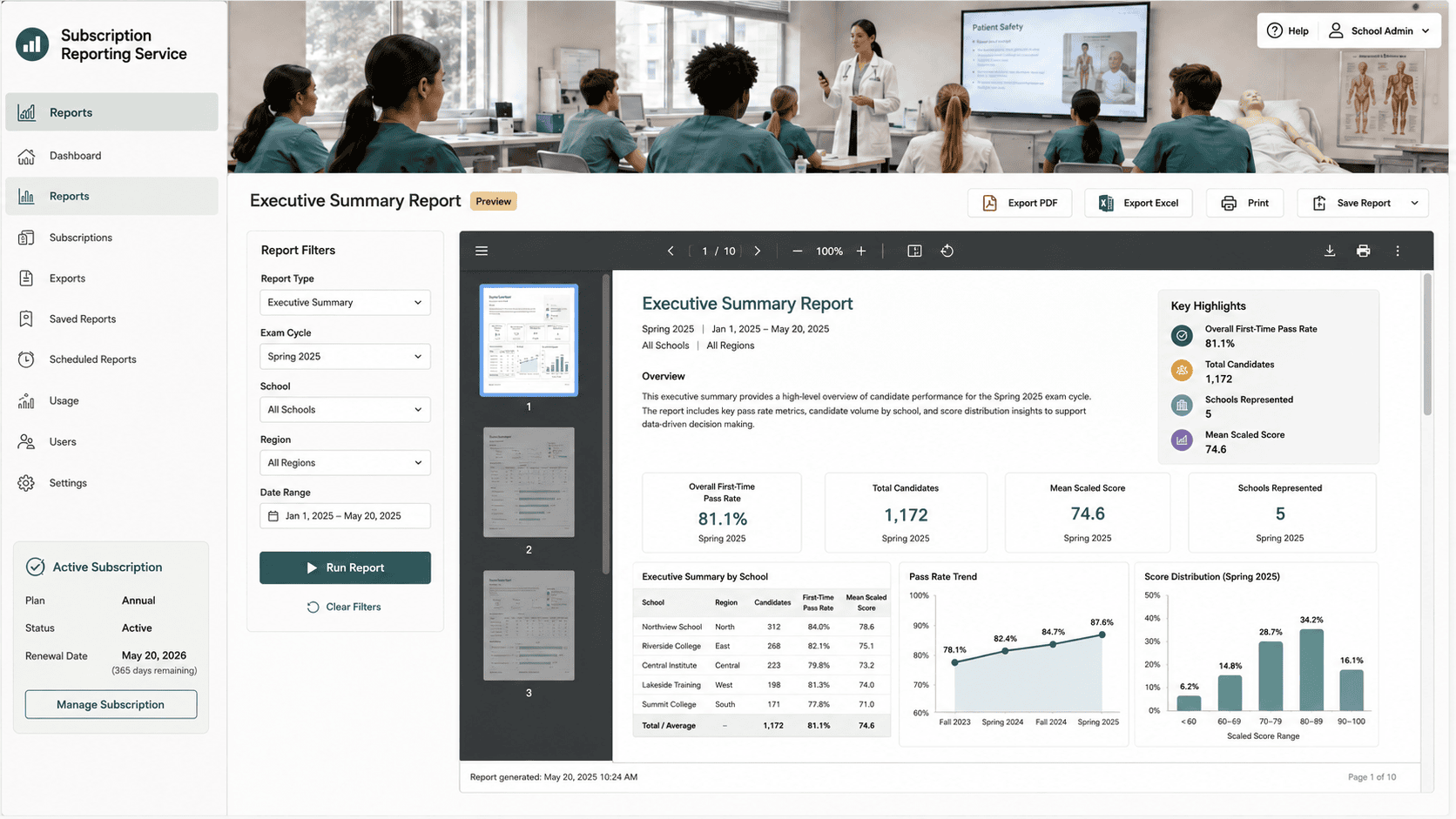
Member Schools Wanted Reports on Demand, Not on a Schedule
Every report the organization produced reached its member schools on the organization’s timetable, not the schools’ timetable. School administrators asked repeatedly for on-demand access, and each request pointed at the same structural fact: report generation was a manual staff function, so delivery frequency was bounded by staff capacity, not by what the data could support. Meeting the requests by adding staff hours would have scaled the cost of the problem, not solved it.
Leadership read the requests as an opportunity rather than a complaint. If school administrators wanted reports conveniently, via a dedicated website, whenever they needed them, then the same capability could be offered as a subscription-based service: a move that would meet the immediate needs of educational institutions while opening an additional revenue stream for the organization. The reporting burden and the new line of business were the same build.
This organization turned its existing reports into a subscription service without replacing the legacy system generating them. If you’re producing reports that stakeholders would pay to access on demand, that’s a narrower build than it sounds.
A Reporting Function Paying Out Hours and Postage Every Year
Left as it was, the manual model billed the organization on a fixed schedule. At least 140 man-hours per year went to manual report generation, and every distribution cycle added the costs of generating and mailing reports, along with the paper use and storage space that physical reporting requires. Meanwhile member schools kept waiting for predetermined intervals to see data they had asked to access on demand, a gap between what stakeholders requested and what operations could deliver.
The larger stake was the unbuilt service. The subscription-based reporting service was intended to open an additional revenue stream and a new line of business; every year it did not exist, the organization carried the reporting cost without the reporting revenue. And a misjudged build had its own downside: staff still needed the existing reports for reference, and the organization’s operations ran on a legacy application platform built in Cold Fusion, so a solution that forced a platform replacement would have put continuity of core operations at risk to solve a delivery problem.
A New Service That Had to Respect the Legacy Platform
The hardest constraint was continuity. The organization’s existing application platform was built in Cold Fusion, and the new subscription reporting system had to interface with that existing system, not replace it. That shaped the engagement into a migration and system integration problem as much as a development problem: current reports had to migrate to the new platform, existing reports had to remain available for staff reference, and additional reports had to be created, all while the legacy system kept running underneath.
The service model added a second layer of scope. Selling reports by subscription means the platform is an e-commerce system as well as a reporting system: it needed detailed modules for payment and refund processing, a website usable by school administrators rather than technical staff, and a Business Intelligence strategy for delivering reports online to two distinct audiences, schools and internal staff. Where existing financial and school reports could be reused, the build had to find and reuse them rather than recreate them.
Senior Microsoft Specialists with Proven Delivery Depth
The requirements defined the vendor profile: a team that could assess the business and technology architectures before writing code, evaluate technologies for a new e-commerce platform, set a Business Intelligence strategy for online report delivery, and design a migration and integration approach around a legacy Cold Fusion platform. This was full-lifecycle custom application development with a system integration core, and it had to produce a service reliable enough to sell to member schools by subscription.
The organization engaged i3solutions, a Microsoft Partner with 30 years of delivery experience and 1,500+ Microsoft engagements, delivered by an all-senior, all US-based delivery team. i3solutions brought its best practices methodology to the front of the engagement: determine the optimal strategy for the new business objectives first, then build to it, so the delivered application would serve both the operational goal of removing manual work and the business goal of opening a new revenue stream.
i3solutions designed and developed the subscription reporting service as a web-based custom application: member schools purchase subscriptions through a dedicated website and generate, view, and print their reports themselves.
PHASE 01
Business and Technology Assessment
i3solutions ran the up-front assessment that identified the business and technology architectures for the new service. The assessment reviewed the organization’s existing processes, defined detailed modules for payment and refund processing, and pinpointed the financial and school reports that could be reused in developing the new web-based application.
PHASE 02
E-Commerce Evaluation and Business Intelligence Strategy
i3solutions evaluated various technologies for the new e-commerce platform and crafted a detailed Business Intelligence implementation strategy for the online delivery of reports to schools and staff, so report access would work for both audiences from one platform.
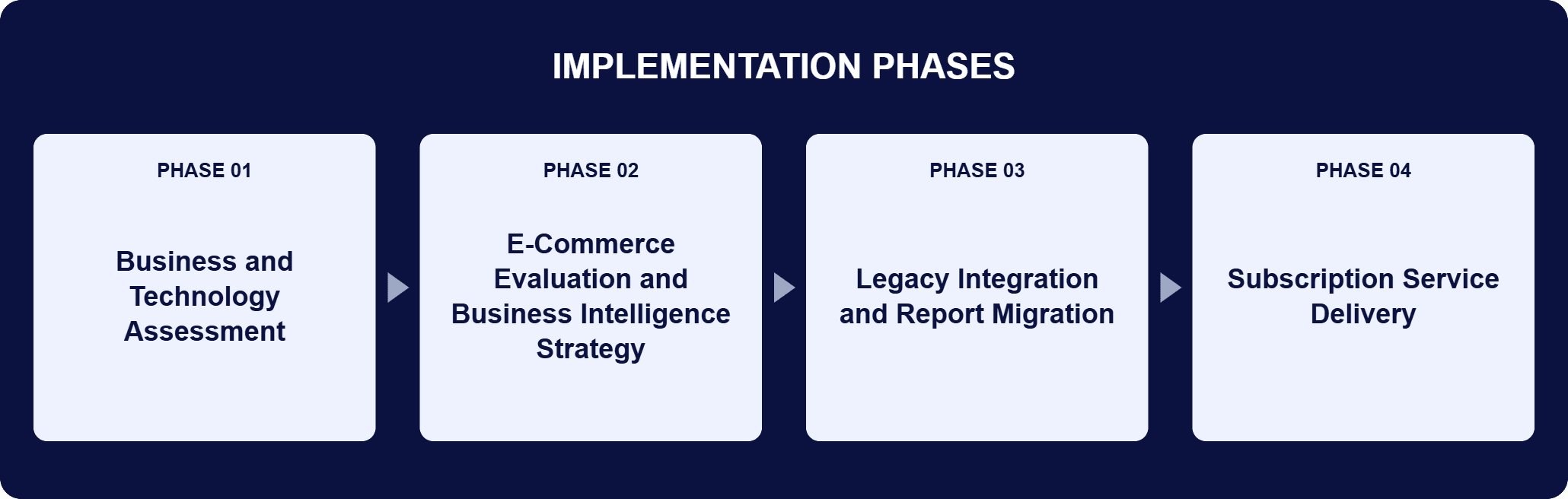
PHASE 03
Legacy Integration and Report Migration
i3solutions provided the recommendations for a migration and integration approach that accommodated the legacy application platform built in Cold Fusion. Current reports migrated to the new platform, existing reports were retained for staff reference, and additional reports were created, with the new system interfacing with the existing one throughout.
PHASE 04
Subscription Service Delivery
The subscription-based reporting system went live as a dedicated website where school administrators purchase subscriptions and run the reports they need, when they need them. The measured results followed: at least 140 man-hours per year of manual report generation off staff, and a new line of business and revenue stream for the organization.
The delivered system is a web-based custom application built to sell and serve reports at the same time. On the commerce side, a dedicated website lets member schools purchase subscriptions, supported by detailed modules for payment and refund processing that the assessment defined before development began. On the reporting side, a Business Intelligence implementation strategy governs the online delivery of reports to schools and to internal staff, and the report catalog was assembled deliberately: financial and school reports identified as reusable were carried into the new application, current reports were migrated to the new platform, additional reports were created, and existing reports were retained for staff reference. Integration set the architecture’s boundary: the organization’s legacy application platform is built in Cold Fusion, and rather than replace it, the new subscription system interfaces with the existing system, preserving continuity with legacy operations while the new service runs in front of it. School administrators run their own reports, on demand, which is what converts the platform from an internal reporting tool into a service the organization can offer its member schools.
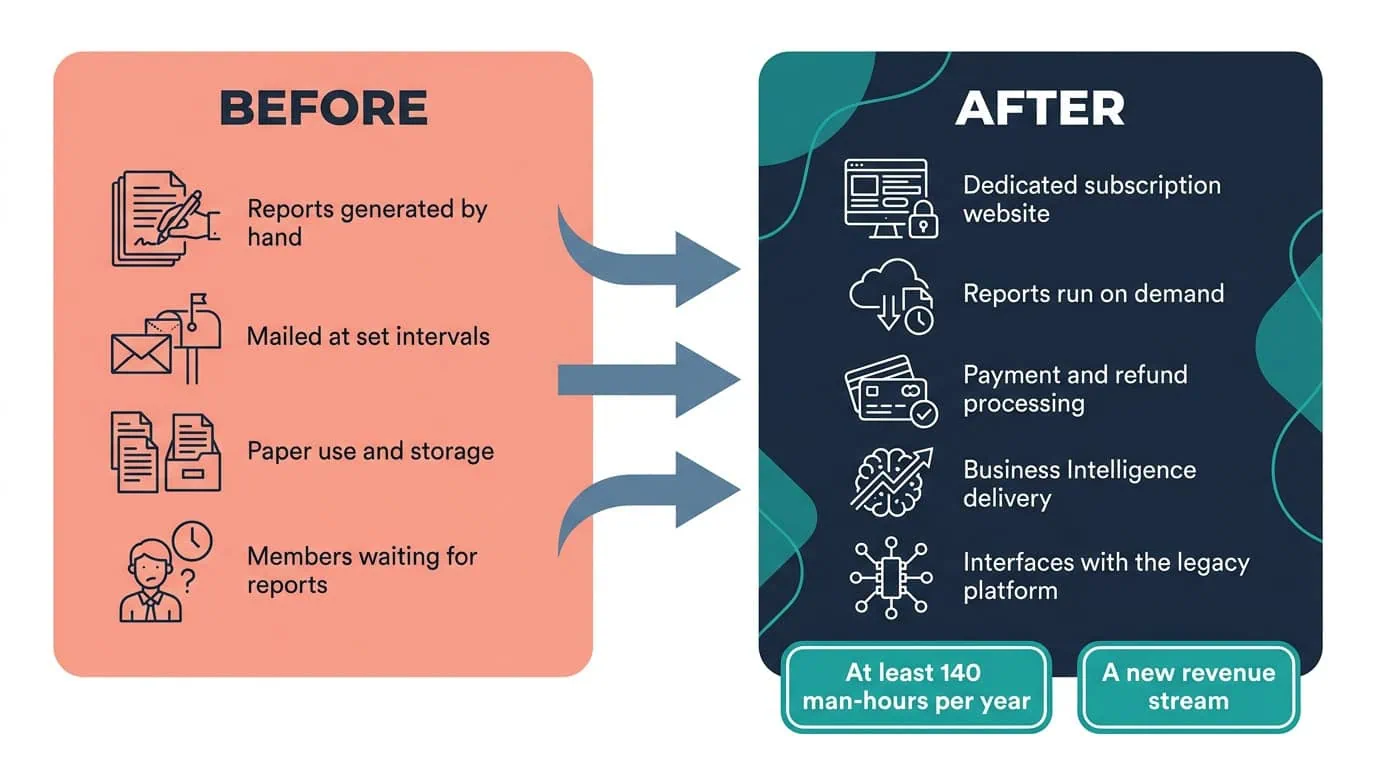
A New Revenue Line, On Demand
A web-based subscription service now lets administrators pull their own reports on demand, turning a manual task into a new line of business.
| Outcome | Before | After |
|---|---|---|
| Staff report generation | At least 140 man-hours per year of manual report generation | Automated report generation, with those hours taken off staff |
| Report delivery to member schools | Reports at predetermined intervals | Administrators run their own reports on demand through the dedicated website |
| Revenue | No subscription reporting offering | A new line of business and additional revenue stream |
| Distribution costs | Costs of generating and mailing reports, with paper use and storage space | Generation and mailing costs cut; paper use and storage space minimized |
| Legacy platform continuity | Legacy application platform built in Cold Fusion | Retained: the new service interfaces with the existing system |
The subscription model turned reporting from a cost into a line of business: the service created an additional revenue stream, and the organization now earns on reports it once produced at pure expense. Automating report generation saved at least 140 man-hours per year that were previously dedicated to manual report generation, and the organization significantly cut the costs associated with generating and mailing reports while minimizing paper use and storage space requirements as it moves toward becoming a paperless organization.
Member schools saw the delivery model flip. Instead of waiting for reports at predetermined intervals, school administrators receive timely, accurate data whenever they need it, and the organization improved customer service through better accessibility and responsiveness. Every audience got a concrete change: schools run reports the moment they need them, staff no longer assemble them by hand, and the organization now bills for a service it used to deliver as overhead.

PENDING-CLIENT-QUOTE
This engagement is relevant for
Less relevant for
A Reporting Cost Center Converted into a Subscription Revenue Line
The engagement established that the reports an organization already produces can carry a new line of business. i3solutions ran the assessment first, identifying the business and technology architectures, the payment and refund processing modules, and the financial and school reports worth reusing, then delivered the subscription service as a web-based custom application with a Business Intelligence strategy for online report delivery to schools and staff.
The legacy Cold Fusion platform stayed in place, with the new system interfacing with it rather than replacing it. Member schools now purchase subscriptions through a dedicated website and pull reports the moment they need them, staff recovered at least 140 man-hours per year of manual report generation, and the organization added a revenue stream while cutting the generating, mailing, paper, and storage costs of the old model.
A subscription-based reporting service turns reports an organization already produces into a self-service product its members pay to access. For this national healthcare licensing organization, i3solutions designed and developed the service as a web-based custom application: member schools purchase subscriptions through a dedicated website and then generate, view, and print their reports themselves, on demand rather than at predetermined intervals. The build covered detailed modules for payment and refund processing, a Business Intelligence strategy for delivering reports online to schools and staff, migration of current reports to the new platform, creation of additional reports, and retention of existing reports for staff reference. Because access is sold by subscription, the same system that removes manual report generation from staff also opens a new line of business and revenue stream for the organization.
With an assessment before development. Using its best practices methodology, i3solutions determined the strategy for the organization’s new business objectives, identified the business and technology architectures, and reviewed the organization’s existing processes. The assessment defined the detailed modules for payment and refund processing and pinpointed the financial and school reports that could be reused in developing the new web-based application, so the build started from what already worked instead of recreating it. i3solutions then evaluated various technologies for the new e-commerce platform, crafted a detailed Business Intelligence implementation strategy for the online delivery of reports to schools and staff, and provided recommendations for a migration and integration approach that accommodated the legacy application platform built in Cold Fusion. The result was a scope grounded in the organization’s actual reports, processes, and platform.
No, and that constraint shaped the architecture. i3solutions provided the migration and integration approach that accommodated the legacy application platform built in Cold Fusion, and the new subscription-based reporting system interfaces with the existing system rather than replacing it. Continuity ran through the report catalog as well: current reports were migrated to the new platform, existing reports were retained for staff reference, and additional reports were created on the new service. The practical effect is that each audience kept what it needed while gaining what it asked for. Member schools get the new on-demand service through the dedicated website; staff keep continuity with the legacy systems and access to the reports they already rely on; and the organization added a new service line without putting its core operating platform through a replacement project.
Automating its reporting processes saved the organization at least 140 man-hours per year that were previously dedicated to manual report generation. The cost savings compound beyond the hours. The organization cut the costs associated with generating and mailing reports, minimized paper use and storage space requirements, and is moving toward becoming a paperless organization. The delivery change carries its own efficiency: school administrators run their own reports through the dedicated website, so report fulfillment no longer routes through staff at all. And because the service is subscription-based, the reporting function moved from a recurring cost line to a source of income, an additional revenue stream from a new line of business, which changes the economics of every report the organization produces.
School administrators stopped waiting. Instead of receiving reports at predetermined intervals, they pull timely, accurate data whenever they need it through the dedicated subscription website. That shift showed up in the organization’s own measures of service: better accessibility and responsiveness to member schools, and higher quality information in administrators’ hands when decisions get made. The report catalog carried continuity with it: current reports migrated to the new platform and additional reports were created, so the reports schools subscribe to cover both what they already received and reporting that did not exist before. For the organization, the service expanded the range of services available to member schools, which was intended to enhance customer relations, with the subscription model turning that improved service into an additional revenue stream from a new line of business.
i3solutions is a Microsoft Partner with 30 years of delivery experience and 1,500+ Microsoft engagements, with every engagement staffed by an all-senior, all US-based delivery team. This engagement shows the profile that work requires: assessment before development, so the business and technology architectures, payment and refund modules, and reusable reports were identified first; an e-commerce technology evaluation and a Business Intelligence strategy, because a subscription service is a commerce platform and a reporting platform at once; and a migration and integration approach that let a legacy Cold Fusion platform keep running underneath a new service. The outcomes are the reference: a new line of business and revenue stream, on-demand reports for member schools, and at least 140 man-hours per year off staff. A short scoping conversation establishes what the equivalent build looks like in your environment.
Yes. The subscription reporting service was built on top of the organization’s existing legacy Cold Fusion platform rather than requiring its replacement, turning a manual, interval-based reporting task into an on-demand service member schools could use directly. That approach avoided a full platform replacement while still solving the actual problem, staff time spent producing reports by hand, and added a new revenue line in the process.
Member schools now purchase subscriptions and pull reports on demand, recovering staff hours while adding revenue. We can talk through what a comparable reporting-to-revenue model would look like for your organization.

US-Based | Est. 1997
© i3solutions. All rights reserved.
US-Based | Est. 1997
© i3solutions. All rights reserved.


