
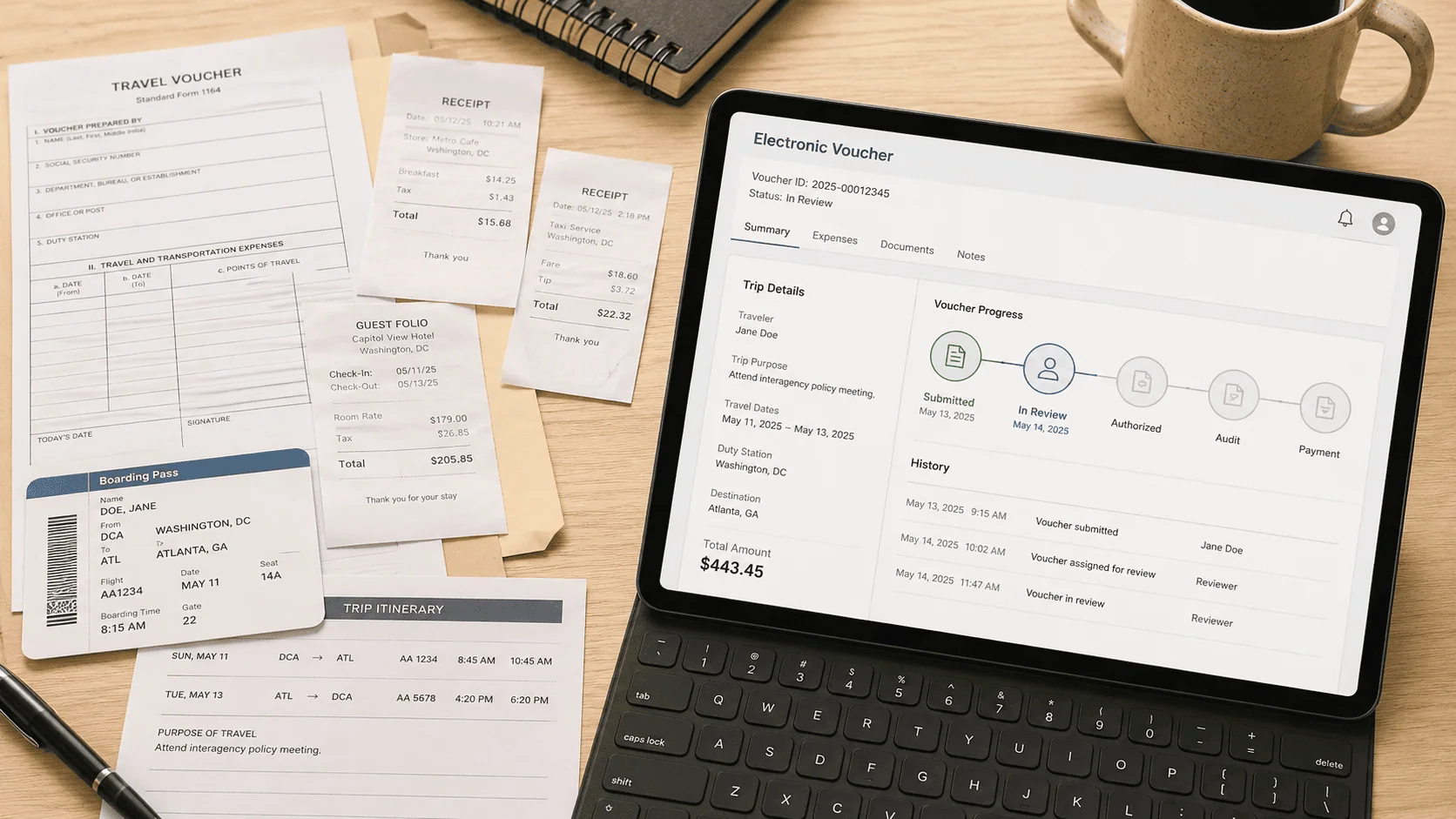
Invoices, receipts, and payments moved entirely by mail across ten regional and sixty-plus field offices.
The client is an independent federal agency based in Washington, DC, dedicated to preserving and promoting labor-management peace and cooperation. Through a network of ten regional offices and over 60 field offices, the agency provides conflict resolution services to industry, government agencies, and communities. That footprint matters to this engagement: the agency’s people work where the disputes are, spread across the country, and the travel and miscellaneous expenses they incur doing it all have to come back through one reimbursement process.
That process ran entirely on paper. Invoices could only be submitted by mail, receipts were managed through the mail, and payment went out as paper checks sent through traditional postal services. The process was outdated and cumbersome, and every stage of it depended on the mail. The agency’s goal was specific: develop and maintain a secure, cloud-based electronic voucher system in which each voucher carries its essential details, staff information, voucher specifics, transportation costs, expenses, comments, and attachments, and in which submission, review, and payment happen without any of it going through the mail.
A federal agency processed travel vouchers entirely by mail across more than 70 regional and field offices, with no visibility into where a voucher stood. i3solutions built a BPM-driven digital workflow carrying each voucher electronically from submission through payment on pay.gov.
DTMO CONUS and OCONUS per diem rates now load automatically via XML and update every year, payments run through pay.gov instead of paper checks in the mail, and no step of the reimbursement cycle (submission, review, authorization, audit, or payment) touches paper anymore across the more than 70 offices.
Every Invoice, Receipt, and Check Depended on the Mail
The defining constraint of the old process was that no step of it could happen without the postal service. A voucher could not enter the workflow except by mail, its receipts could not be handled except through the mail, and its payment could not arrive except as a paper check in an envelope. For an agency whose staff operate from ten regional offices and over 60 field offices, the entire reimbursement workflow moved at the speed of the mail, with the inefficiencies of manual handling added at every stop along the way.
The agency’s decision was to stop patching the paper and replace the system underneath it. i3solutions was tasked with replacing the outdated paper-based system with an electronic process built to enhance both efficiency and accuracy in voucher processing. The mandate was a better process, not a scanned copy of the old one, and that framing set up the engagement’s first move: study the process before building anything.
This agency replaced its reimbursement process end to end rather than merely scanning the paper version of it. If a “digitization” project in your organization risks becoming a scanning project, that distinction is worth raising early.
The Risk Was Digitizing the Process Without Fixing It
Left alone, the paper pipeline charged its costs continuously. Every voucher paid the mail tax at submission, at receipt handling, and again at payment; every rate that entered the math arrived through manual input and error-prone calculations; and nothing about a stack of mailed paper made vouchers easier to review, authorize, audit, or retrieve later. The inefficiencies of traditional mail submission were built into the process itself, so no amount of diligence by staff could work them out.
The subtler risk sat inside the fix. An electronic voucher system that simply reproduced the paper form on a screen would have digitized the inefficiencies along with the process, leaving the agency with the same workflow at a different address. That is the failure mode i3solutions engineered against by conducting a thorough review of the existing processes before implementation, identifying inefficiencies and areas for improvement, and applying Business Process Management principles so the system not only digitized the process but optimized it.
Federal Rates, Accounting Codes, and Roles That Must Stay Current
A federal expense voucher is a structured financial document, and the system had to treat it that way. Each voucher carries staff information, voucher specifics, transportation costs, expenses, comments, and attachments, and it moves through review, authorization, audit, and payment under defined roles: administrators control user management, departmental oversight, role assignments, and per diem rates, while accountants manage fiscal year budgets, field budget allocations, and fund numbers. The platform had to be secure and cloud-based, and it had to keep those responsibilities separate without slowing the voucher down.
The harder constraint was reference data that changes on a schedule. CONUS and OCONUS per diem rates for lodging and meals are published by the Defense Travel Management Office and change annually. The lookup values vouchers are built from, block 1l codes, budget object classes, departments, expense accounting relationships, mileage rates, organizations, payment forms, and projects, change monthly. A system that made humans re-key any of that would have reintroduced the error-prone manual work the engagement existed to remove, so currency had to be automatic.
Senior Microsoft Specialists with Proven Delivery Depth
The requirements defined the vendor profile: a team that could review a federal agency’s existing financial process before writing code, apply Business Process Management principles to redesign it, and then deliver a secure, cloud-based custom web application on the Microsoft stack with the accounting structure, role separation, and integration work a federal reimbursement workflow demands. This was process automation and full-lifecycle custom application development together, not a form moved on screen and not product configuration.
The agency engaged i3solutions, a Microsoft Partner with 30 years of delivery experience and 1,500+ Microsoft engagements, delivered by an all-senior, all US-based delivery team. That profile matched the work: senior engineers who build secure ASP.NET applications over SQL Server as a practiced discipline, and who treat process review as part of development rather than an afterthought, working closely with the agency and overseeing every aspect of the project throughout the software development lifecycle.
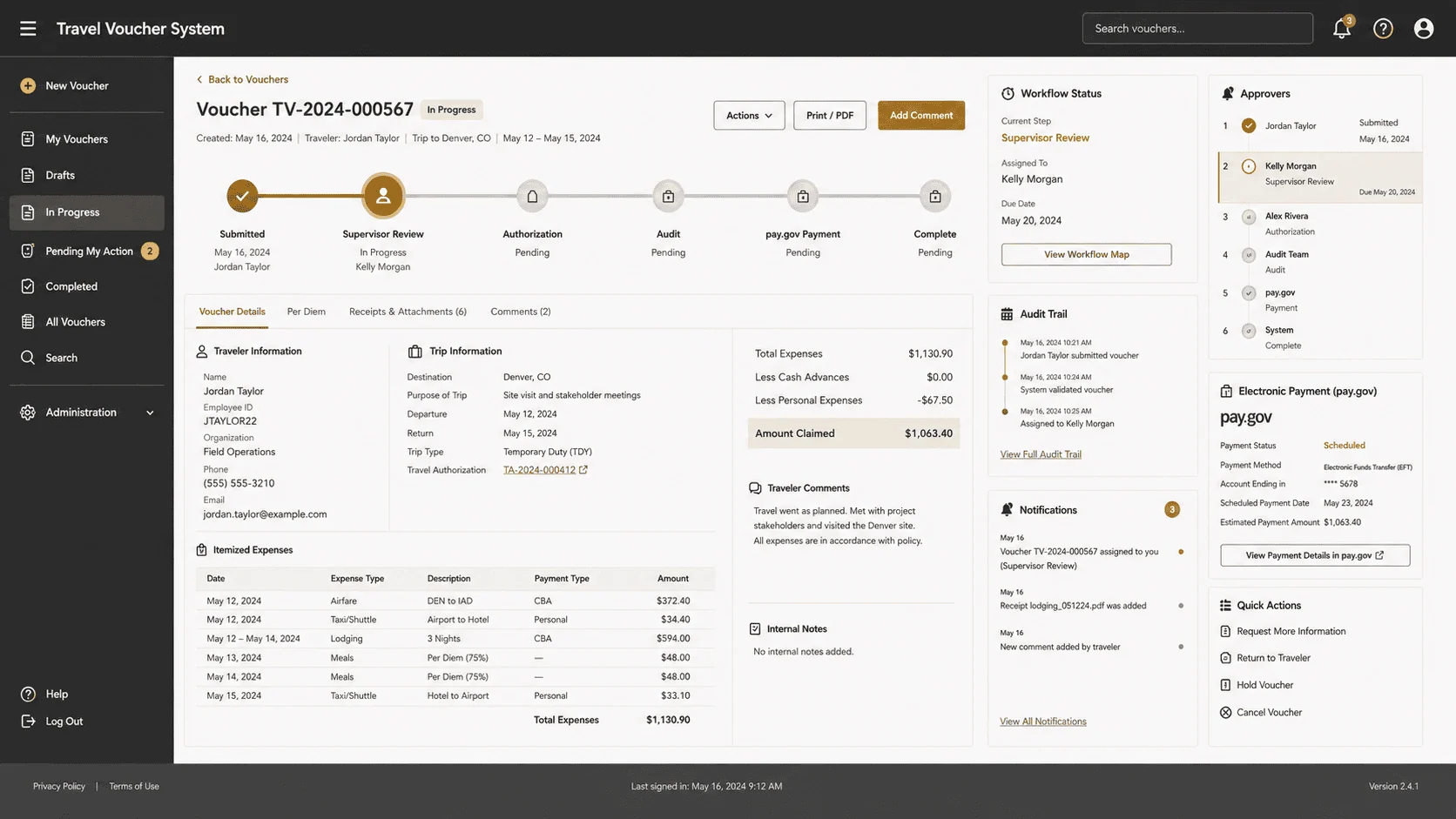
i3solutions built the agency a secure, cloud-based electronic voucher system: one platform in which staff submit a voucher with its staff information, transportation costs, expenses, comments, and attachments, and reviewers then authorize, audit, and pay it without any of it going through the mail.
PHASE 01
Process Review and BPM Analysis
Before implementation, i3solutions conducted a thorough review of the agency’s existing voucher processes to identify inefficiencies and areas for improvement, then applied Business Process Management principles to the redesign. The goal set here governed everything downstream: the system would not just digitize the paper process, it would optimize it.
PHASE 02
Platform Design and Architecture
The system was architected as a secure, cloud-based web application on ASP.NET and C# over Microsoft SQL Server, with Entity Framework abstracting the data layer, Bootstrap and CSS providing responsive design across devices, jQuery, JavaScript, and AJAX driving dynamic updates and real-time interactivity, and Telerik UI components completing the interface. i3solutions built it in Visual Studio.
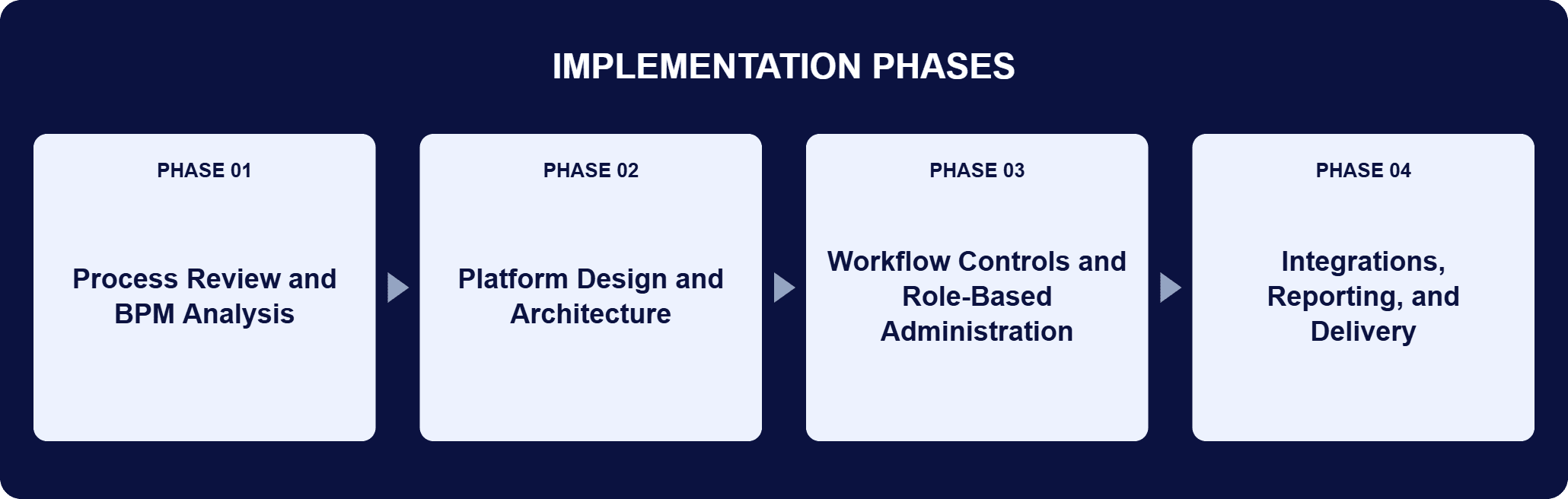
PHASE 03
Workflow Controls and Role-Based Administration
i3solutions implemented a one-voucher-at-a-time rule that prevents multiple unsubmitted vouchers and reduces potential errors, added a search feature for retrieving previous vouchers, gave administrators control over users, departments, role assignments, and per diem rates, and gave accountants control over fiscal year budgets, field budget allocations, fund numbers, and the lookup values vouchers are built from.
PHASE 04
Integrations, Reporting, and Delivery
The automation went live at the edges: Defense Travel Management Office per diem rates loading in XML and updating automatically each year, accounting lookup values updating automatically each month, pay.gov processing payment electronically, SQL Server Reporting Services reporting on voucher processing and user activity, Word and ActivePDF generating printable documents, and SMTP notifying users at submission, approval, and payment.
The system is an ASP.NET and C# application over Microsoft SQL Server, queried in T-SQL through Entity Framework so the data layer stays maintainable without hand-built SQL. The interface runs on Bootstrap and CSS for responsive layout across devices, jQuery and JavaScript for dynamic content updates, form validations, and real-time status tracking, AJAX for asynchronous exchange between browser and server, and Telerik components for a consistent UI. The financial plumbing is where the automation lives: pay.gov processes payment electronically in place of paper checks; CONUS and OCONUS per diem rates for lodging and meals published by the Defense Travel Management Office load in XML format and update automatically each year; and the accounting lookup values vouchers are built from update automatically each month, supporting tracking and auditing. SQL Server Reporting Services generates reports on voucher processing and user activity, Word and ActivePDF produce printable vouchers and documents in PDF format, and SMTP notifies users when a voucher is submitted, approved, and paid. i3solutions built the system in Visual Studio, working closely with the agency throughout the software development lifecycle.
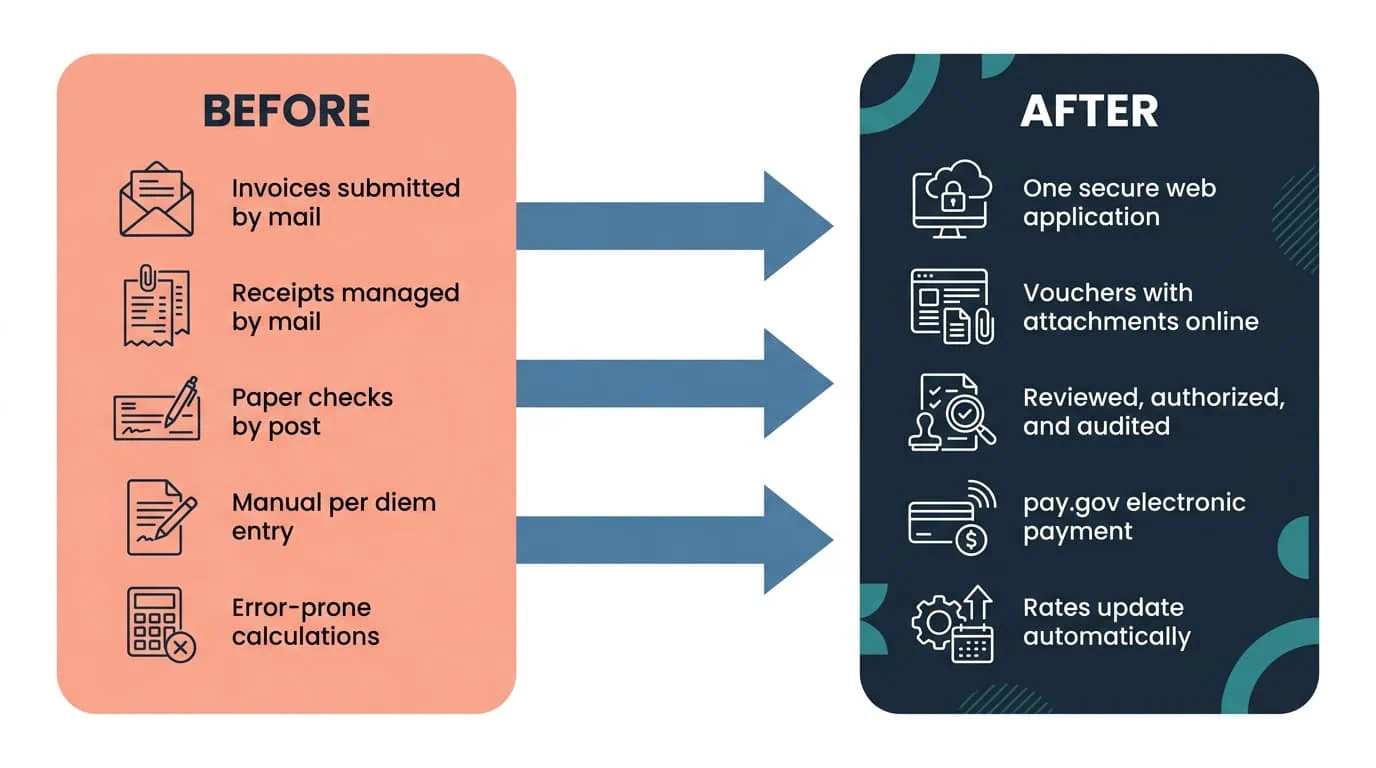
Vouchers, Reviewed and Paid Digitally
A BPM-driven web application now handles electronic vouchers end to end, with payment processed directly through pay.gov.
| Outcome | Before | After |
|---|---|---|
| Voucher submission | Invoices submitted only by mail | Electronic vouchers with staff information, costs, expenses, comments, and attachments |
| Payment | Paper checks sent through traditional postal services | Electronic payment processed through pay.gov |
| Receipts and review | Receipts managed through the mail | Vouchers reviewed, authorized, audited, and paid inside the platform |
| Per diem rates | Manual input and error-prone calculations | DTMO CONUS and OCONUS rates load in XML and update automatically each year |
| Accounting lookup values | Hand-maintained reference data | Automatic monthly updates that enhance tracking and auditing |
The most direct change is that no step of the reimbursement cycle touches the mail anymore: submission, review, authorization, audit, and payment all happen inside one digital platform, and the one-voucher-at-a-time rule reduces potential errors before they enter the pipeline at all. Control moved with it: administrators and accountants gained centralized control over users, departments, roles, per diem rates, budgets, fund numbers, and the lookup values vouchers are built from, consolidating budget oversight and user management in one system. Accuracy came from integration: standardized Defense Travel Management Office rates flow straight into the system, so voucher math relies on up-to-date information without manual input or error-prone calculations.
The workflow maintains itself from there. Lookup values update automatically each month, which enhances tracking and auditing; SQL Server Reporting Services turns voucher processing and user activity into detailed, customizable reports; and SMTP notifications tell users when a voucher is submitted, approved, and paid, so status lives in the system instead of in the mail. The result is a modernized electronic voucher system that removed mail handling, manual rate entry, and hand-keyed reference data from the agency’s reimbursement cycle entirely.

PENDING-CLIENT-QUOTE
This engagement is relevant for
Less relevant for
Voucher Processing Off Paper, onto One Secure Platform
The engagement established that a federal agency’s paper reimbursement process can be replaced end to end rather than merely scanned: submission, receipts, review, authorization, audit, and payment all moved inside one secure, cloud-based application. Because i3solutions reviewed the existing process and applied Business Process Management principles before building, the system optimized the workflow instead of reproducing it, with a one-voucher-at-a-time rule, search across previous vouchers, and separate controls for administrators and accountants.
The reference data federal expense processing depends on now maintains itself: Defense Travel Management Office per diem rates update automatically each year in XML, accounting lookup values update automatically each month, and pay.gov pays vouchers electronically instead of by paper check. The result is a reimbursement cycle with no mail handling, no manual rate entry, and no hand-keyed reference data, delivered by a team that worked closely with the agency throughout the software development lifecycle.
An electronic voucher system is a secure, cloud-based custom web application that replaces a paper expense process end to end. In the system i3solutions built for this independent federal agency, staff submit a travel or miscellaneous expense voucher containing its essential details, staff information, voucher specifics, transportation costs, expenses, comments, and attachments, and reviewers then authorize, audit, and pay it entirely inside the platform. The before state defines the category: at this agency, invoices could only be submitted by mail, receipts were managed through the mail, and payment went out as paper checks through traditional postal services. The electronic system removes the postal service from every one of those steps, with pay.gov handling payment electronically and SMTP notifying users when a voucher is submitted, approved, and paid.
By fixing the process before building the software. In this engagement, i3solutions conducted a thorough review of the agency’s existing voucher processes before implementation, identified inefficiencies and areas for improvement, and applied Business Process Management principles so the system not only digitized the process but optimized it. The difference shows in the details that no paper form ever had: a one-voucher-at-a-time rule that prevents multiple unsubmitted vouchers and reduces potential errors, a search feature that retrieves previous vouchers, defined roles separating what administrators control from what accountants control, and reference data that updates itself on the schedule it actually changes on. i3solutions worked closely with the agency throughout the software development lifecycle, overseeing every aspect of the project from process review through delivery.
CONUS and OCONUS per diem rates for lodging and meals are published by the Defense Travel Management Office, and the system integrates them directly in XML format, so they update automatically each year rather than being entered by hand. That single integration carries a lot of the engagement’s accuracy value: voucher calculations rely on up-to-date, standardized rates without manual input or error-prone calculations, and the annual updating process stops being an administrative task at all. The same principle covers the accounting side on a faster clock: the lookup values used to create and update vouchers are configured to update automatically each month, which keeps voucher data consistent and enhances the agency’s tracking and auditing processes. In both cases the design rule is the same: data that changes on a schedule should never depend on a person remembering to change it.
Yes. Accountants manage fiscal year budgets, field budget allocations, and fund numbers directly, and they control the lookup values used to create and update vouchers: block 1l codes, budget object classes, departments, expense accounting relationships, mileage rates, organizations, payment forms, and projects. Those lookup values are configured to update automatically each month, which supports tracking and auditing without anyone re-keying reference data. Administrators hold a separate set of controls: user management, departmental oversight, role assignments, and per diem rates. That separation is deliberate. A voucher is a financial document moving through review, authorization, audit, and payment, and the system keeps the people responsible for money and the people responsible for access working in their own lanes, each with direct control over the parameters they own.
ASP.NET with C# is the foundation, and Microsoft SQL Server with T-SQL is the database, accessed through Entity Framework so the data layer avoids hand-built SQL. jQuery and JavaScript handle dynamic content updates, form validations, and real-time status tracking; Bootstrap and CSS provide responsive layout across devices; AJAX exchanges data asynchronously between browser and server; and Telerik supplies UI components. Around that core sit the integrations that make it a financial system rather than a website: pay.gov processes payment electronically, SQL Server Reporting Services generates reports on voucher processing and user activity, Word and ActivePDF produce printable vouchers and documents in PDF format, and SMTP sends notifications at submission, approval, and payment. i3solutions built the system in Visual Studio.
i3solutions is a Microsoft Partner with 30 years of delivery experience and 1,500+ Microsoft engagements, with every engagement staffed by an all-senior, all US-based delivery team. That profile fits federal financial systems, where the work is unforgiving in a specific way: roles, budgets, rates, and accounting codes have to be exactly right, and the process has to be improved rather than merely digitized. This engagement is representative of the pattern: a BPM-grounded process review before any code, a secure cloud-based platform on ASP.NET, C#, and SQL Server, integrations that keep per diem rates and lookup values current automatically, and electronic payment through pay.gov. For organizations weighing this class of work, a short scoping conversation establishes what replacing your own paper process would take.
Yes, that was the approach for this federal agency’s electronic voucher system. The travel and expense process was reviewed and optimized with BPM discipline before development started, rather than reproducing the existing paper process on a screen. Per diem rates and accounting lookup values are also configurable by the agency’s own accountants, so routine updates don’t require a developer, which keeps the system from drifting out of date the way the paper process had.
Per diem rates and lookup values update automatically here, removing the manual maintenance that used to introduce errors. We’re glad to discuss what a comparable self-maintaining system would look like for your agency.

US-Based | Est. 1997
© i3solutions. All rights reserved.
US-Based | Est. 1997
© i3solutions. All rights reserved.


