
Michael Branson
The reader this checklist assumes has not committed yet. A platform decision may be leaning one way, a budget cycle may be closing, and the implementation itself has not started. Readiness is worth testing at exactly that point, because every answer in the checklist is cheap to change before a partner is engaged and expensive to change afterwards.
If a rollout is already underway and going badly, that is a different problem with a different sequence, and it is worked through in full at Dynamics 365 implementation rescue. None of that sequence is repeated on this page.
Nothing on this page is gated. Every item in the six dimensions is stated in full, in the order you would work through it, so a reader who works to the end has a real readiness position and nothing left to request.
The readiness checklist has six dimensions. Each one carries items you can complete yourself, against your own organization, without asking a vendor anything. Each item is answerable yes or no, and the answer is backed by something you can hand to somebody else: an export, a log, a written decision, a name. An item you can only answer from memory counts as a no, because the thing being tested is whether the organization holds the answer, not whether one person does.
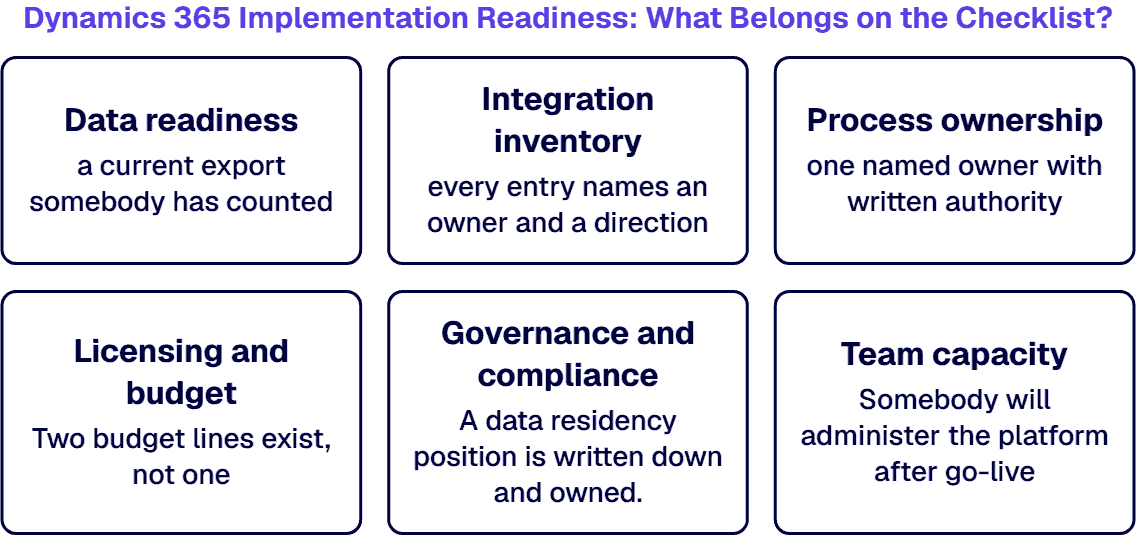
Each dimension closes with what ready looks like on that dimension alone. A dimension is not scored against the others, and the readiness checklist produces no total. What it produces is a position: which dimensions are ready, which are not, and what is missing from each. The closer names the minimum; a dimension with unmet items in the list before its closer is ready with known gaps, and the gaps go in the position.
Data is a dimension that can look ready and not be, because the people describing the condition of the data can be the people least exposed to it.
You are ready on data readiness when every domain in the first release scope has one named owner, a current export somebody has counted, and a signed decision on how much history moves. Where any of those three is missing for a domain, that domain is the finding, and it is a finding you can close yourself before anyone quotes you for it.
The integration question is not how hard the work is. It is whether your organization can currently say, in writing, what has to talk to what.
What the size of that inventory does to the price is a separate question and it already has a page; see the licensing and budget dimension for where it is answered.
You are ready on integration inventory when the inventory for the first release is written down, every entry names an owner and a direction, and every entry marked must-have at go-live has a confirmed technical path. A deferrable entry with no path is not a blocker. A must-have entry with no path is the whole program’s critical path and can be discovered late.
Implementations stall on decisions, not on configuration. Ownership readiness is the test of whether the decisions have somewhere to go.
You are ready on process ownership when every process in the first release scope has one named owner with written authority, a named escalation point, and protected time. Ownership that exists on an organization chart but not in a calendar reads as ready and is not.
Licensing and budget behave as one dimension with two halves that move on different clocks, and the licensing and budget items test only whether your organization has acted on that split, not why it matters.
What drives the implementation number at your scale is answered in full at Dynamics 365 implementation cost, and none of that answer is restated on this page. The readiness question is narrower: whether your organization can currently produce the two lines, the two owners and the counted population.
You are ready on licensing and budget when the entitlement line and the implementation line exist separately, each has a named owner, and the user population is counted from an export rather than estimated. Where the post-go-live year is deliberately unfunded, that is a defensible position as long as it is written down as a decision.
In a regulated estate this dimension sets dates that no one in the program controls, which is why it is worth testing first even though a common order tests it last.
You are ready on governance and compliance when the regimes in scope are stated in writing by their owner, the residency position is decided and named, and you can produce the date of the last access review. An open audit finding does not make you unready. An open audit finding no one has attached to the program does.
This dimension is about your own organization’s people. Whether the firm you hire has the right team is a genuinely different question, and it is answered at Choosing a Dynamics 365 Implementation Partner. Nothing about vendor selection belongs in a readiness position, because a readiness position is what you take into that selection.
You are ready on team capacity when every role your side has to fill has a named person with released hours in writing, and post-go-live administration belongs to somebody by job description. Capacity is assumed more readily than it is written down, and where it is short it turns a good implementation into a late one.
The readiness checklist produces a position, not a score. Work through the six dimensions, mark each one ready or not ready on its own terms, and read the pattern instead of the count.
Two or fewer dimensions short, with the gaps inside your own control, is an ordinary starting position and closing them is work you can do without engaging anyone. Data readiness and integration inventory short together is a pattern that can turn into an expensive discovery later, because both feed the same design decisions and neither can be closed quickly. Governance short is the one to treat as urgent regardless of how the others look, since its dates are set outside the program.
Dimensions will sometimes give you opposite instructions, and there is one rule for it. Where two dimensions disagree, governance and compliance settles the date and data readiness settles the sequence. A date set by an audit obligation is not yours to move, so it governs when; the condition of the data governs what has to happen first, because the other design decisions are made against it. Where team capacity conflicts with either, capacity is the constraint that gets funded or the scope that gets cut, and it is never the assumption that gets stretched.
On sector experience: i3solutions has delivered Dynamics 365 integration engagements for regulated enterprises across healthcare, defense and aerospace manufacturing, and financial services.
On recent platform work: i3solutions recently stood up two brand-new Dynamics 365 instances.
On who does the work: All i3solutions Dynamics 365 developers are U.S.-based.
i3solutions has been a Microsoft partner since 1997.
i3solutions delivery is US-based.
Readiness is assessed across six dimensions the buying organization can verify by itself: data readiness, integration inventory, process ownership, licensing and budget, governance and compliance, and team capacity. Each dimension is answered yes or no against evidence somebody outside the conversation could inspect, such as a current data export, a written system inventory, a named process owner with written authority, a directory export of the user population, a compliance statement from the person who owns compliance, and a written release of named people for named hours. A dimension answered from memory rather than from an artifact counts as not ready, because readiness is a property of the organization and not of the one person who happens to remember.
The work needed is enough to know the condition of the data, not enough to have fixed it. Every master data domain in the first release scope needs one named owner who can approve a merge or a deletion, a current export somebody has counted, and a known duplicate and completeness position taken from that export. A written and signed decision is needed on how much transaction history moves and how much stays in the legacy system or an archive. Anything the business calculates rather than stores needs a field-level inventory naming where the formula lives today and which system is authoritative when two of them compute the same figure differently.
Write down every system that has to exchange data with the new platform in the first release, and give each entry an owner on your side, a direction, a trigger, and a description of what happens today, including the exchanges that are currently a person re-keying between two screens. Measure the volume from a log or an interface report on the existing flow instead of estimating it. Confirm in writing whether each vendor’s product supports an interface and whether your contract covers it. Then mark each entry must-have at go-live or deferrable, and have the process owners review the must-have set, because a must-have entry with no confirmed technical path is the program’s critical path and can be found late.
It requires one named business owner per process in the first release scope, able to settle a design question for their own function without convening a committee, with their escalation threshold written down and a named person who resolves disagreements between owners. The current state has to be documented against evidence, meaning a sample of real transactions reviewed with the people who process them, since the gap between the written procedure and the daily work is where the design risk sits. Owners also need hours in a calendar that somebody has agreed to backfill, and a decision log that survives a change of personnel.
No. An open audit finding does not make an organization unready; an open audit finding that no one has attached to the program does. Governance readiness asks for a written statement of which regimes the data in scope falls under, produced by whoever owns compliance rather than inferred by the technology team, a decided and named data residency position, the audit evidence your organization must already produce today and who asks for it, the date of the last access review, and a place where approval records for production configuration changes already live. Those dates are set outside the program, which is why governance is the dimension to test earliest even though a common order tests it last.
Where two dimensions disagree, governance and compliance settles the date and data readiness settles the sequence: an audit-obligation date cannot be moved and governs when the work finishes, while the condition of the data governs what has to happen first since the other design decisions rest on it. Where team capacity conflicts with either, it is the constraint that gets funded or the scope that gets cut, never the assumption that gets stretched.

US-Based Microsoft System Integrator | Est. 1997
© i3solutions. All rights reserved.
US-Based Microsoft System Integrator | Est. 1997
© i3solutions. All rights reserved.


