
Michael Branson
Your SAP ECC finance estate is moving to Dynamics 365 Finance, and before finance and audit accept a go-live they will ask you for a reconciled trial balance for each legal entity, not a report that the load finished. If the platform decision is made and the migration budget is now yours, the questions finance and audit will put to you are narrower than the ones that got the project approved: what each of your SAP structures becomes, which records move, which stay behind, and what evidence shows the new ledger agrees with the old one before go-live. The first design decision is whether to consolidate charts of accounts before designing dimensions and main accounts, and the load itself runs through Microsoft’s data management framework. Whether to choose Dynamics 365 at all is covered on the Dynamics 365 vs SAP page. Whether to modernize a strained estate or replace it is covered on the Dynamics 365 ERP for regulated enterprises page. Budget and timeline are covered on the Dynamics 365 Finance and Dynamics 365 Supply Chain Management implementation cost page.
When you lay your SAP ECC finance structures beside Dynamics 365 Finance, three translations carry the core of the design, and each of them is a decision rather than a copy.
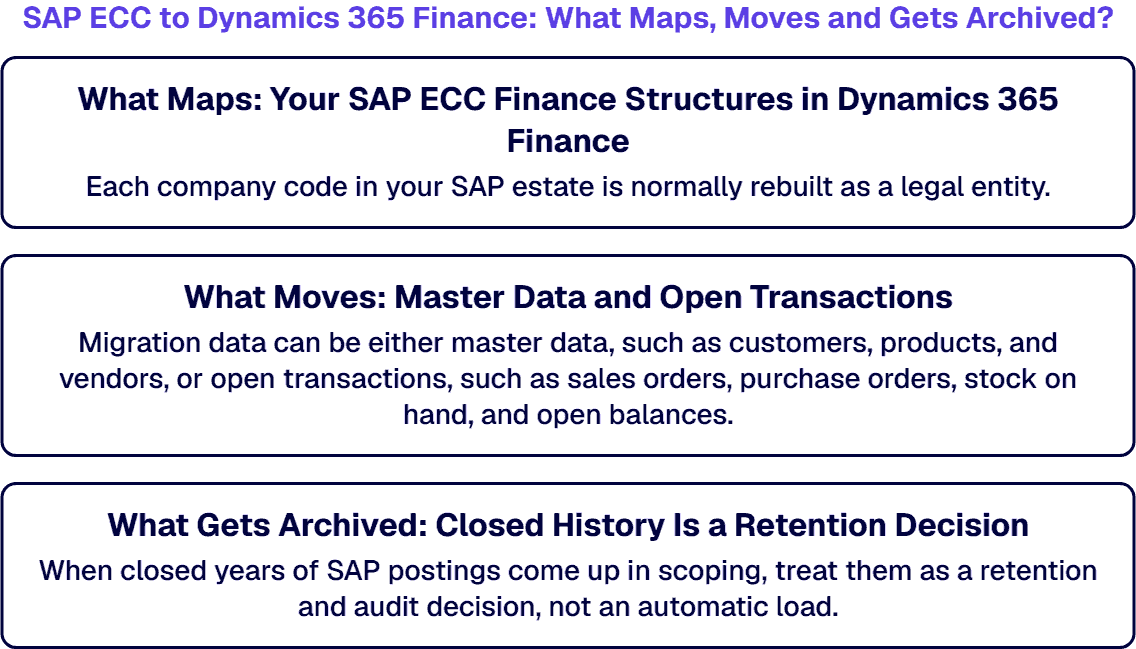
Company code to legal entity. Each company code in your SAP estate is normally rebuilt as a legal entity. Microsoft states that “A legal entity is an organization that has a registered or legislated legal structure,” that “A company is a type of legal entity,” and that “Currently, companies are the only kind of legal entity that you can create, and every legal entity is associated with a company ID.” Source, Microsoft Learn (read date 2026-09-22): Organizations and organizational hierarchies overview.
Controlling area to financial dimensions. The management reporting your controlling area carried is rebuilt as financial dimensions on the ledger. Microsoft states that “Financial dimension values become segments within the ledger account,” and gives the example that “an expense account might include financial dimensions that are named Department, Cost center, and Purpose.” Microsoft states that “In addition, custom dimensions are always shared across legal entities,” so the custom dimension design is an enterprise decision, with per-entity legal entity overrides as the exception. Sources, Microsoft Learn (read date 2026-09-22): Financial dimensions; Plan your chart of accounts.
Chart of accounts. Microsoft describes the chart of accounts as “a structured list of a legal entity’s general ledger accounts” and states that “Any legal entity in an organization can share and use a chart of accounts.” If your SAP estate runs more than one chart, the decision whether to consolidate them before the move takes precedence, because the main account and dimension design downstream depends on it. Source, Microsoft Learn (read date 2026-09-22): Plan your chart of accounts.
If you are scoping the load, Microsoft’s implementation guidance describes migration data this way: “Migration data can be either master data, such as customers, products, and vendors, or open transactions, such as sales orders, purchase orders, stock on hand, and open balances.” The mechanism Microsoft names for the load is the data management framework, which “supports using data entities in the following core data management scenarios,” data migration among them, and which moves records in data packages, each “A single compressed file that contains a data project manifest and data files.” Sources, Microsoft Learn (read date 2026-09-22): Manage configuration and migration data for Dynamics 365 projects; Data management overview.
Field-level mapping belongs in the migration plan, after the legal entities, financial dimensions and chart of accounts are designed, because a field mapping needs a target design to map to. Microsoft’s guidance names that work as “Mapping and transforming the data fields and values between the source and target systems.” Source, Microsoft Learn (read date 2026-09-22): Manage configuration and migration data for Dynamics 365 projects.
When closed years of SAP postings come up in scoping, treat them as a retention and audit decision, not an automatic load. Closed history is not in Microsoft’s description of migration data, so whether any of it loads, for example as summarized period balances for comparative reporting, is your decision, and what must stay reachable is a retention decision. Source, Microsoft Learn (read date 2026-09-22): Manage configuration and migration data for Dynamics 365 projects. The retention test has three questions: what a regulator or auditor must be able to reach, for how long, and from where. The answers come from your own records-retention obligations, and whatever holds the history has to answer those three questions for each legal entity once the SAP system is switched off.
Before you sign off a go-live, Microsoft’s cutover guidance calls for a rehearsal: “Before you do the real cutover, you should practice your cutover plan in a test environment. This is called a mock cutover or a dress rehearsal.” It adds that “You should do the mock cutover several times until you’re confident that everything goes smoothly,” and it names the final call on whether the solution is ready for production: “This is called the go/no-go decision.” Source, Microsoft Learn (read date 2026-09-22): Transition to new solutions successfully with the cutover process.
For a regulated finance estate, the evidence finance and audit will ask for at that decision is a reconciled trial balance for each legal entity, with the open-item subledgers tied back to it: the balances in SAP ECC at the cutover point, the balances loaded into Dynamics 365 Finance, and each difference explained. Run that reconciliation in every mock cutover, so the go/no-go decision rests on a reconciled record and not on a report that the load finished.
A move off SAP ECC also creates integration work, because the systems that fed SAP have to be connected to Dynamics 365 Finance, and that integration seam is covered on the Microsoft integration for ERP and CRM migrations page. i3solutions has delivered Dynamics 365 integration engagements for regulated enterprises across healthcare, defense and aerospace manufacturing, and financial services. Delivery is senior and US-based. i3solutions has completed more than 20 Dynamics 365 integration engagements. The wider practice is set out on the Dynamics 365 development services page.
If you are moving from SAP ECC, the finance estate translates by structure, not field by field: company codes are normally rebuilt as legal entities, and the reporting a controlling area carried is rebuilt as financial dimensions. According to Microsoft, migration data can be master data or open transactions, such as open balances, and the data management framework supports data migration. Closed history is a retention decision, and a mock cutover tests the plan and the ledger load before go-live.
If an auditor or regulator must be able to reach closed SAP history, that is a retention decision, not a load decision. According to Microsoft, migration data can be master data, such as customers, products and vendors, or open transactions, such as open balances. Closed history is not in that list, so whether any of it loads is your decision, and your own records-retention obligations decide how long it is kept and where.
Before go-live, Microsoft’s cutover guidance calls for a mock cutover, or dress rehearsal, in a test environment, repeated until the team is confident, followed by a go/no-go decision on whether the solution is ready for production. For a regulated finance estate, the evidence behind that decision is a trial balance report from each ledger, reconciled for each legal entity, with the open-item subledgers tied back to it and each difference between SAP ECC and Dynamics 365 Finance explained.

US-Based Microsoft System Integrator | Est. 1997
© i3solutions. All rights reserved.
US-Based Microsoft System Integrator | Est. 1997
© i3solutions. All rights reserved.


