
How to Decide Whether to Rewrite Legacy Code
Whether to rewrite legacy code turns on four readable factors, not on the age of the code:
The sequence matters as much as the criteria: stabilize and document first, decide second. A rewrite chosen before the logic has been recovered does not remove the unknowns. It simply moves them into a new codebase, where they cost more to rediscover. Take ownership of what you have, make it safe to touch, and only then choose rewrite, maintain, or replace.
The application still runs. The person who understood it does not work here anymore. And every change you now make carries a risk nobody left on the team can size. That is the situation this page is written for: a business-critical custom application whose author has gone, with no documentation behind it, and a business that still depends on it every day.
The decision in front of you is not sentimental attachment to old code. It is which path costs you less risk over the next three years: rewriting the application, maintaining it, or replacing it. This page walks through how to make that call defensibly, and how to take ownership safely no matter which way it goes.
When the developer who built and maintained an application leaves, the code does not change. What changes is that the only working model of how it behaves has walked out the door. The exposure is not the software. It is everything the software depended on that was never written down.
Four things typically break at once:
This is what a key-person-risk failure looks like in practice, and it is why the honest answer to “should we just rewrite it?” is “not yet.” You cannot make a sound rewrite-versus-maintain decision from inside a system you cannot see. First you make it visible.
Taking over an undocumented custom application is a defined sequence, and it comes before the rewrite decision, not after it. The goal of this stage is narrow and worth stating plainly: make the application safe to operate and safe to touch, so that the decision you make next is made on evidence rather than on fear. Work it in this order.
This stabilization work is valuable whether you ultimately rewrite, maintain, or replace, because all three paths require that you first understand what the application does. i3solutions runs this kind of takeover as a structured stabilization sequence in its legacy system integration consulting, where dependency mapping and a tested change path come before any migration or rewrite commitment.
Once the application is stabilized and its logic is recovered, the decision becomes tractable. Apply the four factors from the Quick Answer as explicit criteria rather than as a gut feel.
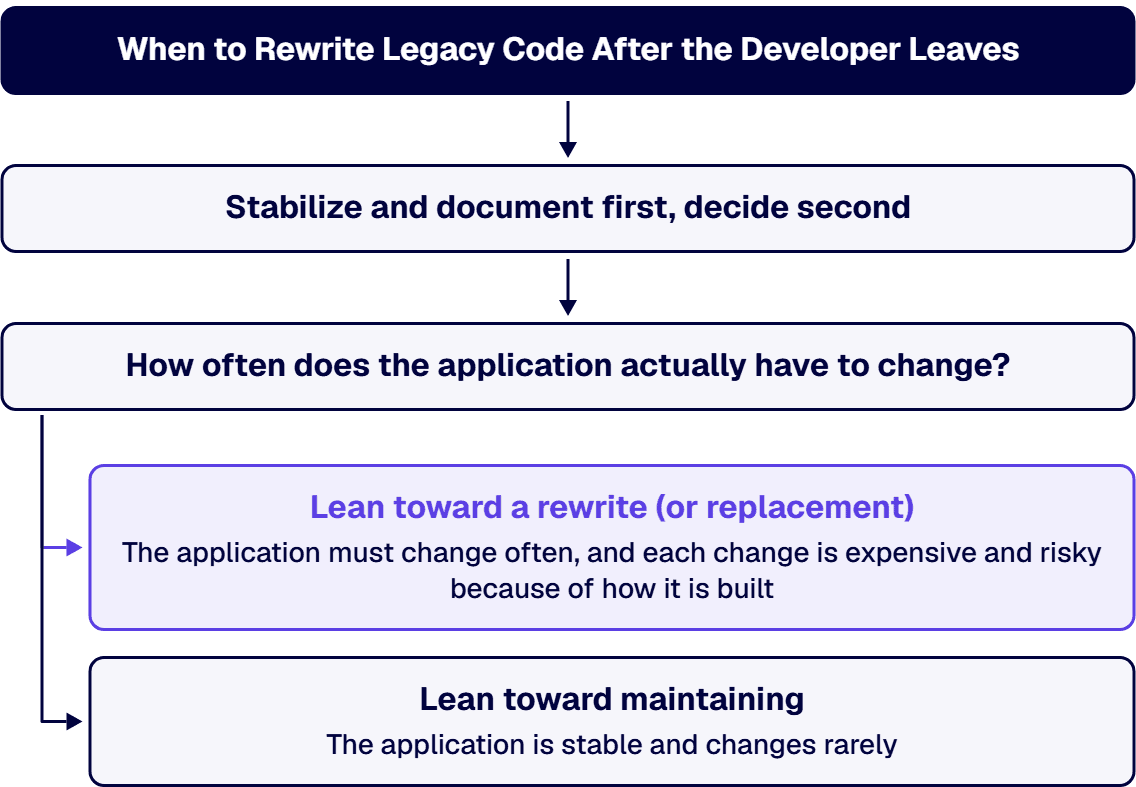
Lean toward a rewrite (or replacement) when:
Lean toward maintaining when:
A note on technical debt, because it is usually the word attached to these systems. Identify technical debt by its interest rate, not its age: debt that matters is debt you keep paying for, in the form of slow changes, repeated incidents, and workarounds that beget workarounds. When technical debt increases unaddressed, the effect is compounding, each change gets slower and riskier than the last, until routine maintenance consumes the capacity that should go to new work. That trajectory, not the calendar age of the code, is what should push a maintain decision toward a rewrite. A stable application with high notional debt that nobody is paying interest on is a weaker rewrite candidate than a younger one you fight every week.
Two guardrails on the decision itself. First, decide against a defined baseline: the recovered logic, the real change frequency, and the measured cost of failure, not an estimate you cannot defend to finance. Second, keep the paths distinct. If the honest problem is a stalled or failed delivery rather than an inherited unowned system, that is a different play, covered in rescuing a failed Microsoft modernization. If the question is broader modernization strategy across a portfolio, start from the application and legacy modernization service view instead.
The honest answer: AI is a real accelerator for the parts of this problem that are about reading, and it is not a substitute for the parts that are about judgment. Treat it as a tool for the stabilization stage, not as a shortcut around the decision.
Can AI rewrite legacy code? In the literal sense of translating source from one language or framework to another, assisted tooling can produce a draft. But a mechanical translation of undocumented code reproduces the behavior you already could not explain, now in a new language, and you still cannot explain it. The translation does not recover intent. It preserves the black box.
Where AI genuinely helps:
Where it does not help, and where relying on it is dangerous:
Used well, AI shortens the path to a system you understand. It does not make the rewrite-versus-maintain decision for you, and it does not excuse skipping the stabilization work that makes any decision safe.
Sometimes the disciplined answer is to not rewrite at all, and it is worth saying so plainly. If an application is stable, changes rarely, runs on a platform with a supported future, and its real problem was that nobody owned it, then the right move is to document it, test it, name an owner, and leave it alone.
How to maintain legacy code in that situation is a matter of turning the stabilization work into a durable, low-cost standing state rather than a one-time scramble:
A rewrite is a large, risky investment. Spending it on an application that is not asking for change is how organizations manufacture the very risk they were trying to avoid. Maintaining a well-owned, well-documented, low-change system is not deferring the problem. For that class of application, it is the answer.
Whichever path you choose, the exit state is the same: the application is owned. You know you are done when four things are true.
That last point is what breaks the key-person-risk cycle for good. The failure was never that a developer left. It was that everything they knew left with them. A decision record and living documentation mean the next departure is a staffing event, not a crisis. This continuity-through-ownership approach is the same one behind i3solutions’ work with a national professional-standards board, whose legacy platform was migrated and integrated while day-to-day operations continued without interruption, documented in the FSBPT case study. For modernization programs where security and compliance evidence are part of the exit criteria, the same discipline is framed in security-aware Microsoft modernization, and the broader trade-off between moving fast and governing well is treated in governance-first versus speed-first modernization.
Rewrite when the platform is near end of support or its skills are scarce, when the application must change often and each change is expensive because of how it is built, and when the business logic has already been recovered so you are rebuilding a known thing rather than a black box. Rewriting is rarely justified for a stable application that changes rarely, and it should never begin before the existing logic is understood, because an unrecovered rewrite simply relocates the unknowns into new code.
AI can draft a translation of code from one language or framework to another, and it genuinely accelerates comprehension, documentation, and test generation. What it cannot do is recover intent that was never written down or carry accountability for validation in a regulated environment. A mechanical AI translation of undocumented code reproduces behavior you still cannot explain, now in a new language. Use AI to help you understand the system faster, not to skip understanding it.
Because the code records what it does but rarely why, and the why is what you need to change it safely. When the person who held that context has left, and there are no tests to tell you whether a change preserved the behavior the business relies on, every edit becomes a gamble that no one on the team is positioned to judge. The difficulty is missing knowledge and missing safety nets, not the syntax of the code.
The most common are undocumented business logic, credentials and access tied to individuals rather than roles, no automated test coverage, and hidden dependencies that break silently when something upstream changes. Underneath all of them sits the core problem in an inherited system: no one remaining can reliably tell a safe change from a dangerous one, so change either stops or ships on faith.
Take ownership before you make decisions. Inventory the application’s parts, move access to named roles, map what depends on it, recover the business logic from the running system, and establish a tested change path with characterization tests. Only once the system is visible and safe to touch should you decide whether to rewrite, maintain, or replace it, and then record that decision with its reasoning so the knowledge does not leave again with the next person.

US-Based | Est. 1997
© i3solutions. All rights reserved.
US-Based | Est. 1997
© i3solutions. All rights reserved.


