

Staff hours went into phone-captured borrower data entry through a parent-company transition.
The client is a regional mortgage originator group in the mid-Atlantic region that built its reputation on exceptional customer experience and trusted advisor relationships with its clients. That reputation is earned in the hours staff spend with borrowers, and daily operations were spending those hours somewhere else. Borrower details arrived by phone, staff retyped them into the mortgage system, and the same information was entered redundantly across multiple systems. The repetitive work was not a back-office nuisance; it consumed the time the team exists to spend helping clients find mortgages that meet their needs.
The second challenge had a clock on it. The group was moving between parent companies, and it needed to maintain its existing client base and business operations through the transition: client records had to stay accessible and service quality had to hold while the organization around the team changed. The group wanted its data processes simplified so less time went to repetitive tasks, and it wanted continuity engineered rather than hoped for. i3solutions delivered two connected builds: a client-facing website that captures borrower information once and routes it to the team automatically, and a SharePoint portal that carried client operations through the organizational change.
A regional mortgage originator’s staff spent their time re-typing borrower details captured over the phone instead of serving clients, a problem that only got harder during a parent-company transition. i3solutions replaced phone intake with an online questionnaire, lifting productivity 75%.
The change produced a 75% improvement in customer service quality and team productivity, since capturing borrower and co-borrower information at the source freed staff from repetitive manual phone data entry, cut administrative costs from redundant entry across multiple systems, and let the same team serve more clients without adding headcount.
The Same Borrower Was Being Typed In Twice
The redundancy was structural, not sloppy. Intake arrived over the phone, so a staff member captured the details once in conversation, then entered them into the mortgage system, and the same information had to reach other systems as well. Every prospective borrower generated repeated manual entry of identical data, and the time it consumed was time the group was already paying for. Leadership set the goal plainly: reduce the time spent on repetitive tasks so the team’s hours went back to clients.
The parent-company transition turned a productivity problem into a timed one. The group could not pause originating loans while its ownership changed, and it could not let client records become unreachable mid-move. The decision was one engagement with two connected builds: automate the intake step that was consuming the hours, and stand up a platform that would keep client information accessible and operations running while the organizational change played out.
Redundant data entry and a risky parent-company transition were solved with a single questionnaire-driven intake system. If your organization is facing a similar combination of manual intake and organizational change, one system can often address both.
Hours Lost Daily, Continuity at Risk Once
The intake cost recurred with every new borrower. Each phone-captured inquiry meant another round of manual entry into the mortgage system and the systems beside it, so administrative cost scaled with exactly the thing the group wanted to grow: new clients. Capacity was capped at what the current staff could retype, and the service experience the group is known for depends on responsiveness that data entry was quietly taxing.
The transition risk was different in shape: not a recurring drain but a single window in which things could break. A move between parent companies with client records scattered across systems risked downtime, data loss, and staff unable to reach client information when clients called. For a group whose business is trusted advisor relationships, losing continuity of service during the transition meant risking the existing client base itself.
Intake That Serves Borrowers, Records That Survive a Transition
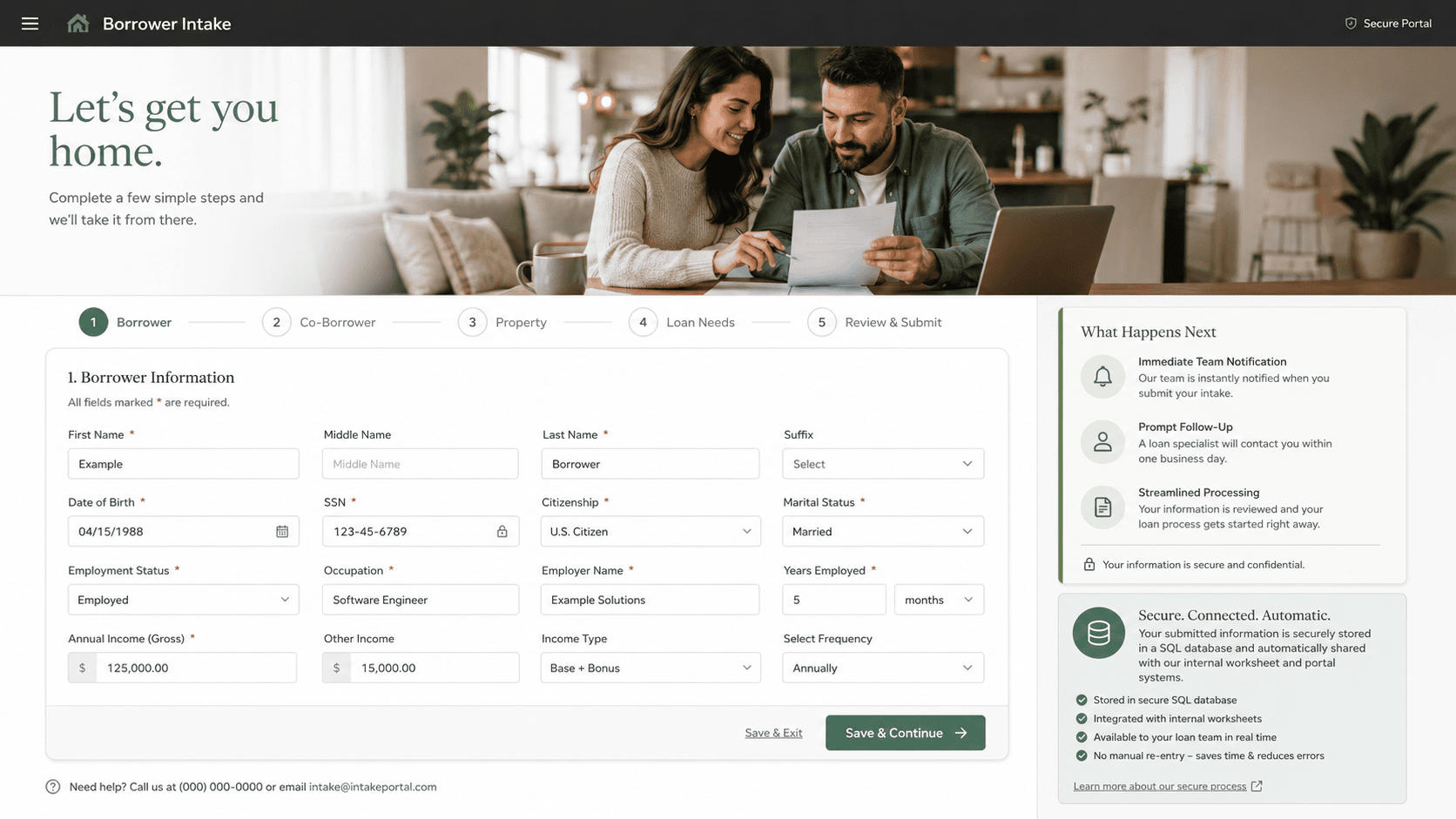
The intake build had constraints on both sides of the form. For borrowers, submitting had to be simple: a questionnaire detailing their mortgage needs, capturing borrower and co-borrower information in one pass. For staff, the output had to land where the team actually works: a database of record and the Excel spreadsheets the group relies on, populated automatically. And speed of response could not be an afterthought; the point of automating intake was to make the first human touch a prompt contact with the prospective borrower, establishing a responsive service relationship and gathering any additional necessary information.
The continuity build had to work mid-transition, not after it. Client data had to be imported into the new platform rather than rebuilt, the portal had to be web-based so team members could reach client information and collaborate from any remote location, and business operations had to continue without interruption while the group moved between parent companies. Both builds had to preserve the service quality the group’s reputation rests on, throughout the change rather than once it settled.
Senior Microsoft Specialists with Proven Delivery Depth
The requirements defined the vendor profile: a team that could design and implement a client-facing web application with a Microsoft SQL Server back end, wire automated population of Excel spreadsheets and immediate email and phone notifications into it, and install SharePoint with the group’s client data imported, all delivered while the group kept originating loans through an ownership change. This was two builds that had to behave as one solution, with no tolerance for a continuity gap in the middle.
The group engaged i3solutions, a Microsoft Partner with 30 years of delivery experience and 1,500+ Microsoft engagements, delivered by an all-senior, all US-based delivery team. That profile matched the work: senior engineers who have built intake, database, and SharePoint collaboration systems on the Microsoft stack repeatedly, and who could deliver both halves of the engagement without adding risk to a transition that already carried enough.
i3solutions delivered two connected builds: an automated client intake system that captures borrower information once and moves it to the team without retyping, and a SharePoint portal that kept client operations running through the transition between parent companies.
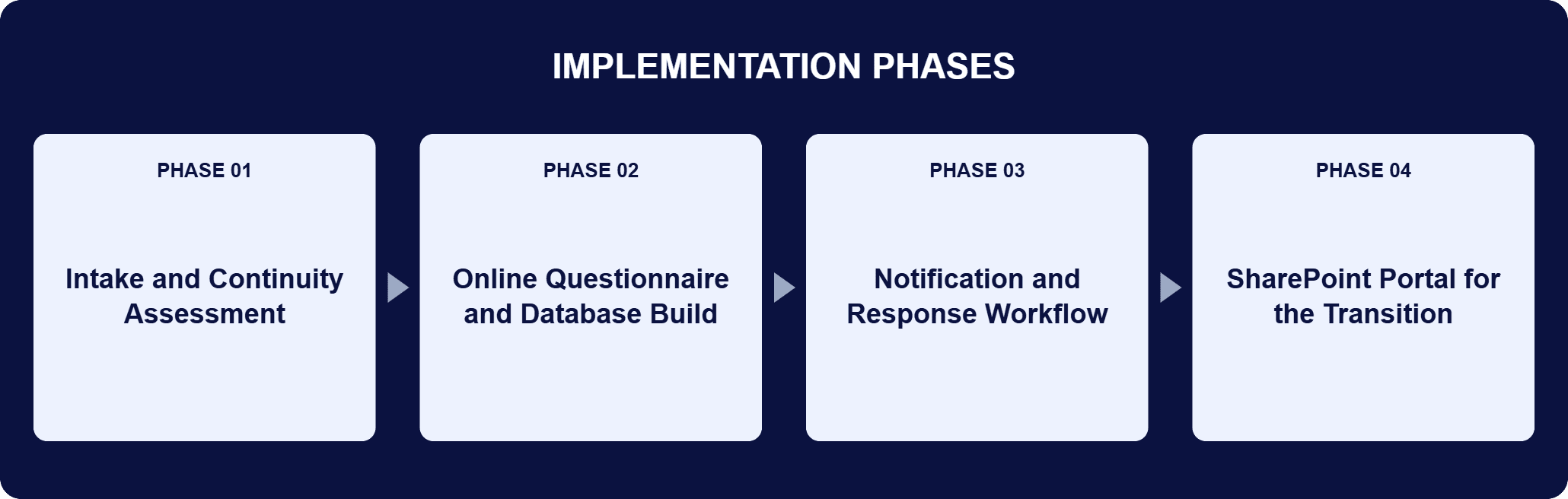
PHASE 01
Intake and Continuity Assessment
i3solutions worked through where borrower information entered the group’s operations: which details arrived by phone, where staff retyped them, which systems held redundant copies, and what the parent-company transition put at risk. The assessment scoped both builds: the questionnaire that would capture data once, and the portal that would keep client records reachable through the change.
PHASE 02
Online Questionnaire and Database Build
i3solutions developed a website where clients electronically submit a questionnaire detailing their mortgage needs. The system captures borrower and co-borrower information, stores it in a Microsoft SQL Server database, and automatically populates the Excel spreadsheets the team works from, removing the manual entry step at its source.
PHASE 03
Notification and Response Workflow
Upon submission, the group receives immediate email and phone notifications, enabling staff to promptly contact the prospective borrower, establish a responsive service relationship, and gather any additional necessary information, with no retyping between the borrower’s answers and the team’s follow-up.
PHASE 04
SharePoint Portal for the Transition
i3solutions installed SharePoint and imported the group’s client data, delivering a web-based portal where team members locate and manage client-related information and collaborate from any remote location. Business operations continued through the transition between parent companies without downtime or data loss.
The intake side of the solution runs a straight line from borrower to team. A client-facing website presents the questionnaire; the borrower describes their mortgage needs and enters borrower and co-borrower information; the submission lands in a Microsoft SQL Server database as the record of the inquiry; and the Excel spreadsheets the team works from populate automatically from that record. The moment a questionnaire arrives, email and phone notifications reach staff, so the first action on a new inquiry is a prompt call to the prospective borrower rather than a data entry session, and any additional necessary information gets gathered in that conversation instead of a second round of typing. The continuity side is SharePoint. i3solutions installed the platform and imported the group’s client data, producing a web-based portal where team members locate and manage client-related information from any remote location. During the transition between parent companies, that portal is what kept operations continuous: client information stayed accessible, the team kept collaborating, and the ownership change above the group never interrupted the client work in front of it.
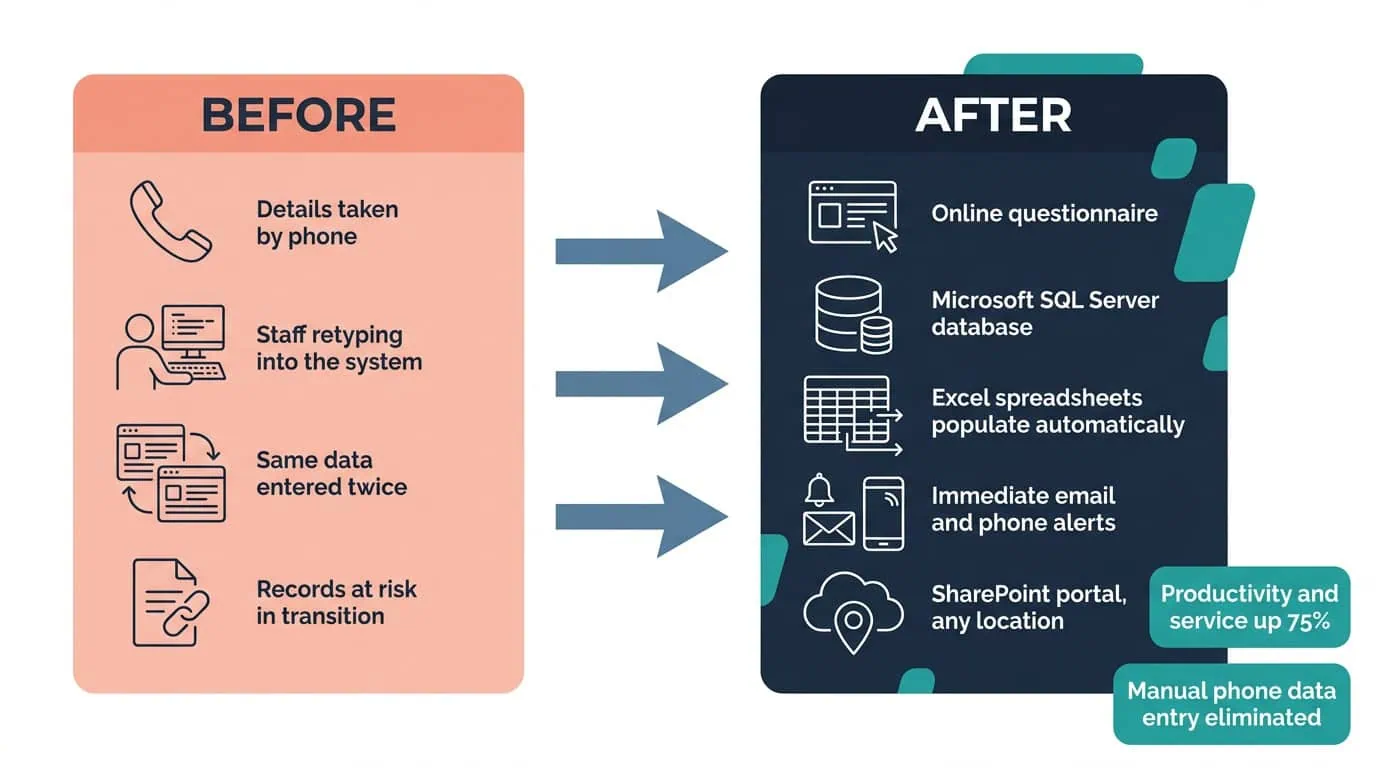
Productivity Up 75%
An online questionnaire with immediate staff notifications replaced manual phone data entry and freed capacity to serve more clients.
| Outcome | Before | After |
|---|---|---|
| Team productivity and customer service | Staff hours consumed by manual phone data entry | 75% improvement in customer service quality and team productivity |
| Administrative costs | The same borrower data entered across multiple systems | Significantly reduced by eliminating manual phone data entry into the mortgage system |
| Client capacity | Capped by time lost to repetitive data entry | More clients served with the same staff size |
| Borrower follow-up | Details captured by phone, then retyped before action | Immediate email and phone notifications the moment a questionnaire arrives |
| Operations through the parent-company transition | Downtime and data loss risk to client records | Continuous operations with client information accessible from any remote location |
The headline number is compound and the group reported it that way: a 75% improvement in customer service quality and team productivity, produced by one change. With the questionnaire capturing borrower and co-borrower information at the source, less of the team’s time is spent on data entry and more of it is devoted to helping clients find mortgages that meet their needs. Administrative costs came down significantly for the same reason: the manual phone data entry step into the mortgage system is gone, and with it the redundant entry across multiple systems.
The capacity result compounds the time result: the same staff size now serves more clients, because the constraint on growth was never headcount. It was the hours retyping consumed. And the continuity result is the one that had a deadline: through the transition between parent companies, the SharePoint portal prevented downtime and data loss and kept client information accessible from any remote location, so the existing client base experienced continuity of service while ownership changed above the team.

PENDING-CLIENT-QUOTE
This engagement is relevant for
Less relevant for
Borrower Data Entered Once, Client Operations That Survive an Ownership Change
The engagement established that the two problems taxing the group, redundant data entry and a risky organizational transition, had one delivery answer. A client-facing questionnaire now captures borrower and co-borrower information at the source, stores it in a Microsoft SQL Server database, populates the team’s Excel spreadsheets automatically, and reaches staff by immediate email and phone notification the moment a prospective borrower submits, which eliminated manual phone data entry, significantly reduced administrative costs, and let the same staff size serve more clients.
A SharePoint portal loaded with the group’s imported client data kept client information reachable from any remote location, and business operations continued through the transition between parent companies without downtime or data loss. The measured result of the intake change is a 75% improvement in customer service quality and team productivity, on a team whose reputation rests on both.
An automated client intake system replaces phone-captured, hand-retyped borrower details with a single electronic capture that feeds every downstream artifact. In this engagement, i3solutions built a website where clients electronically submit a questionnaire detailing their mortgage needs. The system captures borrower and co-borrower information, stores it in a Microsoft SQL Server database, and automatically populates the Excel spreadsheets the team works from. Immediate email and phone notifications tell staff the moment a submission arrives, so the first action on a new inquiry is contact with the prospective borrower, not data entry. The defining property is that information is entered once, by the borrower, at the point of origin; everything after that, the database record, the spreadsheets, and the notification, happens without a person retyping anything into another system.
By starting from where information gets entered today and which handoffs are still manual. For this group, the costly handoff was specific: borrower details taken over the phone and retyped into the mortgage system, with the same data entered redundantly across multiple systems. The automation targeted exactly that step: a web questionnaire captures the data, a Microsoft SQL Server database holds it, Excel spreadsheets populate from it, and immediate notifications move the team to the borrower. i3solutions also scopes for the operational moment the client is in. This group was moving between parent companies, so the engagement paired the intake build with a SharePoint portal that kept client records accessible and operations running through the transition. The results were measured where the work changed: significantly reduced administrative costs, more clients served with the same staff size, and a 75% improvement in customer service quality and team productivity.
i3solutions installed SharePoint and imported the group’s client data, producing a web-based portal where team members quickly locate and manage client-related information. Because the portal is web-based, the team could collaborate from any remote location, which mattered during a transition in which the organization around them was changing. The continuity results were the point of the build: business operations continued without downtime or data loss, client information stayed accessible throughout the organizational change, and the group preserved the continuity and service quality its client relationships depend on. The portal also outlasts the transition it was built for: locating and managing client-related information in one web-based place remains how the team works after the ownership change, not just during it.
The measured headline is a 75% improvement in customer service quality and team productivity, produced by removing the manual entry step: less of the team’s time is spent on data entry, and more of it is devoted to helping clients find mortgages that meet their needs. Administrative costs came down significantly because staff no longer retype phone-captured data into the mortgage system, and the same staff size now serves more clients, which is capacity gained without a hiring cost. On the continuity side, the SharePoint implementation prevented downtime and data loss during the transition between parent companies and kept access to client information intact throughout. Because intake recurs with every new borrower, the saving recurs with every submission: each questionnaire that arrives is one more inquiry that never generates a round of manual entry.
That is the situation this engagement covered. The group had to maintain its existing client base and business operations during a transition between parent companies, while client records lived across multiple systems. i3solutions installed SharePoint and imported the group’s client data, giving the team a web-based portal for locating and managing client-related information and collaborating from any remote location for the duration of the change. The outcome was continuity in both senses that matter: operationally, business continued without downtime or data loss, with client information accessible throughout; commercially, the group preserved the service quality its trusted advisor relationships are built on, so the clients experienced a team that kept working while the ownership above it changed. The transition became an internal event rather than a client-facing one.
i3solutions is a Microsoft Partner with 30 years of delivery experience and 1,500+ Microsoft engagements, with every engagement staffed by an all-senior, all US-based delivery team. That profile fits intake automation for client-facing teams, where the build touches live revenue: the system has to capture borrower and co-borrower information completely, land it where staff already work, and make the team faster to respond, not slower. This engagement is representative of the pattern: a questionnaire website on Microsoft SQL Server with automatic Excel population and immediate email and phone notifications; a SharePoint portal that carried operations through a parent-company transition without downtime or data loss; and a 75% improvement in customer service quality and team productivity. For teams weighing this class of work, a short scoping conversation establishes what automated intake would take in your environment.
Yes, that was the exact condition this platform had to operate under. The SharePoint-based intake system kept client records accessible and operations running through this mortgage group’s move between parent companies, rather than requiring a pause while systems were reconciled. The same automation that replaced manual phone-based data entry also meant the team could keep serving clients during the transition instead of absorbing a second disruption on top of it.
Capturing borrower data once, at the source, is what drove this improvement, not additional headcount. We’re glad to talk through what a comparable intake redesign would look like for your team.

US-Based | Est. 1997
© i3solutions. All rights reserved.
US-Based | Est. 1997
© i3solutions. All rights reserved.


