

A well-defined performance and salary review process wasn’t consistently followed across a global contractor’s management chain.
The client is a global defense contractor whose scale makes process consistency a management problem in its own right: every business unit runs performance appraisals and salary reviews, and the company had invested in getting the process right on paper. It had developed a well-defined and complex process for its managers to complete performance and salary reviews, with established standards covering how an appraisal is completed, how a salary review follows it, and how much of a pay increase each department is allotted.
The process on paper was not the process in practice. The company’s main concern was that the processes were not consistently followed by all of the managers, and, in some cases, the timeliness of reviews was delayed. Every review also carried paperwork, and the whole cycle depended on managers remembering to start it. To make the process easier for managers to complete and, in turn, ensure adherence to the established standards, the company sought to develop an automated web-based system to manage performance appraisals, enforce consistency, and improve the timeliness of reviews.
A global defense contractor had a well-documented performance review process that its managers weren’t consistently following in practice. i3solutions automated merit calculations and paperless routing so every department completes reviews on time and on budget.
The system enforces the company’s review process for every manager, fires email notifications when reviews come due, and calculates each merit increase by job grade while keeping every department within its salary budget automatically.

A Well-Defined Process Is Only as Good as Its Adherence
The company had already done the hard part of performance management: it had a defined process, established standards, an approval structure, and an allotted pay increase percentage for each department. What it did not have was enforcement. A complex process that lives in documentation gets followed the way each manager remembers it, and at this company that meant inconsistent execution across managers and reviews that, in some cases, ran late.
Leadership concluded the fix was not more reminders but a system that carries the process itself: an automated, web-based platform that would take each manager through the review the way the standard specifies, gate the salary review behind the performance review’s approval, and enforce consistency and timeliness as properties of the system rather than habits of the managers.
This contractor’s review process was well documented but inconsistently followed until the system itself enforced it. If your organization has the same gap between policy and practice, that’s a solvable architecture problem, not a training one.
A Standard That Is Not Enforced Is a Suggestion
Left as it was, the gap between the defined process and the followed process recurred with every review cycle. Some managers followed the established standards and some did not, so the consistency the process was designed to guarantee existed only where individual managers supplied it. Late reviews compounded the problem: a review that runs late is a review whose timeliness concern has already materialized, and the company had no mechanism that flagged one before it slipped.
The salary side raised the stakes further. Each department is allotted a pay increase percentage, and merit increases are supposed to follow job grade. Without a system maintaining each department’s salary budget and calculating the eligible merit increase range, staying within those limits depended on the same manual diligence that was already failing to keep reviews consistent and on time.
Enforce the Existing Process, Not a New One
The defining constraint was that the process itself was not up for redesign. The company had a documented standard it wanted followed, so the system had to encode that standard exactly: the performance review completed first and systematically, an approval process gating the salary review, merit increase ranges calculated by job grade, and each department held to its salary budget. The engagement was enforcement engineering, not process consulting.
The second constraint was the split between the people who define the process and the people who execute it. Human resources needed to administer the system itself: defining review cycles for the individual business units and setting up the email notifications that fire when reviews come due. Managers needed the opposite of administration: a system that notifies them to log in and then takes them through the review step by step, replacing the paperwork rather than adding a tool on top of it.
Senior Microsoft Specialists with Proven Delivery Depth
The requirements defined the vendor profile: a team that could design and develop an online system on the Microsoft .NET framework, translate a complex established review process into enforced application logic with an approval workflow in the middle of it, and build the merit calculation and department budget tracking that give human resources control of the outcome. This was a custom web application delivered as workflow automation, and it had to reproduce the company’s standard faithfully because the standard, not the software, was the point.
The company engaged i3solutions, a Microsoft Partner with 30 years of delivery experience and 1,500+ Microsoft engagements, delivered by an all-senior, all US-based delivery team. That profile matched the work: senior engineers who have built approval-driven business systems on the Microsoft stack repeatedly, and who could turn a documented process into a system that enforces it without flattening the complexity the company had deliberately built into its standard.
i3solutions designed and developed an online performance appraisal and salary review system on the Microsoft .NET framework: one web-based system that notifies managers, walks each review through to approval, and enforces the company’s review standards end to end.
PHASE 01
Review Process Capture
The company’s established review process became the system’s specification. i3solutions worked from the established standards: the sequence a performance review must follow, the approval that must complete before a salary review can begin, the merit increase ranges eligible for each job grade, and the pay increase percentage allotted to each department.
PHASE 02
HR Administration and Review Cycles
The system gives the human resources department direct administrative control: HR defines the review cycles for the individual business units in the company and sets up the email notifications that fire when reviews are due, so the schedule lives in the system rather than in anyone’s calendar.
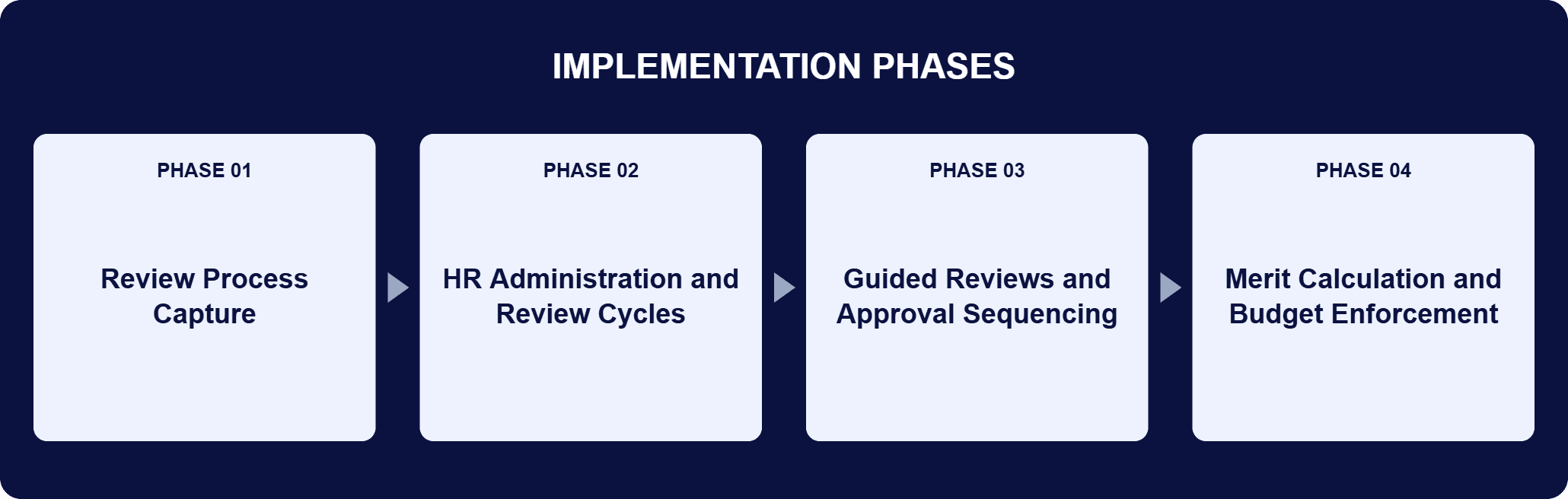
PHASE 03
Guided Reviews and Approval Sequencing
The system automatically notifies managers that they need to log in and complete reviews, then systematically takes each manager through the completion of the performance review. Once the performance review is completed, it must go through an approval process before the salary review can begin.
PHASE 04
Merit Calculation and Budget Enforcement
Upon approval, the system calculates the appropriate merit increase range eligible for a given job grade and provides that information to the manager and to human resources. It also maintains a salary budget for each department, ensuring managers stay within the allotted pay increase percentage, and the paperwork that used to come with employee reviews is gone.
The system is a web-based application built on the Microsoft .NET framework, and its architecture follows the company’s own division of responsibility. Human resources administers the frame: the department defines review cycles for the individual business units and sets up the email notifications that fire when reviews come due, so cadence and coverage are configuration, not coordination. Managers work inside the frame: the system notifies them to log in, then takes them through the performance review systematically. That is how a complex process gets followed by every manager, not just the diligent ones. Sequencing is enforced structurally: a completed performance review must pass through an approval process before the salary review can begin, so the order the standard specifies is the only order the system permits. The salary review then runs on calculated ground: the system computes the merit increase range eligible for the employee’s job grade and provides it to both the manager and human resources, while a per-department salary budget keeps every manager within the allotted pay increase percentage. The paperwork that previously accompanied employee reviews is eliminated outright.

Reviews On Time, Every Time
An online .NET system sequences reviews through approval and enforces the company’s own business rules automatically.
| Outcome | Before | After |
|---|---|---|
| Process adherence | Well-defined process not consistently followed by all managers | The system takes every manager through the performance review systematically, enforcing the company’s business rules |
| Review timeliness | Timeliness of reviews delayed in some cases | Reviews completed on time, with email notifications firing when reviews come due |
| Salary review sequencing | Adherence to the defined order dependent on each manager | Approval process must complete before the salary review can begin |
| Merit increases and budgets | Staying within the allotted pay increase percentage dependent on manual diligence | The system calculates the merit increase range by job grade and maintains each department’s salary budget |
| Review paperwork | Paperwork involved in completing every employee review | Eliminated; the process runs online end to end |
This engagement’s outcomes are operational rather than numeric, and they map one-to-one onto the concerns that triggered it. The consistency concern is closed structurally: the system takes every manager through the performance review the same way, so the established standards are enforced by the application rather than by reminders. The timeliness concern is closed the same way: reviews are completed on time because the system notifies managers when reviews come due and tracks them through completion. The paperwork involved in completing employee reviews is eliminated entirely.
The budget outcome is the one with the most money attached. The system maintains a salary budget for each department and calculates the merit increase range eligible for each job grade, providing both to the manager and to human resources, so performance and salary reviews complete not just on time but within budget, and departments stay within the increase they were allotted as a system property rather than a hoped-for behavior. No engagement-specific figures beyond these were published for this program, and none are invented here.

PENDING-CLIENT-QUOTE
This engagement is relevant for
Less relevant for
The Review Process, Enforced by the System Instead of by Reminders
The engagement established that a complex, documented review process does not have to depend on managers to be followed. i3solutions built an online performance appraisal and salary review system on the Microsoft .NET framework: human resources defines the review cycles and notifications, the system walks each manager through the performance review, and an approval process gates every salary review behind its completed appraisal.
Merit increase ranges follow job grade, each department is held to its salary budget, and the paperwork that used to come with employee reviews is gone. Every salary review in the company now begins from an approved appraisal and a calculated merit range.
It is a web-based application that carries an organization’s review process instead of documenting it: the system notifies managers when reviews are due, takes each manager through the performance appraisal step by step, and sequences the salary review behind an approval process. For this global defense contractor, i3solutions built the system on the Microsoft .NET framework with human resources as its administrator: HR defines review cycles for the individual business units and configures the email notifications that fire when reviews come due. The distinguishing property is enforcement. A documented process depends on each manager to follow it; a system-carried process is followed by construction, because the application takes every manager through the same steps in the same order. It also replaces the paperwork that a manual review process generates with an online record from start to finish.
By treating the existing standard as the specification rather than a starting point for redesign. This company had a rigorously defined process for performance and salary reviews; the concern was adherence and timeliness, not the process itself. i3solutions therefore encoded the standard directly: the system takes managers through the performance review the way the process specifies, requires the approval process to complete before the salary review can begin, calculates the merit increase range eligible for a given job grade, and maintains each department’s salary budget so managers stay within their department’s limit. Administration went to the people who own the process: human resources defines review cycles per business unit and sets up the notifications. The result is a custom web application, delivered as workflow automation, that enforces business rules the company had already written.
That was precisely the situation at this company: a well-defined but complex review process that managers did not all follow, with some reviews running late. i3solutions replaced the manual steps with an online system that notifies managers when their reviews are due and then takes them through the performance review in order, so the rules the process already specified are enforced by the system rather than by reminders. Consistency stops being a training outcome and becomes an application property: every manager sees the same sequence, the salary review cannot start before the performance review is approved, and human resources can see the cycle running instead of chasing it. Timeliness improves for the same reason, because the notification and the workflow live in the same system that tracks the review to completion.
Yes, and the salary side is where the system does its most consequential enforcement. A completed performance review goes through an approval process before the salary review can begin, so compensation decisions always rest on an approved appraisal. Once it is approved, the system calculates the merit increase range eligible for a given job grade and gives that figure to the manager and to human resources, which replaces ad hoc judgment with the company’s own compensation structure. It also maintains a salary budget for each department, so managers stay within the pay increase percentage allotted to them, and human resources can see budget adherence across departments rather than discovering overruns after the cycle closes. The outcome the company measured itself against was reviews completed on time and within budget, and the salary controls are what deliver the second half.
It is a web-based application built on the Microsoft .NET framework. Human resources administers it: the department defines review cycles for the individual business units and sets up the email notifications for when reviews come due, and the system handles the notifying and sequencing from there. That division of labor is deliberate. The people who own the review standard control its schedule and coverage without needing developers, and managers never administer anything: they receive a notification, log in, and are taken through the performance review systematically. Because administration is configuration rather than coordination, a new review cycle for a business unit is a setup task in the system, not a campaign of emails, and the paperwork that previously accompanied employee reviews has no role in the process at all.
i3solutions is a Microsoft Partner with 30 years of delivery experience and 1,500+ Microsoft engagements, with every engagement staffed by an all-senior, all US-based delivery team. This engagement shows the pattern that profile produces: a global defense contractor’s complex, established review process encoded faithfully into a .NET web application, with an approval process gating salary reviews, merit increase ranges calculated by job grade, per-department salary budgets enforcing each department’s increase limit, and the review paperwork eliminated. The hard part of this class of work is fidelity: the system has to enforce the process the company actually wrote, not a simplified version of it. For organizations weighing similar work, a short scoping conversation establishes what automating your review cycle would take in your environment.
Gating every salary review behind a completed, system-enforced appraisal is what closed the compliance gap here. We can walk through what a comparable enforcement layer would look like in your review process.

US-Based | Est. 1997
© i3solutions. All rights reserved.
US-Based | Est. 1997
© i3solutions. All rights reserved.


