

Proposal preparation ran through scattered repositories and manual validation, slowing submissions across hundreds of bids a year.
The client is a global aerospace and defense engine manufacturer that designs and builds advanced aircraft engines and auxiliary power systems, serving a clientele that ranges from commercial airlines to military and business aviation. In that market, contracts are won on proposals: detailed, compliant submissions that stand out for both quality and timeliness, produced across hundreds of bids a year by engineering, pricing, and capture teams working in parallel.
The company faced a persistent challenge in delivering on-time, compliant, and competitive proposals. There was no centralized system for managing proposal information: templates, historical data, and best practices lived in scattered documents, and the departments involved in a proposal did not work from the same information at the same time. The result was bottlenecks, delays, and increased risk in the proposal development process, with preparation running 10 days per submission and delivery targets slipping.
The manufacturer’s proposal teams worked from scattered repositories and manual validation, slowing submissions across hundreds of annual bids. i3solutions centralized the process on the Microsoft stack the company already owned, lifting win rate 5% and adding more than $50 million in awarded contracts.
Proposal preparation time fell 35%, from 10 days to 6.5, freeing $800,000 a year in redeployed staff capacity, and rework dropped 30% while document access across engineering, pricing, and capture teams got 40% faster.

Contracts Were Won and Lost on Timeliness
In aerospace and defense, a proposal that arrives late or falls short on compliance does not get a second reading; the contract goes elsewhere. The company’s proposal process carried exactly those risks: bottlenecks and delays built into a decentralized way of working, and quality that depended on individual effort rather than a system.
The company decided the process needed a real-time system of record for proposals, customizable down to the finest detail, that fit the way its bids actually moved rather than forcing the process to fit a tool. After an exhaustive search, it selected i3solutions to build that system.
This manufacturer’s proposal system runs on the same Office 365 stack many organizations already license, shaped by an analysis of how proposals actually moved through the company. If your organization already has the platform, the gap is usually the process design, not another tool.
Every Late Proposal Is a Lost Contract
The direct stake was revenue: the outcomes ultimately measured, a 5% win-rate increase worth more than $50M in additional awarded contracts in the first year, are also a measure of what the strained process had been leaving on the table. Preparation effort itself was expensive, later quantified at $1M in annual savings and $800K in redeployed staff capacity once fixed.
The compliance dimension carried its own risk. Defense proposals answer exacting requirements, and rework and late corrections, later reduced by 30%, were both a schedule threat and a quality threat. A process that routinely slipped its delivery targets put the company’s standing with its customers at risk on every bid.
Regulated Environment, Hundreds of Concurrent Bids
The system had to work inside the company’s working patterns and industry constraints, not against them. That included the security environment: web access for distributed teams with advanced security rules applied for SharePoint Online and GCC High, the compliance-grade cloud used for defense work. It also included scale, with hundreds of bids in flight and cross-team coordination on each.
A second constraint came from licensing: the system had to be built from the Microsoft products the company already owned rather than new tooling. That constraint shaped the architecture: Power Apps, SharePoint, Teams, Dynamics, Power BI, and Flow on the Office 365 platform, integrated into one working application, with no separate vendor patch cycle to manage.
Senior Microsoft Specialists with Proven Delivery Depth
The company searched for a partner who could build a custom proposal management system tailored to its specific development needs, and i3solutions reviewed the company’s full list of requirements before committing, to ensure the delivered system would be the right one.
The company selected i3solutions, a Microsoft Partner with 30 years of delivery experience and 1,500+ Microsoft engagements, delivered by an all-senior, all US-based delivery team. The fit was the stack itself: a proposal platform assembled from six Office 365 components demands senior engineers who have shipped each piece in production, in regulated environments.
i3solutions built the system around how proposals actually moved through the company, using Business Process Management analysis to shape both the platform and the process it serves.
PHASE 01
Business Process Mapping and Requirements Review
i3solutions applied BPM to analyze the company’s existing proposal development workflows, mapping each process to identify bottlenecks, redundant tasks, and opportunities for automation, and reviewed the company’s full requirements list against the planned solution.
PHASE 02
Architecture on the Platform Already Owned
i3solutions architected the system on the Microsoft platform the company already licensed, the full Office 365 stack, with advanced security rules for SharePoint Online and GCC High.
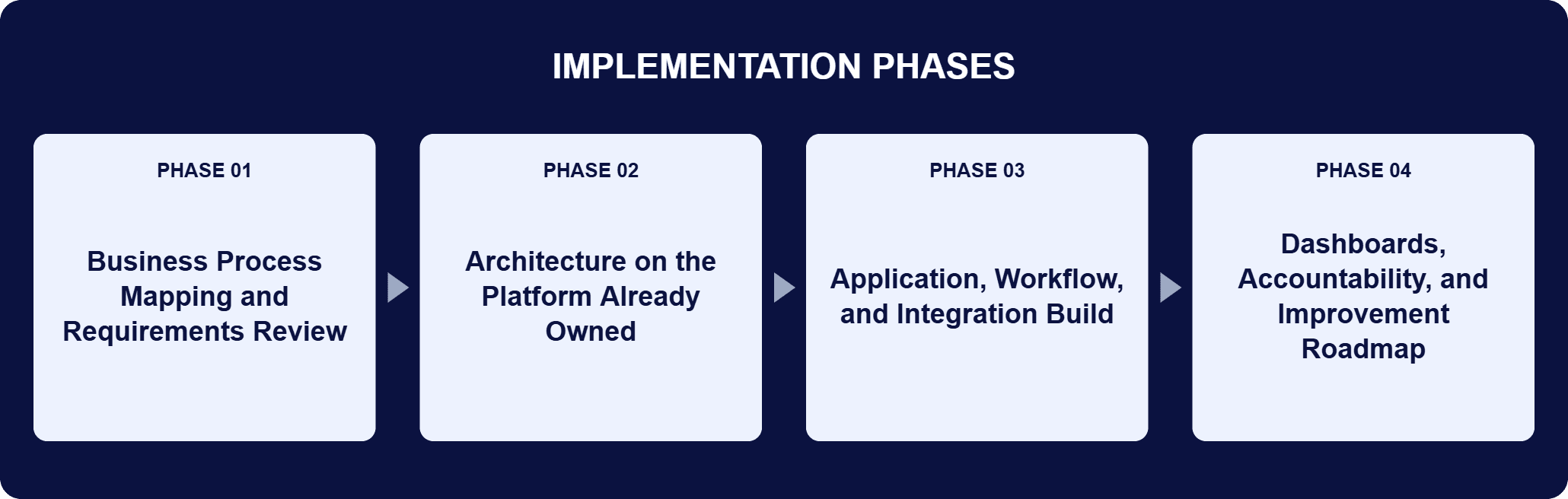
PHASE 03
Application, Workflow, and Integration Build
i3solutions built the Power Apps interface for managing opportunity details, due dates, task completion, approvals, and milestone tracking; the standardized SharePoint document backbone; and the Flow automations that control data sharing between Dynamics, SharePoint, Teams, Dataverse, Office 365, and other internal systems.
PHASE 04
Dashboards, Accountability, and Improvement Roadmap
Power BI reporting connected Dynamics and SharePoint into pipeline, status, and master-schedule views; the BPM work defined clear roles, responsibilities, and workflows for real-time monitoring; and the company received a roadmap for continuous improvement so the system can change as the proposal process changes.
The system runs on the Microsoft platform the company already owned. Power Apps provides the custom interface for managing opportunity details: due dates, task completion percentage, approval processes, workflows, milestone date tracking, and planned versus actual reporting. SharePoint acts as the backbone, storing all proposal and estimate documentation with an automatically standardized folder structure for every proposal. Teams carries real-time collaboration and distribution, giving every group access to the full system alongside native tools like chat, OneNote, and Planner. Dynamics provides the CRM layer, managing the business development pipeline and tracking proposal win and loss ratios as the company’s system of record. Power BI generates the reporting: opportunity status, the overarching pipeline, and the master schedule of due dates, drawn from Dynamics and SharePoint. Flow automates the workflows and controls all data sharing between Dynamics, SharePoint, Teams, Dataverse, Office 365, and other internal systems, carrying the business logic of how the system functions. Office 365 integrates it into one working application, with web access, current Microsoft code updates, no separate vendor patch cycle, and advanced security rules applied for SharePoint Online and GCC High.

Prep Time Down 35%, Win Rate Up 5%
Centralizing proposal resources cut preparation from 10 days to 6.5, reduced rework by 30%, and lifted win rate enough to add $1M in annual savings.
| Outcome | Before | After |
|---|---|---|
| Proposal preparation time | 10 days per submission | 6.5 days (35% faster) |
| Staff capacity | Consumed by manual preparation | $800K annually redeployed |
| Document access | Scattered repositories | 40% faster |
| Rework | Manual validation, late corrections | Reduced 30% |
The system centralized all proposal resources, cutting preparation time by 35% (from 10 days to 6.5). Teams reclaimed $800K annually in redeployed staff capacity and improved on-time delivery across hundreds of bids. Integrated communication tools and real-time dashboards connected engineering, pricing, and capture teams: 40% faster document access, fewer bottlenecks, and leadership visibility that improved decision-making and accountability across departments.
Automated validation workflows reduced rework by 30% and boosted compliance audit scores by 20%, minimizing late corrections and improving proposal accuracy. Efficiency gains and higher quality submissions drove a 5% increase in win rate, delivering $1M in annual prep savings and more than $50M in additional awarded contracts, a clear ROI realized within the first year. The company now exceeds its key performance indicators for proposal delivery: submissions that used to take 10 days of preparation now go out in 6.5, and delivery targets that used to slip are now met as a matter of routine.

“This process improvement is going to streamline adding users and reduce wasted time all around.”
Visual Communication Project Analyst
A global aerospace and defense engine manufacturer
This engagement is relevant for
Less relevant for
Built on the Platform the Company Already Owned
The system worked because it was built on the Microsoft platform the company already owned, shaped by BPM analysis of how proposals actually moved through the company. Nothing in the delivery depended on exotic tooling: the same Office 365 stack many organizations already license carried a proposal operation spanning hundreds of defense and commercial bids. The engagement also established that process and platform improve together, since the BPM work that shaped the system also produced clearer roles, fewer redundant tasks, and a roadmap for continuous improvement the company keeps using. The first-year results, 35% faster preparation, a 5% higher win rate, $1M in annual savings, and more than $50M in additional awarded contracts, made the return unambiguous.
For this manufacturer, it is a single real-time system of record for proposals, built on Power Apps, SharePoint, Teams, Dynamics, Power BI, and Flow on the Office 365 platform. It is the one place where users find everything a proposal needs: templates, historical data, best practices, and standardized document structures, alongside the cross-team communication tools that keep engineering, pricing, and capture teams working from the same information at the same time. In a market where contracts hinge on delivering detailed, compliant proposals on time, the system replaced scattered documents and disconnected teams with one platform, and cut preparation from 10 days per submission to 6.5.
In this engagement, i3solutions started with Business Process Management analysis rather than software: mapping the company’s existing proposal development workflows to identify bottlenecks, redundant tasks, and opportunities for automation, then recommending process changes alongside the platform build. The system was designed around the parameters that drive successful proposal delivery, inside the company’s working patterns and industry constraints, and built on the Microsoft licensing the company already owned. The BPM work also defined clear roles, responsibilities, and workflows for accountability, and left the company a roadmap for continuous improvement so the system can change as the proposal process changes.
Each component carries a defined role. Power Apps provides the custom interface for opportunity details, approvals, milestones, and planned-versus-actual tracking. SharePoint is the document backbone, generating a standardized folder structure for every proposal. Teams carries real-time collaboration and gives every group access to the full system. Dynamics manages the business development pipeline and win/loss tracking as the CRM system of record. Power BI reports on opportunity status, the pipeline, and the master schedule from Dynamics and SharePoint data. Flow automates workflows and controls all data sharing between Dynamics, SharePoint, Teams, Dataverse, Office 365, and other internal systems, and Office 365 integrates the pieces with web access and GCC High-grade security rules.
This engagement’s return was realized within the first year: proposal preparation time fell 35%, from 10 days to 6.5; the win rate rose 5%; annual preparation savings reached $1M; and the higher win rate delivered more than $50M in additional awarded contracts. Behind the headline figures sat operational gains that compounded, including $800K annually in redeployed staff capacity, 40% faster document access, 30% less rework, and compliance audit scores up 20%. A manufacturer estimating its own return should start with preparation hours per bid and bid volume, then weigh the win-rate leverage: in proposal-driven markets, even a small win-rate improvement dominates the labor savings.
i3solutions is a Microsoft Partner with 30 years of delivery experience and 1,500+ Microsoft engagements, with every engagement staffed by an all-senior, all US-based delivery team. This engagement used that depth across the full Office 365 stack, assembled into one system, secured for SharePoint Online and GCC High, and shaped by BPM analysis of the company’s actual workflows. The delivered system now exceeds the company’s key performance indicators for proposal delivery. A working session maps what a centralized system would look like on your stack, which pieces you already own, and comparable engagements to support the internal case.
The system is hosted entirely on Microsoft’s cloud infrastructure and updates automatically as Microsoft releases new features for the Office 365 platform, so there are no manual, vendor-specific software updates. The Business Process Management engagement also produced a roadmap for continuous improvement, so the system can change as the proposal process changes and the company’s own teams stay in control of where it goes next.
These first-year results came from process and platform improving together, not from either alone. We can talk through what a comparable proposal management overhaul would look like for your organization.

US-Based | Est. 1997
© i3solutions. All rights reserved.
US-Based | Est. 1997
© i3solutions. All rights reserved.


