
By Michael Branson
Hiring for Power Apps starts with one decision that comes before any request for proposal: which of four roles the need actually is, build (a developer), staff (staff augmentation), govern, or advise (an advisory partner). Build is for an application that is already defined and needs delivering; staff is for a roadmap you own that is short of senior hands; govern is for apps the business already built that IT has inherited; advise is for a decision nobody in the organization can settle, whether the application should exist at all, whether Power Apps is the right place for it, and what the environment and data loss prevention model should be before the first app is built. When two of the four look right at once, the role that answers the open decision outranks the role that adds capacity, and if the apps already exist and a business process depends on them, govern comes before all three. If your decision is already settled, the page that fits is Power Apps Development Services for delivery against a written definition, Hire Power Apps Developers and Experts for senior hands inside a roadmap you already own, or In-House IT Staff vs a Third-Party Firm for Power Apps for who should hold the platform.
If your team can already build the app but cannot agree on whether it should exist, that is not a development question and it is not a staffing question. It is the question this page answers. The four roles are not four grades of the same service. They differ by what is still undecided when the contract is signed, and that is the axis this page separates them on.
Build. You answered yes to the acceptance-criteria question: the requirement is written, the platform argument is over, and what you are buying is delivery against a definition you already hold. That is a development engagement, and what one covers is set out on Enterprise Power Apps Development Services for Secure, Governed Application Delivery. This page does not describe that work or compare its shapes, because a reader who can write the acceptance criteria today is better served on that page than on this one.
Staff. You answered yes to the named-owner question: someone on your side already holds the roadmap, the environment model and the support commitment, and the gap is senior people working inside them. That is a staffing engagement, and it is covered on Hire Power Apps Developers and Experts, U.S.-Based, for Microsoft Power Platform Projects. The point here is only that a staffing contract assumes the decisions are made, and that assumption is what makes it the wrong instrument when they are not.
Govern. You answered yes to the users question: apps are running, a process depends on them, and the author has moved on or was never accountable for a production system. That situation has its own sequence and its own page, and it is set out on Governing Citizen-Developer Power Apps IT Now Has to Own. This page does not repeat the sequence. It names the trigger and hands the reader over, because the governance case starts from apps that exist and the other three roles start from apps that do not.
Advise. You answered yes to the three-different-answers question, and none of the three roles above fits, because each of them needs a decision you have not made yet. An advisory engagement is bought to close that decision and to leave you holding what it produces: a platform-fit verdict for the process in question, and the environment and data loss prevention model the estate would run under. The test of such an engagement is narrower than a deliverables list, and it is worth writing into the scope: whether those two artifacts exist at the end, and whether your own team can act on them with the firm out of the room. The advisory role is the shortest of the four to specify, and a short specification is the easiest one for a proposal to answer with something else.
Two of the four can fit at the same time, and a document that enumerates four options without saying what happens when they collide has not settled anything. The precedence is this. Where apps are already running under a business process, govern outranks the other three, because a build or a staffing contract layered on an ungoverned estate adds to the estate that caused the problem. Where nothing is running yet and both advise and one of build or staff look right, the open decision outranks the capacity: capacity applied to an unsettled decision builds the wrong thing faster, and the application that results has no stated rationale to offer at the next review. And where the decision is genuinely made, written down as acceptance criteria or as a platform-fit verdict and agreed by the people who will live with it, advise is the wrong purchase and you should stop paying for it; a firm that cannot say so is not advising you.
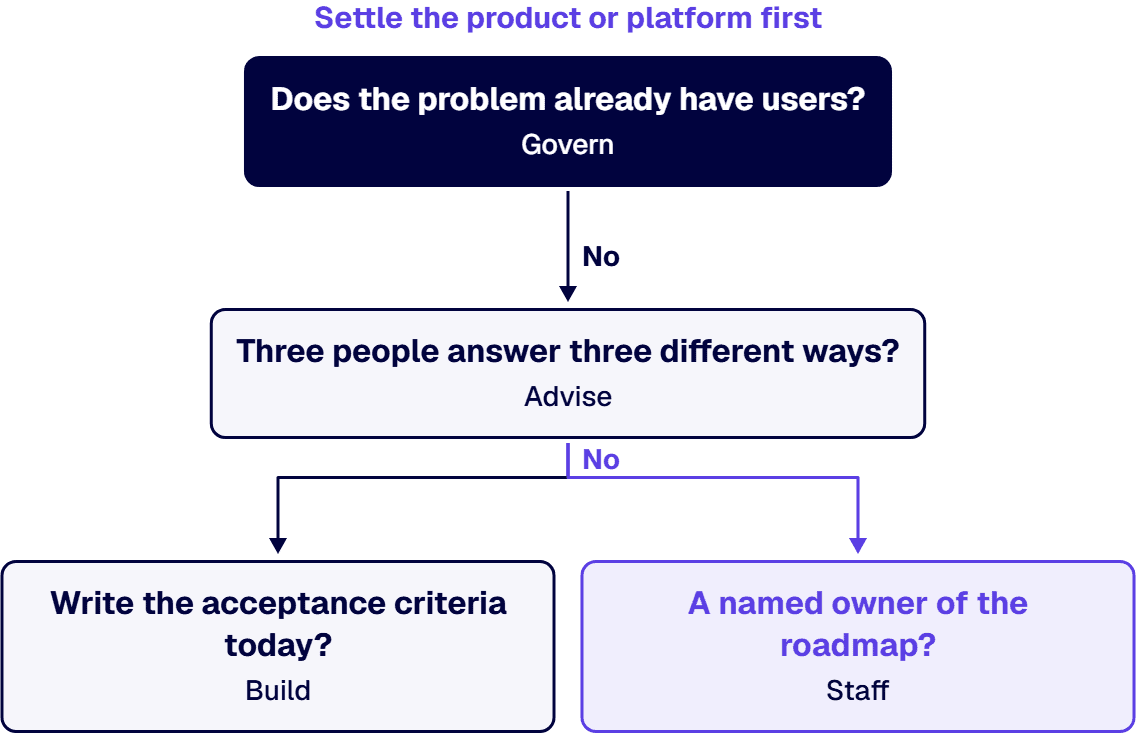
If the argument in your organization is still about which low-code product the application belongs in, you are on this page one decision too early. That is a product question and not a role question, and it is answered on Power Pages vs Power Apps: Which One a Given Application Needs. If the argument is about whether the process belongs on Power Apps or on a different vendor’s workflow platform, that is a platform question, and it is answered on Power Apps vs ServiceNow for Workflow Automation. Neither comparison is restated here. Settle the product or the platform first, then come back to the role, because the role you need depends on which decision is still open and a product argument is a decision still open.
The cost of choosing the wrong role is not a rounding error against the project, and two published figures give a reference point for the shape of it. For Microsoft-centric environments requiring multi-specialty coverage across M365, Azure, Power Platform, and security, external consulting typically costs $40K-$100K annually versus $125K-$175K+ for a single fully-loaded in-house hire who covers only one primary area, as set out on In-House IT vs. External IT Consultants: Total Cost of Ownership, and the same comparison for Power Apps is on In-House IT Staff vs a Third-Party Firm for Power Apps. That comparison is quoted exactly as it is scoped there, in-house hire against external multi-specialty coverage, and nothing between its endpoints is interpolated here.
Against that, capacity is priced by the person and by the month. Typical engagement ranges land at $28,000 to $48,000 per specialist per month for senior US-based Microsoft specialists with named platform depth (SharePoint, Power Platform, Microsoft 365 compliance, Azure security, Dataverse, .NET enterprise integration) and compliance literacy in CMMC 2.0 Level 2, HIPAA Security Rule, NIST 800-171 Rev 2, SOC 2, or DFARS 252.204-7012, as set out on Microsoft Team Augmentation for Regulated Enterprises: How IT Leaders Add Senior Capacity Without Adding Program Risk. Read the two bands side by side and the exposure is legible: capacity bought by the month to work on a question nobody has answered accrues at a capacity rate until the question is answered, and the answer is not a deliverable of a capacity contract. Neither band is a quote for your own engagement, and neither is offered as one; each is a published reference point your own scope is measured against.
If you have a single departmental application, a process owner who can state what the app must do, and an estate whose governance model is already written and in force, the role question above resolves to build and a decision guide is not what you need. Go to the development page and skip this one. The same holds one step further out: where a single senior person inside your own team can settle the platform-fit question from what they already know about the estate, an advisory engagement buys you a second opinion and not a decision, and the honest answer is to let them settle it. And once the role has been settled as advisory, the next artifact is a structured evaluation matrix for comparing firms against weighted criteria, which is a separate document from this one and is not a substitute for settling the role first.
This page sets out a framework for making this decision; it does not describe work i3solutions has delivered on this specific question. i3solutions governs client Power Platform tenants with the Center of Excellence Starter Kit, tenant-level and environment-level DLP policies, and managed environment controls. i3solutions runs client Power Platform work on a multi-tenant Center of Excellence model with separate Dev, Test, UAT, and Production environments promoted through managed solutions. The pillar page for this work is Enterprise Power Platform Development & Implementation Services for Governed Operations. i3solutions has delivered enterprise SharePoint and Power Platform programs for aerospace and defense manufacturers, major defense organizations, a financial-services firm, a national healthcare system, and military organizations.

US-Based Microsoft System Integrator | Est. 1997
© i3solutions. All rights reserved.
US-Based Microsoft System Integrator | Est. 1997
© i3solutions. All rights reserved.


